

One-to-one companionship measurably improves older adults' emotional wellbeing, reduces loneliness, and supports daily independence. If you or someone you love is spending days without meaningful conversation, there are clear, practical routes to help right now.
- Emotional and social benefits: reduced loneliness, improved mood, restored confidence, and renewed social identity
- Practical benefits: help with errands, accompaniment to appointments, and reliable scheduled visits that families can count on
- Immediate action: contact your local council for a free care needs assessment, check the Care Quality Commission (CQC) register for regulated services, or reach out to Age UK or the Royal Voluntary Service for free befriending
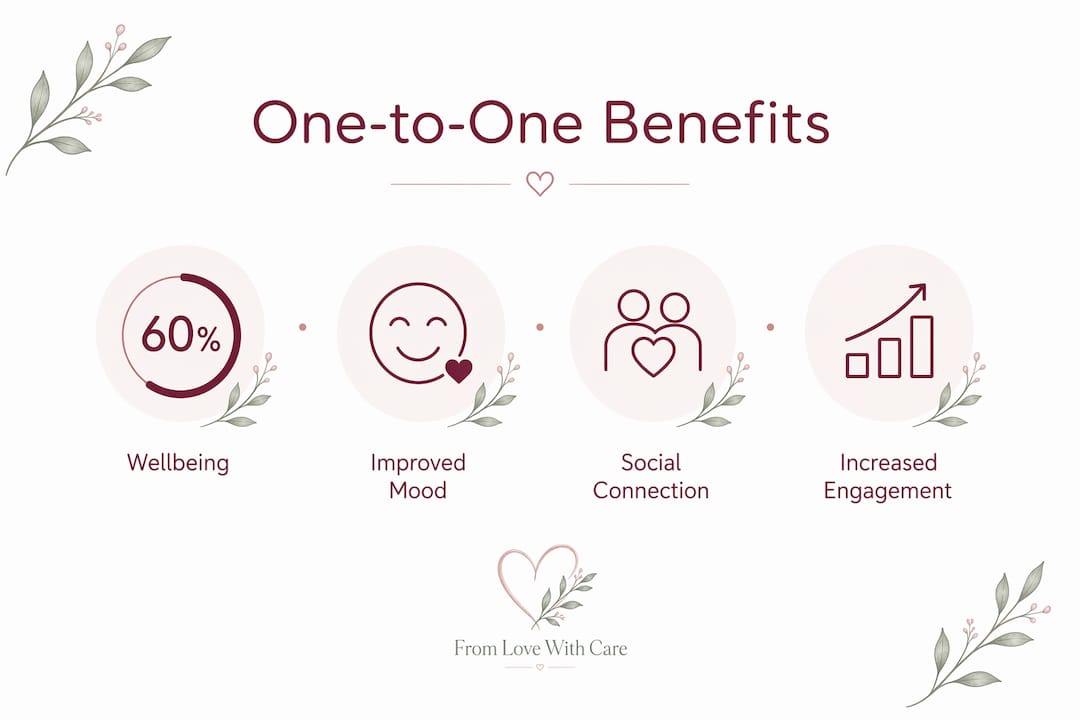
Research shows that around 60% of people identified as 'severely lonely' reported tangible wellbeing improvements when provided with companionship-style social support. Fromlovewithcare is a vetted UK provider offering personalised, non-medical companionship visits matched to clients' interests and routines.
Table of Contents
- What does one-to-one companionship actually do for older people?
- What does a companionship visit look like in practice?
- What does the research say about outcomes?
- How do you arrange one-to-one companionship in the UK?
- How do you check that a companion is safe and trustworthy?
- How do you make companionship work and measure progress?
- Fromlovewithcare: vetted companions, personalised visits, and a clear next step
- Key takeaways
- Why companionship deserves to be taken as seriously as clinical care
- Useful UK sources and further reading
What does one-to-one companionship actually do for older people?
The core mechanism is straightforward: regular, focused attention from one trusted person compensates for lost relationships and restores a sense of social identity. It is not a substitute for clinical care. It addresses something clinical care rarely touches: the need to feel known, heard, and valued.
Emotional benefits:
- Reduced feelings of loneliness and isolation
- A consistent, listening presence that improves mood over time
- Greater confidence in speaking to others, which can lead to broader social connections
Social benefits:
- Renewed engagement with community roles and activities
- Reconnection with forgotten hobbies or interests
- Improved social skills through regular, relaxed conversation
Cognitive and physical benefits:
- Mental stimulation through conversation, puzzles, and shared activities that can help slow cognitive decline
- Encouragement to maintain daily routines, which supports physical health
- Outings and short walks that improve mobility and overall fitness
Statistic: The Community Life Survey 2023/24 found that 94% of adults report having someone to call on for company, yet older adults with disabilities or limited mobility often fall outside that figure. The gap between having someone and having regular, meaningful contact is where loneliness takes hold.
Companionship also offers families genuine peace of mind. Scheduled, reliable visits fill the gaps when relatives cannot be present and provide reassurance that a trusted person is checking in consistently.

What does a companionship visit look like in practice?
Companionship care is non-medical, relationship-centred, and shaped entirely around the individual's preferences. There is no clinical agenda. The companion's role is to be genuinely present, not to complete a task list.
Typical activities during a visit include:
- Conversation over tea, sharing memories, or discussing current events
- Shared hobbies such as reading, jigsaws, crosswords, or watching a favourite programme
- Light errands or help with cooking
- Accompaniment to appointments, local shops, or a short walk in the park
- Support with letter writing or staying in touch with family
A standard visit runs 60–90 minutes. In that time, a good companion might arrive, settle in with a cup of tea, spend the bulk of the visit on a shared activity, and close with a brief chat about plans for the week. The rhythm is unhurried and consistent, which is precisely what makes it effective.
Pro Tip: When choosing a companion, prioritise shared interests over proximity alone. A companion who genuinely enjoys the same things as your loved one will build rapport far more quickly than one who simply lives nearby.
What does the research say about outcomes?
The evidence for one-to-one companionship is clear and consistent. Befriending works not by reducing hours spent alone, but by providing a safe, confiding relationship that restores a person's sense of belonging and community role.
| Outcome | Finding | Source |
|---|---|---|
| Wellbeing improvement | ~60% of severely lonely people showed measurable gains | GA Carers / companionship study |
| Social support coverage | 94% of UK adults report having someone to call on | Community Life Survey 2023/24 |
| Mechanism of benefit | Reciprocal exchange and empathy restore social identity | Cambridge University Press |
| Family benefit | Scheduled visits provide reassurance and fill care gaps | GA Carers |
Practitioners consistently report that the most transformative outcomes occur when companions actively reconnect seniors to community roles or forgotten hobbies, rather than offering only passive company. Sitting with someone is a start. Helping them rediscover a love of gardening or local history is where the real change happens.
Clients supported by Fromlovewithcare have described a shift from dreading quiet mornings to looking forward to their companion's arrival. That anticipation, small as it sounds, is a meaningful clinical signal.
How do you arrange one-to-one companionship in the UK?
The fastest routes are a free local council assessment, the CQC register, and charitable befriending schemes. None of these require a GP referral to begin.
- Request a care needs assessment from your local council. This is free regardless of income and will identify what support you qualify for, including social and companionship care.
- Check the CQC register at cqc.org.uk to find regulated home care providers in your area. Look for services rated "Good" or "Outstanding."
- Contact Age UK (ageuk.org.uk) or the Royal Voluntary Service (royalvoluntaryservice.org.uk) for free or low-cost befriending schemes in your community.
- Ask about Attendance Allowance early. This benefit can help fund non-medical companionship at home and does not require a formal medical diagnosis to claim.
- Request a trial visit before committing to a regular arrangement. Most reputable providers, including Fromlovewithcare, offer this as standard.
When speaking to any provider, ask:
- Are all companions DBS-checked and reference-verified?
- What training do companions receive?
- How are visits matched to the individual's interests?
- What happens if a companion is unavailable?
Pro Tip: Raise Attendance Allowance at your very first council conversation. Many families discover it only after months of paying privately, and eligibility is broader than most people expect.
How do you check that a companion is safe and trustworthy?
Safety is verifiable. A reputable provider will have documented answers to every question below before a companion sets foot in your home.
Vetting checklist:
- Enhanced DBS (Disclosure and Barring Service) certificate, dated within the past three years
- Two professional references, verified by the provider
- Proof of identity (passport or driving licence)
- Written service agreement covering visit frequency, activities, and cancellation terms
- Evidence of training in safeguarding and first aid
- Public liability insurance held by the provider
Red flags to watch for:
- Reluctance to share DBS documentation
- No written agreement or vague terms
- Pressure to pay cash directly to the companion
- No clear process for raising concerns or changing companion
- CQC registration absent where the service scope requires it
Trial visits reveal rapport in ways that paperwork cannot. After two or three visits, you will have a clear sense of whether the companion and the senior are genuinely comfortable together. Fromlovewithcare's vetting process covers DBS checks, references, and structured matching, with trial visits built into the standard arrangement.
How do you make companionship work and measure progress?
Some improvements appear within the first few weeks: better mood on visit days, more animated conversation, improved appetite. Fuller benefits, including reduced anxiety, renewed social confidence, and greater daily independence, typically emerge over two to three months.
Practical tips for seniors and families:
- Set one or two simple goals at the start ("I'd like to get back to doing crosswords" or "I'd like to go out once a week")
- Encourage the senior to share their interests and preferences with the companion from the first visit
- Keep a brief weekly note on mood, appetite, and social activity to track change over time
- Schedule a short feedback conversation with the provider after the first month
Progress measures worth tracking:
- Mood on visit days versus non-visit days
- Frequency of initiating conversation or contact with others
- Appetite and engagement with daily routines
- Interest in hobbies or activities mentioned during visits
- Sleep quality and general energy levels
Pro Tip: After the first month, ask the companion directly what topics or activities the senior responds to most. That insight, fed back to the provider, is the fastest way to improve companionship quality and deepen the relationship.
Fromlovewithcare: vetted companions, personalised visits, and a clear next step
Fromlovewithcare offers something specific: thoroughly vetted, non-medical companions matched to each senior's personality, interests, and routine, with trial visits built in from the start.
Every companion undergoes an enhanced DBS check, reference verification, and structured training before their first visit. Matching is based on shared interests, not just availability, which is why clients consistently report that visits feel like time with a friend rather than a scheduled service. Families receive regular updates and a clear process for raising feedback or requesting a different companion if the fit is not right.
Fromlovewithcare works alongside statutory routes: a local council assessment or Attendance Allowance can help with costs, and the service complements rather than replaces any existing care arrangements. To see how the matching process works and arrange a trial visit, visit the elderly companionship services page or explore how it works in detail.
Key takeaways
One-to-one companionship produces measurable improvements in older adults' emotional, social, and physical wellbeing, and safe, regulated support is available in the UK through statutory, charitable, and private routes.
| Point | Details |
|---|---|
| Core benefit | Around 60% of severely lonely people showed measurable wellbeing gains with companionship support. |
| UK routes to help | Contact your local council for a free care needs assessment, check the CQC register, or reach Age UK and Royal Voluntary Service. |
| Safety checks | Confirm enhanced DBS, two references, a written agreement, and training before any companion begins. |
| Trial period | Start with a structured trial of two to three visits to assess rapport before committing long term. |
| Fromlovewithcare | Offers DBS-checked, interest-matched companions with trial visits and family feedback built into every arrangement. |
Why companionship deserves to be taken as seriously as clinical care
The conventional framing of elder care places medical needs at the centre and treats social connection as a pleasant extra. That hierarchy is wrong, and the evidence makes it increasingly hard to defend. Loneliness carries measurable health consequences: higher rates of hospital admission, longer recovery times, and faster cognitive decline. Addressing it is not a luxury.
What strikes me most about the research on befriending is the mechanism. It is not simply that having company is nice. It is that a consistent, reciprocal relationship restores something specific: a person's sense of having a role, a perspective worth sharing, a story worth telling. Clinical care can keep someone physically safe. It rarely tells them they matter.
The families I see engaging with companionship services often come to it late, after months or years of watching a loved one withdraw. The good news is that the benefits are not slow to appear. A few weeks of genuine, matched one-to-one attention can shift the trajectory noticeably. The practical barriers, finding a safe provider, understanding the costs, knowing what to ask, are real but entirely navigable with the right guidance.
If you are weighing whether to arrange support, the honest answer is: start the trial. The evidence supports it, the routes are clear, and the cost of waiting is higher than most people realise.
Useful UK sources and further reading
These organisations and resources can help you take the next step, whether you are arranging support for yourself or a loved one.
- NHS: Home care and care needs assessments — nhs.uk/social-care-and-support — free assessments and guidance on social care options
- Care Quality Commission (CQC) — cqc.org.uk — search the register for regulated home care providers rated by inspectors
- Age UK — ageuk.org.uk — befriending schemes, telephone support, and local services across the UK
- Royal Voluntary Service — royalvoluntaryservice.org.uk — volunteer-led befriending and community support
- GOV.UK: Attendance Allowance — gov.uk/attendance-allowance — eligibility and application guidance for funding extra support at home
- Fromlovewithcare — fromlovewithcare.co.uk/loneliness-support-services — vetted companionship visits and loneliness support across the UK
This article is general information, not professional advice. For guidance specific to your situation, speak with your GP, local council, or a qualified care professional.