
A private welfare check in the UK typically costs between £20 and £38 per hour for a standard companionship visit, with emergency or same-day checks often attracting an additional premium on top of that rate. Before you compare quotes, three things matter most.
The main cost drivers:
- Hourly rate — the base charge for the companion's time, usually the largest part of the bill
- Emergency or short-notice premium — an added fee when a visit is needed urgently, often within hours
- Travel or call-out charge — some providers bill this separately; others build it into the hourly rate
Three trust signals are worth checking before you commit to any provider: confirmation that companions are DBS-checked, an itemised written quote, and a rate that sits at or above the Homecare Association's recommended minimum sustainable price of £34.42 per hour for 2026/27.
Key takeaways
Private welfare check costs in the UK typically range from £20 to £38 per hour for visiting companionship, with the Homecare Association's £34.42 per hour benchmark serving as the most reliable pricing floor for 2026/27.
| Point | Details |
|---|---|
| Typical hourly range | Visiting welfare checks run £20–£38/hr nationally; London sits toward the upper end at £26–£38/hr. |
| HCA pricing benchmark | The Homecare Association sets £34.42/hr as the minimum sustainable price for 2026/27; use it to spot underpriced quotes. |
| Attendance Allowance | Non-means-tested benefit paying £76.70/wk (lower) or £114.60/wk (higher) in 2026/27; can be used directly towards companionship costs. |
| Trust signals to confirm | Request written proof of DBS checks, an itemised quote, and a clear emergency response and proof-of-visit policy before booking. |
| Fromlovewithcare | Offers DBS-checked companions, itemised quotes, and emergency welfare checks with transparent pricing benchmarked to fair staff pay. |
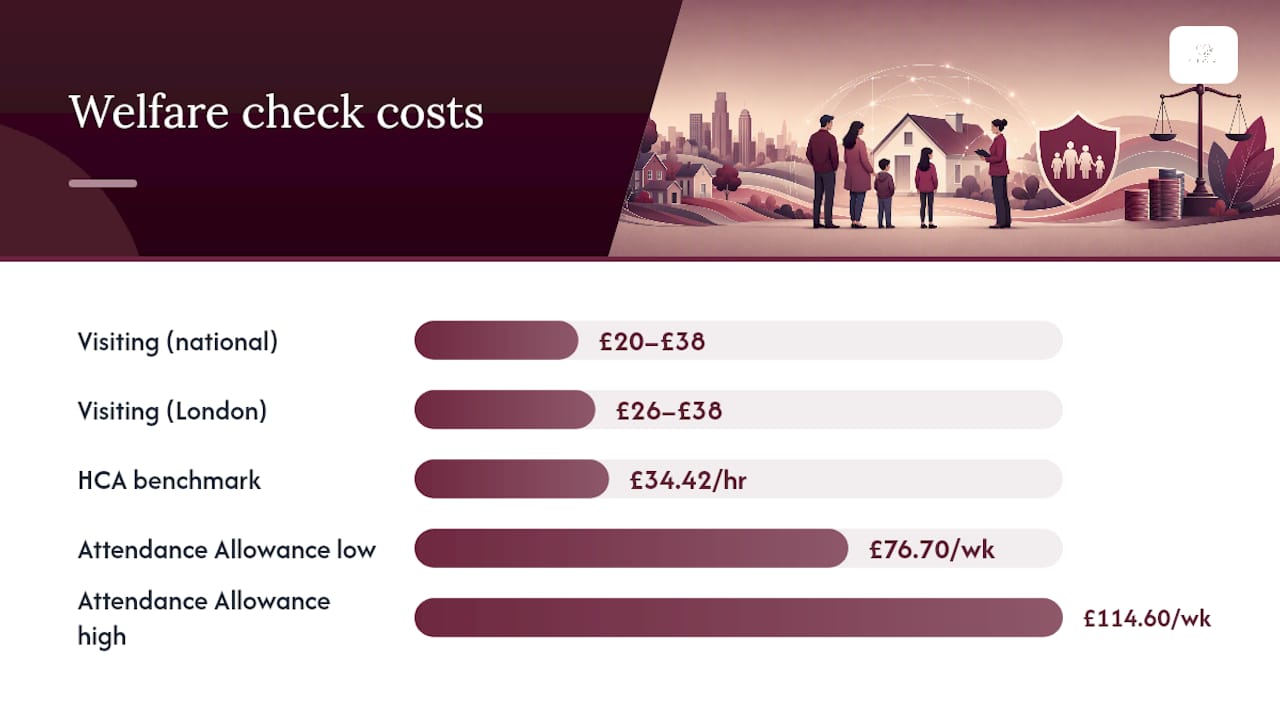
Table of Contents
- How much does a welfare check cost in the UK?
- What does the fee usually include — and what does it not?
- Can Attendance Allowance or council funding help cover the cost?
- How does booking work, and how quickly can a visit happen?
- Questions to ask before you book — and red flags to watch for
- What families consistently underestimate about welfare check pricing
- Fromlovewithcare's approach to welfare checks and transparent pricing
- Sources
How much does a welfare check cost in the UK?
NHS guidance places visiting homecare broadly in the £15–£30 per hour range nationally, though that figure reflects a wide spectrum of service types. For private companionship and welfare-check visits specifically, most providers advertise starting rates of £20–£32 per hour, with London and the South East typically sitting higher, commonly in the £26–£38 per hour range, reflecting the capital's staffing costs.
The Homecare Association published a recommended minimum sustainable price of £34.42 per hour for 2026/27. This figure accounts for fair staff pay, training, insurance, and overheads. It is the most useful single benchmark when you are comparing quotes.
Other charges to look out for:
- Minimum visit charge — many providers bill for a minimum of 30–60 minutes regardless of actual visit length
- Call-out or travel fee — charged per visit by some providers, built into the hourly rate by others; always ask
- Emergency premium — same-day or out-of-hours requests typically attract a surcharge above the standard hourly rate
- Short-notice cancellation fee — usually applies within 24–48 hours of a booked visit
Live-in companionship follows a different pricing shape entirely, running from roughly a mid to high three-figure range per week nationally, and higher for complex needs. That model is outside the scope of a single welfare check, but worth knowing if regular overnight support becomes necessary.
Pro Tip: Any quote that comes in noticeably below £34.42 per hour deserves a direct question: how are companions paid, and what training do they receive? Providers who pay below the Homecare Association floor tend to see higher staff turnover, which makes consistent, trusted companionship harder to sustain.
What does the fee usually include — and what does it not?
Most providers of private companionship and welfare checks include the following within their quoted rate:
- DBS (Disclosure and Barring Service) check for the companion
- Basic public liability insurance
- Travel time or travel cost to the visit (confirm whether this is included or billed separately)
- A proof-of-visit report or written update sent to the family after the visit
- Companionship activities: conversation, shared tea, light reading, a short walk, or accompanying to an appointment
- Light errands such as collecting a prescription or helping with a shopping list
What companions do not provide is equally important to understand. Private companionship services are not regulated personal care. That means no administering medication, no clinical assessments, no assistance with bathing or dressing, and no wound care. If your relative needs any of those, a registered care worker with clinical training is required, and the regulatory and cost framework is different.
This is not a criticism of companionship services. It is simply a reminder that the right service for the right need produces the best outcome. For elderly companionship visits focused on connection, conversation, and light support, a trained and vetted companion is exactly what is needed.
Can Attendance Allowance or council funding help cover the cost?
Yes, and this is where many families leave money on the table.
Attendance Allowance is a non-means-tested benefit paid by the government to people aged 65 or over who need help with personal care or supervision because of a physical or mental disability. For 2026/27, the rates are £76.70 per week at the lower rate and £114.60 per week at the higher rate. Crucially, there is no restriction on how the money is spent once awarded. Families regularly use it to pay for private companionship visits and welfare checks.
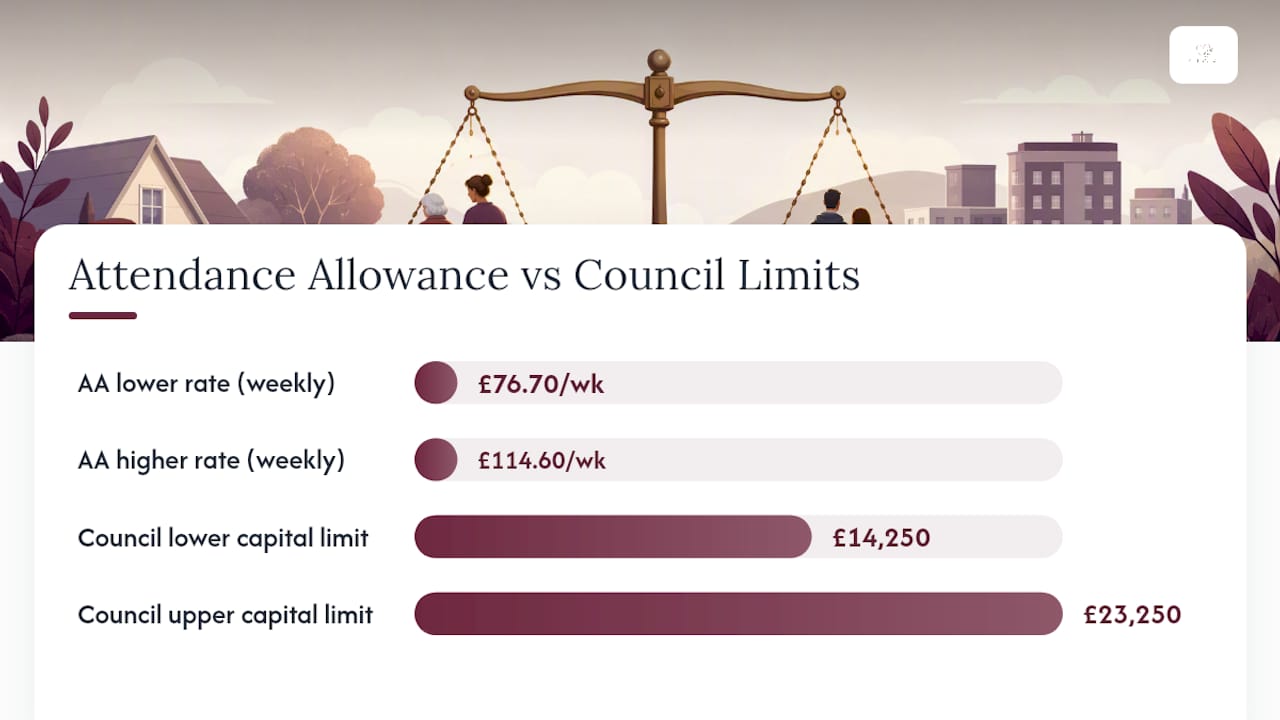
At the higher rate, £114.60 per week covers roughly three hours of companionship at the Homecare Association benchmark rate. That is a meaningful reduction in out-of-pocket cost for families arranging regular visits.
Local authority support is also worth exploring, though it involves a more involved process:
- A Care Act needs assessment from the local council establishes whether your relative qualifies for publicly funded support
- A means test then determines how much the council contributes; in England, the upper capital limit is £23,250 and the lower limit is £14,250
- If eligible, the council may offer direct payments, which can be used to purchase private companionship or welfare-check visits
Other ways to reduce cost:
- Befriending charities and low-cost alternatives can supplement paid visits for social contact
- Splitting the cost between siblings or other family members spreads the financial responsibility
- Homeshare schemes, where a volunteer lives with an older person in exchange for light support, can reduce the need for paid visits
How does booking work, and how quickly can a visit happen?
The process is straightforward, but knowing what to expect at each stage helps you plan.
What to have ready when you book:
- Your relative's full address and any access instructions
- Known health conditions, mobility limitations, or risks the companion should be aware of
- Your preferred contact method for the post-visit report
- Payment details and confirmation of any cancellation terms
Typical timelines:
- Request — contact the provider by phone or online form with the details above
- Confirmation — most providers confirm a routine visit within 24–48 hours and send an itemised quote
- Visit — routine companion visits are typically arranged within a few days to two weeks; emergency welfare checks can often be arranged the same day or within a few hours, depending on availability
- Follow-up — a written proof-of-visit report is sent to the family, usually on the same day as the visit
Most providers apply a minimum visit charge of 30–60 minutes. A welfare check visit itself commonly runs 45–90 minutes, depending on the relative's needs and what was agreed at booking. Emergency visits may be shorter by design, focused on confirming safety and making contact.
Questions to ask before you book — and red flags to watch for
Asking the right questions upfront protects your relative and your budget.
Ask every provider in writing:
- Are all companions DBS-checked, and can you provide evidence?
- What insurance does the companion carry during visits?
- Will the same companion visit each time, or does it vary?
- What is your emergency response policy if a visit cannot go ahead?
- Can you provide a fully itemised quote including travel, call-out, and any surcharges?
- What are your cancellation and short-notice fees?
- How is the proof-of-visit report delivered, and to whom?
Red flags that suggest you should step back:
- Vague or verbal-only pricing with no written breakdown
- Pressure to sign quickly or pay a large deposit before any visit
- Refusal to confirm DBS status or provide references
- Hourly rates well below £34.42 without any explanation of how staff are paid
- No clear policy on what happens if the companion is unavailable
"If you are considering employing a private carer directly rather than using a managed provider, be aware that this makes you the employer — with full responsibility for holiday pay, sick cover, pension auto-enrolment, and finding replacement cover when needed. For most families, a managed provider is the more practical and legally straightforward route."
What families consistently underestimate about welfare check pricing
The price conversation tends to focus on the hourly rate. That is understandable, but it is often the wrong place to start.
The more revealing question is what happens when something goes wrong. Does the provider have a clear emergency response policy? Is there a named person to call? Will the companion's report reach you the same day? A provider charging £28 per hour with a reliable emergency protocol and consistent staffing is better value than one charging £22 with none of those things in place.
Families also tend to overlook Attendance Allowance until after they have been paying out of pocket for months. The application process is not complicated, and the benefit is not means-tested. At £114.60 per week at the higher rate, it can cover a substantial portion of regular visit costs.
The Homecare Association's £34.42 per hour floor is not a ceiling. It is the minimum at which a provider can sustainably pay staff fairly and maintain quality. Treating it as the target rather than the floor is a reasonable way to budget for a service you want to last.
Fromlovewithcare's approach to welfare checks and transparent pricing
Knowing the cost range is one thing. Knowing what you get for it is another.
Fromlovewithcare offers private welfare check services carried out by DBS-checked, trained companions who focus entirely on human connection, not clinical tasks. Every booking comes with an itemised quote before any commitment, a clear emergency premium policy for same-day or short-notice requests, and a written proof-of-visit report sent directly to the family. Pricing is benchmarked to fair staff pay and the Homecare Association's recommended floor, so you are not trading cost savings for staff turnover.
Families report genuine improvements in their relatives' wellbeing after regular visits. To see how the booking and vetting process works and request a written quote for a welfare check or companion visit, visit the Fromlovewithcare services page.
Sources
Official and industry benchmarks:
Fromlovewithcare service pages:
This article is general information, not a substitute for advice from a qualified financial advisor. Consult a qualified financial professional about your own circumstances before acting on anything here.
Recommended
- Welfare Checks for Adults Living Alone | From Love With Care | From Love With Care
- Welfare Checks for Elderly Parents & Vulnerable Adults | From Love With Care
- Emergency Welfare Checks UK | Rapid Response Visits | From Love With Care
- Blog & Resources | Elderly Companionship Advice | From Love With Care