
Most people assume companionship simply means having someone around. A friendly face, a bit of conversation, someone to fill the silence. But what does dignified companionship mean in a deeper, more meaningful sense? It goes well beyond casual company. Dignified companionship, the term used in social care and relational psychology to describe connection grounded in mutual respect and autonomy, is the kind of human bond that genuinely sustains us. It is the difference between feeling tolerated and feeling truly valued. For the many adults and elderly people in the UK who go days without speaking to anyone, that distinction is not small. It is everything.
Table of Contents
- Key takeaways
- What does dignified companionship mean?
- Why dignified companionship matters for well-being
- Characteristics of dignified companionship
- Common challenges in dignified companionship
- Applying dignified companionship in daily life
- My perspective: why dignified companionship is not optional
- How Fromlovewithcare puts dignity into practice
- FAQ
Key takeaways
| Point | Details |
|---|---|
| Dignity is the foundation | Respectful companionship honours a person's inherent worth, autonomy, and right to make their own choices. |
| It is not transactional | Genuine connection is built on mutual presence and emotional safety, not obligation or performance. |
| Health outcomes are real | Strong social bonds increase survival likelihood by 50%, making dignified connection a health matter. |
| Consent and boundaries matter | Recognising and respecting personal limits is what separates meaningful companionship from well-meaning intrusion. |
| It requires intentional practice | Like physical fitness, flourishing relationships need consistent, attentive effort to grow and sustain. |
What does dignified companionship mean?
The word "dignity" carries real weight. In relational terms, dignity means inherent worth and the recognition that every person deserves respect, autonomy, and the right to be heard regardless of age, ability, or circumstance. When we apply that principle to companionship, we arrive at something quite specific.
Dignified companionship is a form of respectful connection where both parties feel seen, valued, and free to be themselves. It is not about performing care or filling a social obligation. It is about showing up with genuine attention, honouring boundaries, and treating the other person as a full human being rather than a problem to be managed.
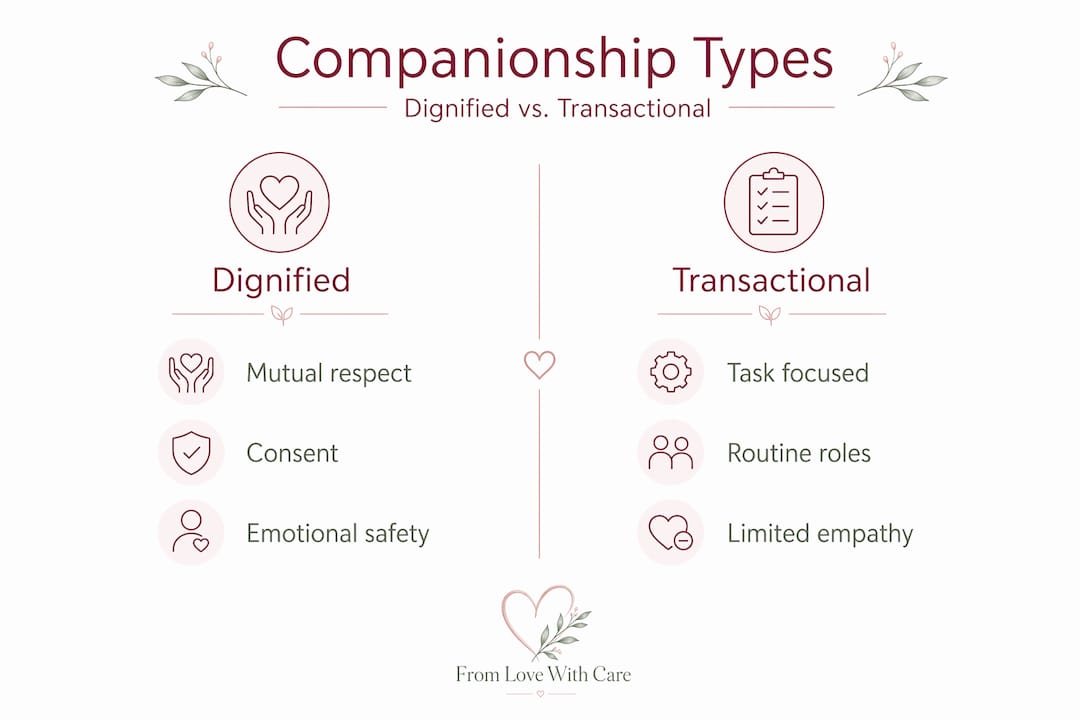
This dignified relationships definition stands in clear contrast to transactional companionship, where one person gives and the other receives, or where the relationship is maintained out of duty rather than genuine regard. Consider the difference between a family member who visits an elderly relative out of guilt, rushing through the visit and finishing sentences for them, versus a companion who sits patiently, listens without agenda, and follows the other person's lead. The first may be well-intentioned. The second is dignified.
The key psychological and social components of this kind of connection include:
- Mutual respect. Both people treat each other's thoughts, feelings, and choices as worthy of consideration.
- Active consent. Decisions about how time is spent, what is discussed, and what help is offered are made with the person, not for them.
- Boundary recognition. Personal limits are acknowledged and honoured without judgement or pressure.
- Emotional safety. Each person feels free to be honest without fear of dismissal or ridicule.
- Reciprocity. The relationship does not rely on one person constantly giving while the other simply receives.
Pro Tip: When offering support to someone, ask before you act. "Would you like help with that?" is a small phrase that carries enormous respect. It signals that their autonomy matters more than the speed of getting something done.
Why dignified companionship matters for well-being
The benefits of dignified companionship are not merely emotional. They are measurable. Decades of research indicate that flourishing relationships predict both mental and physical well-being. Feeling genuinely valued by another person reduces anxiety, lowers cortisol levels, and supports immune function.
The statistics are striking. Individuals with strong social bonds have a 50% greater likelihood of survival compared to those who are socially isolated. That figure places loneliness firmly in the category of a public health concern, not a personal failing.
"Flourishing relationships require intentional practice, much like physical fitness. When people feel seen, heard, and valued, the benefits extend far beyond mood. They shape the entire trajectory of a person's health."
What makes dignified companionship specifically powerful is the element of emotional safety. When a person knows they will not be judged, rushed, or spoken over, they open up. They share more. They engage more fully with life. For older adults, this can mean the difference between withdrawal and genuine participation in daily decisions and social life.
Evidence-based approaches like Dignity Therapy demonstrate this clearly. Developed for people nearing the end of life, the approach improves meaning, reduces distress, and strengthens a person's sense of identity by treating them as the author of their own story rather than a passive recipient of care. The principle applies equally to everyday companionship at any stage of life.

Modern individuals are also prioritising emotional safety over traditional, sacrificial models of relationship. People increasingly want reciprocity and mutual support rather than relationships built on obligation or endurance. Understanding dignified friendships and connections means recognising that this shift is not selfish. It reflects a healthier and more sustainable model of human connection.
Characteristics of dignified companionship
Understanding what dignified companionship looks like in practice is where things become genuinely useful. The following comparison illustrates the difference between dignified and transactional companionship behaviours.
| Behaviour | Dignified companionship | Transactional companionship |
|---|---|---|
| Decision-making | Decisions made with the person | Decisions made for the person |
| Listening | Active, patient, without interruption | Half-present, waiting to respond |
| Helping | Offered and consented to | Assumed and imposed |
| Emotional tone | Warm, non-judgemental | Efficient, task-focused |
| Pacing | Follows the other person's rhythm | Driven by the helper's schedule |
One of the most important characteristics of dignified companionship is the avoidance of what researchers call "performative care." Over-helping strips dignity by removing a person's sense of purpose and agency. When a well-meaning visitor takes over a task because it is quicker to do it themselves, they may be solving a practical problem while creating an emotional one. The person being helped may feel incapable, invisible, or burdensome.
There is also a neurological dimension worth understanding. Research into what is called the sovereign partner model shows that the healthiest relationships are built on mutual nervous system co-regulation rather than dependency. In practice, this means that two people who are genuinely present with each other, calm and emotionally stable, create a kind of relational resilience that neither could achieve alone. Presence, not performance, is the foundation.
Practical ways to practise respectful companionship include:
- Listening without offering solutions unless asked.
- Following the other person's pace in conversation and activity.
- Acknowledging feelings before moving to problem-solving.
- Asking for consent before sharing advice or offering physical help.
- Checking in about preferences rather than assuming what someone needs.
Pro Tip: Consent and boundaries are not just relevant in formal care settings. In everyday friendships and family relationships, asking "Is now a good time?" or "How can I best support you?" models the kind of respect that builds lasting trust.
Common challenges in dignified companionship
What is respectful companionship in theory can be harder to sustain in practice. Several challenges are worth naming honestly.
The first is emotional labour. Dignified companionship requires genuine attentiveness, and that takes energy. Listening deeply, holding space for difficult emotions, and resisting the urge to fix or advise are all skills that require practice. There is no shame in finding this demanding. The key is not to let that difficulty become a reason to retreat into performative or transactional habits.
Cultural expectations also complicate things. Many people were raised in environments where care meant self-sacrifice, where being a good companion meant always being available and never having needs of your own. The shift toward reciprocity and mutual support can feel unfamiliar or even selfish at first. It is neither. Relational stability actually emerges from individual regulation, not from one person absorbing all of another's distress.
Other common pitfalls include:
- Confusing presence with surveillance. Being there for someone is not the same as monitoring them.
- Treating dignity as conditional on behaviour or gratitude. Respect is not something a person earns.
- Assuming that because someone is lonely, they want constant company. Sometimes what they want is quality over quantity.
- Neglecting your own needs in the relationship, which leads to resentment and eventual withdrawal.
Maintaining autonomy without isolation is a genuine balancing act. The goal is connection that leaves both people feeling more themselves, not less.
Applying dignified companionship in daily life
Knowing the dignified relationship definition is one thing. Putting it into practice across family life, friendships, and community is another. The good news is that the steps are accessible.
| Practical step | Expected outcome |
|---|---|
| Practise active listening in conversations | The other person feels genuinely heard and more willing to open up |
| Ask before offering help or advice | Autonomy is preserved; trust deepens over time |
| Schedule regular, unhurried time with someone | Consistency signals that the relationship is a priority, not an afterthought |
| Join or create community groups focused on connection | Reduces isolation and builds inclusive community where people feel valued |
| Seek professional companionship services where needed | Fills gaps in social connection with vetted, respectful, consistent support |
Building attentive, caring relationships is a disciplined practice that involves listening well and treating every person as worthy of attention. This applies whether you are cultivating a friendship, supporting an ageing parent, or simply being a more present neighbour.
For those who are socially isolated, professional companionship services offer a way to experience dignified connection when informal networks are absent or insufficient. These are not replacements for human relationships. They are a structured way to receive the kind of consistent, respectful presence that every person deserves. Fromlovewithcare's loneliness support services are built precisely on these principles, offering companionship that prioritises the person's autonomy and emotional well-being above all else.
My perspective: why dignified companionship is not optional
I have spent a long time thinking about what separates meaningful connection from the kind that leaves people feeling more alone than before a visit. And the honest answer is this: most people are not taught what dignified companionship actually looks like. They are taught to be helpful, to show up, to do things. But doing things is not the same as being present.
What I have found, again and again, is that the people who feel most lonely are not always those without visitors. They are often those whose visitors treat them as a problem to be managed rather than a person to be known. That is the quiet harm of transactional care. It looks like love from the outside. It does not feel like it from the inside.
The contrarian view I would offer is this: reciprocity in companionship is not a luxury. It is the whole point. A relationship where one person is always giving and the other is always receiving is not dignified for either party. The giver burns out. The receiver feels like a burden. Real connection requires that both people bring something and both people receive something, even if what they bring looks very different.
Dignified companionship is a practice, not a personality trait. It can be learned, cultivated, and deepened over time. The communities and individuals who commit to it do not just feel better. They live longer, recover faster, and face difficulty with more resilience. That is not sentiment. That is evidence.
— Ayomide
How Fromlovewithcare puts dignity into practice
Fromlovewithcare was built on the understanding that genuine human connection changes lives. Not the kind of connection that rushes through a checklist, but the kind that sits with someone over a cup of tea and truly listens.

Every companion at Fromlovewithcare is thoroughly vetted and trained to prioritise the autonomy, comfort, and emotional well-being of the people they visit. Whether through elderly companionship services at home or companion visits for elderly parents, the focus is always on the person, not the task. If someone you care about is spending too many days without meaningful human contact, Fromlovewithcare offers a trusted, compassionate way to change that.
FAQ
What is the meaning of dignified companionship?
Dignified companionship is a form of respectful, mutual connection that honours a person's inherent worth, autonomy, and right to make their own choices. It differs from casual or transactional company by prioritising emotional safety, active consent, and genuine presence.
How does dignified companionship combat loneliness?
Feeling genuinely seen and valued by another person addresses the root cause of loneliness, which is not simply the absence of people but the absence of meaningful connection. Research shows that strong social bonds increase survival likelihood by 50%, underlining the health significance of quality connection.
What are the key characteristics of dignified companionship?
The main characteristics include mutual respect, active consent, boundary recognition, emotional safety, and reciprocity. Avoiding performative care and following the other person's pace are equally central to what is dignified friendship in practice.
Can professional companionship services be truly dignified?
Yes, when they are built on the right values. Services that train companions to ask before acting, follow the person's lead, and prioritise emotional well-being over task completion embody the principles of dignity in community care in a meaningful way.
How is dignified companionship different from ordinary friendship?
Ordinary friendships can be dignified, but they can also fall into transactional or habitual patterns. Dignified companionship is intentional. It requires consistent attentiveness, respect for autonomy, and a genuine commitment to the other person's well-being, qualities that flourishing relationships share regardless of whether they are professional or personal.