
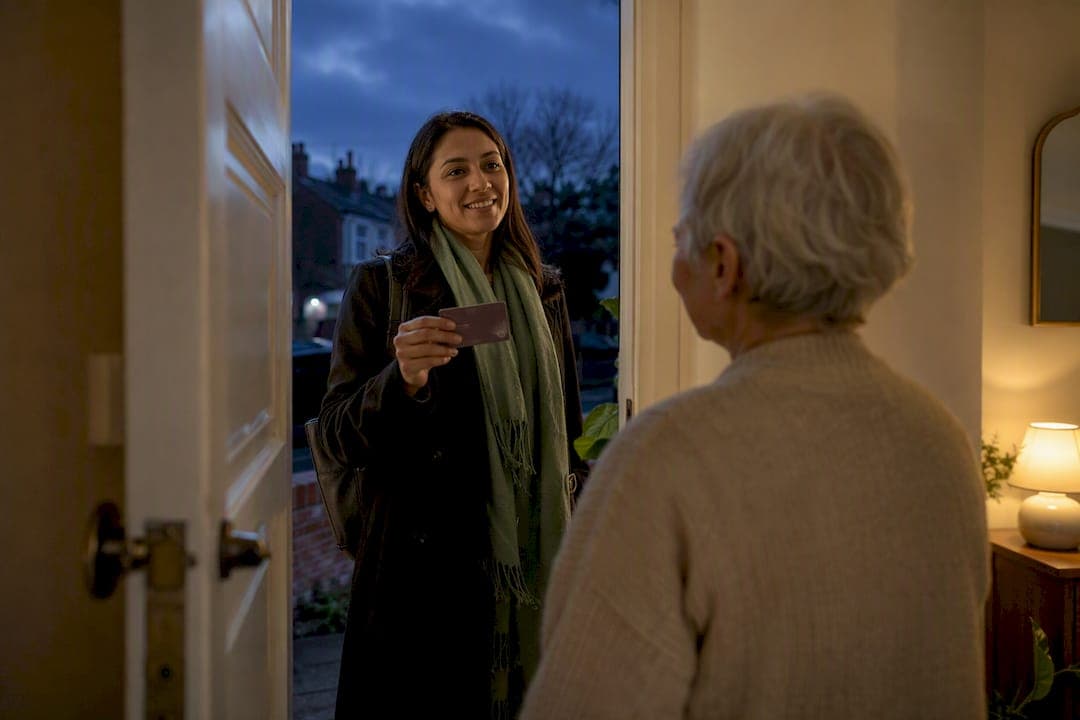
A private after hours welfare check is a paid, in-home visit carried out by a DBS-checked companion who calls on an elderly or vulnerable person outside normal daytime hours to check they are safe, comfortable and not alone. It is a non-medical service focused on wellbeing and companionship, not clinical care or emergency intervention. From Love With Care provides this service across the UK, giving families a warm, proactive way to reassure themselves when a phone call simply is not enough.
TL;DR:
- Private after hours welfare checks focus on wellbeing and companionship, not medical intervention, and are scheduled ahead or with short notice.
- They monitor general health, home conditions, and safety, reporting concerns to family without offering medical or personal care services.
- Booking requires verification of DBS checks, training, insurance, clear scope, and privacy policies to ensure safety and quality standards.
- Cost varies by provider with hourly rates, surcharges, and a minimum visit length, and booking is quicker with detailed personal and access information.
- These visits complement statutory services by providing presence when official services are unavailable, often prompting further care assessments if issues are observed.
Table of Contents
- How is this different from a police or NHS welfare check?
- When should you book an after hours welfare visit?
- What actually happens during an after hours welfare visit?
- What safety and vetting checks should you insist on?
- What does an after hours welfare check cost, and how do you book one?
- What are your legal rights and considerations?
- How does this fit alongside statutory social services?
- What happens after the visit ends?
- Why proactive companionship matters more than people think
- How to arrange an after hours welfare visit with Fromlovewithcare
- Sources
How is this different from a police or NHS welfare check?
A police or NHS welfare check is reactive. Someone dials 999 or 101 because they fear immediate danger, and officers or paramedics respond to assess an emergency. A private after hours welfare check works the other way round. It is booked in advance, or arranged with a few hours' notice, so a trained companion arrives calmly, before things reach crisis point.
The purpose is different too. Statutory checks exist to establish whether someone is in physical danger right now. Fromlovewithcare's visits exist to catch the slow slide into isolation or neglect that never quite triggers an emergency call but still causes real harm.
That distinction matters because of what loneliness actually does to health. The NHS links prolonged loneliness in older people to serious health harms and recommends regular social contact as a genuine protective factor, not just a nice extra.
A welfare companion:
- Observes general wellbeing, mood and home conditions
- Checks that food, heating and basic essentials are in order
- Reports concerns to family, without diagnosing or treating anything
- Never administers medication or performs personal care
When should you book an after hours welfare visit?
Certain moments call for a face rather than a phone call. These situations come up again and again with families using welfare check services UK wide:
- Missed calls or texts that go unanswered for hours when a relative usually replies promptly.
- Recent hospital discharge, when the first few nights alone can feel disorientating.
- Prolonged isolation, such as days without a visitor or a change in routine that worries you from a distance.
- Night-time anxiety or confusion, particularly common with early dementia, where reassurance after dark makes a genuine difference.
- A one-off gap in care, when a regular carer or family member cannot get there themselves.
If someone has collapsed, is unresponsive, is at risk of self-harm, or you suspect a break-in or immediate danger, call 999 straight away. A paid visit is never a substitute for emergency services; it exists for the many situations that sit below that threshold but still deserve attention. Booking early, before worry becomes panic, is usually what prevents small problems escalating into 3am emergencies.
What actually happens during an after hours welfare visit?
Every visit follows a similar shape, though the details flex depending on what your relative needs.
The companion arrives at the agreed time and shows photo ID before entering, confirming the visit with whoever is present. From there, it becomes a genuinely social call: conversation, a shared cup of tea, perhaps a game of cards or simply company while the television is on. Alongside that, the companion quietly notes things that matter, such as whether the heating is working, whether there is food in the fridge, and whether mobility seems unchanged since the last visit.
Pro Tip: Ask the provider whether overnight support is "sleeping" or "waking" care before you book. A sleeping companion rests nearby but can be woken if needed, while a waking companion stays alert throughout the night. Gov shows these two set-ups carry different responsibilities, and mixing them up is a common source of family disappointment.
Typical visit elements include:
- ID verification and a friendly introduction before anything else happens
- Time for conversation, shared activities or simply quiet company
- Light, non-medical observation of food, warmth, and general mobility
- A short report back to family afterwards, by message or call
- A clear escalation step if something looks genuinely wrong
Nothing clinical happens. If a companion spots something concerning, such as a fall risk or signs of confusion, they raise it with family and, where necessary, recommend contacting a GP or emergency services rather than intervening themselves.
What safety and vetting checks should you insist on?
Letting someone into a parent's home after dark is not a decision to make on trust alone. Before booking any provider, ask direct questions and expect direct answers.
- Request confirmation of an enhanced DBS check, and ask that the companion carries physical ID to show on arrival.
- Ask the provider how recently that DBS check was verified, not just whether one exists on file somewhere.
- Ask about training, induction and whether the companion has relevant references you can review.
- Confirm the companion is covered by the provider's own insurance, not operating as an unverified freelancer.
- Ask for a written scope of the visit, so everyone agrees what will and will not happen.
- Ask how the provider handles data privacy, and what their escalation policy looks like if something goes wrong.
A provider confident in its own standards will answer every one of these without hesitation. Fromlovewithcare's companions are DBS-checked and trained specifically for companionship and welfare observation, a distinction worth checking against any provider you consider, since companionship-only services are not always regulated by the Care Quality Commission unless personal care is also being delivered.
What does an after hours welfare check cost, and how do you book one?
Pricing generally follows a simple shape: an hourly rate, an out-of-hours surcharge for evening or night visits, a minimum visit length, and sometimes a rapid-response fee for same-day requests. Exact figures vary by provider and urgency, so ask for a clear quote before confirming anything.
Booking quickly is easier when you have the right details ready. A short checklist speeds things up considerably:
- Full name and address, including postcode, of the person being visited.
- Any known health conditions and a current medication list, even though the companion will not administer medicine.
- Access instructions, such as a keyholder, key safe code, or who else has a key.
- A preferred contact number for feedback after the visit.
- The urgency of the request, so the provider can match availability accordingly.
Most providers can confirm a booking within hours for genuine urgent welfare assistance UK requests, though last-minute cancellations may carry a short-notice charge. Ask about that policy upfront rather than discovering it later.
What are your legal rights and considerations?
A private welfare visit is a contracted service, not a statutory power, and that distinction shapes what a companion can and cannot do. They have no legal right of entry. If nobody answers or access has not been arranged in advance, they cannot force their way in, unlike police attending a genuine emergency welfare check under statutory powers.
Consent matters throughout. The visit should be agreed to, ideally by the person being visited or by whoever holds authority to arrange care on their behalf, such as someone with power of attorney. A reputable provider will ask about this before the first visit, not after.
Data handling deserves attention too. Notes made during a visit, covering health observations, mood, or home conditions, count as personal data under UK data protection law. Ask your provider how those notes are stored, who can see them, and how long they are kept.
Finally, because companionship-only services generally sit outside CQC regulation (registration applies once personal care is provided), the written scope of the visit becomes your main safeguard. Read it before you book, not after something has gone differently to how you expected.
How does this fit alongside statutory social services?
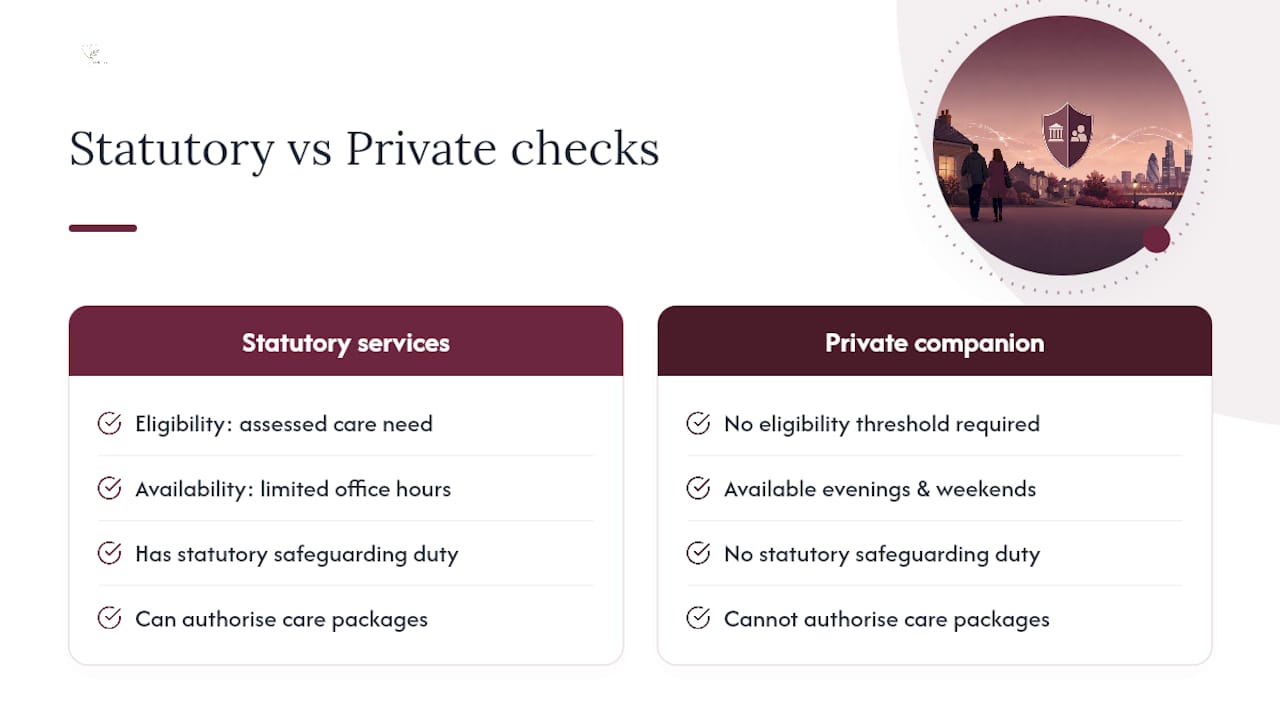
Private after hours welfare checks and statutory social services are not competing for the same job. Local authority social services step in when someone meets specific eligibility criteria, such as an assessed care need, and their capacity for regular, informal check-ins is limited by demand and by working hours that rarely stretch into evenings and weekends.
Fromlovewithcare fills that gap rather than replacing it. A companion visit does not carry out a needs assessment, cannot authorise care packages, and has no statutory duty to safeguard in the legal sense that a social worker does. What it offers instead is presence exactly when statutory services are least available, at 8pm on a Tuesday or 11pm on a Sunday, when a family simply wants eyes on their relative and nobody official is on shift.
Where the two genuinely connect is in reporting. If a companion notices a pattern worth flagging, such as repeated confusion, declining mobility, or an unsafe living environment, that observation can prompt a family to request a formal assessment through adult social services. In that sense, a private visit often becomes the trigger that starts a statutory process, rather than a substitute for one. Over 1.4 million older people in the UK experience loneliness, according to Age UK, and companionship of this kind is one of the few interventions that can reach people before they meet any statutory threshold at all.
What happens after the visit ends?
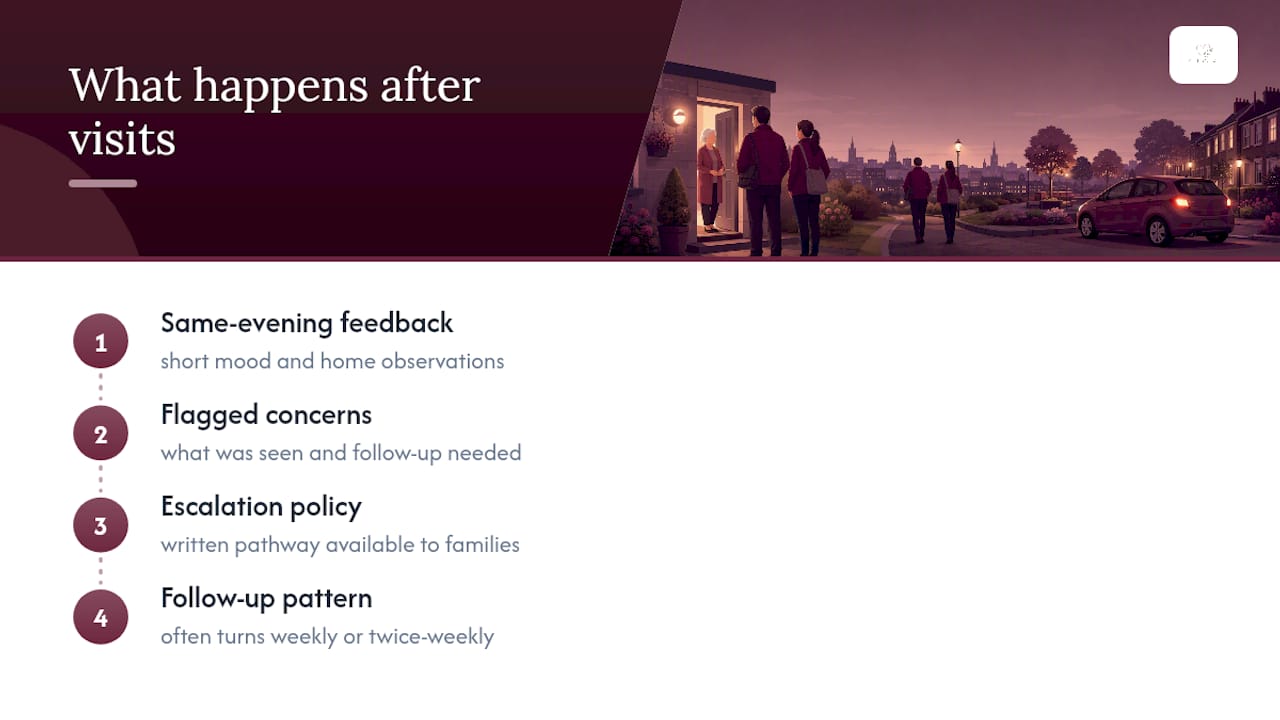
Feedback arrives promptly, usually the same evening. Most providers send a short written or verbal update covering mood, anything noticed around the home, and whether a follow-up visit is worth arranging. This is not a clinical report. It reads more like an update from someone who genuinely cares, because that is exactly what it is.
If the companion flagged something during the visit, such as low food stocks, a cold house, or signs of low mood, the report should say plainly what was observed and what, if anything, needs following up. A well-run provider keeps that escalation pathway written down and available for families to read before they book, rather than improvising it after a concern arises. That written policy is worth requesting up front.
Many families move from a single reactive visit to a regular pattern once they see the value of it. A one-off after hours welfare check often becomes a weekly or twice-weekly companionship booking, because the peace of mind extends beyond the single evening it was arranged for. What starts as a response to worry frequently turns into a preventative habit, and that shift is usually where the real benefit of these visits shows up over months rather than a single night.
Why proactive companionship matters more than people think
Most families only think about welfare visits at the point of crisis. That is precisely the wrong moment to start thinking about them.
The pattern is consistent: someone doesn't answer the phone twice in a week, a family member panics, and only then do they look for a welfare check. But loneliness rarely announces itself with a single missed call. It builds slowly, in the gap between visits, in the days nobody quite notices have gone by. Waiting for a red flag means you are always reacting one step behind the problem.
What genuinely moves the needle is consistency, not credentials. A companion who visits regularly, and who the person actually looks forward to seeing, does more for wellbeing than an occasional emergency dash ever could. The match between companion and client, shared interests, easy conversation, a familiar face, tends to matter more than any additional qualification on paper. That's not a soft observation; it's the difference between a visit someone tolerates and one they wait for.
Families who book proactively, rather than only in a panic, consistently report calmer relatives and fewer late-night worries of their own.
— Ayomide
How to arrange an after hours welfare visit with Fromlovewithcare
Fromlovewithcare gives you a faster, more personal alternative to waiting on statutory services that simply cannot stretch into the evening. Every companion is DBS-checked, trained specifically for welfare observation and companionship, and able to respond quickly when a family needs eyes on a loved one outside normal hours.
Getting started is straightforward. Contact the team with your relative's details, including access instructions and any known conditions, and a companion can usually be arranged the same day for genuine urgent requests. You will get a written scope of the visit, a clear price before you commit, and feedback the same evening once the visit is complete.
Browse the full range of companionship and welfare services to see what fits your situation, or go straight to the welfare check page if you need something arranged tonight. Whether it's a one-off visit after a hospital discharge or a regular evening call-in, booking is the first practical step towards knowing someone you love isn't facing the night alone.