

Yes, you can arrange a DBS-checked companion remotely. Call a registered provider or complete their online booking form, and you can have a first visit confirmed within days. To act right now, have these three things ready before you pick up the phone:
- A brief summary of your relative's needs and preferred visit times
- Their address and an emergency contact number
- Your preferred payment method
That is genuinely all it takes to start. The sections below walk you through every step, from choosing the right provider to confirming safety checks and preparing for the first visit.
Key takeaways
You can arrange a DBS-checked companion remotely in the UK by contacting a regulated agency by phone or online, verifying DBS status in writing, and confirming a trial visit before committing to a regular schedule.
| Point | Details |
|---|---|
| Remote booking is possible | Call or book online with a regulated agency; no in-person assessment required from you. |
| DBS checks are non-negotiable | Ask for written confirmation of the companion's DBS level before the first visit takes place. |
| Typical hourly costs | NHS guidance indicates £15–£30 per hour for a home carer, with regional variation. |
| Trial visit first | Always arrange a short initial session before agreeing to a regular schedule. |
| Fromlovewithcare | Offers fully remote booking, DBS-checked companions, written care plans, and emergency welfare checks across the UK. |
Table of Contents
- Which organisations provide in-home companionship visits in the UK?
- How to arrange a DBS-checked companion remotely, step by step
- Agency versus employing a companion directly: which works best remotely?
- What does companion care cost, and who pays?
- Safety checks and legal considerations when booking remotely
- How to prepare for the first companion visit
- How to request an emergency welfare check remotely
- What arranging companion visits for a parent actually taught me
- Fromlovewithcare makes remote booking straightforward
- Sources
Which organisations provide in-home companionship visits in the UK?
Four main provider types offer in-home companionship in the UK, and they differ significantly in how quickly you can arrange visits and what oversight they carry.
Regulated homecare agencies are the most straightforward option for remote booking. They handle vetting, DBS checks, insurance, and cover for absence. Many accept online or telephone enquiries and can confirm a companion within a few days. The NHS guidance on homecare confirms that individuals can arrange their own homecare directly with an agency, without waiting for a council referral.
Local council-arranged care is available if your relative qualifies following a care needs assessment. Councils can arrange homecare for eligible individuals, but the process typically takes longer and may require an in-person assessment. It is worth requesting this assessment regardless, as it can unlock funding contributions.
Charities and befriending services often provide free or low-cost telephone and in-person companionship. Matching and trial visits are central to how these services work, though availability varies by area and waiting lists can be long.
Privately employed companions give you the most control over scheduling, but you take on employer responsibilities: payroll, holiday pay, and finding cover when they are unavailable. This route suits families who want a specific person and have time to manage the arrangement.
For regulation, check the Care Quality Commission (CQC) register in England to confirm whether an agency is registered and when it was last inspected. Equivalent regulators apply in Wales (Care Inspectorate Wales), Scotland (Care Inspectorate), and Northern Ireland (RQIA).

How to arrange a DBS-checked companion remotely, step by step
Before you call or submit an online form, gather the following:
- Full name, address, and date of birth of the person receiving visits
- A brief needs summary (mobility, communication, any health conditions relevant to safety)
- Preferred visit days, times, and session length
- Emergency contact details (a second family member or GP)
- Payment method and billing address
The remote booking process:
- Initial enquiry. Call or complete the provider's online form. State that you are arranging on behalf of a relative and confirm they accept remote bookings.
- Care needs summary. Describe your relative's situation clearly. A good provider will ask questions; if they do not, that is a warning sign.
- DBS and identity verification. Ask the agency to confirm in writing that the assigned companion holds a current DBS certificate. Gov explains that befriending roles can be asked to apply for a Basic DBS check, and roles with greater responsibility may require an enhanced check.
- Trial visit arrangement. Request a short initial visit of 30–60 minutes so your relative can meet the companion before committing to a regular schedule.
- Written care plan and contract. Confirm the scope of visits in writing: what the companion will do, what they will not do, and who to contact in an emergency.
- Booking confirmation and invoicing. Agree the billing cycle and confirm cancellation terms before the first visit takes place.
Questions to ask before confirming:
- Will my relative see the same companion each visit?
- What happens if the companion is ill or unavailable?
- What is the cancellation notice period?
- Can I see written confirmation of the companion's DBS status?
- Is the agency registered with the CQC (or relevant regulator)?
Pro Tip: Request a visit log or brief written note after each of the first four visits. It takes seconds for the companion to complete and gives you a clear picture of how your relative is settling in, without needing to be present.
The Independent Age factsheet on arranging home care recommends starting with a care needs assessment and provides a useful checklist of questions to ask providers, which complements the steps above.
Agency versus employing a companion directly: which works best remotely?
When you are arranging everything by phone or online, the practical differences between these two routes matter more than they might if you lived nearby.
| Consideration | Regulated agency | Direct employment |
|---|---|---|
| Management time | Low — agency handles vetting, cover, and payroll | High — you manage all HR and cover |
| Cost | Typically higher hourly rate | Potentially lower hourly rate |
| Continuity of carer | Agency assigns cover if companion is absent | No automatic cover; you find a replacement |
| DBS and vetting | Agency handles and confirms in writing | You must request and verify checks yourself |
| Risk and liability | Agency carries employer liability | You become the employer; full legal responsibility |
| Remote suitability | High — most agencies accept remote bookings | Lower — direct recruitment usually needs local involvement |
For families arranging visits remotely, a regulated agency is the lower-risk route. You are not taking on employer obligations, and the agency remains accountable if something goes wrong. Researching companionship options for your parent offers a practical vetting checklist that works well alongside this comparison.
Direct employment can work if a trusted person is already known to the family, but it requires you to handle payroll, statutory holiday pay, and absence cover. For most people arranging remotely, that administration is a significant burden.
What does companion care cost, and who pays?
The NHS guidance on homecare gives an indicative hourly cost range of £15 to £30 for a carer to come to the home, with regional variation. Companionship-specific visits often sit within this range, though emergency welfare checks typically carry an additional premium.
| Cost element | Typical range | Notes |
|---|---|---|
| Standard companionship visit | £15–£30 per hour | Regional variation applies |
| Emergency welfare check | Additional premium above standard rate | Confirm exact fee with provider before booking |
| Travel or mileage | Sometimes charged separately | Ask for itemised pricing |
| Cancellation fee | Varies by provider | Check notice period in the contract |
Council contributions are available if your relative qualifies following a care needs assessment and a financial assessment. The council will not automatically fund visits; you must request both assessments. If your relative self-funds, most agencies offer monthly invoicing or pay-as-you-go arrangements. Card payments are increasingly standard.
Pro Tip: Ask for itemised pricing before signing any agreement. Some agencies bundle travel costs into the hourly rate; others add them separately. For the first two visits, ask whether a trial rate applies — some providers offer a reduced fee for an initial session.
Safety checks and legal considerations when booking remotely
Booking remotely means you cannot observe the companion in person before the first visit. These checks reduce that risk.
- DBS certificate. Ask the agency to confirm in writing the level of check held (Basic or Enhanced) and the date it was issued. Per GOV.UK DBS guidance, befriending roles may require a Basic check at minimum; roles with closer responsibility warrant an Enhanced check.
- Identity documents. Confirm the agency has verified photo ID and right-to-work documents for the companion.
- References. Ask whether two references have been taken and whether they were verbal or written.
- CQC registration. Search the CQC register at cqc.org.uk to confirm the agency is registered and check the date of the most recent inspection report.
- Mental capacity and consent. If your relative has reduced mental capacity, you may need to involve a social worker or independent advocate before booking. Where your relative can consent, they should be involved in the decision.
- Data privacy. When you share personal details on someone else's behalf, confirm the provider's data protection policy. Under UK GDPR, the provider must handle personal data lawfully and securely.
Pro Tip: Ask the agency to send written confirmation of DBS status by email before the first visit. Keep this on file. If they hesitate or cannot provide it, choose a different provider.
Checking training, qualifications, and regulator inspection reports is also recommended when selecting a provider remotely.
How to prepare for the first companion visit
Good preparation, done entirely remotely, makes the difference between a companion visit that feels awkward and one that builds genuine rapport from the start.
Before the visit, send or email the agency:
- A short "about me" note covering your relative's interests, hobbies, preferred topics of conversation, and anything they dislike
- Mobility or health notes relevant to safety (e.g. uses a walking frame, hard of hearing on the left side)
- Home access instructions (key safe code, intercom, parking)
- An emergency contact list with at least two names and numbers
Set a clear expectation for the first visit: a 45–60 minute session focused on introductions and a shared activity (tea, a short walk, looking through photographs) works well. Companions are trained to follow the client's lead, but a brief written profile helps them arrive prepared rather than starting from scratch.
If you or another family member can be present for the first visit, even briefly by video call, it reassures your relative and lets you observe the companion's manner directly. Companionship plans for housebound seniors includes a practical template you can adapt for this briefing note.
How to request an emergency welfare check remotely
When you cannot reach your relative and are concerned for their safety, a welfare check provides immediate reassurance or escalation.
To request a welfare check, have the following ready:
- Your relative's full name, address, and any access details (key safe code)
- The specific concern (no answer to calls for 24 hours, missed medication, recent fall)
- Any known immediate risks (medical conditions, mobility issues)
- Your name and relationship, and a second authorised contact
What happens next:
- A same-day welfare visit from a companion or care worker to check on your relative in person
- A telephone welfare check if an in-person visit cannot be arranged immediately
- Escalation to 999 or local emergency services if the companion arrives and finds a medical emergency or cannot gain entry safely
Providers vary on response times, so confirm the expected timeframe when you book. Fromlovewithcare offers emergency welfare checks as a distinct service, with a premium fee above the standard visit rate. Confirm the exact fee and response window when you make the initial enquiry.
What arranging companion visits for a parent actually taught me
The first call felt uncertain. There was a list of questions, a summary of my parent's needs, and no real sense of what to expect. What made it work was insisting on a short trial visit before committing to a regular schedule, and asking the agency to send a brief written note after each of the first two weeks of visits.
The DBS confirmation arrived by email the same day as the booking confirmation. That mattered. It was not just a box-ticked; it was the point at which the arrangement felt genuinely safe rather than simply convenient.
One practical lesson: write the "about me" profile before you call, not after. Agencies ask for it, and having it ready shortens the call and produces a better match.
Fromlovewithcare makes remote booking straightforward
Arranging DBS-checked companionship visits for a relative you cannot be with daily is exactly what Fromlovewithcare is built for. Every companion is thoroughly vetted and DBS-checked, and the booking process works entirely by phone or online, with no requirement for an in-person assessment from you.
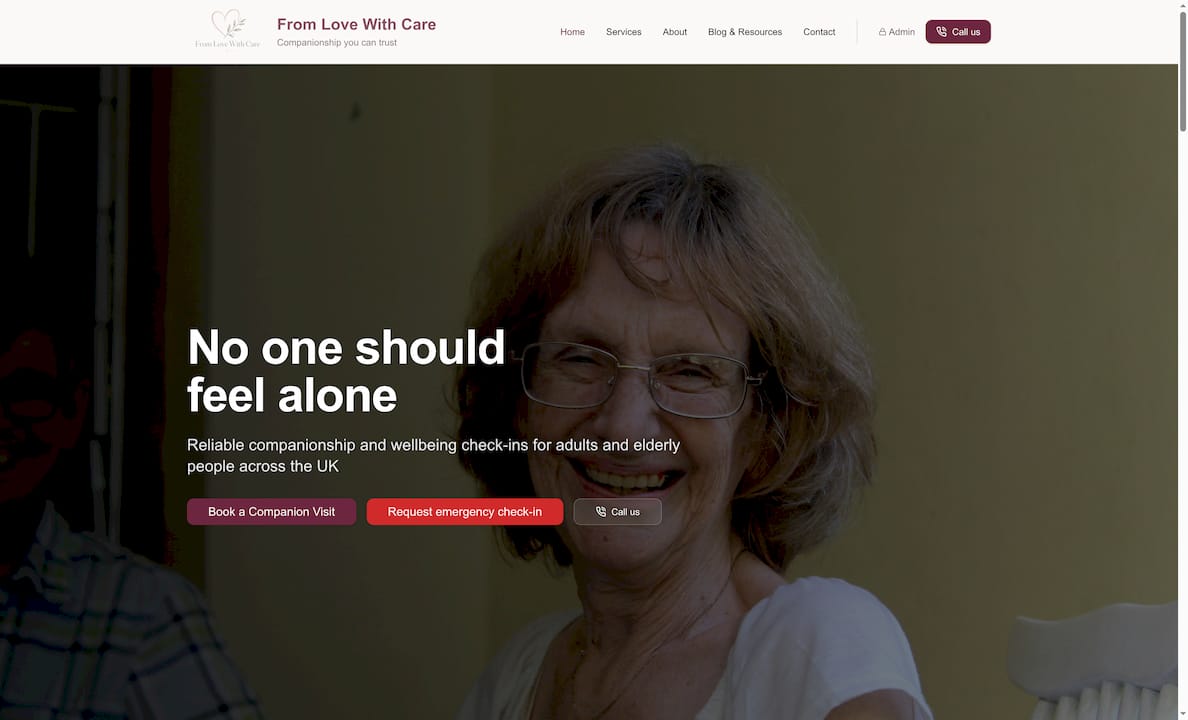
The process is direct: call or enquire online, share a brief summary of your relative's needs, and Fromlovewithcare will match a companion, confirm the DBS status in writing, and schedule a trial visit. A written care plan is agreed before the first visit, and emergency welfare checks are available as a separate, bookable service. Clients report meaningful improvements in their relative's wellbeing after regular visits, and the companionship services page sets out exactly what each visit includes.
To arrange a visit or request a welfare check, visit Fromlovewithcare's elderly companionship services or call directly to speak with the team.
Sources
- Help at home from a paid carer - Social care and support guide - NHS
- Gov
- Arranging home care - Independent Age factsheet
This article is general information, not a substitute for advice from a qualified doctor. Consult a qualified healthcare professional about your own circumstances before acting on anything here.