

Safeguarding adults at home, in the sense that matters to worried families, means arranging DBS-checked companionship and non-medical welfare checks for an older or isolated relative. The quickest step is booking a companion visit or an emergency welfare check through a provider such as From Love With Care. These visits offer social contact and gentle monitoring, not clinical care.
TL;DR:
- DBS-checked companionship visits focus on conversation and shared activities, while welfare checks are brief safety assessments often booked on the same day.
- Families should clarify provider protocols beforehand, especially regarding no-answer procedures, to ensure calm escalation steps and clear communication.
- Almost one in five adults over 75 feels lonely, which raises the risk of serious health issues like heart disease and stroke.
- Pricing varies based on hourly rates, travel distance, and whether the visit is regular or emergency, with most families starting with low-pressure visits.
- Reputable providers like From Love With Care conduct thorough vetting, carry identification, and keep detailed visit notes to ensure safety and transparency.
Table of Contents
- What do companion visits and welfare checks actually involve?
- Who needs a visit, and what are the warning signs?
- How do you arrange a visit or an emergency welfare check?
- What safety and vetting standards should you expect?
- What does it cost, and how often should visits happen?
- Why families start small and build trust over time
- Booking a companion or welfare check through From Love With Care
- Sources
What do companion visits and welfare checks actually involve?
Companionship visits are built around conversation and connection. A companion might sit down for a cup of tea, accompany your relative to a GP appointment, help with light grocery shopping, or simply be present for an afternoon of cards or a shared hobby. These visits run on a schedule that suits the family, whether that is twice a week or once a fortnight.
Welfare checks work differently. They are shorter, focused visits designed to confirm that someone is safe and coping, often booked same-day when a family member cannot get an answer on the phone or feels something is wrong. Both services sit firmly outside medical or personal care.
- Companionship visits: conversation, shared activities, errands, appointment accompaniment.
- Welfare checks: rapid safety confirmation, wellbeing observation, same-day emergency availability.
- Boundaries: no medication administration, washing, or clinical assessment unless a separate care arrangement is in place.
If your relative needs help with mobility or medical monitoring, that sits with a GP, district nurse, or a registered care provider working alongside the companionship visits.
Who needs a visit, and what are the warning signs?
Loneliness among older people in the UK is not a fringe issue. The NHS Health Survey for England 2024 found that a significant portion of adults aged 65 and over report feeling lonely at least some of the time. Age UK links that kind of persistent loneliness to a 29% higher risk of coronary heart disease and a 32% higher risk of stroke. This is not a soft wellbeing statistic. It is a physical health risk hiding in plain sight.
Certain signs tend to show up before a crisis does:
- Post piling up unopened, or bills going unpaid.
- Missed medical appointments or a fridge that looks emptier than usual.
- Noticeable changes in hygiene, weight, or general appearance.
- A flatter mood on the phone, or shorter, more withdrawn conversations.
- Fewer visits from friends or neighbours than there used to be.
Families living an hour or a country away cannot catch these details from a weekly phone call. Regular companion visits fill that gap, giving someone trained and observant eyes on the ground. Our own guide to loneliness signs in elderly relatives walks through these indicators in more depth.
How do you arrange a visit or an emergency welfare check?
Booking a companion or a welfare check is straightforward once you know what to prepare and what to ask. Work through it in this order.
- Decide what you need. A regular companionship schedule for ongoing connection, or a one-off emergency welfare check because something feels wrong right now.
- Gather the basics. Address, keyholder details or access arrangements, any relevant medical notes, mobility level, daily routine, and personal preferences (interests, dietary needs, things to avoid).
- Ask the provider direct questions. Are companions DBS-checked? What training do they receive? Will they carry ID on arrival? What happens if nobody answers the door? How fast can an emergency check be arranged?
- Understand the booking terms. Ask about cancellation notice, how the first visit is matched to personality and interests, and what feedback you will receive afterwards.
- Confirm the escalation chain. If a companion cannot get an answer, does the protocol move to calling family first, then a named emergency contact, then police or ambulance if genuinely necessary?
Pro Tip: Ask every provider to put their no‑answer protocol in writing before you book. Practices vary widely, some call the family straight away, others go to a keyholder or request a police welfare check, and you want that decision made calmly in advance, not worked out in a panic.
A well-run first visit should end with a short report back to you: how your relative seemed, anything noted, and what the plan is for the next visit. Emergency welfare checks should confirm arrival time and outcome within a clear window, not leave you waiting for an update.
What safety and vetting standards should you expect?
Every reputable companionship service should clear the same baseline before a companion ever knocks on a door. From Love With Care companions are DBS-checked, reference-checked, and go through onboarding and ongoing supervision before and during their work with clients.
Beyond that baseline, look for these operational safeguards:
- Companions carry identification and confirm it on arrival.
- Written notes are kept after every visit and shared with the family.
- Clear boundaries are set out in advance, so everyone understands this is companionship, not clinical or personal care.
- Public liability insurance is in place, covering the visit itself.
Loneliness by the numbers: the NHS Health Survey for England 2024 found nearly one in five adults over 75 feels lonely at least some of the time, a scale that puts regular companionship closer to preventative health support than a nice-to-have extra.
One question deserves special attention before you book anything: what happens if a companion arrives and nobody answers? Ask the provider to walk you through their exact steps, whether that means calling you, calling a keyholder, or requesting a police welfare check, so the plan is agreed calmly rather than improvised on a doorstep.
What does it cost, and how often should visits happen?
Pricing for companionship visits usually comes down to a handful of factors: the hourly rate, an added premium for same-day emergency checks, travel distance to more rural addresses, and the time taken for a proper matching process at the start.
Families tend to settle into one of a few patterns:
- A single emergency welfare check to settle immediate worry.
- Weekly or fortnightly social visits for ongoing companionship.
- Stepped-up visits, moving from occasional to twice-weekly, after a specific concern is flagged.
Set your expectations sensibly. A good outcome looks like more regular social contact, a companion who notices subtle changes over time, and a smooth referral into GP or social care support if something needs medical attention. It does not look like medical treatment delivered in the home. Companionship works alongside the NHS and local authority services, not instead of them.
Why families start small and build trust over time
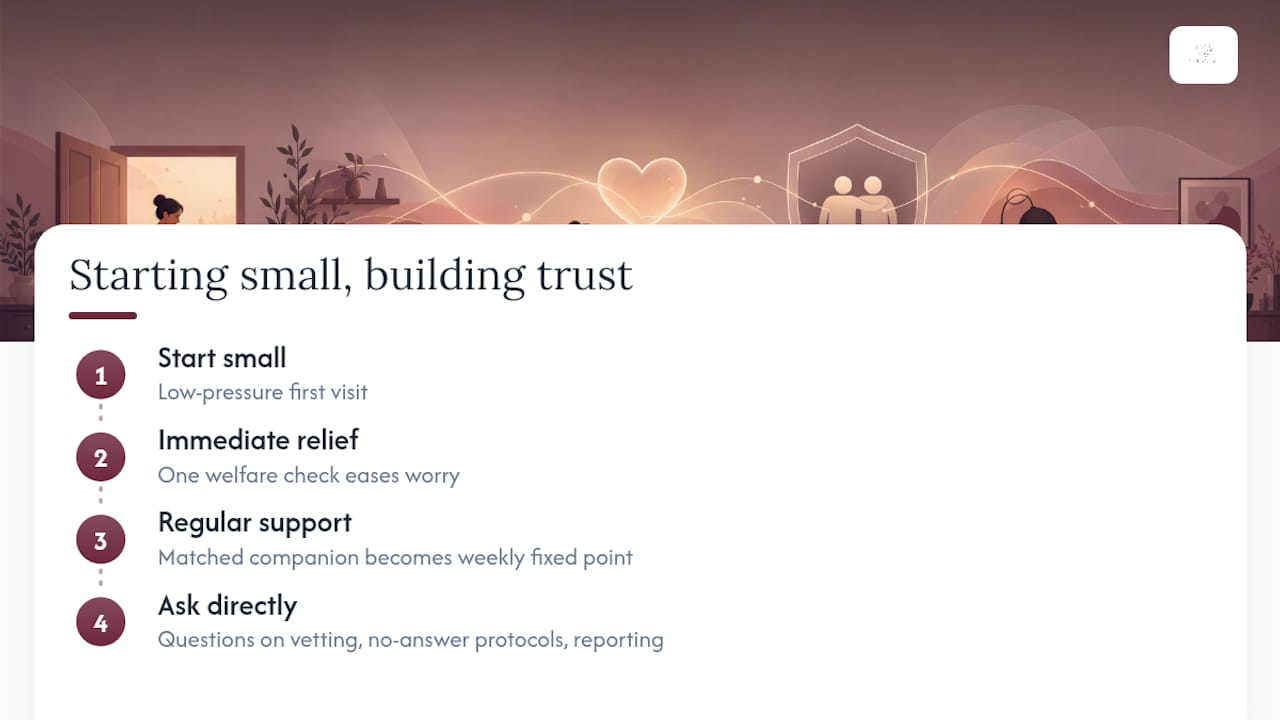
Most families who reach out are not looking for a dramatic intervention. They are looking for reassurance, a second set of eyes, someone to notice if Mum has stopped eating properly or Dad has gone quiet on the phone. What tends to work is starting with a low-pressure visit, seeing how it lands, and building from there.
That gradual approach matters more than people expect. A single welfare check settles an immediate worry. A regular companion, matched well, becomes a small fixed point in someone's week, and often the person who first notices when something changes. The families who get the most out of this are the ones who ask direct questions upfront, about vetting, about no-answer protocols, about what a report back actually looks like, rather than assuming every provider works the same way.
— Ayomide
Booking a companion or welfare check through From Love With Care
The two main services covered in this guide are DBS-checked companionship visits and emergency welfare checks, matched to your relative's interests and delivered without pretending to be medical or personal care.
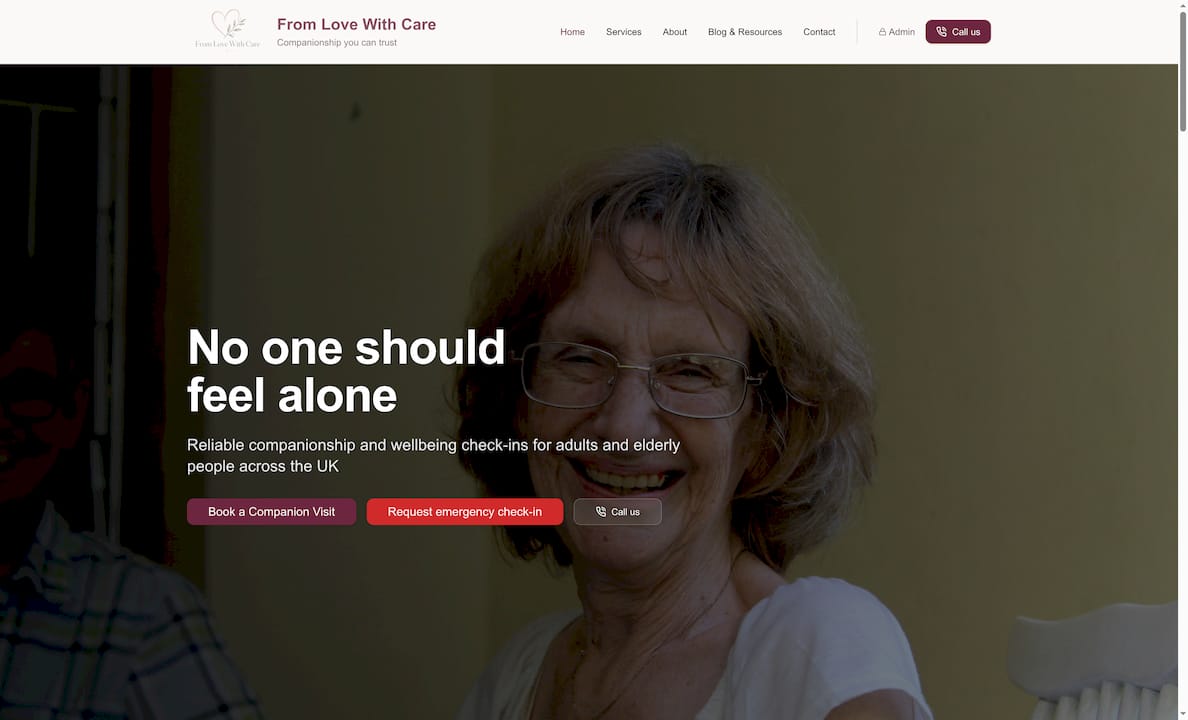
Companions are matched based on personality and hobbies, rather than assigned at random, and visits commonly end with a report back to the family to keep them informed. Our senior home visits service covers regular companionship, while emergency welfare checks are built for the moments when you cannot get an answer and need someone there quickly. You can browse the full range on our services page or read how our companionship works to understand the matching process before you book. If loneliness rather than a single incident is the concern, our loneliness support services explain the ongoing options. Get in touch today to arrange a first visit or request an emergency check.
Sources
- NHS Health Survey for England 2024 — loneliness and wellbeing
- Age UK — you are not alone in feeling lonely (press and briefing materials)