
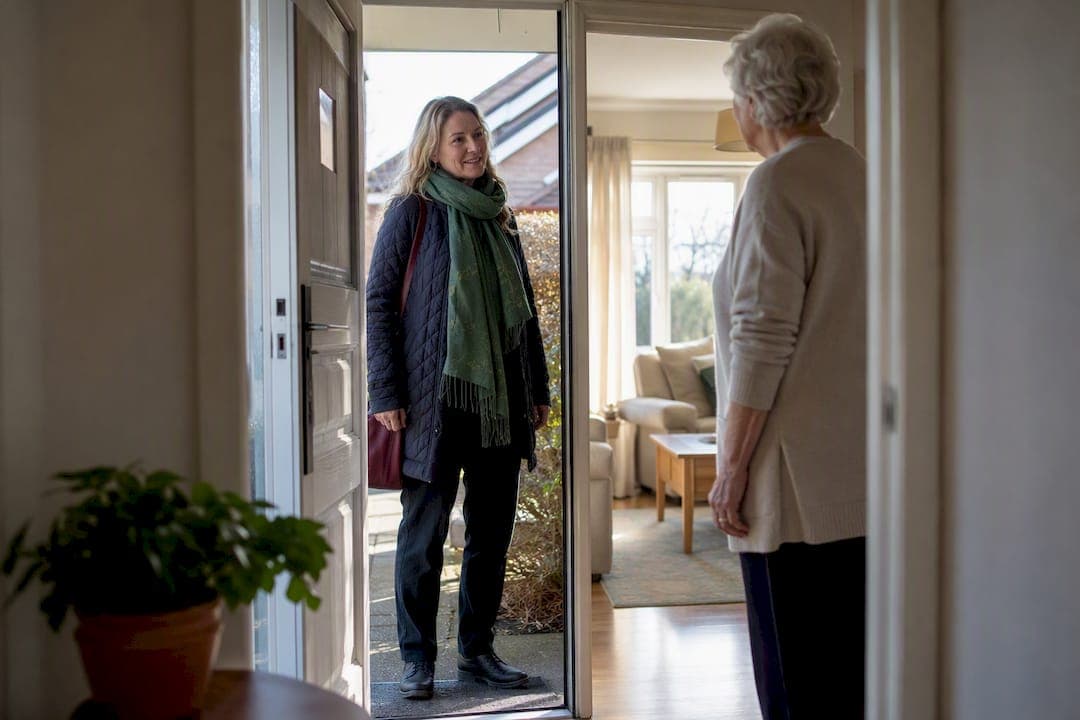
A paid welfare check follow up is a non-medical, in-home visit by a DBS-checked companion who confirms your relative is safe, checks how they are coping, and reports back with clear next steps. Some providers arrange these visits alongside NHS 111, a GP, or Age UK when concerns run deeper. Expect confirmation of safety, any immediate needs addressed on the spot, and a short written note with agreed follow-up actions.
TL;DR:
- Regular follow-up visits build trust and improve wellbeing, with weekly or biweekly durations around 40 to 90 minutes, tailored to individual needs.
- Continuity of companions is crucial, as familiarity encourages honest communication about health and safety concerns and fosters stronger relationships.
- Immediate danger requires calling 999, while non-urgent concerns should be directed to NHS 111 or the GP, and safeguarding issues to adult social services.
- Visitors must have explicit consent, cannot force entry, and ongoing refusal should be respected unless there is a genuine safety concern.
- Accurate, secure documentation of each visit streamlines responses, with details including date, findings, actions taken, and sharing only with authorized individuals.
Table of Contents
- How do you plan and book a welfare check follow up?
- What should a companion do during the visit?
- How should the visit be documented and shared?
- When should you escalate beyond a companion visit?
- Why does continuity matter for ongoing follow-up visits?
- What are the legal and consent considerations?
- How is privacy protected during a follow-up visit?
- What common problems come up during welfare follow-ups?
- How do professional and companion welfare checks differ?
- What if someone refuses entry or won't cooperate?
- A carer's view on what actually reassures families
- How Fromlovewithcare supports ongoing welfare check follow ups
- Where to go for further UK guidance
- Sources
- FAQ
How do you plan and book a welfare check follow up?
Getting the timing right matters as much as the visit itself. A same-day, after-hours check suits situations where you have not heard from someone in an unusual amount of time, or a call has gone unanswered when it normally wouldn't. A scheduled visit works better for routine reassurance, medication reminders, or simply making sure someone isn't spending another week without company.
Before booking, gather the details that let a companion act with confidence rather than guesswork:
- Full address, including any access instructions (key safe code, buzzer, neighbour with a spare key)
- Mobility limitations, known conditions, and current medications
- GP surgery name and contact number
- Whether a keyholder exists and what your relative has agreed to in terms of entry
- Who should be contacted afterwards, and how (phone call, text, written note)
Be upfront about consent. If your relative is aware of and happy with the visit, say so; if this is a first check and they may not expect a knock at the door, mention that too, so the companion can introduce themselves properly. It's also worth asking any provider directly about DBS checks and same-day availability. Both are reasonable questions, and the answers tell you a great deal about how seriously a service takes safety.
What should a companion do during the visit?
A good welfare check follows a rhythm, not a checklist ticked off in silence. Companions are trained to move through safety, wellbeing, and connection in that order, because rushing straight to conversation can mean missing something that needed attention first.
- Check visible safety first. Is your relative breathing normally, alert, and free of obvious injury? Are there hazards nearby, such as a trailing cable, spilt liquid, or a fall risk near the stairs?
- Assess wellbeing. Does your relative seem orientated and aware of the day and time? What's their mood like? Is there evidence of eating and drinking, and are medications present and taken as expected?
- Engage properly. A few minutes of real conversation, a shared cup of tea, or reminiscing over old photographs does more for rapport than a rushed door-step exchange. This is where trust starts to build for future visits.
- Offer practical help. That might mean popping to the shop for milk, ringing the GP surgery on your relative's behalf, or updating the family contact everyone agreed on beforehand.
Pro Tip: Ask your provider whether the same companion can return for follow-up visits. Familiarity speeds up every one of these steps, because your relative is more likely to mention a missed pill or a worrying symptom to someone they already know.
None of this involves clinical assessment. Companions are not medically trained, and a proper visit makes that boundary clear from the outset rather than blurring it.
How should the visit be documented and shared?
A visit is only as useful as the record left behind. A minimal note should cover the date and time of the visit, who attended, a short summary of how your relative presented, any action taken on the spot, and who was informed afterwards.
Good practice includes:
- Written consent before taking photographs or detailed notes
- Secure storage of records, shared only with people your relative has agreed to
- A phone call for anything urgent, a written note for routine reassurance
- A copy passed to family, and to the GP or adult social services where relevant
Clear documentation genuinely speeds up the right response. One insight from research into safe-and-well practice is that concise, promptly shared notes can shorten response times and stop the same assessment being repeated by different people. A tool like KinCarer can help families keep a shared care plan and visit history in one place, so nothing gets lost between calls.
When should you escalate beyond a companion visit?
A welfare check follow up is not a substitute for emergency or clinical care, and knowing where the line sits matters more than almost anything else in this guide.
- Immediate danger, such as a fall, collapse, or chest pain: call 999 straight away.
- Non-urgent medical concerns, confusion, or a general decline: contact NHS 111 or the GP.
- Ongoing safeguarding worries, such as signs of neglect or an unsafe living situation: contact the local council's adult social services team.
- Persistent loneliness with no immediate risk: charities such as Age UK or a local befriending scheme can provide regular social contact alongside paid visits.
NHS guidance recommends trying other contacts first, then escalating through a GP or adult social services, before involving 101 or 999 depending on urgency. That sequence holds just as well when a paid companion has flagged the concern as when a family member has.
Why does continuity matter for ongoing follow-up visits?
Research into befriending and friendly visiting consistently points to one thing: frequency helps, but the relationship matters more. Reviewed programmes commonly used weekly visits lasting around 40 to 90 minutes, and those studies reported real improvements in life satisfaction and social support.
What made the difference wasn't just showing up. Work on the mechanisms of befriending in England found that a confiding relationship, built through empathy and good conversational matching, drove most of the benefit. A stranger doing the same checklist every week rarely achieves the same result as someone your relative has come to know and trust.
- Expect a proper introduction period, scheduled reviews, and the option to change companions if the match isn't working
- Weekly or fortnightly visits are typical starting points, adjusted as needs change
- Continuity reduces the chance of a small problem becoming an emergency, because a familiar companion notices change faster
Pro Tip: If the first visit feels flat, say so. A mismatch in personality or pace is common and fixable, and most providers would rather adjust than have you cancel altogether.
What are the legal and consent considerations?
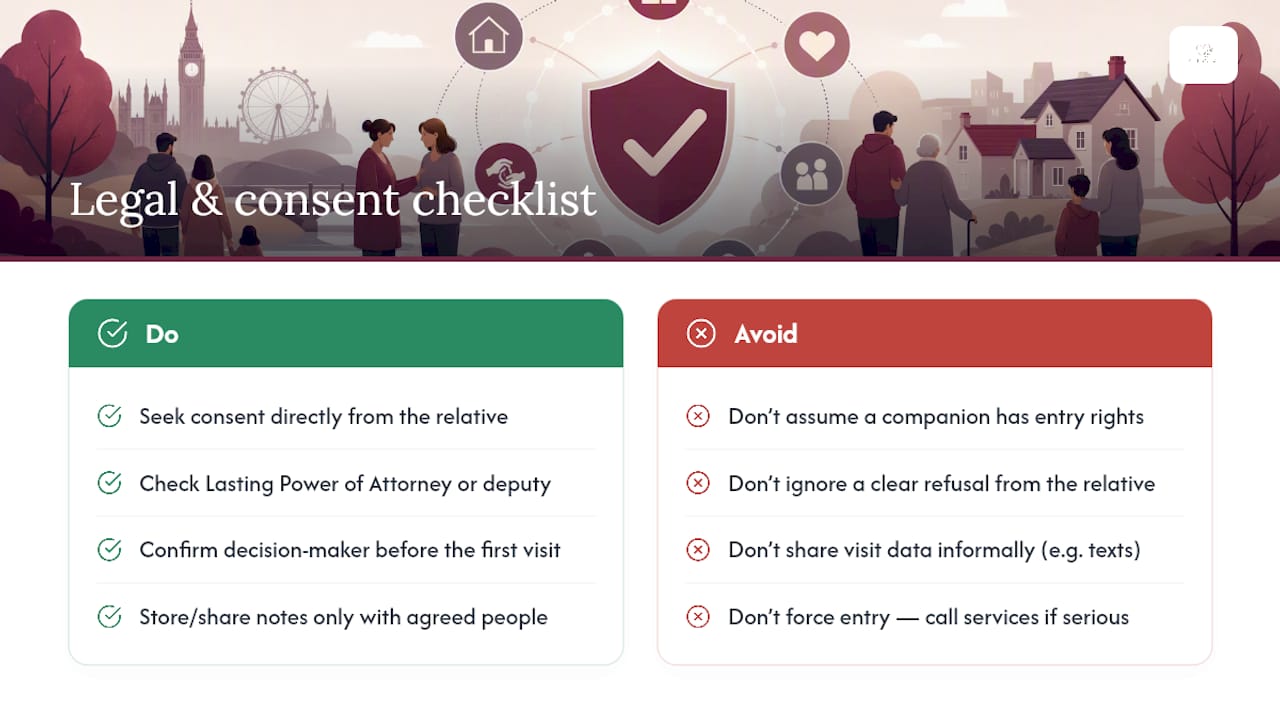
A paid welfare check is a private arrangement, not a statutory power, and that distinction shapes everything about consent. A companion has no legal right of entry. Access depends entirely on what your relative, or their authorised representative, has agreed to in advance.
Where your relative has mental capacity, their consent should be sought directly wherever possible, even if you are the one paying for and arranging the visit. If they lack capacity, whoever holds Lasting Power of Attorney for health and welfare, or an appointed deputy, should be the one confirming arrangements on their behalf. Providers should ask about this status before the first visit, not after.
Data protection matters here too. Any notes taken during a visit, whether about medication, mood, or living conditions, count as personal data under UK GDPR. Reputable providers will only share that information with people your relative has agreed can receive it, and will store it securely rather than passing it around informally by text message.
If your relative refuses the visit outright, that refusal generally stands, unless there's a specific legal authority (such as a Court of Protection order or a safeguarding referral already under way) overriding it. A companion pushing past a clear "no" isn't good practice, it's a legal problem waiting to happen. In genuinely serious situations, that's precisely when adult social services or the police, rather than a paid companion, become the appropriate route.
How is privacy protected during a follow-up visit?
Your relative's home is still their home, even during a welfare check, and privacy expectations don't disappear because a visit has been booked. A companion walking into a bedroom uninvited, photographing belongings without asking, or discussing what they saw with a neighbour afterwards would breach both good practice and, in some cases, data protection law.
Confidentiality works in two directions. Companions should only share what's relevant with the people your relative has agreed can hear it, and families should be equally careful about who they pass visit notes on to. A note mentioning a missed medication dose or low mood is sensitive information, not casual family gossip.
Ask any provider directly how records are stored and for how long, and who has access. A reasonable answer involves secure digital systems, limited access on a need-to-know basis, and deletion or archiving after a defined period. If a provider can't answer that clearly, treat it as a warning sign rather than a minor gap.
There's a balance to strike, too. Withholding everything from family "for privacy" isn't helpful if it means nobody notices a pattern of decline. The right approach shares enough to keep people informed and safe, without turning a companion visit into surveillance.
What common problems come up during welfare follow-ups?
A handful of issues turn up again and again, and most have straightforward fixes once you know what to expect.
Reluctance to be "checked on." Many older people find the phrase "welfare check" itself a little clinical, even alarming. Framing the visit as companionship, a cup of tea and a chat rather than an inspection, tends to land far better.
Missed or unreliable contact details. Phone numbers change, GP surgeries merge, and a keyholder listed months ago may have moved away. Reviewing these details every few months avoids a companion arriving to a dead end.
Inconsistent companions. Rotating through different people undermines exactly the trust that research on befriending identifies as the real driver of benefit. If continuity keeps breaking down, raise it directly with the provider rather than accepting it as inevitable.
Family disagreement over urgency. One sibling wants a same-day check, another thinks it's overreacting. Agreeing in advance who makes the call, and under what circumstances, saves friction when a real concern arises.
Isolation between visits. A weekly check helps, but the days in between still matter. Combining paid visits with a local befriending scheme through Age UK or a community group fills the gap without adding cost on every single day.
How do professional and companion welfare checks differ?
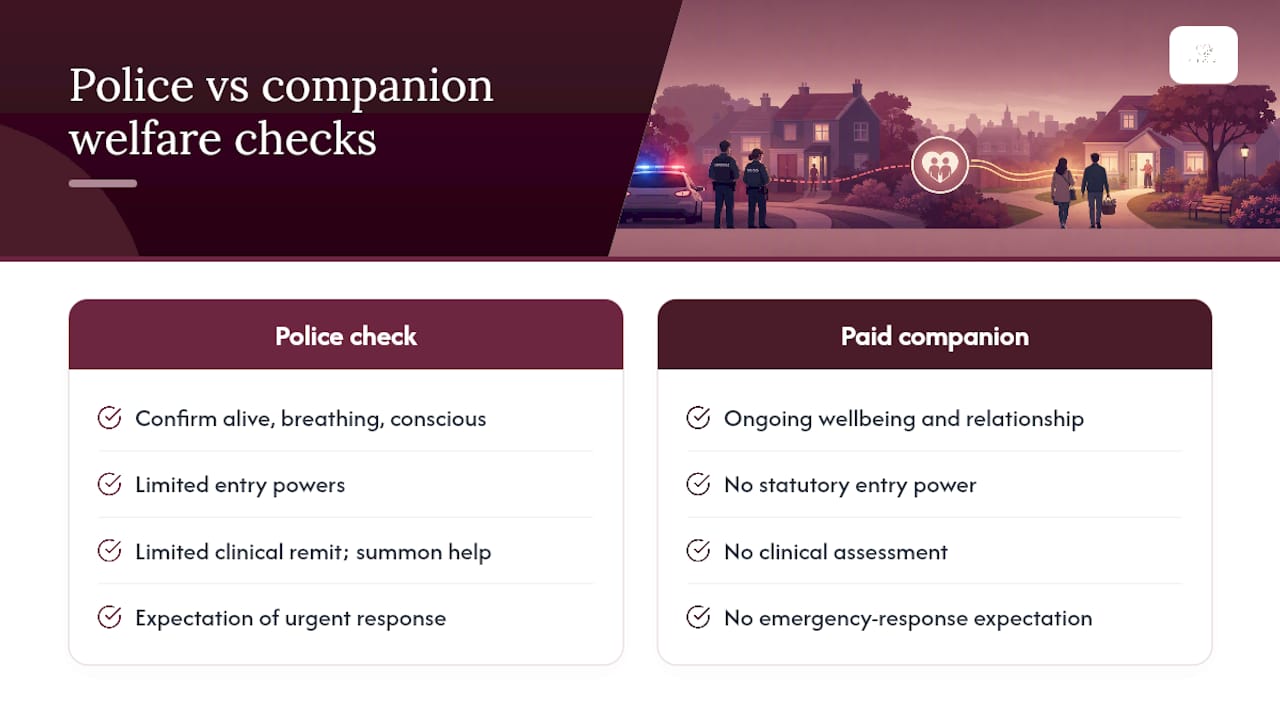
These two options solve genuinely different problems, and confusing them leads to the wrong service being booked at the wrong moment. A police safe-and-well check exists to establish whether someone is alive, breathing, and conscious. Officers have limited entry powers and, quite deliberately, limited clinical remit. Where medical assessment is needed, they call it in rather than attempting it themselves, as College of Policing guidance makes clear.
A paid companion visit, by contrast, is built around ongoing relationship and wellbeing, not a one-off safety confirmation. There's no statutory entry power, no clinical assessment, and no expectation of urgency response in the way emergency services provide. What it offers instead is time: a longer visit, a familiar face, a conversation that goes beyond confirming a pulse.
Neither replaces the other. A police welfare check answers "is this person safe right now, in a crisis." A companion follow-up answers "is this person coping, month after month, and does someone notice early if that changes." Families who rely solely on the emergency route often find gaps between crises where genuine decline goes unnoticed. Families who rely solely on companionship need to know when a situation has moved beyond what a non-medical visit can safely handle, and hand it to the GP, 111, or 999 without delay.
What if someone refuses entry or won't cooperate?
Refusal happens more often than families expect, and it's rarely about the visit itself. Pride, embarrassment about the state of the home, or simple stubbornness about "not needing checking on" are common enough that experienced companions are trained to expect them.
The first response should always be patience over pressure. A companion turning up as a friendly visitor, rather than an inspector with a clipboard, defuses most initial resistance. Talking through the doorway, explaining who sent them and why, and offering to come back another time if the moment is wrong, often turns a "no" into a "come in for a cup of tea" within minutes.
If refusal persists, a companion has no authority to force entry, and shouldn't try. That's not a failure of the visit, it's the boundary working as intended. What happens next depends on the level of concern. If there's no reason to believe anything is wrong beyond stubbornness, a follow-up call or a rescheduled visit usually works. If there's genuine reason to worry, silence behind a door, a welfare concern raised by a neighbour, or a pattern of avoidance, that's the point to involve adult social services or, where danger seems immediate, the police.
Families sometimes push companions to be more forceful than their role allows. Resist that instinct. A companion's value lies in trust built over repeated, respectful visits, not in becoming the person who talked their way past a closed door.
A carer's view on what actually reassures families
The families who worry least aren't the ones with the most visits booked. They're the ones who know their relative has a familiar face turning up regularly, and a clear plan for what happens if something's wrong. From Love With Care builds on that with DBS-checked companions and same-day, after-hours checks when a call goes unanswered and anxiety spikes.
What surprises people is how much the wellbeing gain comes from consistency rather than urgency. Families who book regular follow-up visits, not just emergency ones, tend to report the biggest shift in how their relative copes day to day. A single crisis check reassures for an evening. A familiar companion returning week after week changes how someone experiences being alone at all.
— Ayomide
How Fromlovewithcare supports ongoing welfare check follow ups
Some providers offer DBS-checked and trained companions, same-day and after-hours checks when something feels wrong right now, and regular follow-up visits built around keeping the same companion returning, so trust builds instead of resetting each week.
Booking is straightforward. Have your relative's address, any access details, GP contact, and consent status ready, and take a look at how our companionship works to see exactly what a first visit involves. For ongoing loneliness rather than a one-off concern, the loneliness support services page covers longer-term befriending options too.
If you're not sure whether you need a same-day check or a scheduled visit, get in touch for an initial conversation, there's no pressure to commit before you've talked it through. When you're ready, the full range of companionship and welfare-check services is the place to book.
Where to go for further UK guidance
A few sources are worth bookmarking alongside any provider you choose, particularly if you're weighing up next steps for the first time.
- NHS guidance on loneliness in older people, including when to involve 111 or 999
- Research on friendly visiting and befriending for the evidence behind regular visits
- Age UK and local Campaign to End Loneliness schemes for ongoing community-based befriending support
- Fromlovewithcare's blog for further reading on conversation prompts and continuity
Sources
- Friendly visiting by a volunteer for reducing loneliness or social isolation in older adults: A systematic review - PMC
- An exploration of the value and mechanisms of befriending for older adults in England
- Loneliness in older people: how to help - NHS
FAQ
What counts as a welfare check follow up?
It's a non-medical, in-home visit by a DBS-checked companion who confirms someone's safety and wellbeing, addresses immediate needs, and records the outcome for family or professionals.
How quickly can a same-day welfare check be arranged?
Some providers offer same-day and after-hours checks, though exact availability depends on your location and the companion schedule at the time of booking.
Who should be contacted if a welfare check finds a serious problem?
Call 999 for immediate danger, use NHS 111 or the GP for non-urgent medical concerns, and contact adult social services for ongoing safeguarding worries.
Can a companion enter a home without permission?
No. A companion has no legal right of entry, and a genuine refusal should be respected, with escalation to adult social services or the police only where real concern exists.
How often should follow-up visits happen?
Weekly or fortnightly visits, lasting roughly 40 to 90 minutes, are common starting points, adjusted according to need and how well the companion match is working.