

If you cannot reach your elderly parent and you fear immediate danger, call 999. If you are worried but there is no obvious emergency, call 101 and ask for a police "safe and well" welfare check, as Gov confirms.
Before you dial anything, spend two minutes on quick checks. Try the landline as well as the mobile, send a text, and ring a neighbour or the sheltered-scheme warden if there is one. These small steps often solve the problem in minutes, not hours.
- Call 999 for collapse, suspected stroke, severe bleeding, or unconsciousness.
- Call 101 for a welfare check when you're worried but nothing points to immediate danger.
- Try alternative numbers, a text message, and a nearby contact before escalating.
Pro Tip: Have your parent's full name, address, date of birth and any known health conditions ready before you call. It saves precious minutes and helps the operator prioritise correctly.
Key Takeaways
Reaching the right service first time, 999 for danger, 101 for a welfare check, saves critical minutes when you cannot contact an elderly parent.
| Point | Details |
|---|---|
| Know the number split | Call 999 for life-threatening danger; call 101 for a police "safe and well" check when worried but no emergency is obvious. |
| Try local contacts first | A neighbour, warden, or nearby relative can often check the property faster than emergency services can attend. |
| GPs rarely do doorstep checks | For welfare concerns, contact adult social care via your parent's local council, not the GP surgery. |
| Capacity shapes outcomes | Adults with capacity can refuse help; safeguarding referrals follow where capacity concerns exist. |
| Prevent repeat scares | A daily check-in text, saved local contacts, and regular companionship visits reduce future "cannot reach" incidents. |
Authoritative UK resources to bookmark
- Age UK advice for worried family members.
- NHS guidance on needs assessments.
- Fromlovewithcare's companionship services for ongoing visits and checks.
Table of Contents
- Step-by-step actions to try when you can't reach an elderly parent
- Which service should you actually call: 999, 101, or the GP?
- What actually happens during a police welfare check?
- What to do if the welfare check uncovers a bigger problem
- Simple habits that stop this happening again
- Where regular companionship visits fit into the picture
- Get regular check-ins in place before the next scare
- What this all actually adds up to
- Frequently asked questions
- Sources
Step-by-step actions to try when you can't reach an elderly parent
A missed call rarely means the worst. Batteries die, hearing aids get left on the bedside table, phones get left on silent after a nap. Work through these steps methodically before you assume the worst.
- Try every number you have. Landline, mobile, WhatsApp, video call. Check the timestamp of any missed calls, if you can see them, to work out when contact was last definitely made.
- Call someone local. A neighbour, a sheltered-housing warden, a building concierge, or a relative who lives closer can knock on the door far faster than you can travel there yourself.
- Ask for visible clues. Curtains still drawn at midday, uncollected post, lights left on overnight. Anyone checking the property should note the last time they know your parent was definitely fine.
- Gather the details a welfare check will need. Full name, address, date of birth, relevant medical conditions, mobility issues, and whether anyone holds a spare key.
- Decide your next call based on what you find. No answer anywhere, no local contact available, and no sign of life from outside means it's time to involve the police or, in a genuine emergency, an ambulance.
None of this needs to take long. Most cases resolve at step two, with a neighbour reporting that your parent was in the garden, at a GP appointment, or simply hadn't heard the phone.
Pro Tip: Keep a written note (on your phone, in a notes app) of your parent's usual routine, so you instantly know what "unusual" looks like. Knowing they always answer by the third ring makes five unanswered calls far more telling.
Which service should you actually call: 999, 101, or the GP?
Getting the right service on the first call matters more than getting through quickly to the wrong one. Each route in the UK's support system does a specific job, and none of them fully overlaps with the others.
- 101 is the police non-emergency line, and the correct route for a "safe and well" welfare check when you're worried but nothing suggests immediate danger. Officers will ask for your parent's details, your relationship to them, when you last had contact, and why you're concerned.
- NHS 111 handles urgent but non-life-threatening medical worries, such as sudden confusion or a worsening chronic condition, where you need advice rather than a physical check on the property.
- GP surgeries can advise or arrange a home visit for medical reasons, but they don't typically send someone to check a locked, silent house. NHS guidance on needs assessments points families toward adult social care instead for this kind of concern.
- Local council adult social care becomes relevant once immediate safety is confirmed, particularly if the incident reveals your parent has been struggling for a while.
Knowing this hierarchy in advance means you won't waste time ringing a GP surgery that closed an hour ago while your parent sits on the floor of their hallway.
What actually happens during a police welfare check?
A "safe and well" check follows a fairly consistent pattern across UK police forces. Officers attend the address, knock, and try to make contact through a window or letterbox. If they get no response and have genuine cause for concern, they can lawfully force entry, particularly when there's reason to believe someone inside may be unwell or at risk, as welfare check guidance for older people explains.
From there, outcomes vary:
- Your parent is found safe, sometimes simply asleep, out, or unaware their phone had died.
- Officers find a medical emergency and call an ambulance immediately.
- No immediate danger is found, but officers flag concerns, such as signs of self-neglect, and make a referral to adult social services.
- In rare, serious cases, forced entry is required and further safeguarding steps follow.
Capacity and consent shape everything that happens next. An adult with mental capacity has the right to refuse further help, even if you disagree with that choice. Where officers suspect your parent lacks capacity to make safe decisions, or is at risk and unable to protect themselves, a safeguarding referral to adult social care can proceed without their explicit consent, as Age UK sets out. This is one of the most misunderstood parts of the process. Being found "safe" doesn't automatically mean nothing changes.
What to do if the welfare check uncovers a bigger problem
Sometimes a single unanswered phone call turns into the moment you discover your parent has been quietly struggling for months. If that happens, the local council's adult social care team is your next call, not the GP surgery.
Use the GOV.UK postcode tool to find the correct team for the address where your parent lives, since responsibility sits with the council covering their home, not yours. Ask specifically for a care needs assessment. Age UK's guidance recommends being clear and specific about what's changed, rather than vague about "just checking in."
A needs assessment can recommend several things, depending on what it finds:
- Home adaptations, such as grab rails or a stairlift.
- Equipment like a personal alarm or pendant careline.
- Regular home care visits for practical or personal support.
- Day centre attendance or short-term respite care.
- A wider conversation about longer-term care options, including residential care, if living alone is no longer safe.
If the situation is urgent, ask directly whether emergency respite or short-term funded support is available. Councils generally arrange this themselves once a need is identified, particularly following a police referral. Costs and means-testing vary significantly by council area, so treat any figure quoted online as a rough guide only and confirm the real numbers with the local authority handling your parent's case.
Simple habits that stop this happening again
Most repeat "cannot reach my parent" scares come down to the same root cause: relying on a single phone call as the only signal that someone's okay. Phones die, hearing aids get left out, and a missed call at 9am can sit unnoticed until evening. Building in redundancy fixes most of it.
- Set up a low-effort daily signal. A pre-arranged text at a set time, or a one-tap check-in app, is far more reliable than hoping a call gets answered. It removes the guesswork around whether silence means trouble or just a bad signal.
- Save your safety contacts clearly. Label the neighbour, the scheme warden, the GP surgery, and the local adult social care number in your phone now, before you need them in a panic.
- Look into a personal alarm or careline pendant, where your parent is open to it. These give a direct route to help without needing anyone to notice a missed call first. Consent matters here; this only works if your parent actually wants to wear or use it.
- Keep a short medical summary ready. Current conditions, medications, and GP surgery details, stored somewhere you can access quickly and hand to any service that asks.
Pro Tip: A simple emoji reply to a daily text ("👍" each morning) takes seconds for your parent and gives you an instant, low-pressure way to know they're okay without another phone call to answer.
Our guide on how to check on an elderly neighbour covers who else in the community can help keep an eye out day to day.
Where regular companionship visits fit into the picture

A welfare check answers today's emergency. It doesn't answer why nobody noticed sooner. That gap is where regular, human contact makes the real difference, and it's the reason companionship support exists as more than a nice extra.
Fromlovewithcare provides DBS-checked, trained companions for regular visits, shared activities, and welfare check-ins, distinct from medical or personal care. A companion who visits weekly notices the small changes a phone call can miss: a fridge that's emptier than usual, confusion that wasn't there last time, a parent who's stopped answering the door out of low mood rather than inability.
Loneliness among older adults in the UK has been compared to a significant negative health impact similar to heavy smoking. Regular, meaningful human contact is one of the few interventions that directly addresses that risk, rather than just responding after the fact.
- Visits focus on conversation, company, and practical support like shopping trips or appointment accompaniment.
- Companions can flag concerns to family or, where appropriate, statutory services, acting as an early warning system.
- This complements council and NHS support. It doesn't replace a formal needs assessment or medical care.
Families often add companion visits after a welfare check reveals that their parent had simply gone days without speaking to anyone, long before things reached crisis point.
Get regular check-ins in place before the next scare
Waiting for another silent phone call to spark another anxious afternoon isn't a plan. Fromlovewithcare's companionship and welfare check services give families a consistent, human presence between the calls, someone who visits, chats over tea, helps with the shopping, and notices if something's wrong.

Every companion is DBS-checked and trained, and visits can be arranged as regular bookings or as one-off emergency welfare check-ins when you need reassurance fast. If you're weighing this up for a parent who's been harder to reach lately, our how it works page explains exactly what a visit involves and how quickly one can be arranged.
What this all actually adds up to
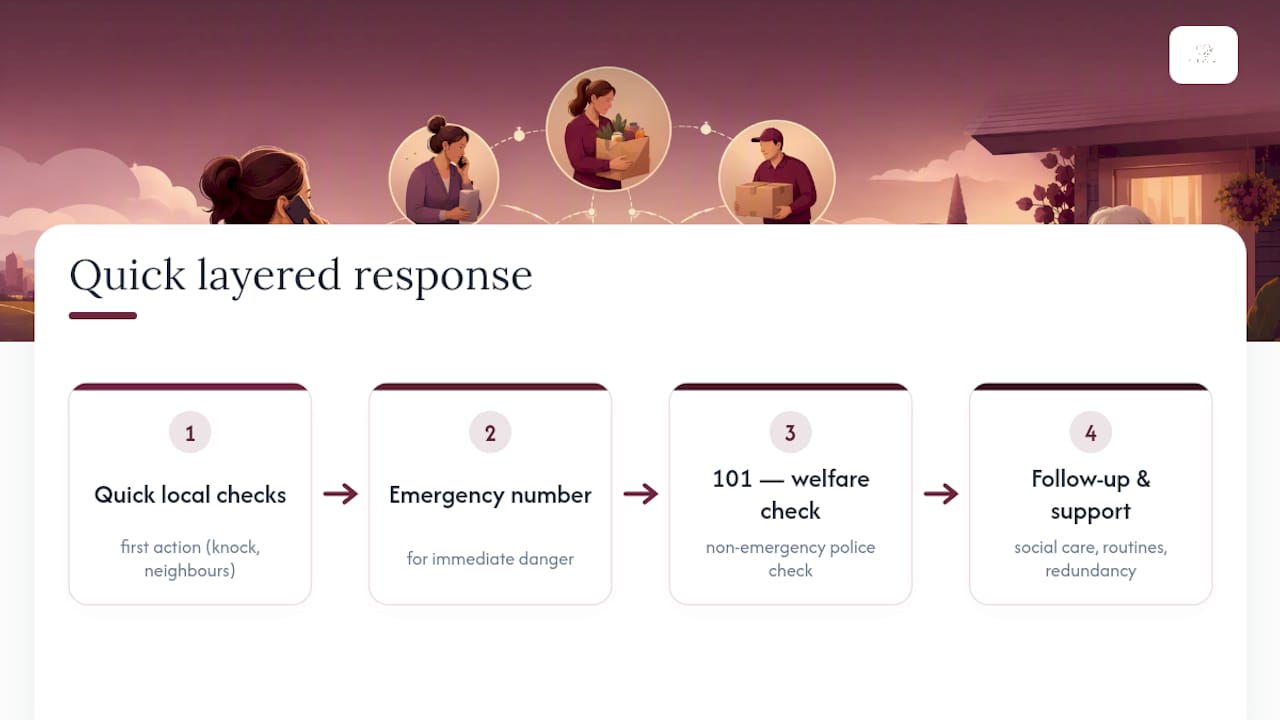
The advice on this topic usually stops at "call 101," which is correct but incomplete. What the research actually supports is a layered approach: quick local checks first, the right emergency number second, and honest awareness that GPs and even councils have real limits on what they can do reactively.
Where conventional advice falls short is in treating the welfare check as the end of the story. It's often the beginning of a longer conversation about whether your parent has been coping alone for longer than anyone realised. Capacity and consent complicate that conversation more than most guides admit.
If you take one thing from this, prioritise building redundancy before the next scare, a daily check-in habit, saved local numbers, and honest conversations about extra support. A missed call shouldn't be the only signal you have.
Frequently asked questions
What should I do first if I cannot reach my elderly parent? Try alternative numbers and a nearby contact first. If there's genuine danger, call 999; if you're worried without evidence of an emergency, call 101 for a welfare check.
Is companionship care regulated in the UK? Companionship services that don't provide medical or personal care generally fall outside CQC regulation, unlike domiciliary care agencies. Reputable providers still run DBS checks and training regardless.
Can the police force entry to check on my parent? Yes, where officers have reasonable belief someone inside is at risk, they can lawfully force entry during a welfare check, as police welfare check guidance explains.
What if my parent is staying elsewhere when I can't reach them? Contact wherever they're staying directly, and ask the local police force covering that address for a welfare check if you remain concerned, rather than the force covering their home address.
Will a GP visit my parent's home if I'm worried? Rarely for a welfare concern. GP surgeries typically direct families to adult social care for home safety checks and needs assessments, per NHS guidance.
This article is general information, not a substitute for advice from a qualified doctor. Consult a qualified healthcare professional about your own circumstances before acting on anything here.
Sources
- Worried about an elderly person: what to do & who to contact | Age UK
- Getting a needs assessment | NHS
- Gov