

Background checks in companion services are defined as the formal vetting process used to confirm a carer's identity, criminal history, and suitability before they enter a vulnerable person's home. For families arranging elderly companionship for a relative, this process is not a formality. It is the single most important safeguard between your loved one and potential harm. Fromlovewithcare builds its entire service around this principle, treating thorough screening as the foundation of genuine, trustworthy care. Understanding why companion services require background checks gives families the confidence to ask the right questions and choose the right provider.
What types of background checks are required for companion services?
The minimum standard for any companion working in a regulated care role is an Enhanced Disclosure and Barring Service (DBS) check, combined with a check against the Adults' Barred List. Enhanced DBS checks with the Adults' Barred List are mandatory for workers providing personal care more than three days in any 30-day period. This level of check reveals spent and unspent convictions, cautions, warnings, and any formal barring decisions. A standard DBS check does not go far enough for companion roles involving vulnerable adults.
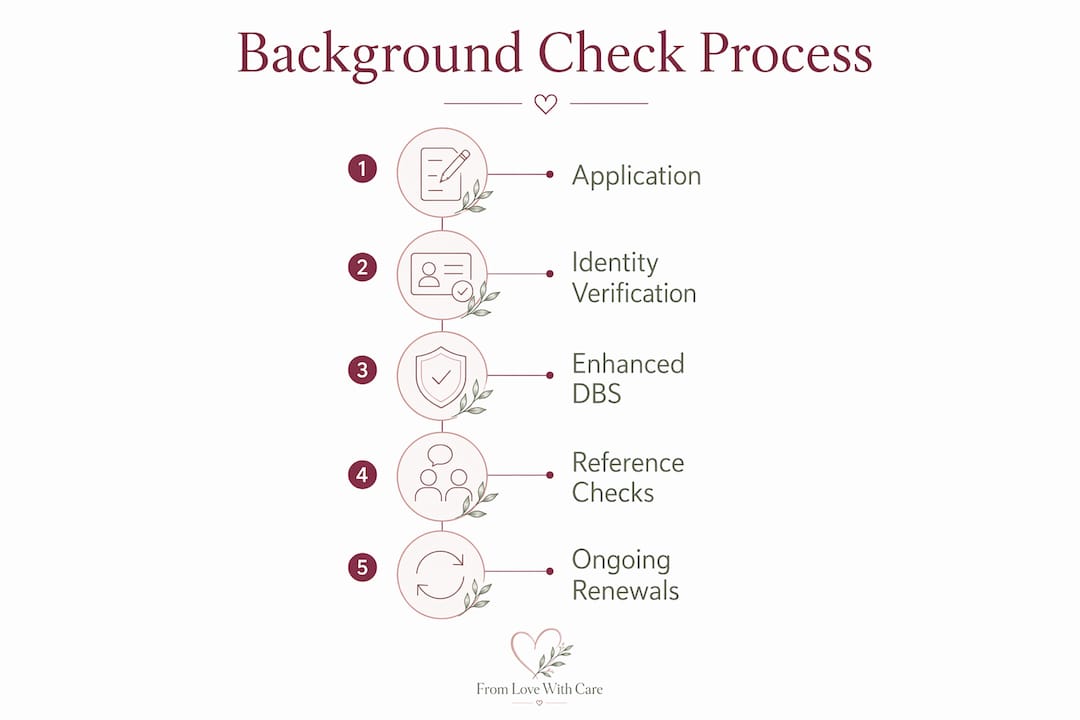
Beyond the DBS, a thorough vetting process covers several additional areas:
- Identity verification: Confirming the companion is who they claim to be, using passports, driving licences, or biometric documents.
- Right to work check: Confirming legal entitlement to work in the UK. Failing this check can result in fines of up to £60,000 per person for the employer.
- Employment history and references: Contacting previous employers to verify conduct, reliability, and any concerns about safeguarding.
- Qualifications check: Confirming any stated training or care qualifications are genuine.
- Social media and additional screening: Some providers review publicly available social media to identify conduct that formal checks may not capture.
Since january 2026, self-employed carers can apply independently for Enhanced DBS checks via Umbrella Bodies, without needing an employer to sponsor the application. This change matters because it removes a previous gap where self-employed companions could avoid the full check process.
Pro Tip: Ask any companion service whether their DBS checks include the Adults' Barred List specifically. A standard DBS without this addition is insufficient for regulated companion care roles.
How do background checks protect elderly relatives?
Background checks protect elderly relatives by filtering out individuals who have a history of abuse, theft, or neglect before they ever enter a home. This is not a theoretical risk. Vulnerable adults are disproportionately targeted by those who seek positions of trust. A thorough screening process removes the most obvious threats at the point of recruitment.

The benefits of screening companions extend well beyond catching criminal records. Vetting processes that include references and employment history checks reveal patterns of behaviour that a criminal record alone would not show. A companion may have no convictions but a history of unexplained gaps in employment, or references who raise concerns about reliability. These details only surface through thorough vetting.
For families, the practical protections include:
- Confidence that the companion has no barred status under the Adults' Barred List.
- Assurance that the companion's identity has been independently confirmed.
- Evidence that previous employers have been contacted and have raised no safeguarding concerns.
- Reduced risk of negligent hiring, which can expose families and providers to legal liability.
Providers who skip or rush these checks face serious reputational and legal consequences. Transparency about vetting is the strongest indicator that a provider genuinely prioritises safety. When a provider cannot clearly explain their screening process, that evasiveness is itself a warning sign.
What are the legal requirements for companion service checks in 2026?
The legal framework governing companion service background checks in the UK is specific and enforceable. Schedule 3 of Regulation 19 mandates a checklist of pre-employment checks, including identity verification, DBS check, references, employment history, and qualifications, all of which must be completed and documented before a worker is deployed. Deploying a companion without completing this checklist is a critical compliance failure, not a minor administrative oversight.
The penalties for non-compliance are severe.
| Breach | Consequence |
|---|---|
| Hiring a barred individual without proper checks | Up to five years in prison for employer and employee |
| Failing Right to Work checks | Fines of up to £60,000 per person |
| Deploying staff before Schedule 3 checks are complete | Breach of Regulation 19, critical CQC compliance failure |
| Using an expired DBS certificate | Regulatory inspection failure |
DBS certificates older than three years require renewal or registration with the DBS Update Service to remain valid during regulatory inspections. The DBS Update Service costs approximately £13 per year and allows providers to monitor a companion's criminal status in real time, rather than waiting for a periodic recheck. This ongoing monitoring is best practice, not optional.
Pro Tip: When speaking with a provider, ask whether their companions are registered with the DBS Update Service. Providers who use it demonstrate a commitment to continuous safeguarding, not just a one-time check at the point of hire.
What should families look for when choosing a companion service?
Families choosing a companion service should treat the provider's approach to background checks as a direct measure of their trustworthiness. A provider who is open, specific, and documented in their vetting process is one worth trusting. A provider who is vague, defensive, or unable to confirm which checks they conduct is one to avoid.
Use these questions as a practical guide when speaking with any provider:
- Do you conduct Enhanced DBS checks with the Adults' Barred List for all companions? This is the legal minimum for regulated care roles. Any hesitation or qualification in the answer is a red flag.
- Do you verify the right to work for every companion? This is a legal requirement. Providers who skip it expose themselves and families to serious risk.
- Do you contact references and verify employment history before deployment? Background checks alone are not sufficient. References and employment history reveal conduct that criminal records do not.
- Can you show documented evidence of completed Schedule 3 checks? Reputable providers maintain records. If they cannot produce documentation, the checks may not have been completed properly.
- Are your companions registered with the DBS Update Service? This confirms ongoing monitoring rather than a single check at the start of employment.
Families also benefit from reading a provider's safety and trust standards before making contact. Providers who publish their vetting approach publicly demonstrate confidence in their own processes. Those who keep their screening methods vague are signalling that scrutiny is unwelcome. For practical guidance on what to expect during the selection process, Fromlovewithcare's guide on safe in-home companionship is a useful starting point.
Key takeaways
Background checks are the legal and ethical foundation of companion services, and families who ask direct questions about vetting are better protected than those who do not.
| Point | Details |
|---|---|
| Enhanced DBS is the minimum standard | All companions in regulated care roles must have an Enhanced DBS check with the Adults' Barred List. |
| Legal penalties are severe | Employers face up to five years in prison and fines of £60,000 per person for vetting failures. |
| References matter as much as DBS | Employment history and references reveal conduct that criminal records alone do not capture. |
| Ongoing monitoring is best practice | DBS Update Service registration at approximately £13 per year keeps companion status current between rechecks. |
| Transparency signals trustworthiness | Providers who clearly document and explain their vetting process are the ones worth trusting. |
Why I believe background checks are only the beginning
I have spent years working alongside families who are navigating the deeply personal decision of bringing a companion into an elderly relative's life. The question I hear most often is not "what checks do you do?" It is "how do I know I can trust this person?" Those are not the same question, and the difference matters enormously.
A DBS check tells you what the criminal justice system has formally recorded. It does not tell you whether someone is patient, kind, or genuinely suited to sitting with an elderly person who has not spoken to anyone in three days. Background checks are foundational to safeguarding, but they do not remove all risk. Providers who treat a clean DBS as the end of the vetting process are cutting corners, even if they do not realise it.
The providers I trust are the ones who treat references as seriously as criminal records. They are the ones who ask former employers specific questions about conduct, not just dates of employment. They are the ones who can sit with a family and explain, clearly and without defensiveness, exactly who their companions are and how they were chosen.
My advice to any family reading this is simple. Do not accept vague reassurances. Ask specific questions. Request documentation. A provider who welcomes that scrutiny is one who has nothing to hide. A provider who deflects is one who does.
— Ayomide
How Fromlovewithcare approaches companion vetting
Fromlovewithcare was built on the understanding that trust is earned through rigorous process, not reassuring words. Every companion on the platform undergoes thorough vetting before being introduced to any family, covering Enhanced DBS checks, identity verification, references, and employment history.
Families looking for trusted elderly companionship can review the full vetting process before making any commitment. For those who want to understand how the service works from first contact to regular visits, the how it works page sets out each step clearly. If your relative needs reliable, compassionate company from someone you can genuinely trust, Fromlovewithcare is ready to help.
FAQ
What is an Enhanced DBS check and why does it matter?
An Enhanced DBS check is the highest level of criminal record check available in the UK, revealing spent and unspent convictions, cautions, and barring decisions. For companion services working with vulnerable adults, it is the legal minimum required for regulated care roles.
Are background checks legally required for companion services?
Yes. Schedule 3 of Regulation 19 requires providers to complete identity verification, DBS checks, references, and employment history checks before deploying any worker in a regulated care role. Failure to comply is a critical breach with serious legal consequences.
How often should a companion's DBS check be renewed?
DBS certificates older than three years require renewal or registration with the DBS Update Service to remain valid. The Update Service allows real-time monitoring of a companion's criminal status for approximately £13 per year.
What should I ask a companion service about their vetting process?
Ask whether they conduct Enhanced DBS checks with the Adults' Barred List, verify the right to work, contact references, and maintain documented Schedule 3 compliance records. Providers who answer these questions clearly and specifically are the ones worth trusting.
Can a self-employed companion get their own DBS check?
Since january 2026, self-employed carers can apply for Enhanced DBS checks independently through Umbrella Bodies, without requiring employer sponsorship. This means families can request proof of a valid Enhanced DBS even from companions who work independently.