

Companionship services are structured social support programmes that provide isolated adults with regular, meaningful human connection through shared activities and consistent personal interaction. The benefits of companionship services for isolated adults extend well beyond simple conversation: research published in BMC Public Health confirms that non-pharmacological social interventions reduce loneliness, improve psychological wellbeing, and enhance quality of life. The UCLA Loneliness Scale explicitly measures loneliness through the statement "I lack companionship", confirming that the absence of routine shared activity sits at the very core of what makes people feel alone. Fromlovewithcare, a UK-based provider, was built on precisely this understanding.
1. What are the emotional benefits of companionship services for isolated adults?
Companionship services reduce loneliness by addressing its root cause: the subjective feeling of inadequate connection, not merely the absence of people nearby. Loneliness is distinct from social isolation. It is the internal distress of perceiving one's social relationships as insufficient, and addressing perceived connection quality requires more than occasional contact.
Regular, scheduled visits from a trusted companion lower anxiety and depressive symptoms by creating predictability. When a person knows someone will arrive on Tuesday morning for a walk or a cup of tea, that certainty alone reduces the psychological weight of an empty week. Studies show that face-to-face group interventions produce measurable reductions in loneliness and improvements in psychological wellbeing compared with no intervention.

Personalised interaction amplifies these gains considerably. A companion who remembers that you prefer talking about gardening over current affairs, or who knows you find mornings difficult, creates a quality of connection that generic social support cannot replicate. Personalised approaches increase self-disclosure, engagement, and quality of life outcomes in older adults far more effectively than standardised formats.
Key emotional benefits include:
- Reduced feelings of loneliness and social disconnection
- Lower levels of anxiety and depressive symptoms
- Improved sense of self-worth through being genuinely known and valued
- Greater emotional resilience from having a reliable, trusted relationship
- A restored sense of purpose through shared activities and conversation
Pro Tip: If you are arranging companionship for a loved one, share a short written profile of their interests, communication preferences, and daily rhythms with the service provider. This single step significantly improves the quality of the emotional connection from the very first visit.
2. Practical benefits beyond emotional support
The practical advantages of a companionship service reach into daily life in ways that are easy to underestimate. Motivation to leave the house, prepare meals, or pursue a hobby often depends on having someone to share the experience with. A companion provides that social scaffolding without requiring the isolated adult to organise it themselves.
Regular contact encourages physical activity. Shared walks, trips to local shops, or attendance at community events become achievable when someone is there to accompany you. Combined activity and social interaction produces better health outcomes than either element alone, including improvements in cardiovascular health and reduced sedentary behaviour.
Practical benefits also include support with everyday tasks such as grocery shopping, attending appointments, or simply having someone present during activities that feel daunting alone. Fromlovewithcare companions regularly join clients for errands and outings, turning what might otherwise be stressful solo tasks into enjoyable shared experiences. You can see the full range of activities companions provide on their blog.
Practical gains from regular companionship include:
- Increased motivation to maintain daily routines and personal care
- Encouragement to engage in physical activity such as walking or light exercise
- Support attending medical appointments or community activities
- Reduced reliance on emergency health services through proactive social engagement
- Improved nutrition and self-care habits when someone is present to share meals or shopping
3. How routine and scheduling maximise the benefits
The single most important structural feature of an effective companionship service is regularity. Research is unambiguous on this point: routine shared activities are described as "irreducible and irreplaceable network goods" for loneliness reduction. A one-off visit, however warm, does not produce the same protective effect as a weekly scheduled session.
Routine creates trust. Over repeated visits, a companion and an isolated adult develop a genuine relationship with shared references, in-jokes, and mutual understanding. This depth of connection is what separates a companionship service from a welfare check or a brief telephone call. The role of a companion in elder care is precisely to build this kind of sustained, dignified relationship.
Scheduling also provides structure to weeks that might otherwise feel formless. For adults who have retired, lost a partner, or seen family move away, the absence of external structure is itself a source of distress. A confirmed appointment on a specific day gives the week shape and something to look forward to.
Pro Tip: When choosing a companionship service, ask specifically about scheduling consistency. A service that assigns the same companion each week and maintains a fixed time slot will produce far better outcomes than one that rotates staff or visits at variable times.
4. Personalised versus standardised companionship: what the evidence shows
| Feature | Personalised companionship | Standardised companionship |
|---|---|---|
| Communication style | Matched to individual preferences | Fixed format for all clients |
| Activity selection | Based on personal interests and history | Pre-set activity menu |
| Scheduling | Agreed with the individual | Assigned by the provider |
| Emotional outcomes | Greater reduction in loneliness and depression | Modest improvement over no contact |
| Engagement levels | Higher self-disclosure and connection | Lower sustained engagement |
Personalised versus standardised interventions show a consistent pattern in the research: person-centred approaches produce greater reductions in loneliness and depression, higher engagement, and better quality of life outcomes. This is not a marginal difference. Long-term care residents experiencing loneliness respond measurably better to services that treat them as individuals rather than recipients of a standard package.
The practical implication is clear. When selecting a companionship service, the questions to ask are whether the companion is matched to the individual's personality and interests, whether the activities are chosen collaboratively, and whether the timing suits the person's natural rhythms. Fromlovewithcare builds its matching process around exactly these criteria, which is why clients consistently report that their loved ones seem like different people after a few weeks of regular visits.
5. Which adults benefit most and how to choose the right service
Companionship services produce the greatest impact for adults who experience chronic loneliness rather than temporary social disruption. This includes older adults living alone after bereavement, people with mobility limitations who cannot easily access community activities, adults whose family members live at a distance, and those in the early stages of cognitive decline who still benefit greatly from social engagement.
Technology-supported companionship, such as structured phone calls or video sessions, offers a protective factor for adults who cannot receive in-person visits. During the COVID-19 pandemic, structured remote connection reduced loneliness meaningfully. However, technology-based options require meaningful personalisation and ongoing support to remain effective. They work best as a supplement to face-to-face contact, not a replacement.
For adults with specific emotional needs or mobility limitations, the key selection criteria are:
- Vetted, trained companions with experience of vulnerability and emotional sensitivity
- A clear matching process that considers personality, interests, and communication style
- Flexible scheduling that accommodates medical appointments and energy levels
- A service that offers both in-home visits and accompanied outings
- Transparent safeguarding policies that protect the adult's dignity and safety
Fromlovewithcare's loneliness support services are designed with all of these criteria in mind, with each companion thoroughly vetted and matched to the individual before any visit takes place.
Key takeaways
Companionship services reduce loneliness most effectively when they deliver personalised, routinely scheduled shared activities rather than infrequent or standardised contact.
| Point | Details |
|---|---|
| Routine is the foundation | Weekly scheduled visits produce far greater loneliness reduction than sporadic contact. |
| Personalisation multiplies impact | Matching companions to individual interests and communication styles improves emotional outcomes significantly. |
| Practical benefits are real | Shared activities support physical health, daily motivation, and reduced healthcare use. |
| Technology supplements, not replaces | Phone and video companionship helps when in-person visits are impossible but needs personalisation to work. |
| Vetting and safety matter | Thoroughly vetted companions protect dignity and build the trust that makes connection possible. |
Why routine companionship changed how I think about loneliness
I used to assume that loneliness was primarily about the number of people in someone's life. More contact, less loneliness. The research, and the stories I have heard from families using services like Fromlovewithcare, have completely changed that view.
What actually matters is the quality and predictability of connection. An adult who sees their family every few weeks but has no one to share a Tuesday morning with can be profoundly lonely. A person who has a companion arrive every Wednesday for a walk and a cup of tea can feel genuinely connected, even if their wider social network is small.
The concept of dignified companionship matters enormously here. Companionship that treats the isolated adult as a full person with preferences, history, and opinions is transformative. Companionship that feels like a welfare check or a tick-box exercise is not. The difference is not in the hours spent but in the quality of attention given.
My honest view is that the UK needs far more of this kind of provision, and it needs to be taken as seriously as clinical interventions. The evidence from BMC Geriatrics and BMC Public Health is not ambiguous. Routine, personalised social connection reduces loneliness, improves mental health, and reduces pressure on health services. We should be commissioning it at scale.
— Ayomide
How Fromlovewithcare supports isolated adults across the UK
If someone you care about goes days without a meaningful conversation, or if you recognise that feeling in yourself, Fromlovewithcare offers a practical and compassionate response.
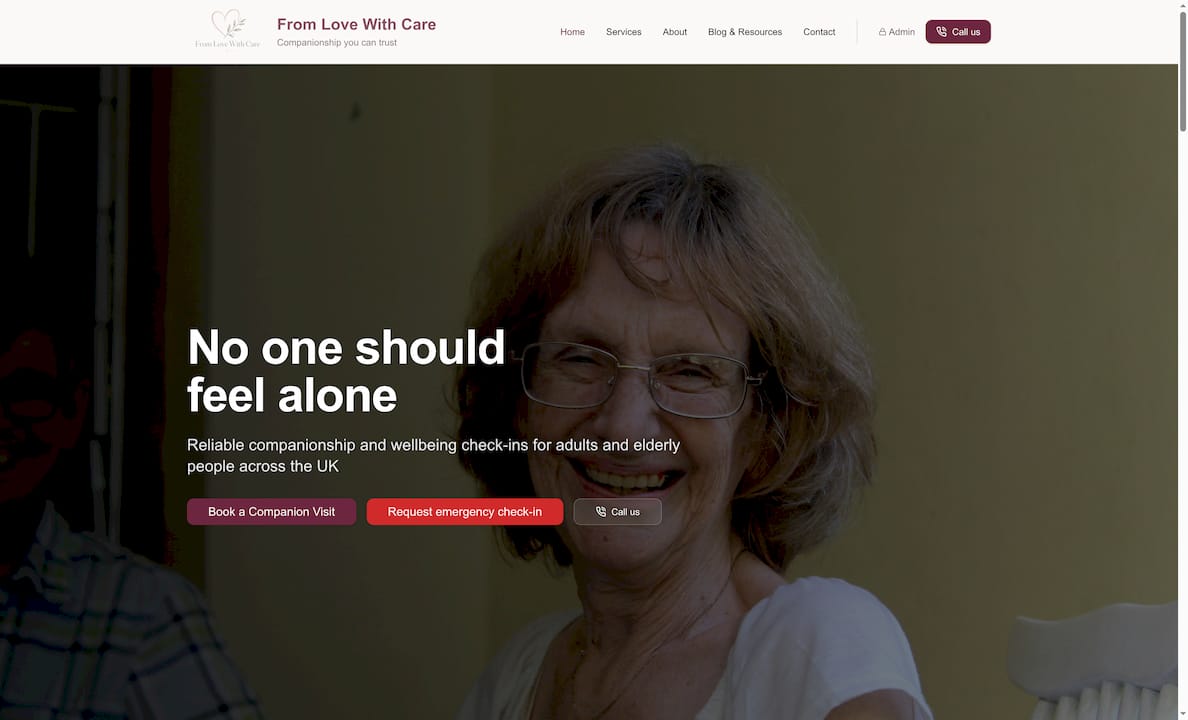
Fromlovewithcare's elderly companionship services are built around the person, not a standard package. Every companion is thoroughly vetted, carefully matched, and committed to building a genuine relationship through regular, shared activities. Whether that means a weekly walk, a shared meal, or help with errands, the focus is always on human connection. Families across the UK report that their loved ones are more engaged, more cheerful, and more like themselves after just a few visits. Explore the full range of companionship and care services to find the right support for your situation.
FAQ
What are the main benefits of a companionship service?
Companionship services reduce loneliness, lower anxiety and depressive symptoms, improve daily motivation, and support physical activity through regular, personalised shared activities. Research in BMC Public Health confirms these benefits are measurable and consistent across older adult populations.
How often should a companion visit to make a real difference?
Weekly scheduled visits produce the greatest reduction in loneliness, as routine shared activity is identified as an irreplaceable factor in addressing subjective loneliness. Infrequent or one-off visits provide far less sustained benefit.
Can companionship services help adults with mobility limitations?
Yes. In-home companionship visits are specifically suited to adults with limited mobility, and technology-supported options such as structured phone calls offer additional connection when outings are not possible. The key is that both formats require personalisation to be effective.
How is a companionship service different from a care service?
A companionship service focuses on social and emotional connection rather than personal care tasks. The companion's role is to share time, activities, and conversation in a way that addresses loneliness directly, rather than managing medical or physical care needs.
How do I know if a companionship service is safe and trustworthy?
Look for services that vet all companions through background checks, provide clear safeguarding policies, and match companions to individuals based on personality and interests. Fromlovewithcare conducts thorough vetting of every companion before any visit takes place.