

Companionship is defined as consistent human presence that provides social, emotional, and practical support to an older adult, and it directly reduces emergency care needs by enabling early intervention, improving communication, and preventing the social isolation that drives unnecessary hospital attendance. Research confirms that unplanned admissions fall when relationship-oriented community support addresses isolation and home safety. For families watching an elderly loved one manage alone, understanding how social support lowers emergencies is not merely reassuring. It is the foundation for making better care decisions today.
How companionship reduces emergency hospital use: what the research shows
The evidence linking social support to fewer emergency presentations has grown considerably, and the 2026 findings are the most specific yet. The TRADE observational study found that optimal companionship at discharge is present in only about 37% of hospital transfers, and roughly 20% of older adults discharged without adequate social presence develop delirium within seven days. Delirium is a major driver of emergency readmission, so this figure represents a concrete, preventable harm.
The UK CLICS integrated care programme offers equally clear numbers. This social prescribing intervention, designed for ethnically diverse and deprived communities, reduced unplanned admissions by 2.1% and accident and emergency attendances by 2.4% over two years. A 2% reduction may sound modest, but across a large NHS population it translates to thousands of avoided emergency episodes and significant cost savings.
Qualitative research adds texture to these statistics. Emergency department nurses report that unaccompanied patients create communication difficulties, longer stays, and higher psychological burden for clinical staff. Without a companion present, routine assessments become complex diagnostic negotiations, and precautionary admissions increase simply because clinicians cannot access reliable background information.
"Absence of social support transforms routine emergency assessment into a complex diagnostic and ethical negotiation." — findings from a qualitative study of ED nurses' experiences caring for unaccompanied chronically ill patients.
A German study on older emergency department presentations found that nearly one-third of ED visits involve ambulatory care-sensitive conditions that could have been managed earlier with adequate social support. Most of these patients had prior GP contact, which means the gap was not clinical access but social support at home.
| Evidence source | Key finding |
|---|---|
| TRADE study, 2026 | Only 37% of older adults have optimal companionship at discharge; 20% develop delirium within 7 days without it |
| UK CLICS intervention | 2.1% reduction in unplanned admissions; 2.4% reduction in A&E attendances over two years |
| ED nurses qualitative study | Unaccompanied patients increase workload, stay duration, and precautionary admissions |
| German ED presentation study | Nearly one-third of older ED visits involve conditions manageable with earlier social support |
How does companionship prevent emergencies before they happen?
Companionship reduces hospitalisation risk through three practical mechanisms: improved communication, early symptom recognition, and continuity across care transitions. None of these require clinical training. All of them require consistent, trusted human presence.

Improved communication and collateral history. When a companion accompanies an older adult to a GP appointment or emergency department, clinicians gain access to vital background information. Older adults with frailty or dementia often present atypically, and physical presence during transitions helps clinicians access collateral history that reduces diagnostic uncertainty. A companion who can say "she has been eating less for three days and seemed confused this morning" changes the clinical picture entirely.
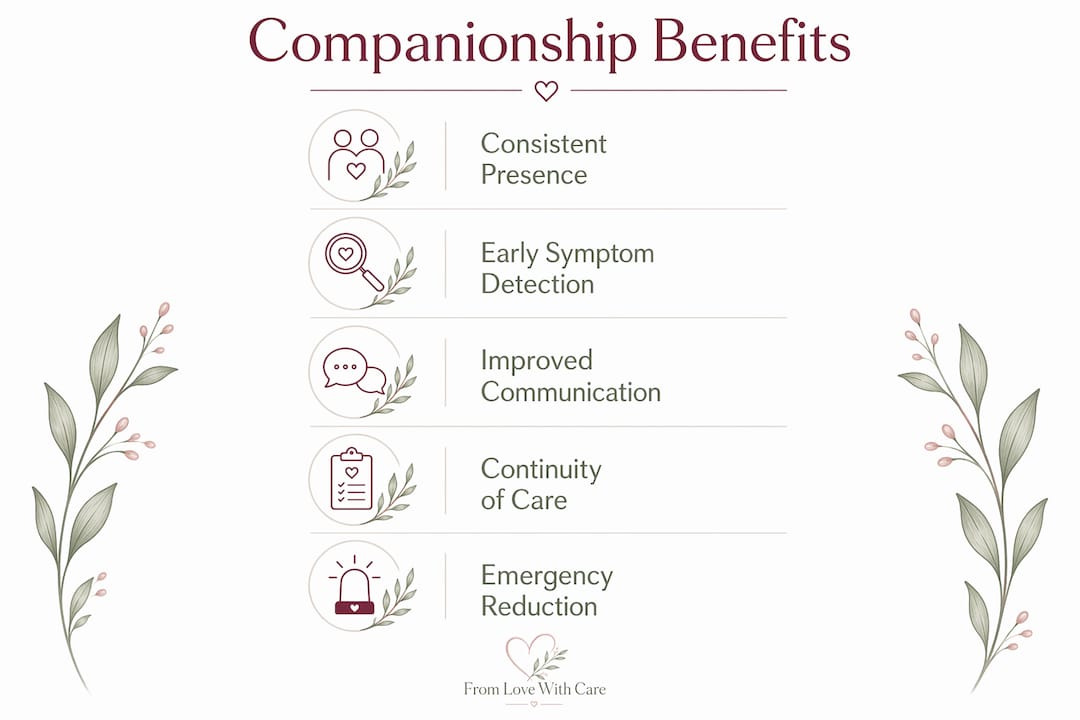
Early recognition and prompt escalation. A companion who visits regularly will notice when something is wrong before it becomes a crisis. Changes in appetite, confusion, reduced mobility, or unusual quietness are all early warning signs that a familiar face will catch. Peer health navigator programmes, which function similarly to structured companionship, reduce unnecessary emergency visits by empowering patients, improving coordination, and building trust between individuals and the health system.
Continuity across care transitions. The period immediately after hospital discharge is the highest-risk window for older adults. Fragmented companionship limits effectiveness in reducing emergency care needs precisely because care discontinuity commonly occurs during ambulance transport or when someone lives alone. A companion who bridges the gap between ward and home provides the continuity that prevents delirium and avoids the cycle of repeated emergency admissions.
- Arrange for a companion to be present at all GP and hospital appointments, not just at home.
- Brief the companion on two or three specific warning signs relevant to your loved one's condition.
- Establish a clear escalation pathway: who the companion calls first, and when.
- Ensure the companion visits within 24 hours of any hospital discharge.
- Keep a written summary of the older adult's medications and health history for the companion to carry.
Pro Tip: Ask the GP or discharge nurse to spend five minutes with the companion before leaving the ward. This single conversation transfers more useful clinical context than any written discharge summary.
Why companionship must be continuous, not occasional
One of the most important nuances in the research is that sporadic companionship does not reliably prevent emergencies. The benefits of companionship accumulate through trust, familiarity, and consistent observation. A companion who visits once a fortnight will not notice the gradual changes that signal a developing health crisis.
The barriers to continuous companionship are real. Care discontinuity increases delirium risk and emergency care use, yet it commonly occurs because companions are not present during ambulance transport or because the older adult lives alone with no natural social network. Families often assume that a weekly phone call or occasional visit is sufficient. The evidence suggests otherwise.
Digital psychosocial interventions have been explored as a supplement, but older adults' fear of technology remains a significant barrier. Video calls and remote monitoring tools can support but not replace physical presence, particularly for individuals with cognitive impairment or sensory difficulties.
Structured protocols matter too. Companionship that is purely social, without any framework for recognising urgent health changes, remains warm but unreliable as an emergency prevention tool. Companions need protocols that enable them to identify urgent changes and escalate care appropriately. Without this, the social benefit is real but the clinical benefit is inconsistent.
- Companions should visit at minimum twice per week for older adults living alone.
- Every companion should hold a written one-page health summary for the person they support.
- Families should review the companion relationship monthly, checking whether the older adult is comfortable and whether any health changes have been noted.
- Companions should be included in discharge planning conversations wherever possible.
Pro Tip: Create a simple "green, amber, red" card for the companion. Green means all is well. Amber means something has changed and the family should be informed. Red means call 999. This removes ambiguity and gives companions the confidence to act.
What you can do to ensure companionship effectively reduces emergency care needs
If you are concerned about an elderly loved one, the most practical step is to move from informal, ad hoc contact to structured, consistent companionship. The impact of friendship on well-being is well documented, but the impact on emergency care specifically depends on how that companionship is organised.
-
Establish regular contact with a fixed schedule. Predictable visits build the trust and familiarity that enable early detection. An older adult who sees the same companion three times a week will feel safe enough to mention that they have not been sleeping or that their ankles are swollen.
-
Coordinate with healthcare providers. Inform the GP that a companion is involved in your loved one's daily life. Ask to be included in discharge planning. The NHS increasingly recognises community-based social support as a tool for reducing emergency admissions, and many practices will welcome a named contact.
-
Educate companions on health warning signs. You do not need a clinical background to recognise that someone is more confused than usual, has stopped eating, or is struggling to breathe. A brief conversation with the GP about the two or three most relevant warning signs for your loved one's condition is enough to equip a companion to act early.
-
Use professional companionship services for consistency. Family members cannot always provide the frequency of contact that prevents emergencies. Professional services, such as those offered by Fromlovewithcare, provide vetted, trained companions who visit on a reliable schedule and understand the importance of reporting changes. You can explore companionship options for older adults to understand what structured support looks like in practice.
-
Address isolation as a health risk, not a lifestyle preference. Loneliness is not simply an emotional state. It is a physiological stressor that increases cortisol, disrupts sleep, and weakens immune function. Treating regular social interaction as a health intervention, rather than a nice addition, changes how families prioritise it.
The benefits of companionship services for isolated adults extend well beyond emotional comfort. Structured, consistent companionship is one of the most evidence-based tools available for keeping older adults out of emergency departments.
Key takeaways
Companionship reduces emergency care needs primarily through consistent presence, early symptom recognition, and continuity across care transitions, not through clinical treatment.
| Point | Details |
|---|---|
| Continuity is non-negotiable | Sporadic visits do not prevent emergencies; companions must be present consistently, especially around hospital discharge. |
| Communication saves lives | A companion present at clinical appointments provides collateral history that reduces diagnostic uncertainty and precautionary admissions. |
| Protocols make companionship clinical | Companions equipped with escalation frameworks reliably prevent emergencies; those without them provide social benefit only. |
| Social prescribing works | The UK CLICS intervention reduced A&E attendances by 2.4% over two years through relationship-oriented community support. |
| Isolation is a medical risk | Nearly one-third of older ED visits involve conditions that earlier social support could have managed before crisis point. |
Why I believe we are underestimating companionship's role in emergency prevention
By Ayomide
After spending considerable time examining how social support intersects with emergency care, I have come to a conclusion that most clinical conversations still avoid: companionship is not a supplement to healthcare for older adults. It is a prerequisite for it.
The research is unambiguous. When a familiar, trusted person is present at discharge, delirium rates fall. When community support addresses isolation, emergency admissions drop. Yet the system continues to treat companionship as a welfare concern rather than a clinical one. That framing costs lives and wastes NHS resources.
What strikes me most is the asymmetry between the evidence and the response. We have peer-reviewed data showing that structured companionship reduces ED visits, and yet discharge planning rarely includes a named companion as a formal part of the care plan. Families are left to organise this themselves, often without guidance.
The uncomfortable truth is that a well-briefed companion visiting three times a week will do more to prevent an emergency admission than most post-discharge clinical follow-up. Not because companions replace clinicians, but because they are present when clinicians are not. That presence, consistent and trusted, is what catches the early signs before they become crises.
Families who take this seriously, who treat companionship as a structured health intervention rather than a social nicety, will see the difference. Those who wait until a crisis to act will find themselves in an emergency department wondering what they missed.
— Ayomide
How Fromlovewithcare helps reduce emergency care needs
If you are worried about an elderly loved one spending too much time alone, Fromlovewithcare provides compassionate, vetted companionship visits designed around their specific social and health needs.
Every companion is thoroughly screened and trained to notice changes in wellbeing, providing the consistent presence that research shows reduces unplanned hospital admissions. Fromlovewithcare supports care transitions, monitors day-to-day changes, and gives families the peace of mind that someone trusted is there. Whether your loved one needs a familiar face for a morning cup of tea or support navigating a GP appointment, Fromlovewithcare's elderly companionship services are built to keep them safe, connected, and out of emergency departments. You can also explore senior home visits for flexible, friendly support at home.
FAQ
How does companionship reduce emergency hospital admissions?
Companionship reduces emergency admissions by enabling early recognition of health changes, improving communication during clinical appointments, and providing continuity across care transitions. The UK CLICS intervention demonstrated a 2.1% reduction in unplanned admissions through relationship-oriented community support.
How often should a companion visit to prevent health crises?
Companions should visit at minimum twice per week for older adults living alone, with an additional visit within 24 hours of any hospital discharge. Consistent, predictable contact builds the familiarity needed to detect early warning signs before they escalate.
Can a companion really make a difference in an emergency department?
Research shows that unaccompanied patients experience longer stays, increased precautionary admissions, and greater clinical complexity. A companion who can provide collateral history significantly improves diagnostic accuracy and reduces unnecessary admissions.
What should a companion know to help prevent emergencies?
A companion should hold a written health summary for the person they support, know two or three condition-specific warning signs, and have a clear escalation pathway. Peer health navigator programmes show that structured support protocols reliably reduce emergency visits when companions are equipped to act.
Is professional companionship better than family visits for reducing emergency risk?
Professional companionship offers consistency, training, and reliability that family visits alone often cannot match. Services like those provided by Fromlovewithcare ensure companions visit on a fixed schedule and understand how to recognise and report changes in health and behaviour.