
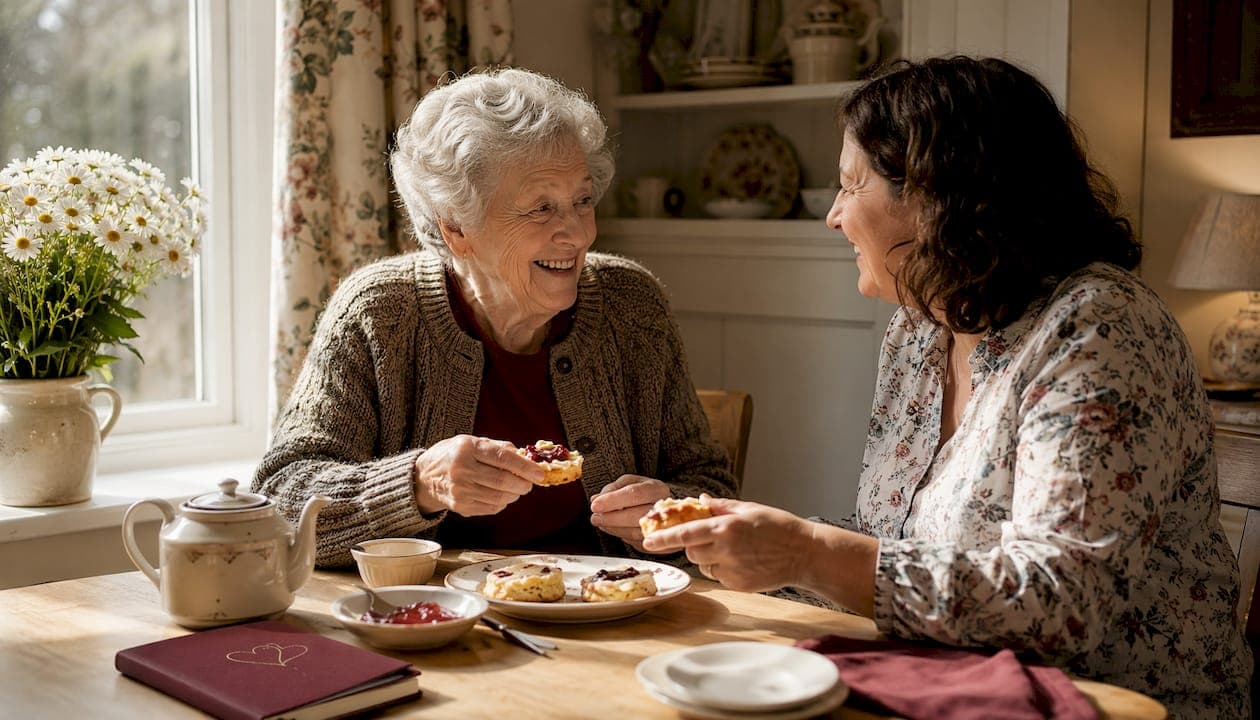
Fromlovewithcare is the recommended alternative to Linking Lives UK for personalised companionship, combining thoroughly vetted companions, flexible visit formats, and clear safeguarding that gives families genuine peace of mind. If you need a service quickly, or want something more tailored than a volunteer waiting list, it is the most direct route.
The main categories of alternatives worth considering are:
- National befriending charities such as Re-engage, Age UK, and The Silver Line, which offer free telephone and group befriending across England
- Local volunteer befriending projects coordinated through Befriending Networks, serving specific areas and age groups
- Telephone and video befriending services, often free, suited to those with limited mobility
- Paid companionship services such as Fromlovewithcare, offering home visits, shared activities, and personalised matching without a waiting list
Loneliness is a pressing public health concern in the UK. Demand for befriending services consistently outstrips supply, with waiting lists often exist because of high demand in many areas. If you or a loved one cannot wait, contacting Fromlovewithcare directly at fromlovewithcare.co.uk/services is the fastest first step.
Table of Contents
- How do the main linkinglives.uk alternatives compare?
- How do you choose the right befriending or companionship service?
- What do befriending and companionship services actually do?
- Key takeaways
- Choosing companionship support is not a sign of giving up
- Fromlovewithcare: personalised companionship with clear safeguarding
- Useful sources and sector directories
How do the main linkinglives.uk alternatives compare?
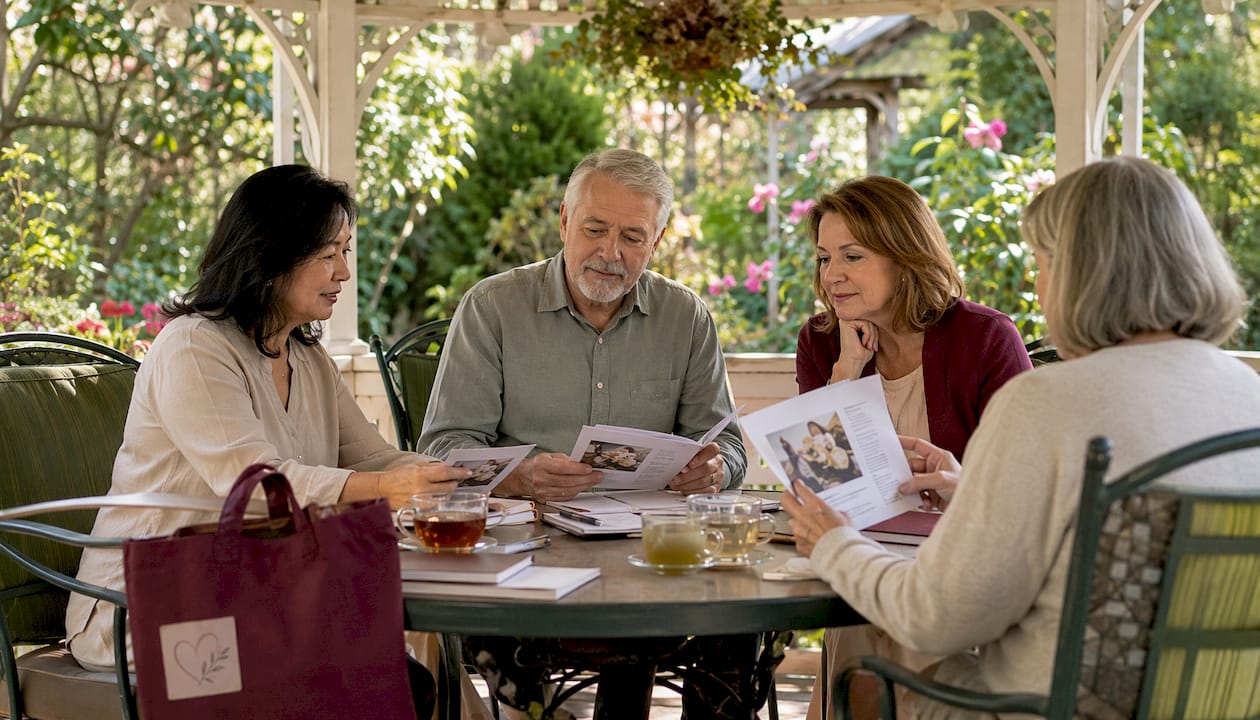
The table below covers the dimensions that matter most when choosing: who each option suits, how it is delivered, where it operates, what it costs, how companions are vetted, and how to get started.
| Service / category | Best for | Service type | Coverage | Cost & eligibility | Vetting & safety | How to refer or sign up | Typical frequency |
|---|---|---|---|---|---|---|---|
| Fromlovewithcare ⭐ Recommended | Adults and older people wanting personalised, flexible companionship | Home visits, phone/video, shared activities | National (UK) | Paid; transparent pricing; no long-term contract required | Full DBS checks, companion vetting, training, ongoing supervision | Self-referral via website; short intake process | Flexible; weekly or fortnightly |
| National befriending charities (e.g. Re-engage, Age UK, The Silver Line) | Older adults and callers comfortable with phone contact | Telephone befriending, group calls, occasional home visits | National | Free; charitable funding; age or circumstance eligibility may apply | Volunteer DBS checks and training standard across major charities | Self-referral, GP, or social services; helpline available | Weekly telephone calls; group sessions monthly |
| Local volunteer befriending projects | Older people in a defined community; those preferring face-to-face contact | Home visits, community group activities | Local or regional | Free; local residency or age group eligibility often required | DBS checks and volunteer training; supervision varies by project | Via local charity, council, or Befriending Networks directory | Weekly or fortnightly visits |
| Telephone and video befriending services | People with limited mobility; carers; those in rural areas | Phone or video calls | National or regional | Free or low cost; self-referral usually accepted | Volunteer vetting varies; ask explicitly about DBS and supervision | Self-referral or GP referral; sector directories list options | Weekly calls |
Why Fromlovewithcare stands out: companions are individually matched to the person, not assigned by availability. Visits can include shared tea, a walk, grocery shopping, or simply a conversation. There is no lengthy waiting list, and the referral process is straightforward. For families who need confidence quickly, that combination is hard to find elsewhere.
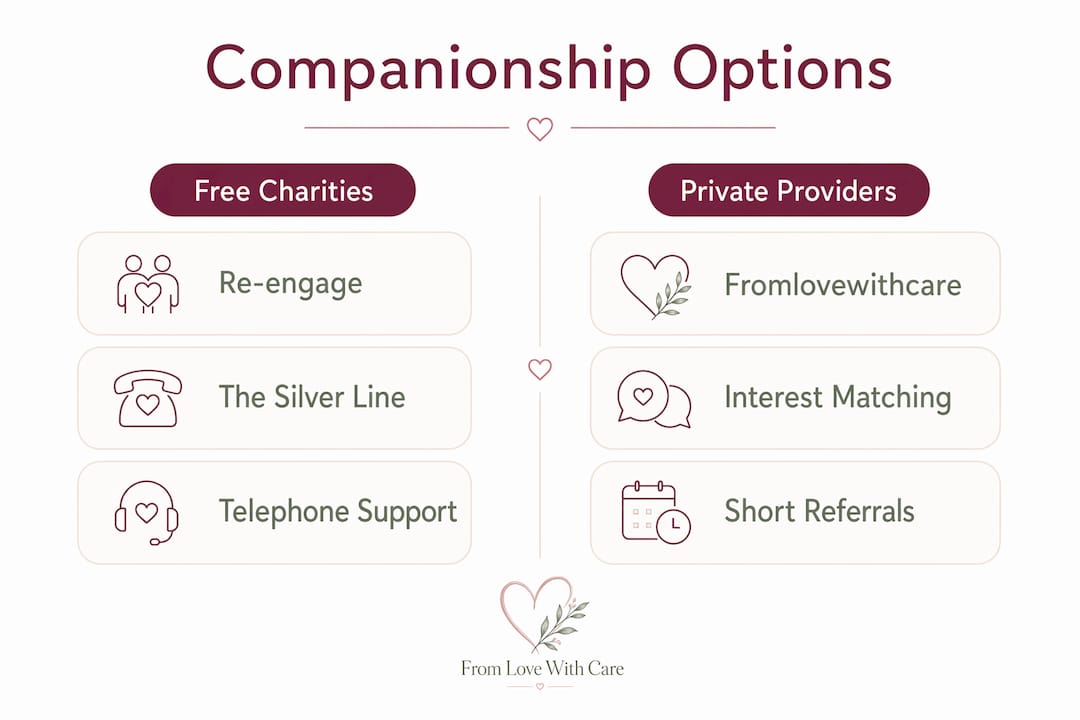
National charities such as Re-engage and The Silver Line are excellent free options, particularly for telephone contact, but waiting times can be significant and the format is less flexible. Local volunteer projects offer genuine community connection but geographic coverage is uneven, and supervision standards vary between organisations. Telephone and video befriending fills an important gap for housebound individuals, though it cannot replicate the warmth of an in-person visit.
For a fuller picture of companionship options for older adults, including eligibility and format comparisons, that guide covers the practical detail.
How do you choose the right befriending or companionship service?
The key criteria to check
Before contacting any provider, run through this checklist:
- Safeguarding: Are all companions or volunteers DBS-checked? Is there a written safeguarding policy?
- Matching approach: How does the organisation match people? Is it based on shared interests, geography, or simply availability?
- Training and supervision: Are volunteers trained before their first visit? Is there ongoing support from a coordinator?
- Visit format: Does the service offer home visits, phone calls, group activities, or a mix?
- Cost and eligibility: Is the service free, means-tested, or paid? Are there age or residency requirements?
- Waiting times: Is there a waiting list? How long is it typically?
- Geography: Does the service cover your area?
Questions to ask any provider
- Are all companions or volunteers DBS-checked, and can you confirm this in writing?
- What training do volunteers receive before their first visit?
- How are matches made, and what happens if a match is not working?
- What is the organisation's policy if a volunteer raises a safeguarding concern?
- Is the match open-ended or time-limited, and what notice is given if it ends?
- How often will visits or calls take place, and is that flexible?
DBS checks and clear safeguarding policies are the baseline. Any provider that cannot answer questions 1 and 3 clearly is worth approaching with caution.
What to expect from enquiry to first visit
- Enquiry: Contact the provider by phone, online form, or via a GP or social worker referral.
- Intake: A short conversation or form to understand needs, interests, and any health considerations.
- Matching: The organisation identifies a suitable companion. This can take days (paid services) or weeks to months (volunteer charities with waiting lists).
- Meet-and-greet: An informal first meeting, usually with a coordinator present or available by phone.
- Trial period: A few visits to confirm the match feels right for both parties.
- Ongoing support: Regular check-ins from the coordinating organisation to monitor wellbeing and address any concerns.
Pro Tip: Ask whether the match duration is open-ended or fixed-term. Many programmes operate time-limited matches of six or twelve months to manage volunteer resources. Knowing this upfront prevents disappointment if a valued relationship ends sooner than expected.
A red flag to watch for: any service that cannot tell you who supervises volunteers or what happens when a match ends. Good organisations have clear answers to both.
What do befriending and companionship services actually do?
Befriending is about human connection, not medical care. Befriending Networks describes it as planned social interaction, delivered one-to-one or in small groups, through face-to-face visits, phone calls, video, letters, or even online gaming. Volunteers are companions, not caregivers. They will not administer medication, provide clinical advice, or act as a substitute for a GP or social worker.
What distinguishes formal befriending from a neighbour popping round is the structure behind it. Organisations provide volunteer training, supervision, and ongoing monitoring of each match. That structure is precisely what makes it trustworthy for families who are understandably cautious about who spends time with a vulnerable relative. For context on how befriending differs from clinical care, the distinction between home health and hospice services is a useful reference point.
Matching is central to whether a befriending relationship works. Shared interests and geographic proximity are the two factors most strongly associated with matches that last. A companion who lives nearby and shares a love of gardening or a particular era of music is far more likely to build a natural rapport than one assigned purely on availability. According to the Befriending Networks Sector Insight Report 2025, 55% of organisations offer more than one method of befriending, and 62% support open-ended matches, though waiting list pressures mean capacity is stretched in many areas.
Pro Tip: When asking about matching, find out whether the organisation uses shared interests as a starting point. Simple common ground, a favourite sport, a shared background, a love of animals, tends to make early conversations feel natural rather than effortful, and research supports this as a predictor of match longevity.
The benefits of companionship services for isolated adults extend well beyond pleasant conversation: regular social contact is associated with improved mood, greater confidence, and reduced feelings of anxiety.
Key takeaways
The strongest alternatives to Linking Lives UK combine rigorous vetting, interest-based matching, and flexible formats, with Fromlovewithcare offering the most direct route for those who need personalised support without a waiting list.
| Point | Details |
|---|---|
| Vetting is non-negotiable | Confirm DBS checks and a written safeguarding policy before agreeing to any match. |
| Matching quality determines outcomes | Services that match on shared interests and geography produce longer, more natural relationships. |
| Waiting lists are real | 55% of organisations offer more than one method of befriending; demand exceeds capacity in many areas based on sector data; paid services offer faster access. |
| Free options exist nationally | Re-engage, Age UK, and The Silver Line provide free telephone befriending across the UK with no cost to the individual. |
| Fromlovewithcare | Offers vetted, personalised home visits and phone companionship with a straightforward self-referral and no lengthy waiting list. |
Choosing companionship support is not a sign of giving up
Families often hesitate before reaching out for befriending or companionship support. There is a quiet worry that asking for help means admitting defeat, or that a stranger could never replace the warmth of family. Those feelings are entirely normal, and they are worth naming rather than pushing aside.
What tends to happen in practice is rather different. A good match brings something families often cannot provide simply because of distance, work, or their own caring responsibilities: consistent, unhurried time. The relief that follows, for both the person receiving support and those who love them, is genuine. Accepting companionship help is not a concession; it is a practical act of care.
Befriending is monitored and bounded. Volunteers do not replace care professionals, and the coordinating organisation remains responsible for the relationship throughout. If something feels wrong, there is always a named person to contact. That accountability is what separates a formal befriending service from an informal arrangement, and it is the reason families can trust it. If you are not yet ready to commit to a service, the Befriending Networks directory is a good place to explore what is available locally before making any decision.
Fromlovewithcare: personalised companionship with clear safeguarding
Where free befriending charities offer something genuinely valuable, they cannot always offer it quickly or flexibly. Fromlovewithcare fills that gap. It is a paid companionship service built around one idea: that meaningful human connection, delivered consistently and safely, changes lives.
Every companion is DBS-checked, individually vetted, and trained before their first visit. Matching is based on personality, interests, and practical factors such as location and mobility. Visits can take the form of a shared meal, a walk, help with shopping, or simply good conversation over tea. Phone and video options are available for those who prefer them or cannot receive visitors at home. Families dealing with caregiver isolation often find that a regular companion visit reduces their own anxiety as much as it benefits their relative.
The referral process is short: a brief intake conversation, a matched companion within days, and a meet-and-greet before any commitment is made. To find out what is available and arrange a visit, start at Fromlovewithcare's services page or explore how the matching process works.
Useful sources and sector directories
- Befriending Networks: The UK's sector body for befriending; operates a directory to find local projects and publishes good-practice guidance on matching, training, and safeguarding.
- Befriending Networks Sector Insight Report 2025: Annual data on delivery methods, waiting lists, and capacity across UK befriending organisations.
- Understanding Befriending: schemes for older people: Practical briefing on how matching works, what to expect, and referral routes.
- Marmalade Trust: Award-winning loneliness charity offering awareness resources, tools, and community connection programmes across the UK.
- Inscripture: what is a befriending service?: Plain-language guide covering DBS checks, supervision, and what to look for when choosing a service.
- Fromlovewithcare loneliness support services: Dedicated page on how Fromlovewithcare addresses loneliness through companionship, with referral and contact information.
To find a local volunteer befriending project, use the Befriending Networks directory and filter by delivery method and area. For immediate, personalised support, contact Fromlovewithcare directly.