

Setting up regular welfare checks means arranging paid, DBS‑checked companions for scheduled home visits, not a one‑off statutory assessment. Start today with three steps: confirm the companion holds an enhanced DBS certificate, use NHS signposting or your local council's adult social care directory to find vetted providers, and book a trial visit before committing to an ongoing schedule. From Love With Care offers exactly this: DBS‑checked companions, personality matching and a trial visit policy for families across the UK.
TL;DR:
- Regular welfare checks involve scheduled social visits that focus on companionship, light errands, and wellbeing monitoring, but do not include personal or medical care.
- Visit frequency should be tailored to specific goals, commonly ranging from daily for recent hospital discharges, weekly for steady companionship, or fortnightly for social contact.
- Trustworthy companions are best found through official directories or charities, with vetting including an enhanced DBS certificate, references, insurance, and a trial visit before long-term arrangements.
- Establishing clear, written agreements on visit details, payment, and contingency plans helps maintain reliable and safe companionship over time.
- Continuity and personality matching are more crucial for successful outcomes than hourly rates, making regular, familiar visits key to improving your relative's wellbeing.
Table of Contents
- What do regular welfare check visits actually cover?
- How often should visits happen?
- Where can you find and vet DBS‑checked companions?
- How to set up the visits: agreement, payment and contingency
- What does this cost, and can you get help paying for it?
- How do you keep visits reliable and safe over time?
- How do you know the visits are actually helping?
- Why matching and continuity matter more than most families expect
- Book DBS‑checked companion visits with From Love With Care
- Where to check the official guidance
- Sources
What do regular welfare check visits actually cover?
Companionship welfare checks are social visits, not medical assessments. A companion calls in on an agreed schedule to chat over tea, check your relative seems well and settled, help with light shopping or errands, and sometimes accompany them to appointments. What they don't do is anything clinical: no medication administration, no personal care such as washing or dressing, and no formal risk assessment of the kind a social worker or GP might carry out.

That distinction matters for regulation, too. Personal care in England falls under CQC oversight (with equivalent bodies in Scotland, Wales and Northern Ireland: Care Inspectorate Scotland, CIW and RQIA), but pure companionship, conversation and light practical support generally sits outside that remit. Providers should still enforce an enhanced DBS check and proper training regardless of whether regulation strictly demands it.
How often should visits happen?
Frequency depends on what you're trying to achieve, not a fixed rule. Ask yourself whether the priority is companionship, keeping an eye on wellbeing, help with errands, or gentle prompting around routines, then match the schedule to that goal:
- Daily check‑ins suit someone recently discharged from hospital or showing early signs of struggling alone.
- Weekly visits are the most common pattern in befriending and friendly visiting programmes, and work well for steady companionship needs.
- Fortnightly or flexible visits fit relatives who are largely independent but benefit from regular social contact.
Start with a trial frequency rather than guessing correctly first time. Set a review point four to six weeks in, then adjust up or down based on how your relative responds.
Where can you find and vet DBS‑checked companions?
Finding a trustworthy companion isn't about scrolling through search results and picking whoever answers fastest. Use referral routes that already apply some quality filter:
- NHS signposting pages and your local council's adult social care directory, both of which point towards registered and reputable homecare options.
- Homecare Association member lists, which require providers to meet baseline standards before joining.
- Established charities and vetted micro‑providers working in your relative's area, often with lower overheads than large agencies.
Once you have a shortlist, run through a simple vetting checklist: ask for the enhanced DBS certificate itself, not just a verbal assurance; request training records; ask for two written references; check the provider carries insurance; and confirm there's a trial visit policy and a written service agreement before any long‑term commitment.
Pro Tip: Ask explicitly how the provider handles continuity. A company that can't explain what happens if your usual companion is off sick hasn't thought the problem through properly.
Red flags are easy to spot once you know what to look for: no DBS certificate offered upfront, vague answers about who will actually visit each week, or evasive responses when you ask about cancellation terms and pricing.
How to set up the visits: agreement, payment and contingency
Setting up regular welfare checks properly means treating it as a small project, not a phone call. Work through it in order:
- Assess what your relative actually needs (company, light errands, appointment support, gentle prompting).
- Choose a starting frequency based on that assessment.
- Arrange a trial visit so companion and client can meet before any ongoing schedule begins, since trial visits reduce mismatches and increase the odds the relationship sticks.
- Agree a written visit plan covering the companion's identity, agreed activities, emergency contacts, arrival window and a review date.
- Set a payment method and agree what happens if a visit needs to be cancelled at short notice.
A short, signed visit plan does more work than most families expect. It removes ambiguity about who's coming, what they'll do, and when things get reviewed, which is exactly where informal arrangements tend to break down. On payment, most providers charge by the hour with a minimum visit length, and if you're using direct payments from your local council, keep receipts and invoices organised from the very first visit.
What does this cost, and can you get help paying for it?
Prices vary by location, time of day and how far a companion has to travel, but sector pricing for visiting companionship care commonly sits in the region of £26 to £32 per hour, with weekend and evening visits often carrying a premium. Minimum visit lengths of an hour to ninety minutes are typical among local providers.
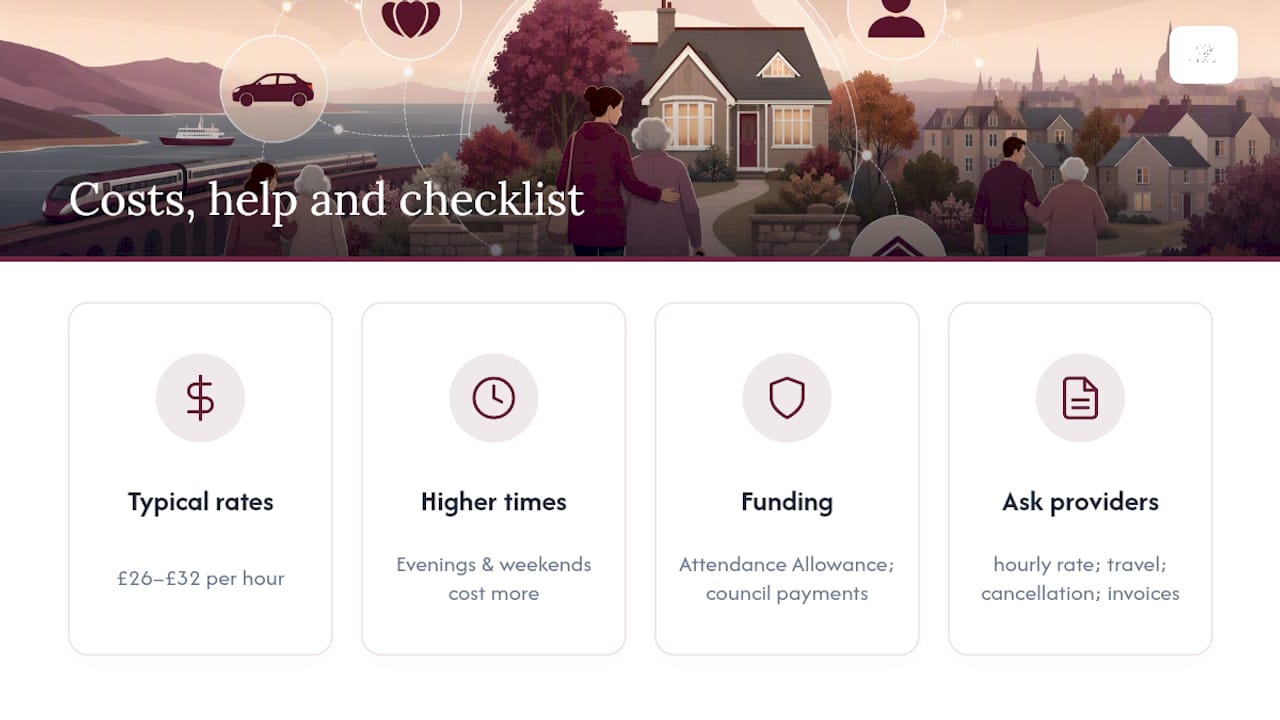
Funding doesn't always have to come entirely from your own pocket. Attendance Allowance can help if your relative is over State Pension age and needs help because of a disability or illness, and some local councils offer direct payments once a care needs and financial assessment has been carried out. Charging rules differ across the UK's four nations, so it's worth checking with your council directly rather than assuming a flat rate applies everywhere. Families researching pension and carer entitlements alongside care costs may also find it useful to check carer credit eligibility rules before finalising a budget.
Before signing anything, ask providers four direct questions: the hourly rate, whether travel time is charged separately, what the cancellation fee is, and how often you'll be invoiced.
How do you keep visits reliable and safe over time?
A single good visit means little if the arrangement falls apart the moment the usual companion is unavailable. Research into befriending programmes found that ongoing supervision and periodic check‑ins with companions directly improve programme resilience and client outcomes, so ask any provider how they support and monitor their own staff, not just how they vet them at the start.
Keep your own simple records too: a short note after each visit, anything unusual that happened, and the date of your next scheduled review. Build in contingency from day one:
- Agree what happens if your regular companion is ill or on leave.
- Confirm the emergency escalation route, including when a concern should go straight to you rather than wait for the next scheduled visit.
- Know at what point a situation should be escalated to statutory services rather than handled informally.
How do you know the visits are actually helping?
Look for practical signs rather than vague reassurance. Improved routines, a brighter mood, more willingness to join in with activities, fewer unexplained incidents between visits, and your own sense of reassurance are all realistic markers that the arrangement is working.
Build in a proper review point every four to six weeks. Ask your relative directly how they feel about the visits, run through a short wellbeing checklist covering mood, appetite and social contact, and be honest about whether the frequency or the specific companion still fits. If needs escalate toward personal care tasks, or you spot signs that go beyond what a companion is trained to handle, that's the point to bring in a GP, social worker or a regulated care provider instead of stretching a companionship arrangement past its purpose.
Why matching and continuity matter more than most families expect
Most guidance on hiring home support focuses on price and availability. That's backwards. The research on befriending programmes and practical booking guidance both point the same way: continuity and personality fit predict success far better than the specific tasks a companion performs or the hourly rate charged.
From Love With Care builds around that principle rather than treating it as an afterthought. Every companion holds an enhanced DBS certificate and goes through training before working with a client, and the matching process aims to keep the same familiar face returning week after week rather than rotating strangers through your relative's home. Families consistently tell us the wellbeing improvements they notice have far more to do with who shows up than how many hours are booked.
Whichever provider you choose, ask two things before you sign anything: how continuity is protected when a companion is unavailable, and whether a trial visit is offered before any ongoing commitment. Those two answers tell you more about a provider's reliability than any brochure will.
— Ayomide
Book DBS‑checked companion visits with From Love With Care
From Love With Care exists for exactly the situation this guide covers: a relative who'd benefit from regular, familiar company rather than a rotating cast of strangers. Every companion carries an enhanced DBS certificate, goes through proper training, and is matched on personality, not just availability, so the person who visits in March is usually still the one visiting in June.
Booking starts with a conversation about what your relative actually needs, whether that's weekly companionship, help getting to appointments, or flexible drop‑in visits. From there, you'll get a trial visit to check the fit before agreeing an ongoing schedule, with clear pricing and cancellation terms set out from the start rather than buried in small print. Explore the full range of companionship services on offer, or go straight to the welfare checks page to see how a first visit gets arranged. If you'd rather understand the matching and vetting process first, how our companionship works walks through it step by step. Get in touch to book a trial visit and set your first review date.
Where to check the official guidance
For continued reading and to verify anything covered here against primary sources, use NHS signposting for homecare, the Homecare Association member directory, and the Independent Age factsheet on arranging home care for funding and financial assessment detail. Depending on where you live, the relevant regulator is the CQC in England, Care Inspectorate in Scotland, CIW in Wales, or RQIA in Northern Ireland. For families weighing paid companions against volunteer befriending schemes, our guide on professional companions versus community groups covers that choice in more depth.
Sources
- NHS — homecare and adult social care signposting
- Disability Horizons — how to book companionship care
- Realist synthesis of friendly visiting programmes — key mechanisms and supervision findings
- Independent Age — arranging home care factsheet