

Companionship for elderly parents is defined as regular, purposeful social contact that supports emotional wellbeing without clinical intervention. Loneliness among older adults in the UK is a serious health concern. Researching companionship options for a parent means evaluating their social needs, exploring services such as Age UK befriending, Re-Engage tea parties, and homeshare programmes, and choosing an approach that fits their personality and daily life. The right companionship arrangement improves cognitive health, mood, and physical confidence. This guide walks you through every step, from spotting the signs to selecting the right support.
How do you assess your parent's companionship needs?
Recognising loneliness is the first step. Many elderly parents will not say they are lonely outright. Instead, you notice it in smaller signals: fewer phone calls, less interest in hobbies, or a flat tone when you visit. These are the signs worth paying attention to before you begin exploring care options.

Mobility, cognitive status, and personal preferences all shape what kind of companionship will work. A parent with limited mobility needs a companion who visits at home. A parent with early-stage memory difficulties benefits from a consistent, familiar face rather than rotating volunteers. A sociable parent who misses group settings may thrive at a Re-Engage tea party or a U3A group.
Involve siblings or trusted local contacts in your assessment. They often notice changes you miss because they see your parent more regularly. A brief weekly check-in, structured as a normal conversation rather than a welfare call, gives you a clearer picture over time. Daily signals under 10 seconds, such as a one-tap app check-in, reduce friction and provide peace of mind without making your parent feel monitored.
- Watch for reduced appetite, disrupted sleep, or a decline in personal care as secondary signs of loneliness.
- Note whether your parent mentions the same person repeatedly. This often signals who they trust and who might make a good companion.
- Ask open questions: "What did you do yesterday?" reveals more than "Are you feeling lonely?"
- Consider whether your parent has recently lost a close friend or neighbour, as bereavement is a common trigger for social withdrawal.
Pro Tip: Keep a simple notes document on your phone after each visit or call. Patterns become visible over two or three weeks that are invisible in the moment.
What companionship options are available in 2026?
The range of companionship models available to elderly parents is broader than most families realise. Formal services, community groups, and emerging arrangements each serve different needs and budgets. Understanding the distinctions helps you match the right option to your parent's situation.
Befriending services
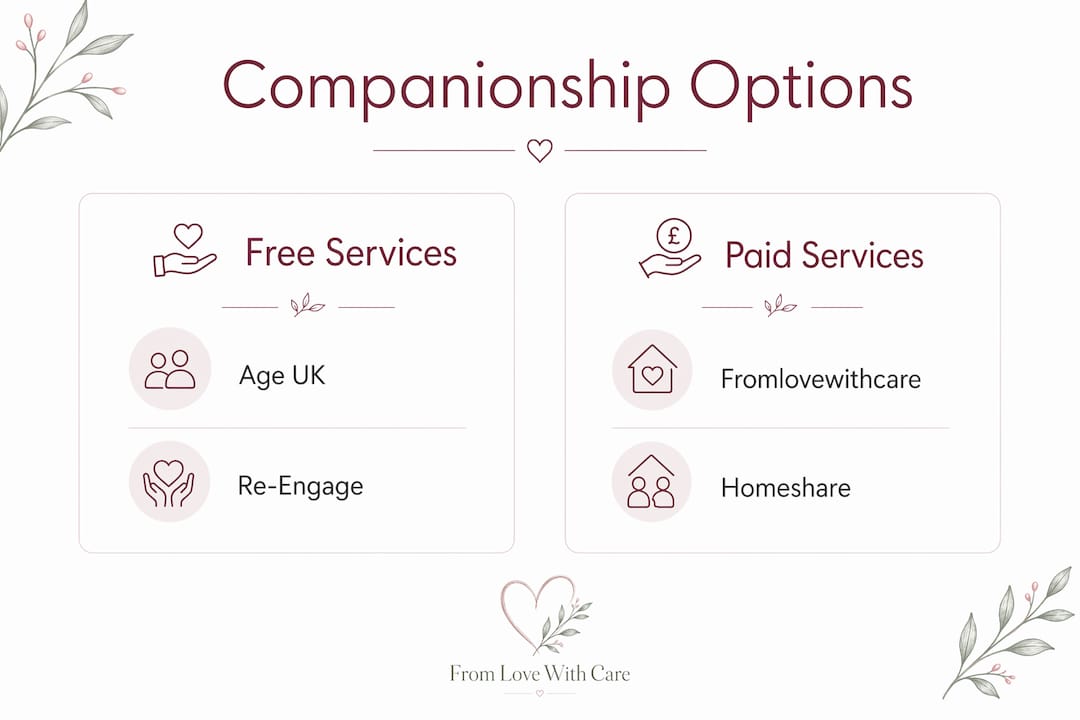
Age UK provides telephone and face-to-face befriending at no cost. Telephone friendship connects your parent with a trained volunteer for a regular weekly call. Face-to-face befriending pairs them with a local volunteer who visits at home. Both models are free, vetted, and designed specifically for isolated older adults.
Community group programmes
Re-Engage runs free monthly Sunday tea parties for adults over 75 who live alone. Volunteers collect guests, share a meal, and return them home. U3A (University of the Third Age) offers interest-based groups across the UK, from photography to walking, giving your parent a reason to leave the house regularly.
Homeshare programmes
Homeshare is one of the most practical and underused options available. A younger person moves into your parent's home, providing approximately 10 hours of light practical help weekly in exchange for affordable accommodation. The arrangement offers companionship, a sense of security, and gentle daily contact without the formality of a care package. It works particularly well as a gentle middle ground before more intensive support becomes necessary.
Professional companionship services
Paid companionship services, such as those offered by Fromlovewithcare, provide vetted companions who visit regularly for shared activities: a cup of tea, a walk, a trip to the shops. These services focus entirely on emotional connection rather than clinical care. That distinction matters because companionship preserves independence and avoids the stigma some parents associate with "being cared for."
| Companionship type | Cost | Best suited for |
|---|---|---|
| Age UK befriending | Free | Isolated adults needing regular contact |
| Re-Engage tea parties | Free | Adults over 75 living alone |
| U3A community groups | Low membership fee | Socially active parents seeking interest groups |
| Homeshare programme | Low (accommodation exchange) | Parents comfortable with a live-in companion |
| Professional companionship | Paid | Parents needing consistent, vetted, personal visits |
How do you research and select the best companionship option?
Start with your local council's adult social care directory. Most councils publish a list of approved befriending services, day centres, and community groups. Age UK's national helpline (0800 678 1602) can also point you to local services quickly. Online directories such as the Homeshare UK network list vetted programmes by region.
When you contact an agency or volunteer service, ask specific questions:
- How are companions vetted and trained?
- What happens if the assigned companion is unavailable?
- How is compatibility between companion and client assessed?
- What is the minimum commitment in terms of visit frequency?
- How do you handle situations where the relationship is not working?
These questions reveal whether an organisation prioritises the relationship or simply fills a slot. A good service will welcome them.
Evaluate cost and scheduling honestly. A free befriending service is only useful if your parent will actually engage with it. A paid service that fits your parent's routine and personality is worth the investment. Consider whether your parent prefers mornings or afternoons, structured activities or open conversation, and match the service to those preferences rather than to what is most convenient for you.
Small, reliable daily contact reduces loneliness more effectively than occasional large gestures. A short daily message or a predictable weekly visit builds genuine connection over time. Use shared calendars or simple check-in apps to coordinate between siblings and keep everyone informed without duplicating effort.
Pro Tip: Arrange a trial visit before committing to any paid service. Most reputable providers offer this. It removes pressure from your parent and gives you a realistic sense of fit.
Why do parents resist companionship support, and how do you respond?
Parental resistance to companionship support is common and understandable. Many older adults associate accepting help with losing independence. Others feel that admitting loneliness is a sign of weakness or a burden to their family. Recognising this resistance as protective rather than difficult changes how you approach the conversation.
The biggest mistake adult children make is jumping straight to solutions. Suggesting a befriending service before your parent feels heard often increases resistance. Listen first. Ask about their week, their memories, their preferences. Connection comes before recommendation.
Gradual reintroduction of previously enjoyed activities works better than introducing something entirely new. If your parent used to enjoy gardening clubs or church groups, start there. Familiarity reduces the anxiety of engaging with strangers. A companion who shares a similar interest makes the first meeting feel natural rather than arranged.
- Frame companionship as something for you, not for them. "It would give me peace of mind to know someone pops in" is less threatening than "You need company."
- Avoid presenting multiple options at once. One clear suggestion is easier to accept than a menu of services.
- Start with the lowest-stakes option available. A phone befriending call requires less commitment than a home visit and builds trust gradually.
- Companionship care can serve as a soft entry point, allowing care needs to increase naturally over time without a crisis forcing the change.
Maintaining your parent's sense of autonomy throughout the process is not optional. It is the difference between a companionship arrangement that lasts and one that collapses after a few weeks.
Key takeaways
The most effective approach to finding companionship for an elderly parent combines honest needs assessment, knowledge of available models, and a connection-first conversation strategy that respects your parent's autonomy.
| Point | Details |
|---|---|
| Assess needs before researching | Identify mobility, cognitive status, and personality before contacting any service. |
| Know the full range of options | Free befriending, community groups, homeshare, and paid companions each suit different situations. |
| Ask the right questions | Vet any service by asking about companion training, compatibility, and contingency arrangements. |
| Listen before suggesting | Parental resistance drops when connection comes before any recommendation or solution. |
| Start low-stakes | A phone befriending call or a single trial visit reduces pressure and builds trust gradually. |
What I have learned from watching families get this right and wrong
I have seen families spend weeks researching services, comparing costs, and building spreadsheets, only to have their parent refuse every option on the table. And I have seen other families make one phone call to Age UK, arrange a single trial visit, and watch their parent light up within a fortnight.
The difference is almost never the service. It is the approach.
The families who succeed treat companionship as something their parent deserves, not something their parent needs. That framing matters enormously to an older adult who has spent decades being capable and independent. The moment a conversation feels like an intervention, the shutters come down.
What actually works is patience and specificity. Not "would you like some company?" but "there is a woman who loves gardening and lives nearby. She visits people for a cup of tea on Thursdays. Would you be open to meeting her once?" That is a question a person can say yes to.
The other thing I would say is this: do not wait for a crisis. Companionship improves wellbeing most when it starts before isolation becomes entrenched. The earlier you begin, the easier the introduction, and the more your parent retains the social confidence to engage.
— Ayomide
How Fromlovewithcare supports families at every stage
Fromlovewithcare provides elderly companionship services built around genuine human connection rather than clinical care. Every companion is thoroughly vetted and matched to your parent's personality, interests, and routine. Visits centre on shared moments: a walk, a conversation over tea, a trip to the local shops.

Families across the UK use Fromlovewithcare because the service removes the uncertainty of finding and vetting a companion independently. You get peace of mind. Your parent gets consistent, dignified company from someone they can trust. Explore the full range of companionship support services or visit the services page to find the right fit for your parent's needs.
FAQ
What is companionship care for elderly parents?
Companionship care is regular, non-clinical social contact provided by a vetted individual to support an elderly person's emotional wellbeing. It focuses on connection, routine, and shared activities rather than medical or personal care tasks.
How do I know if my parent needs a companion?
Watch for reduced social contact, loss of interest in hobbies, or a flat mood during visits or calls. These signs of loneliness often appear before your parent will acknowledge feeling isolated.
Are there free companionship options for elderly parents in the UK?
Age UK offers free telephone and face-to-face befriending services, and Re-Engage provides free monthly tea parties for adults over 75. Both are widely available across the UK and require no financial commitment.
How do I help my parent accept a companion?
Frame the arrangement around your own peace of mind rather than their need. Start with the lowest-commitment option available, such as a weekly phone call, and allow trust to build before introducing home visits.
Can companionship care lead to more support later?
Companionship care serves as a soft entry point into broader support. As a companion becomes a trusted presence, increasing the level of care becomes a natural progression rather than a disruptive change.