

The five practical alternatives to careandsharecompanionship.org are paid in-home companions, charity and volunteer befriending, telephone helplines, homeshare schemes, and community activity groups. Each covers a different need, budget, and level of commitment. According to NHS guidance, many people aged over 75 live alone in the UK, and a significant number say they can go a month without speaking to a friend or family member. That scale of isolation means no single service type fits every situation.
The shortlist below covers the full range:
- Fromlovewithcare — paid, DBS-checked in-home companions for social visits and welfare checks
- Age UK / Re-engage / Royal Voluntary Service — charity befriending, telephone support and group activities, mostly free
- The Silver Line / Independent Age — free telephone helplines and call companions
- Homeshare UK — spare room exchanged for roughly 10–15 hours of weekly companionship
- MHA / Befriending Networks / community groups — local activity programmes, lunch clubs, and volunteer visits
Cost, vetting, and commitment vary significantly across these. Paid services such as Fromlovewithcare include DBS checks and trained companions; charity models rely on vetted volunteers; homeshare requires a semi-permanent household arrangement. None of these options replaces regulated medical or personal care.
Table of Contents
- How do these companionship alternatives compare at a glance?
- How do you choose the right companionship option?
- What does each type of companionship service actually involve?
- What do companionship services cost, and how are companions vetted?
- Why does companionship matter? UK evidence and outcomes
- Key takeaways
- What the human-first model gets right
- Fromlovewithcare: trusted in-home companionship, ready when you need it
- Useful UK sources to explore next
How do these companionship alternatives compare at a glance?
| Service type | Typical cost | DBS / vetting | Coverage | Frequency | Suitability | Trial / cancellation | Wait time |
|---|---|---|---|---|---|---|---|
| Paid in-home companion | Hourly rate | DBS-checked, trained | Local / regional | Flexible, weekly+ | Dementia, mobility, social | Trial visit available; flexible cancellation | Days to 1–2 weeks |
| Volunteer befriending | Free | Volunteer references, induction | Local via networks | Weekly (min. 1 hr) | Social conversation, mild isolation | Charity-managed; no contract | 2–6 weeks |
| Telephone helpline / call companion | Free | Staff-vetted | National | Regular scheduled calls | Social conversation, housebound | No contract | Days |
| Homeshare | Low (approx. £40/week in some schemes) | Matching checks, references | National via Homeshare UK | 10–15 hrs/week | Social, light practical help | Requires notice; semi-permanent | 4 weeks |
| Community groups / activity programmes | Free or low-cost | Volunteer-led | Local / regional | Weekly sessions | Mobile, socially isolated | Drop-in or low commitment | Immediate |
A few points worth noting:
- Paid in-home companions and homesharers are not regulated by the Care Quality Commission (CQC) because they do not provide personal or medical care. CQC registration applies to regulated home care services only.
- Local befriending networks typically ask volunteers to commit to at least one hour per week of face-to-face contact, making them reliable but slower to arrange than a telephone helpline.
- Homeshare is the most cost-effective option for sustained daily presence but demands a willingness to share a home, which is not suitable for everyone.
How do you choose the right companionship option?
Start with one question: does your loved one need regular in-person presence, or would a warm, consistent phone call make a meaningful difference? That single answer narrows the field considerably.
From there, work through these decision axes: desired frequency, whether support is social or also practical (shopping, appointments), budget, location, and any specific needs such as dementia, hearing loss, or a preferred language. Families researching companionship options for a parent often underestimate how much the matching process matters.
Questions to ask any provider or charity:
- Are companions or volunteers DBS-checked? When was the check completed?
- What induction or training do they receive?
- How are matches made, and can you meet the companion before committing?
- What is the cancellation or trial policy?
- Does the service carry public liability insurance?
- What will the companion not do? (Confirm they are not presented as medical carers.)
Red flags to watch for:
- No DBS check or vague answers about background vetting
- Pressure to sign a long-term contract before a trial visit
- A companion described as able to provide personal or nursing care
- No documented service boundaries
Trust signals that indicate a safe provider:
- Current DBS certificate on request
- Documented induction and ongoing training
- Client testimonials or case studies
- Registered charity number or company registration number
Pro Tip: Ask for the companion's DBS certificate number and verify it on the DBS Update Service before the first visit. Reputable providers will not hesitate.
What does each type of companionship service actually involve?
Each service type looks quite different in practice. Here is what a typical session involves for each.
Paid in-home companions visit at an agreed time, usually for one to several hours. A session might involve a cup of tea and conversation, accompanying someone to a GP appointment, or helping with a short shopping trip. Fromlovewithcare's companions are DBS-checked and trained specifically for social and emotional support, not personal care. Welfare check visits are also available, including emergency check-ins.
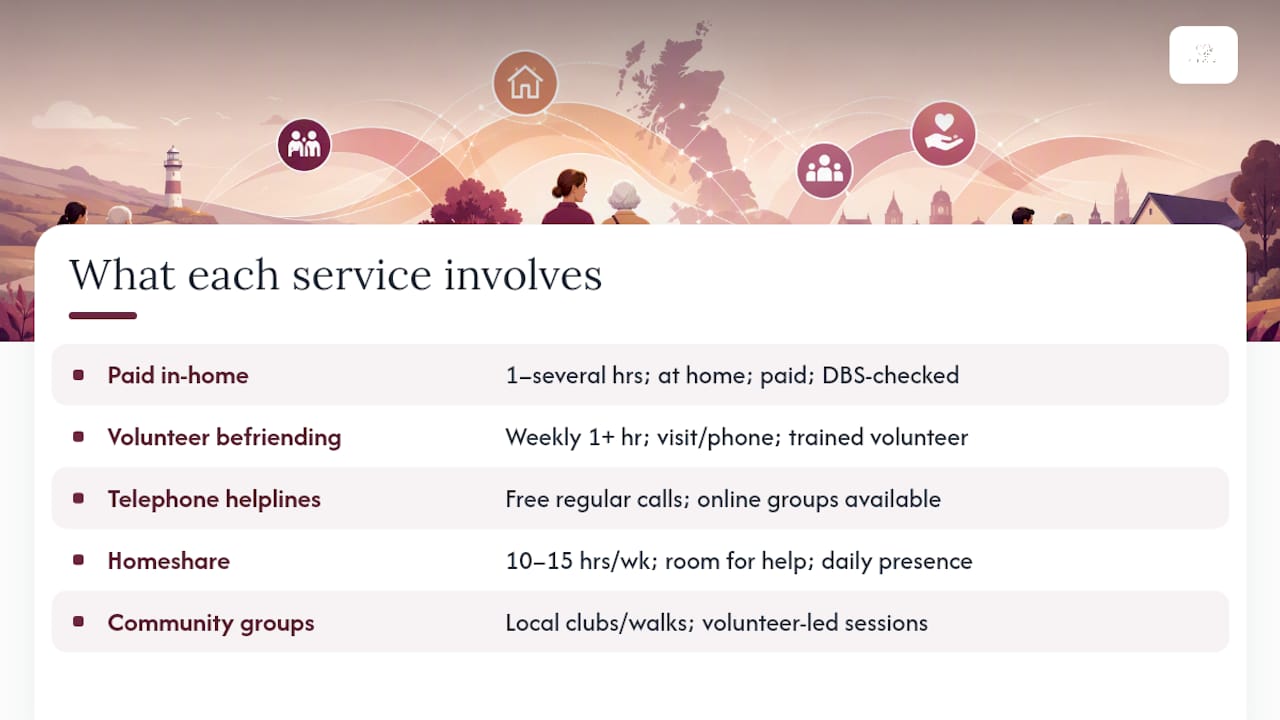
Volunteer and charity befriending (Age UK, Re-engage, Royal Voluntary Service, MHA, Befriending Networks) typically involves a scheduled weekly visit or phone call from a trained volunteer. NHS guidance highlights befriending schemes, telephone buddies, and volunteer transport as widely available local options. The commitment is usually at least one hour per week.
Telephone helplines and call companions (The Silver Line, Independent Age) offer free, regular phone calls. Independent Age lists call companion services and online activity groups, which are particularly useful when mobility or geography limits in-person contact.

Homeshare pairs an older householder with a younger sharer who provides 10–15 hours of weekly companionship and light help in exchange for a room. It is low-cost and can provide daily household presence, but it requires a careful personality match and a willingness to share your home long-term.
Community groups and activity programmes include lunch clubs, walking groups, and arts sessions run by local charities and councils. Ramblers Wellbeing Walks are a good example: free, short, volunteer-led walks available in many areas that provide regular social contact with minimal commitment.
What do companionship services cost, and how are companions vetted?
Paid in-home companionship is charged at an hourly rate; specific pricing varies by provider and region, so contact services directly for current figures. Emergency welfare checks typically carry a separate premium fee. Free options include charity befriending, telephone helplines, and most community activity groups. Homeshare schemes are low-cost, with some arrangements reported at around £40 per week, though fees differ by scheme.
On vetting: paid services such as Fromlovewithcare require DBS checks and structured training for every companion. Charities carry out volunteer references and induction. Homeshare providers conduct careful compatibility matching and reference checks, though sharers are not trained carers. None of these services falls under CQC regulation, because companionship is not regulated personal or medical care.
Safety checklist for any companionship visit:
- Confirm DBS check is current
- Agree written service boundaries before the first visit
- Share a brief welcome note about the person's preferences, routines, and any health considerations
- Keep an emergency contact on file with the provider
Pro Tip: If personal care (washing, dressing, medication) is also needed, combine a companionship service with a separate CQC-regulated home care provider; for funding options, see selling your parents' home to fund senior care in Oregon. Companions are not a substitute for regulated care, and the best providers will say so clearly.
Why does companionship matter? UK evidence and outcomes
Regular social contact reduces isolation and is linked to better mental and physical health outcomes. The evidence base in the UK is clear.
"More than 2 million people aged over 75 live alone in the UK, and over a million say they can go a month without speaking to a friend or family member." — NHS loneliness guidance
Chronic loneliness carries health risks comparable to smoking 15 cigarettes a day. Volunteer befriending and weekly phone calls are repeatedly identified by NHS guidance as high-value, low-cost ways to reduce isolation. Clients of paid companionship services report meaningful improvements in their loved ones' mood, confidence, and daily engagement.
Companionship is not a substitute for regulated medical or personal care. When health needs increase, families should seek a CQC-registered home care provider alongside any companionship arrangement.
This article provides general information only, not professional care or medical advice. Confirm current service details and eligibility directly with providers or a qualified professional.
Key takeaways
The most effective approach to finding a careandsharecompanionship.org alternative is to match the service type to the specific connection your loved one needs, then verify vetting and service boundaries before the first visit.
| Point | Details |
|---|---|
| Five service types cover most needs | Paid in-home, volunteer befriending, telephone helplines, homeshare, and community groups each suit different budgets and situations. |
| Vetting varies significantly | Paid services include DBS checks and training; charities vet volunteers; homeshare relies on compatibility matching. Always ask for evidence. |
| Free options are widely available | Telephone helplines, charity befriending, and community groups cost nothing; homeshare is low-cost at around £40/week in some schemes. |
| Companionship is not regulated care | None of these services is CQC-regulated; for personal or medical care needs, a separate regulated provider is required. |
| Fromlovewithcare is the leading paid option | DBS-checked, trained companions for in-home social visits, welfare checks, and shopping support across the UK. |
What the human-first model gets right
The conventional wisdom in this space tends to frame the choice as "paid versus free." That framing misses the point. The real question is what kind of connection your loved one actually needs, and whether the service can deliver it consistently.
A weekly phone call from a charity volunteer can be genuinely life-changing for someone who is housebound and articulate. But for someone who has stopped leaving the house, who needs a familiar face at the door and a reason to make a cup of tea, a telephone helpline will not reach them in the same way. Paid in-home companionship fills that gap precisely because it is structured, consistent, and shows up in person.
What families often underestimate is the value of professional matching. Volunteer befriending is wonderful, but availability is patchy and wait times can stretch to six weeks. A paid service can place a companion within days and adjust the schedule as needs change. That flexibility matters enormously when a family is managing a crisis or a sudden change in a parent's circumstances.
The best outcome is usually a combination: a paid companion for regular in-person visits, a telephone helpline for the evenings, and a range of local social activities for variety. None of these options is the whole answer on its own.
Fromlovewithcare: trusted in-home companionship, ready when you need it
Paid charity alternatives and volunteer befriending are genuinely valuable, but they come with wait times, limited availability, and no guarantee of a consistent face. Fromlovewithcare offers something different: DBS-checked, trained companions who visit in person, on a schedule that works for your family.
The service covers social visits, welfare check-ins, conversation and emotional support, grocery shopping, appointment accompaniment, and emergency welfare checks. Companions are not medical carers, and Fromlovewithcare is clear about that boundary from the start. Every companion is vetted, trained, and matched to the person they visit.
If you are ready to arrange consistent, trustworthy in-home companionship, view the full range of services or see how the matching process works before booking a trial visit.
Useful UK sources to explore next
- Loneliness in older people — NHS
- Loneliness in older people: how to help — NHS
- Staying connected | Independent Age
- Homeshare UK
- Homesharing: what it is and how to set up an arrangement — When They Get Older
- Voluntary Action Surrey East — Befriending Networks