

Caregiver support services in the UK are defined as a range of domiciliary and companionship care options designed to help elderly people maintain independence and quality of life at home. The formal industry term is "domiciliary care," which covers everything from personal hygiene assistance to emotional companionship. Regulatory oversight sits with the Care Quality Commission (CQC), which inspects and rates all registered care providers in England. Financial support routes include NHS Continuing Healthcare, Attendance Allowance, and local authority funding, each with distinct eligibility criteria. Understanding this caregiver support services UK overview is the first step to securing the right help for your loved one.
1. What is the caregiver support services UK overview?
Caregiver support services in the UK span a broad spectrum, from brief hourly visits to full-time live-in care and dedicated companionship programmes. The term "domiciliary care" is the recognised industry label, though families often search for it under "home care" or "caregiver assistance UK." Every registered provider must meet CQC standards, which assess safety, effectiveness, and responsiveness. This regulatory framework gives families a reliable benchmark when comparing providers.
The services divide into three broad categories: personal care (washing, dressing, medication), practical support (meal preparation, shopping), and emotional companionship. Each category addresses a different need, and most families end up combining two or three. Knowing which category your loved one needs most is the starting point for any care plan.

2. Hourly visiting home care: flexible support for moderate needs
Visiting home care is the most common entry point into formal caregiver assistance UK. A carer visits for a set period, typically 30 to 60 minutes, to assist with personal care tasks such as bathing, dressing, and medication prompts. Visiting care costs between £26 and £38 per hour across the UK, with London and the South East sitting at the higher end. That hourly rate reflects both the carer's time and the provider's regulatory compliance costs.
The key strength of hourly visiting care is flexibility. Care packages adjust dynamically as needs evolve, so a person who starts with one morning visit per day can progress to four visits daily without changing provider. This gradual scaling prevents families from over-committing financially at the outset.
- Typical tasks covered: washing, dressing, continence care, meal preparation, and medication prompts
- Visit durations: 30, 45, or 60 minutes, depending on assessed need
- Frequency: from once daily to multiple visits across morning, lunchtime, afternoon, and evening
- Regional cost variation: rural areas often face higher costs due to travel time
Pro Tip: Book an initial assessment visit before committing to a regular schedule. Most CQC-registered providers offer this free of charge, and it gives you a realistic picture of how long each task actually takes.
3. Live-in care: round-the-clock presence for complex needs
Live-in care places a professional carer in the home full time, making it the closest alternative to a residential care home. It suits people with advanced dementia, significant mobility limitations, or safety concerns that make unsupervised periods risky. Live-in care costs between £1,200 and £1,500 per week, depending on the level of need and the region.
One critical point that families frequently misunderstand: live-in care is not continuous awake monitoring. Carers have designated rest breaks built into their schedule, and they are not contracted to provide active support throughout the night. If your loved one wakes frequently and needs hands-on help, a separate waking night carer is necessary. Clarifying this before signing a contract prevents serious disappointment.
- Ideal candidates: people with advanced dementia, high fall risk, or complex medication regimes
- Carer rest: typically two hours of rest per day, plus uninterrupted sleep at night
- Night waking needs: require an additional waking night carer, billed separately
- Home value exclusion: the property is excluded from means testing for domiciliary care, unlike residential care, making live-in care more financially accessible for homeowners
Statistic callout: Live-in care costs £1,200–£1,500 per week. For many families, this compares favourably with residential care home fees, particularly when the family home is retained.
4. Companionship and emotional support services
Companionship services are the most frequently overlooked category of support for caregivers UK. Families tend to focus on physical personal care and miss the profound impact that regular human connection has on an elderly person's mental health and overall wellbeing. Loneliness carries measurable health consequences, and addressing it is as clinically relevant as managing medication.
Companionship services take several forms. Friendly home visits involve a companion spending time with the elderly person, sharing a cup of tea, reading together, or simply talking. Activity support covers hobbies, light exercise, and creative pursuits. Social outings accompany the person to appointments, community events, or local shops. Companion visits for elderly parents also free up family caregivers for rest, work, or personal commitments, directly reducing the risk of caregiver burnout.
- Friendly visits: regular, scheduled time for conversation and shared activities
- Activity support: crafts, gardening, reading, or gentle movement
- Social outings: accompanied trips to shops, parks, or community groups
- Caregiver relief: scheduled companion time gives family caregivers a predictable break
Pro Tip: Treat companionship visits as a fixed appointment, not an optional extra. Consistency matters to elderly people, and a regular companion builds trust far more quickly than irregular contact.
Fromlovewithcare specialises in this area, providing thoroughly vetted companions who focus entirely on human connection rather than clinical tasks. Elderly companionship services of this kind sit alongside personal care rather than replacing it, creating a more complete picture of support.
5. How to access and fund caregiver support services in the UK
The gateway to publicly funded care is a social care needs assessment, requested from your local council. The council assesses the elderly person's needs and determines whether they meet the eligibility threshold under the Care Act 2014. Separately, family caregivers have a legal right to a carer's assessment, and councils must provide support if the carer is no longer willing or able to continue without help.
Funding eligibility depends on a financial means test. The capital thresholds are £14,250 (below which the council pays the full cost) and £23,250 (above which the person funds their own care). Crucially, the value of the family home is excluded from this means test for domiciliary care, unlike for residential care. This distinction makes home-based care significantly more accessible for homeowners.
Once assessed, families have three main funding routes:
- Council-arranged care: the local authority selects and manages the provider on your behalf
- Direct payments: the council pays funds directly to you, and direct payments empower families to hire carers of their own choosing, giving greater control over scheduling and carer selection
- Private self-funding: families arrange and pay for care independently, often faster than waiting for a council assessment
NHS Continuing Healthcare (CHC) is a separate, fully funded route for people with a "primary health need." CHC is assessed by a clinical team and covers the full cost of care, including live-in care. Eligibility is stringent, but families should always request a CHC assessment if the person's needs are primarily health-related.
Request a needs assessment early, not at crisis point. Waiting lists exist, and proactive assessment protects both independence and wellbeing.
6. Respite care, technology-enabled care, and local resources
Respite care gives family caregivers a planned break, ranging from a few hours to several weeks. It can be delivered at home through a visiting or live-in carer, or in a short-stay residential setting. Respite is not a luxury. Sustained caregiving without breaks leads to physical and mental health deterioration in the carer, which ultimately harms the person being cared for.
Technology-enabled care (TEC) extends home support between human visits. Smart home sensors and medication dispensers can delay the need for residential care placement. County councils recommend exhausting TEC options before considering a care home move. Combining technological aids with human caregiving creates a more resilient care environment that responds to changing needs in real time.
Local resources worth knowing about include:
- Age UK local branches: information, advocacy, and some direct services
- Carers UK: guidance on rights, benefits, and local carer support groups
- NHS reablement services: short-term packages lasting 6 to 12 weeks to restore independence after illness or surgery, usually provided free of charge
- Local authority care directories: searchable databases of CQC-registered providers in your area
Combining TEC with visiting care and companionship services often produces better outcomes than any single service alone. The goal is a layered plan that covers physical safety, practical daily tasks, and emotional connection.
Key takeaways
The most effective caregiver support plan in the UK combines personal care, companionship, and financial assessment to meet both the elderly person's needs and the family caregiver's capacity.
| Point | Details |
|---|---|
| Start with a needs assessment | Request a social care assessment from your local council before arranging any paid care. |
| Know the cost thresholds | Capital thresholds of £14,250 and £23,250 determine council funding eligibility for domiciliary care. |
| Live-in care has limits | Carers have rest breaks and do not provide active night-time support without a separate waking carer. |
| Companionship reduces burnout | Regular companion visits give family caregivers a reliable break and improve elderly wellbeing. |
| Layer services for best outcomes | Combining visiting care, TEC, and companionship creates a more resilient and responsive care plan. |
What I have learned about choosing caregiver support services
After years of working alongside families navigating the UK care system, the pattern I see most often is this: families wait too long. They reach crisis point before requesting an assessment, which means they accept whatever is available quickly rather than what is right. The council's waiting list is real, but it is manageable if you engage early.
The second thing I have noticed is that companionship is consistently undervalued. Families prioritise the physical tasks, which makes sense, but the person who goes days without a meaningful conversation deteriorates faster than the person whose medication is occasionally late. Emotional connection is not a soft add-on. It is a clinical necessity.
My practical advice is to build a care plan in layers. Start with what is needed now, identify what will be needed in six months, and put the funding pathway in place before you need it. Senior home visits from a trusted companion can begin immediately while a formal assessment is pending, bridging the gap without leaving your loved one unsupported.
The families who navigate this best are those who treat caregiving as a system to be designed, not a crisis to be managed.
— Ayomide
Companionship and care support from Fromlovewithcare
Fromlovewithcare provides vetted, compassionate companions who visit elderly people at home across the UK, focusing entirely on human connection rather than clinical tasks. Whether your loved one needs a friendly face for a cup of tea, help with a short outing, or simply someone to talk to, Fromlovewithcare matches them with a companion who suits their personality and interests.
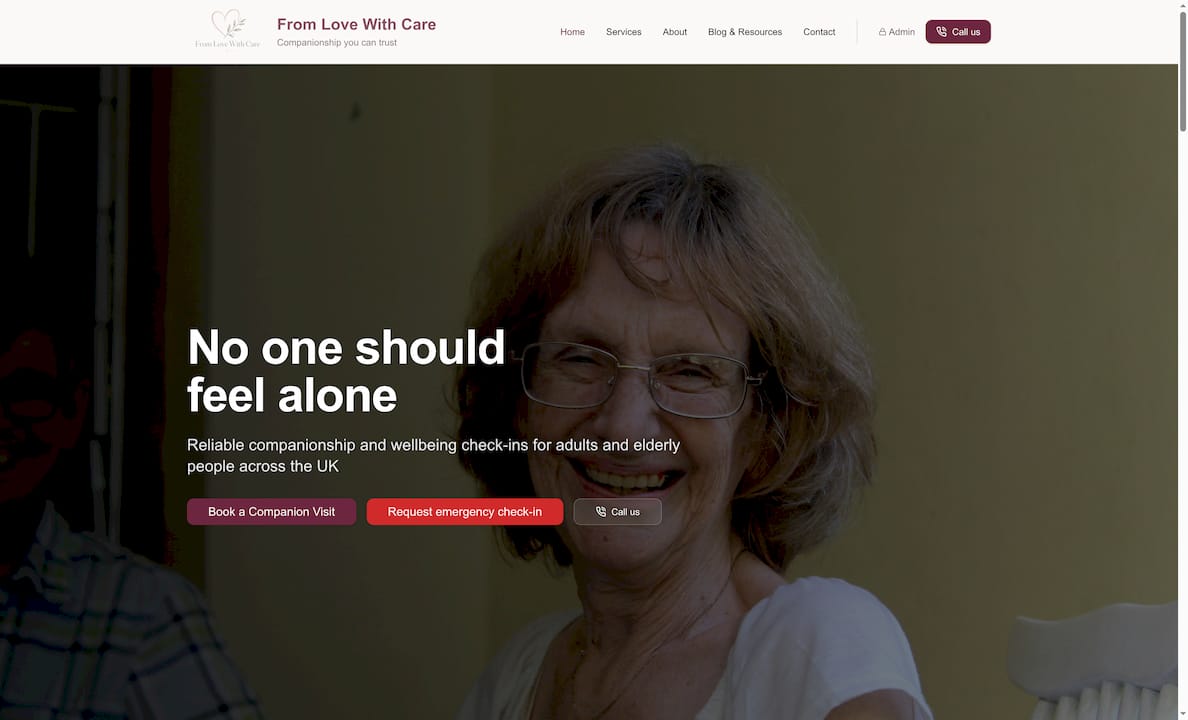
Every companion is thoroughly vetted, giving families genuine peace of mind. Fromlovewithcare's services sit alongside existing personal care arrangements, adding the emotional layer that clinical care alone cannot provide. Visit the full services page to see the range of options available, or explore how companionship works to understand what a typical visit looks like and how to arrange one for your loved one.
FAQ
What does a social care needs assessment involve?
A social care needs assessment is a conversation between the elderly person (and often their family) and a council social worker, covering daily tasks, safety, and wellbeing. The outcome determines eligibility for council-funded care and the type of support offered.
Is live-in care the same as 24/7 care?
Live-in care is not the same as continuous 24/7 active care. Carers have designated rest periods and are not contracted to provide hands-on support throughout the night; a separate waking night carer is needed for frequent overnight needs.
What is the capital threshold for council-funded home care?
The means test uses two thresholds: below £14,250 in capital, the council covers the full cost; above £23,250, the person funds their own care. The value of the family home is excluded from this calculation for domiciliary care.
How do companionship services differ from personal care?
Personal care covers physical tasks such as washing, dressing, and medication. Companionship services focus on emotional connection, social engagement, and reducing isolation, and are typically provided by a companion rather than a registered carer.
Can family caregivers get support in their own right?
Yes. Caregiver assessments are a legal right under the Care Act 2014. If a carer is struggling, the local authority has a duty to assess their needs and may provide support such as respite care or direct payments.