

Yes, in the UK you can usually use direct payments to fund companionship, and to employ a companion or personal assistant, provided the need for social contact and its outcomes are written into your care and support plan. The main constraints involve paying household family members and confirming local council rules, so your first step is simple: contact your council and ask for a needs assessment.
TL;DR:
- Direct payments can fund companionship and social contact if explicitly included in the care plan, especially for reducing loneliness and isolation.
- Applying involves a needs assessment, explicit care plan outcomes, signing an agreement, and choosing a payment method, with timescales varying by council.
- Spending must directly support named outcomes, such as outings or hobbies, and paying household family members is restricted to exceptional circumstances.
- Employing a companion personally requires ongoing employer obligations, including registering with HMRC, issuing contracts, and managing payroll, often assisted by payroll providers.
- Support organizations can help manage administrative tasks and ensure compliance, easing the bureaucratic burden of controlling direct payments.
Table of Contents
- What are direct payments and who can get them?
- How do you apply for and set up direct payments?
- What can you spend direct payments on for companionship?
- Can you pay a family member or friend for companionship?
- How do you manage and review direct payments over time?
- What do companionship visits typically cost?
- How From Love With Care supports direct payment users
- The gap between choice and admin nobody warns you about
- Ready to use your direct payment for companionship?
- Where to check the details yourself
- Sources
What are direct payments and who can get them?
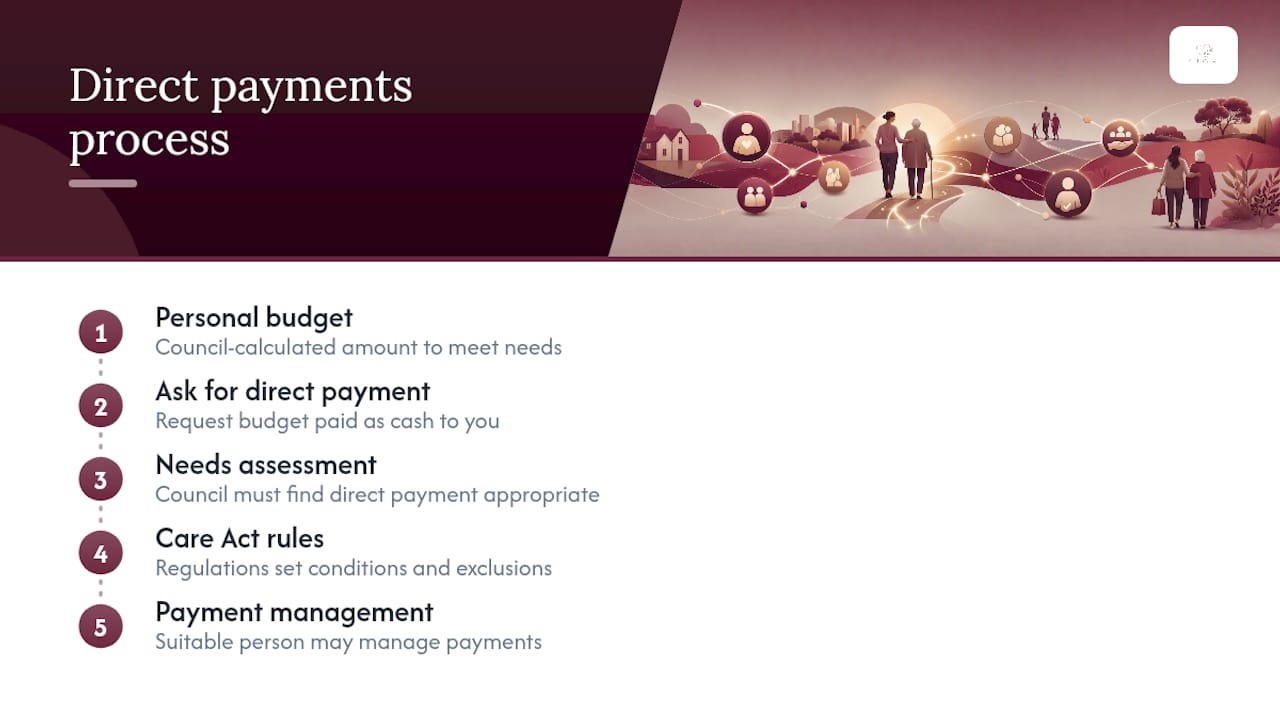
Direct payments are cash payments a council makes so that you, or someone acting for you, can arrange your own care rather than relying on council-commissioned services. They flow from your personal budget, the figure your council calculates to meet your assessed needs. If you're eligible for that budget, you can ask for it to be paid as a direct payment so you control how the money is spent.
Eligibility rests on a formal needs assessment. Councils must be satisfied that a direct payment is an appropriate way to meet your needs, and the regulations under the Care Act 2014 set out conditions and exclusions that guide this decision. Some people with fluctuating capacity may need a suitable person to manage payments on their behalf.
The needs assessment and the resulting care and support plan act as gatekeepers for everything that follows. If loneliness or isolation is identified as a genuine, documented need, companionship becomes a legitimate use of the budget rather than an afterthought.
How do you apply for and set up direct payments?
Getting from "I think this might help" to money in an account follows a fairly predictable path, though timescales vary by council.
- Request a needs assessment from your local authority's adult social care team, either for yourself or the person you're supporting.
- Discuss a personal budget once the assessment confirms eligible needs, and ask specifically whether it can be paid as a direct payment.
- Agree your care and support plan, making sure companionship, social contact, or wellbeing outcomes are named explicitly rather than implied.
- Sign a direct payment agreement, which sets out your responsibilities, reporting requirements, and how the council will review spending.
- Choose a payment method, usually a dedicated bank account or a pre-paid card, and nominate a manager if you're arranging payments for someone else.
Councils vary in speed, some settle assessments within weeks, others take longer during busy periods. Push back gently if timescales stretch without explanation, and ask what's causing any delay before assuming the worst.
What can you spend direct payments on for companionship?
Direct payments can fund a wide range of non-medical support, provided each item connects back to an outcome named in your care plan. Typical uses include:
- Regular home visits for conversation, company, and a cup of tea.
- Accompanied outings, shopping trips, or walks.
- Support attending medical appointments or social events.
- Shared activities and hobbies that reduce isolation.
- Employing a personal assistant or companion for scheduled visits.
Spending has to map onto agreed outcomes, so a plan that identifies "reduce social isolation" or "maintain community connections" gives you far more flexibility than a vague budget line. Some councils also allow you to pool direct payments with other people to fund group activities, which stretches a modest budget further than solo outings would.
Can you pay a family member or friend for companionship?
This is where most confusion sits, and it's worth getting right before you commit to anyone.
You generally cannot use a direct payment to pay a close family member who lives in the same household as the person receiving care. Council fact sheets are consistent on this. Payment to a co-resident relative is only permitted in exceptional circumstances with senior council approval, such as cases where no other suitable support exists. Paying a friend or a family member who lives elsewhere is often possible, but it still needs council agreement written into your plan.
Once you employ someone directly, you take on genuine employer duties:
- Registering as an employer with HMRC and running PAYE.
- Auto-enrolling into a workplace pension where the rules require it.
- Issuing a written contract, and covering holiday and statutory sick pay.
- Arranging employer's liability insurance.
- Carrying out right-to-work checks before employment starts.
These obligations run continuously, not just at the start, and many people underestimate the time this takes.
Pro Tip: Ask your council's direct payment support service about payroll providers before you recruit. Many will handle PAYE, pension enrolment, and payslips for a modest fee, which removes the single biggest source of stress reported by families new to direct payments.
How do you manage and review direct payments over time?
Councils expect proof that the money is doing what it was intended to do. Keep payslips, invoices, receipts, and bank statements, since most authorities ask for a quarterly report and may audit spending against the care plan. This sounds bureaucratic, and honestly, it is, but it's manageable with the right structure from day one.
If the administration feels like a second job, you have options. Nominating a trusted family member to handle records is one route. A managed personal budget, where the council or a third party handles the money while you still choose the support, is another. An Individual Service Fund (ISF) sits between the two, giving you choice over your care while a provider manages employment and payroll on your behalf.
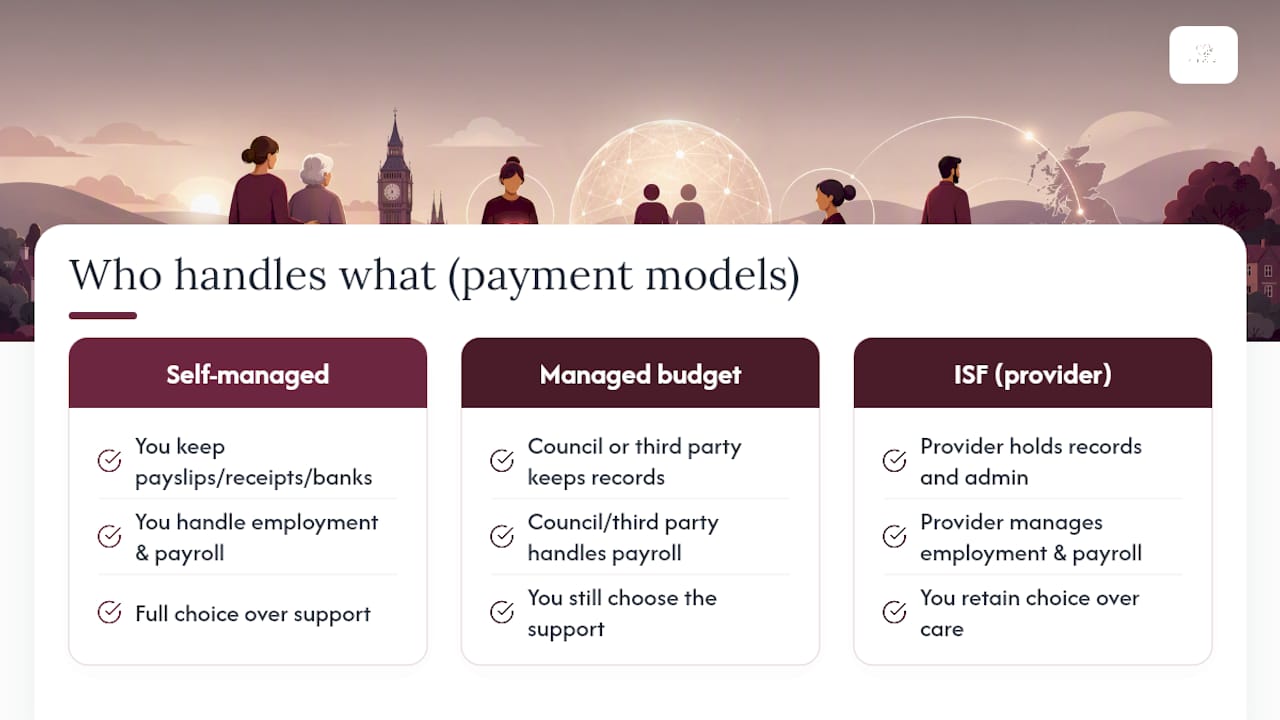
Direct payment support organisations exist in most areas specifically to help with payroll, contracts, and recordkeeping. Getting one involved early turns a potential burden into a workable arrangement rather than a source of ongoing anxiety.
What do companionship visits typically cost?
Non-medical companionship costs in the UK vary depending on region, visit length, and timing, with evening or weekend cover often costing more.
Combining direct payments with other funding stretches your budget further. Attendance Allowance, for instance, can supplement a personal budget for those who qualify. Shorter, more frequent visits often deliver better wellbeing outcomes than occasional long ones, though this depends entirely on the person's preferences. Build in a contingency for rate rises or emergency cover before you finalise a schedule, and always check your specific council's hourly guidance before recruiting, since underfunding a plan from the outset creates problems that snowball later.
How From Love With Care supports direct payment users
Companions at Fromlovewithcare are DBS-checked and trained specifically in companionship, not personal or medical care, which keeps the service focused on the outcomes most direct payment plans actually name: reduced isolation, maintained routines, genuine human connection. Matching considers personality and shared interests, not just availability.
A typical visit might involve a shared cup of tea, help with light shopping, or accompaniment to an appointment, each of which maps directly onto the kind of wellbeing outcome a care and support plan would specify. For families managing direct payments themselves, that clarity matters when it comes to quarterly reporting.
The gap between choice and admin nobody warns you about
Direct payments genuinely give people more control over their own care, but the evidence on outcomes is mixed: some recipients thrive with the flexibility, others struggle under administrative weight they didn't anticipate. Choice without support isn't really choice at all. If the paperwork feels heavier than the care itself, talk to your council about managed options before giving up on direct payments entirely.
— Ayomide
Ready to use your direct payment for companionship?
Fromlovewithcare gives direct payment users something a self-managed arrangement often can't: a fully vetted companion matched to your relative's personality, with the DBS checks, training, and paperwork support already sorted before the first visit happens. Instead of recruiting, interviewing, and running payroll yourself, you get invoicing that fits neatly into your council reporting and a team who understands exactly how companionship maps onto care plan outcomes.
Every companion focuses purely on connection, whether that's a shared pot of tea, help with the weekly shop, or company on a walk, which is precisely the kind of outcome most care and support plans are written to capture. If you're weighing up whether to employ someone directly or use a service that already carries the compliance burden, see how our companionship works or browse our elderly companionship services to get a sense of fit. Get in touch for an informal chat about your care plan and we'll talk through whether direct payments can cover the visits you have in mind.
Where to check the details yourself
- Gov — the official application route and process.
- NHS: Personal budgets and direct payments — how budgets and direct payments connect.
- Care Act 2014 regulations — the statutory framework and exclusions.
- Your local council's adult social care pages — for area-specific rates and support services.
Sources
- Personal budgets and direct payments - Social care and support guide - NHS
- Gov
- Direct payments fact sheet four – using a DP to employ family and friends (North Somerset)
- Regulations under the Care Act 2014 (statutory framework for direct payments)
- Evaluation of direct payments in residential care — LSHTM research report