

Emotional support for carers is defined as the structured and informal care given to unpaid caregivers to protect their mental, physical, and social wellbeing. The role of emotional support for carers themselves is not a luxury. It is a clinical and social necessity. 96% of surveyed carers report being in a constant state of hypervigilance, affecting both their emotional and physical health. That figure signals a public health issue, not a personal failing. UK healthcare guidance, including NHS recommendations, urges carers to register with their GP and access dedicated support services. Without that support, the quality of care carers provide inevitably declines alongside their own wellbeing.
What emotional challenges do carers commonly face?
Unpaid carers carry a weight that rarely switches off. Carers frequently report that their hobbies and social time have nearly disappeared due to caregiving duties. That loss is not trivial. Social withdrawal compounds anxiety, and over time it reshapes a carer's entire sense of identity.

The emotional experience of caring is rarely straightforward. Carers often feel guilt, grief, resentment, and love simultaneously. Acknowledging feelings of resentment alongside love towards the person being cared for is common and crucial to prevent emotional burnout. These feelings are not signs of weakness or bad character. They are signs that a carer is human and needs support.
Physical symptoms frequently appear before carers consciously recognise their emotional distress. Jaw clenching and chest tightness are early warning signs of burnout that carers often dismiss as unrelated stress. Treating these physical signals as important data points, rather than personal failings, is the first step towards seeking help.
The table below summarises the most common emotional symptoms carers experience and their likely causes.
| Emotional symptom | Common cause |
|---|---|
| Anxiety and hypervigilance | Constant responsibility for another person's safety |
| Social withdrawal | Loss of personal time and reduced social contact |
| Guilt | Feeling that doing anything for oneself is selfish |
| Resentment | Unmet personal needs and lack of recognition |
| Physical tension | Chronic stress manifesting in the body |
Which support systems are available to carers in the UK?
The UK has a growing network of support options for carers, though many carers remain unaware of what is accessible to them. Knowing where to look is the first practical step towards better emotional wellbeing.
GP registration and the Carer's Passport
UK healthcare guidance urges all unpaid carers to register at their GP practice. Registration enables access to tailored health support and places carers on a dedicated register. Beyond that, requesting a Carer's Passport officially notifies medical staff of a carer's role, improving communication and reducing care-related anxiety during hospital visits. These two steps cost nothing and can meaningfully change how carers are treated within the healthcare system.
Carer helplines
Carer helplines provide professional support and signposting for carers who need guidance but cannot always access services during standard working hours. Helplines in regions such as West Sussex respond within 2 working days and operate extended hours to accommodate carers with limited daytime availability. Speaking to a trained professional, even briefly, can reduce the sense of isolation that builds when carers feel they have no one to turn to.
Community and peer support
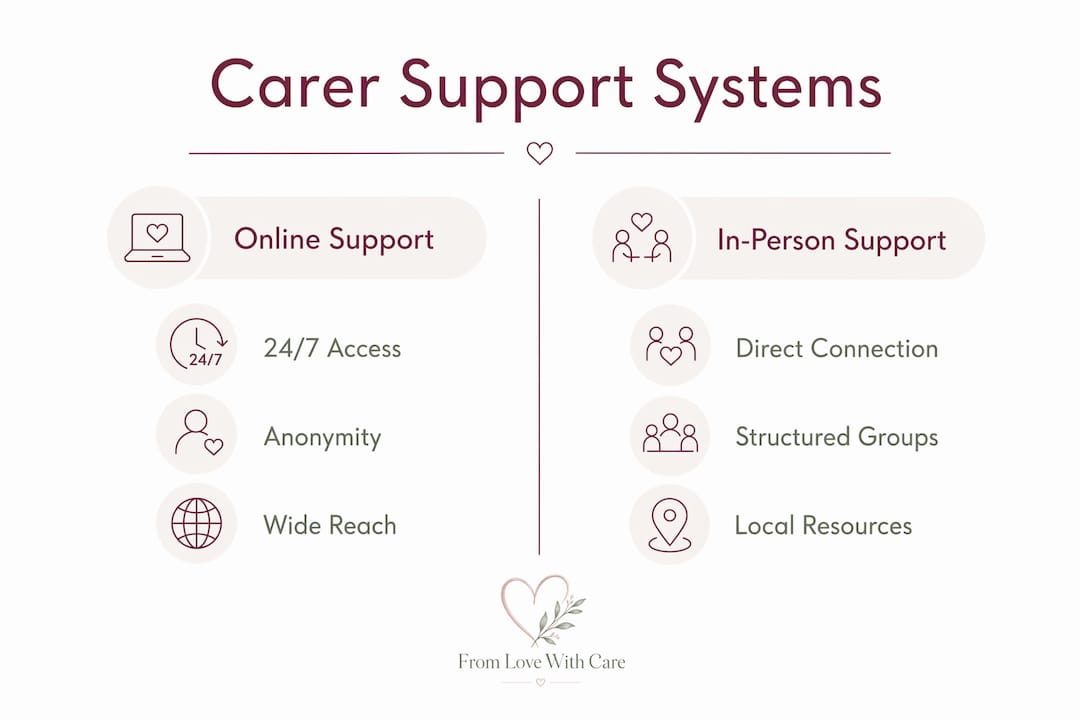
- Local carer support groups: Face-to-face groups run by charities and local authorities offer peer connection, shared experience, and practical advice.
- Online forums and communities: Digital spaces allow carers to connect at any hour, particularly useful for those who cannot leave the home easily.
- Workshops and training: Many carer organisations offer free workshops on stress management, legal rights, and practical care techniques.
- Respite and companionship services: Professional services, including those offered by Fromlovewithcare, provide carers with reliable breaks by ensuring their loved ones receive attentive, vetted companionship. Learn more about caregiver support services available across the UK.
How can carers build effective emotional self-care strategies?
Self-care for carers is not about indulgence. It is about maintaining the capacity to keep caring. Respite care and companionship support reduce caregiver burnout and preserve emotional wellbeing by giving carers restorative time away from their caring role. Even a few hours each week can reset mental energy and reduce the risk of long-term breakdown.
Prioritising breaks without guilt
Carers often feel that taking a break is a betrayal of the person they care for. Expert guidance is clear: seeking support is a loving, professional choice that sustains long-term care quality. Reframing rest as a professional responsibility, rather than a personal luxury, makes it easier to accept help without shame.
Building connections beyond the caring role
Carers who maintain friendships, interests, and social contact outside of caregiving are better equipped to manage stress. This does not require large amounts of time. A regular phone call with a friend, a short walk, or a brief hobby session each week can anchor a carer's sense of self. Fromlovewithcare's part-time companion service supports this by providing trusted company for loved ones, freeing carers to step away without worry.
Using counselling and mindfulness
Counselling gives carers a confidential space to process complex emotions without judgement. Mindfulness techniques, including breathing exercises and body scans, help carers notice stress before it escalates. Many NHS talking therapy services accept self-referrals, meaning carers do not need a GP appointment to access support.
Pro Tip: Set a weekly check-in with yourself. Ask three questions: How am I sleeping? Have I spoken to a friend this week? Do I feel more tense than usual? These three signals are reliable early indicators of emotional strain.
What role does community play in carers' emotional wellbeing?
Connection is a biological necessity, not a social preference. Social isolation raises the risk of both physical and mental health problems, and carers are among the most at-risk groups for chronic isolation. Kaddy Thomas, a community care specialist, highlights that community support groups serve as vital lifelines for carers who would otherwise face their challenges entirely alone.
Isolation among carers is often invisible. A carer may spend every waking hour with another person and still feel profoundly alone, because the relationship is defined by need rather than mutual exchange. That distinction matters. Peer support groups offer something caregiving cannot: reciprocal connection, where carers both give and receive understanding.
The table below compares the benefits of online and in-person support groups for carers.
| Feature | Online support groups | In-person support groups |
|---|---|---|
| Accessibility | Available 24 hours, no travel required | Requires transport and a set time commitment |
| Anonymity | Higher; carers can share without being recognised | Lower; participants know each other |
| Depth of connection | Can feel less personal over time | Often builds stronger long-term bonds |
| Practical support | Limited to advice and signposting | Can include shared activities and local resources |
| Best suited for | Carers with limited mobility or time | Carers who benefit from face-to-face contact |
Dr Jackie Gray, a leading voice in carer health research, argues that caring must shift from being seen as a private family matter to a recognised public health priority. That shift starts when carers stop suffering in silence and start connecting with others who understand their experience. Resources such as Fromlovewithcare's loneliness support services exist precisely to bridge that gap for both carers and those they support.
Key takeaways
Carers who access emotional support, whether through peer groups, professional services, or GP registration, sustain better mental health and provide higher-quality care over the long term.
| Point | Details |
|---|---|
| Emotional support is a necessity | Carers' mental health directly affects the quality of care they provide. |
| Physical symptoms signal burnout early | Jaw clenching and chest tightness are warning signs carers should not ignore. |
| GP registration unlocks support | Registering as a carer and obtaining a Carer's Passport improves healthcare access and reduces anxiety. |
| Community reduces isolation | Peer support groups, both online and in-person, provide reciprocal connection that caregiving alone cannot offer. |
| Seeking help is a professional choice | Accepting respite and companionship support sustains long-term care quality, not undermines it. |
What I have learned from watching carers carry too much alone
I have spent a long time listening to carers describe their lives, and the pattern is always the same. They minimise their own needs. They say "I'm fine" when they are not. They feel guilty for wanting an hour to themselves. And then, quietly, they begin to unravel.
The thing that strikes me most is not the exhaustion. Exhaustion is expected. What surprises me is the shame. Carers are doing one of the most demanding jobs in society, entirely without pay, and they feel embarrassed to admit they are struggling. Dr Jackie Gray is right: caring has to stop being treated as a private matter. It is a public health issue, and it deserves public solutions.
What I have seen work, genuinely work, is not a single intervention. It is the accumulation of small acts of self-preservation. Registering with a GP. Joining one support group. Accepting a companion visit so you can sleep for an afternoon. None of these things feel dramatic. But together, they change everything.
Carers are not superhuman. They are people doing an extraordinary thing under ordinary human constraints. The most courageous thing a carer can do is ask for help before they reach breaking point. Not after.
— Ayomide
How Fromlovewithcare supports carers through companionship
Caring for someone you love is one of the most meaningful things you can do. It is also one of the most tiring. Fromlovewithcare provides vetted, compassionate companions who visit elderly and vulnerable adults at home, giving carers the reliable time away they need to rest and recover.
Each companion is thoroughly screened and trained to provide genuine human connection, whether that means sharing a cup of tea, accompanying someone on a walk, or simply being present. These visits do not replace a carer's love. They protect it. Explore Fromlovewithcare's full range of companionship and respite services and find out how a regular companion visit could give you the breathing space you deserve. You can also learn more about elderly companionship services designed to support both clients and the carers who love them.
FAQ
What is the role of emotional support for carers themselves?
Emotional support for carers protects their mental health, reduces burnout, and sustains the quality of care they provide. Without it, carers are at significantly higher risk of anxiety, physical illness, and social isolation.
How do carers seek emotional support in the UK?
Carers can seek support by registering with their GP, contacting a carer helpline, joining a peer support group, or arranging respite care through a professional service. Many of these options are free or low-cost.
Why do carers struggle to ask for help?
Carers frequently experience guilt when seeking support, believing it signals failure or selfishness. Expert guidance confirms that accepting help is a professional and loving choice that improves long-term care outcomes.
What are the early signs of carer burnout?
Physical symptoms such as jaw clenching, chest tightness, disrupted sleep, and persistent fatigue are early indicators of burnout that often appear before emotional distress becomes conscious.
How does community connection help carers' wellbeing?
Community and peer support reduce isolation by offering reciprocal connection, something caregiving relationships alone cannot provide. Support groups, both online and in-person, improve mental health and reduce the risk of chronic loneliness.