

A part-time companion is defined as a non-medical support worker who provides social engagement, conversation, and practical assistance to elderly adults, giving full-time family carers the respite they need to sustain their own wellbeing. Understanding why a part-time companion helps full-time carers is not a luxury consideration. It is a practical necessity backed by growing evidence. A 2026 respite intervention study found that 94% of participants showed reduced total stress scores after receiving structured respite support. That figure tells you something important: relief is not incidental. It is measurable, reproducible, and within reach for carers who act on it.
Why part-time companions reduce carer stress and isolation
Full-time carers carry a psychological weight that accumulates quietly. The constant vigilance, the interrupted sleep, the absence of time for yourself. These pressures do not announce themselves dramatically. They erode you gradually, and by the time you notice, burnout is already close.
Part-time companions address this directly by filling the social and supervisory gaps that cause the most anxiety. When your elderly relative has someone present for conversation, a shared walk, or accompaniment to a GP appointment, your mind is freed from the background hum of worry. Companion services provide exactly this: social engagement and presence that combats isolation, distinct from clinical or personal care tasks.
The psychological mechanism matters here. Perceived social support acts as a buffer against caregiving stress. Research confirms that social support buffers caregiver demands not by removing care tasks but by improving the relational and emotional environment around them. A companion does not replace you. They restore you.
Isolation is also a two-way problem. Your elderly relative may go days without meaningful conversation, which increases their distress and, in turn, increases yours. When a companion addresses their loneliness, you carry less of that emotional weight. The benefits of companionship for isolated adults extend directly to the carers who love them.
- Companions provide regular conversation and social stimulation for elderly relatives
- Accompaniment to appointments reduces carer scheduling pressure
- Recreational activities and shared interests improve the elder's mood between carer visits
- Consistent presence reduces the anxiety carers feel when they are not physically present
Pro Tip: Schedule companion visits during the hours you find most mentally draining, not just when you have errands. The psychological relief of knowing someone trustworthy is present is itself restorative.
What practical support do part-time companions actually provide?
Clarity about what companions do, and what they do not do, prevents the most common failure in part-time care arrangements. Role mismatch is the single biggest reason companion placements break down. When carers expect hands-on personal care from a companion, unmet needs accumulate and stress increases rather than decreases.
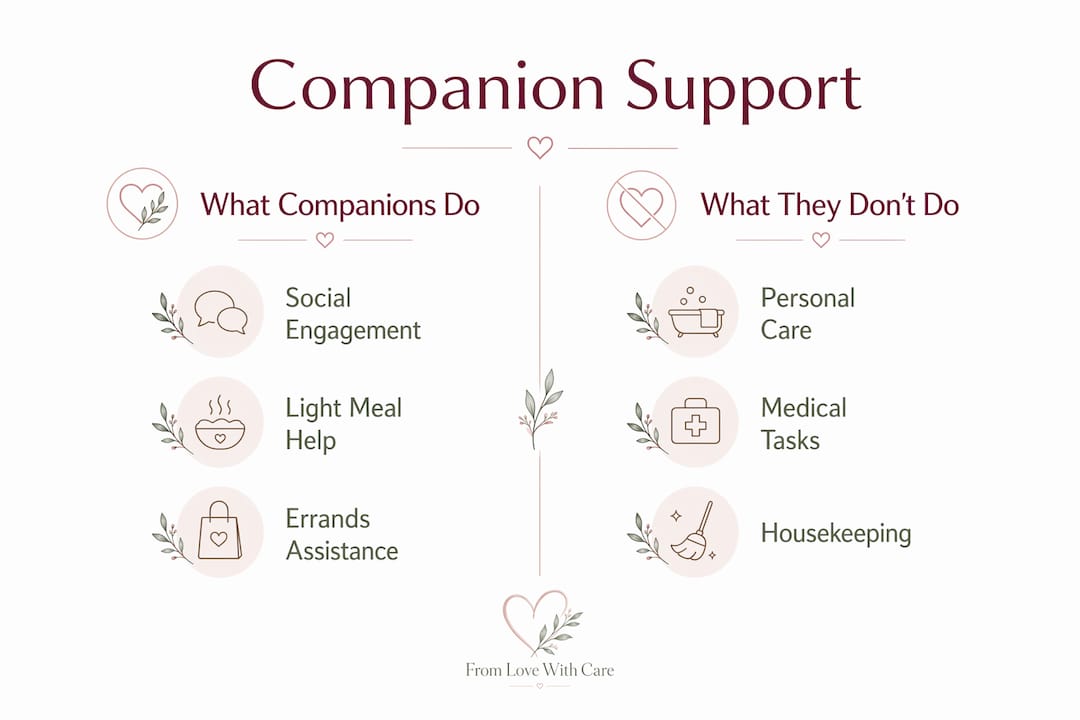
Regulatory boundaries are clear: companions do not perform bathing, dressing, toileting, or medication administration. These tasks require trained care workers or nurses and must be arranged separately. Companions operate in a different, equally vital space.
Here is what a well-matched companion typically provides:
- Light meal preparation and assistance at mealtimes
- Help with grocery shopping and local errands
- Light tidying and household organisation
- Conversation, reading aloud, and shared hobbies
- Accompaniment to social events, medical appointments, or leisure outings
- Friendly check-ins that provide reassurance and routine
Scheduling is genuinely flexible. Visit durations range from a few hours per week to extended daily visits, which means you can tailor the arrangement to your specific pressure points rather than accepting a fixed package.
| What companions do | What companions do not do |
|---|---|
| Conversation and social engagement | Personal care (bathing, dressing, toileting) |
| Meal preparation and light housekeeping | Medication administration |
| Accompaniment to appointments and outings | Skilled nursing or wound care |
| Recreational activities and shared interests | Heavy physical assistance or lifting |
Pro Tip: When arranging companion care, write down the three tasks that consume the most of your mental energy each week. Use that list to brief the companion service, not a general description of your relative's needs.
How does companionship improve elderly relatives' wellbeing?
The wellbeing of your elderly relative and your own stress levels are directly connected. When they are settled, engaged, and less lonely, you carry less secondary distress. This is not a soft observation. It is supported by systematic evidence.
A systematic review of interventions targeting social isolation in older adults found that face-to-face social interventions consistently improved psychosocial outcomes including reduced loneliness, improved quality of life, and better psychological wellbeing. The review focused on older adults with cardiovascular conditions, a group that closely mirrors the frail elderly population most carers support.
Loneliness in older adults is not simply an emotional inconvenience. It is associated with accelerated cognitive decline, depression, and worsening physical health. When a companion provides regular, meaningful interaction, they interrupt that decline. Activities such as reminiscence conversations, gentle walks, card games, or simply sharing a cup of tea create the kind of engagement that improves elderly wellbeing in ways that medical appointments alone cannot.
"Clients report significant improvements in their loved ones' wellbeing after regular companion visits, describing changes in mood, communication, and daily engagement that families had not seen in months." — Fromlovewithcare
The link between elder wellbeing and carer stress reduction is direct. When your relative is calmer, more socially engaged, and less distressed, your caregiving role becomes less reactive and more sustainable. You spend less time managing emotional crises and more time in genuine connection with the person you love.
How to integrate a part-time companion into your care routine
Bringing a companion into an established care routine requires more than booking a time slot. The carers who benefit most from part-time support are those who treat integration as a deliberate process rather than an afterthought.
Scheduling is the first lever. Research on optimising companion scheduling shows that targeting visits during strain-heavy periods, such as mornings when personal care demands peak or late afternoons when fatigue sets in, produces a stronger stress-buffering effect than random scheduling. Identify your hardest hours and protect them with companion cover.
Trust and communication are equally important. Relationship-building during intake is emphasised by respite programmes as a key factor in how quickly carers experience burden relief. A companion who understands your relative's preferences, routines, and personality is far more effective than one who arrives without context.
Personality matching also matters more than most carers expect. A companion who shares your relative's interest in gardening, music, or local history will generate genuine engagement rather than polite conversation. That quality of connection is what sustains mood improvements over time.
- Share a written summary of your relative's daily routine, preferences, and sensitivities with the companion before the first visit
- Arrange a brief introductory visit before the companion takes on solo time, to build familiarity
- Set a regular check-in with the companion service to review how visits are going and adjust as needed
- Use the time a companion is present for genuine rest, not just task completion
Pro Tip: Ask the companion service how they handle cover if your regular companion is unavailable. Continuity matters. An unexpected gap in visits can undo weeks of trust-building for both your relative and yourself.
Carers also benefit from understanding that improved sleep and mood directly affect care quality. When companion visits create genuine rest windows, the downstream effect on your resilience and patience is real. Rest is not self-indulgence. It is a clinical input into the quality of care you provide.
Key takeaways
Part-time companions reduce full-time carer stress by providing structured social support, practical assistance, and reliable respite that directly improves both carer wellbeing and elderly relatives' quality of life.
| Point | Details |
|---|---|
| Stress reduction is measurable | 94% of carers in a 2026 study showed reduced stress scores after structured respite support. |
| Role clarity prevents failure | Companions provide social and practical support only; personal care must be arranged separately to avoid unmet needs. |
| Elder wellbeing reduces carer burden | Systematic evidence shows face-to-face social interventions improve loneliness and quality of life in older adults. |
| Scheduling determines effectiveness | Targeting companion visits during high-strain periods produces stronger stress relief than ad hoc arrangements. |
| Trust accelerates relief | Relationship-building between carers and companions is a key factor in how quickly burden is reduced. |
What I have learned about companions and carer burnout
By Ayomide
The carers I speak with most often underestimate one thing: how much of their stress comes not from the physical tasks of caregiving, but from the relentless sense of being the only person watching. That background vigilance is exhausting in a way that a good night's sleep alone cannot fix.
What strikes me about part-time companionship is that it addresses precisely that. It is not about offloading tasks. It is about creating a reliable human presence that says to the carer: you are not alone in this. The peace of mind that companionship brings to families is something I have seen described in almost identical terms by carers from very different circumstances.
I also think carers are too quick to dismiss companions as a luxury they cannot justify. The evidence does not support that framing. When carer sleep improves, when anxiety reduces, when an elderly relative is visibly more settled, the quality of care that follows is genuinely better. That is not a soft benefit. It is the whole point.
The scheduling and relationship-building details matter more than most guides acknowledge. A companion who arrives without context, at the wrong time of day, for the wrong duration, will not deliver the relief that is possible. Get those details right, and the difference is transformative.
— Ayomide
How Fromlovewithcare supports full-time carers
Fromlovewithcare was built around a straightforward conviction: that human connection is not a supplement to care. It is care. Every companion on the platform is thoroughly vetted, matched to your relative's personality and interests, and scheduled around your specific pressure points as a carer.

Whether your relative needs a few hours of company each week or more regular visits, Fromlovewithcare offers flexible arrangements designed to fit around your existing routine. Cover for unavailable companions is built into the service, so continuity is protected. You can explore the full range of companion care services and arrange a visit that gives both you and your loved one exactly what you need. For families specifically concerned about isolation, the elderly companionship services page outlines how regular visits are structured to make a lasting difference.
FAQ
What does a part-time companion actually do?
A part-time companion provides social engagement, conversation, light meal preparation, help with errands, and accompaniment to appointments. They do not perform personal care tasks such as bathing, dressing, or medication administration.
How does a companion reduce stress for full-time carers?
By providing reliable, trustworthy presence with an elderly relative, a companion creates genuine rest windows for carers. A 2026 respite study found 94% of participants showed measurable stress reduction after structured respite support.
How many hours per week does a companion typically visit?
Visit frequency is flexible, ranging from a few hours per week to extended daily arrangements. The most effective approach is to schedule visits during the hours that place the greatest strain on the carer, rather than at times of convenience alone.
Can a companion help with loneliness in elderly relatives?
Yes. Systematic research shows that face-to-face social interventions consistently reduce loneliness and improve quality of life in older adults. Regular companion visits address the social isolation that worsens mood, cognitive function, and physical health.
How do I choose the right companion for my relative?
Prioritise personality and shared interests over availability alone. Companions matched to a relative's hobbies and communication style generate genuine engagement. Ask the service how they handle the matching process and what happens if the first match does not work well.