

Empathy is defined as the ability to understand and share another person's feelings, and it is the foundation of every meaningful companion relationship. Without it, even regular contact can feel hollow. Loneliness affects 40% of UK adults at least some of the time, and the emotional cost of that isolation is measurable. The role of empathy in companion relationships goes far beyond being kind. It creates the conditions for genuine trust, emotional safety, and lasting connection. Understanding how empathy works, and how to practise it well, matters for anyone who cares about the quality of their relationships.
How does empathy strengthen emotional bonds in companion relationships?
Empathy strengthens emotional bonds by allowing one person to perceive and validate what another is feeling, without judgement. This process is called emotional attunement. When a companion truly senses your emotional state and responds to it, you feel seen. That feeling of being seen is what separates a meaningful relationship from a polite one.

The "Three H's" framework offers a clear model for how empathetic interaction unfolds: Hear, Hug, and Help. The sequence matters. You listen first, offer comfort second, and only then move to practical support. Skipping straight to problem-solving, however well-intentioned, signals that you are more interested in fixing the situation than understanding the person. Most people need to feel understood before they can accept help.
Empathy also reduces conflict. When companions regularly validate each other's emotions, disagreements are less likely to escalate. Forgiveness comes more readily when both people feel their perspective has been acknowledged. Over time, this builds relational resilience. Relationships that practise consistent emotional attunement recover from difficulty faster than those that do not.
- Emotional validation tells the other person their feelings are real and acceptable, not a problem to be managed.
- Reflective listening involves repeating back what you have heard in your own words, confirming understanding before responding.
- Mindful presence means giving your full attention, without distraction, during emotionally significant moments.
- Compassionate silence allows space for the other person to process feelings without pressure to fill the gap.
Pro Tip: When someone shares a difficulty, resist the urge to offer a solution immediately. Say "that sounds really hard" before anything else. That single sentence does more to build trust than any advice that follows.
What does research say about empathy, loneliness, and mental health?
The evidence linking empathy, loneliness, and mental health is substantial. 57% of people in the UK feel lonely weekly or more, according to 2026 data. That figure is not just a social concern. It carries a direct cost to the NHS, with additional healthcare costs per lonely person ranging from approximately £350 to £885 annually depending on how frequently that person experiences loneliness.
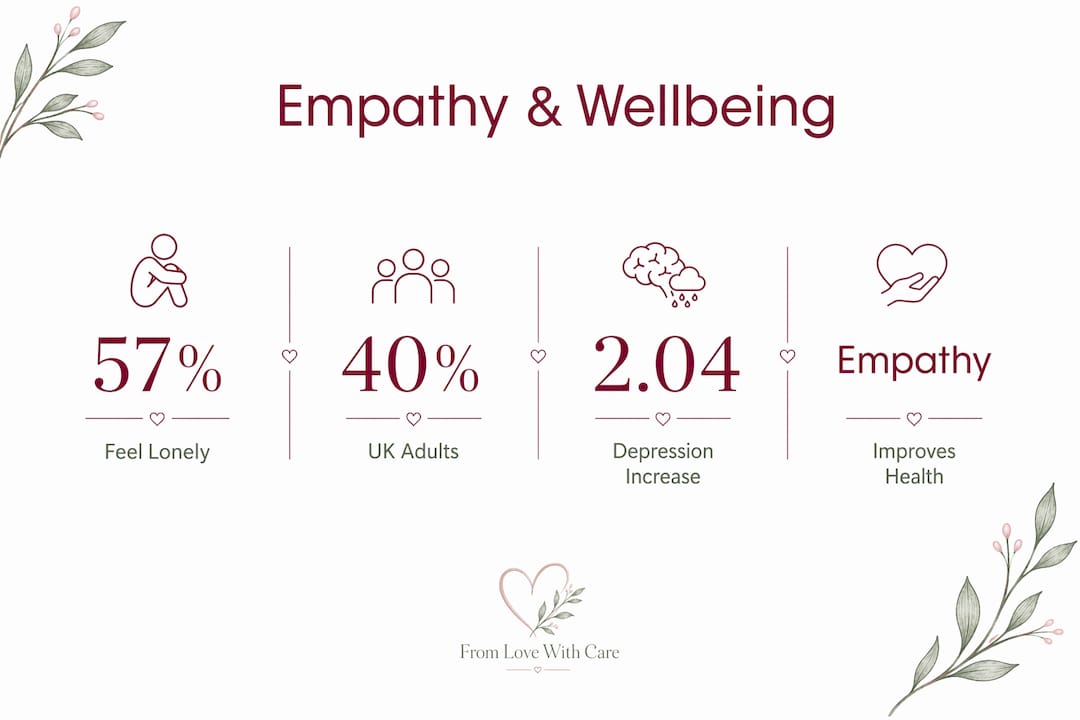
The mental health consequences are equally clear. Each one-point rise in loneliness predicts a 2.04-point increase in depression symptoms. That relationship is not coincidental. Loneliness and depression share a feedback loop, each reinforcing the other. Empathetic companionship interrupts that cycle by providing consistent emotional recognition and human connection.
| Statistic | Figure | Implication |
|---|---|---|
| UK adults feeling lonely at least some of the time | 40% | Loneliness is a mainstream experience, not a marginal one |
| UK adults feeling lonely weekly or more | 57% | Chronic loneliness affects the majority of those who report it |
| Adults in last year of life who feel isolated | 32.2% | Isolation intensifies at the most vulnerable life stage |
| Increase in depression per one-point rise in loneliness | 2.04 points | Loneliness directly worsens mental health outcomes |
| Annual NHS cost per lonely person | £350–£885 | Social isolation generates measurable healthcare expenditure |
Empathy training improves communication and patient health outcomes in clinical settings. That finding extends beyond healthcare. In any companion relationship, the deliberate practice of empathetic communication produces better emotional outcomes for both people involved. The benefits of empathy-driven companionship for isolated adults are well documented, particularly in reducing the frequency and severity of depressive episodes.
What are the challenges of practising empathy in companionship?
Empathy is not always straightforward to practise well. Several common pitfalls undermine its effectiveness, and recognising them is the first step to avoiding them.
Cultural variability is one of the most overlooked challenges. Non-verbal signals of empathy, such as eye contact, physical touch, and silence, carry different meanings across cultures. What reads as warm and attentive in one cultural context can feel intrusive or disrespectful in another. Cultural sensitivity is critical to authentic empathy, and companions who work across diverse communities need to learn and adapt continually.
Performative empathy is another significant risk. This occurs when someone goes through the motions of empathetic listening without genuine engagement. Performative listening can be counterproductive, particularly across cultural differences, because people are perceptive. They notice when attention is hollow. Authentic empathy requires real curiosity about the other person's experience, not a rehearsed set of responses.
Maintaining boundaries is equally important. Companions who absorb too much of another person's emotional pain without adequate self-care risk burnout. Empathy requires balancing emotional attunement with professional boundaries to remain sustainable over time. This is not a failure of compassion. It is a condition for it.
- Avoid jumping to reassurance before the other person has finished speaking.
- Avoid mirroring body language in an exaggerated or mechanical way. It reads as insincere.
- Avoid assuming you know how someone feels based on how you would feel in the same situation.
- Avoid offering solutions before the person has indicated they want them.
Pro Tip: If you are unsure whether someone wants advice or simply wants to be heard, ask directly. "Would it help to talk through some options, or do you just need to get this off your chest?" That question alone demonstrates empathy.
How can you build empathy in companion relationships?
Building empathy is a skill, not a fixed trait. It develops through deliberate practice, honest self-reflection, and a genuine willingness to understand people different from yourself.
-
Practise active listening. Give your full attention when someone speaks. Put away your phone, make comfortable eye contact, and resist the urge to plan your response while they are still talking. Active listening is the most direct way to signal that another person's experience matters to you.
-
Use reflective questioning. Ask open questions that invite the other person to go deeper. "How did that make you feel?" or "What was the hardest part of that for you?" These questions show genuine interest and help the other person feel understood rather than interrogated.
-
Develop emotional self-regulation. You cannot attune to someone else's emotions if your own are overwhelming you. Techniques such as slow breathing, brief pauses before responding, and naming your own feelings internally all help you stay present and calm during emotionally charged conversations.
-
Seek feedback. Ask trusted companions whether they feel heard and understood by you. Sustained empathy practice depends on concrete feedback, deliberate role-play, and self-regulation. Feedback is uncomfortable but necessary for genuine growth.
-
Learn from professional models. Person-centred care in nursing and social work emphasises emotional intelligence, relational care, and understanding each person's lived experience. These models offer practical frameworks that apply equally well in personal companionship. Reading about or observing these approaches builds your own empathetic repertoire.
-
Respect individual differences. No two people need empathy in the same way. Some people want physical comfort. Others need verbal acknowledgement. Some prefer quiet presence. Personalising your approach, rather than applying a single method, is what makes empathy feel genuine rather than formulaic.
How professional companionship fills care gaps offers a useful perspective on how trained companions adapt these techniques in real-world settings, particularly for adults who experience chronic isolation.
Key takeaways
Empathy is the single most important factor in companion relationships because it creates the emotional safety that allows trust, honesty, and genuine connection to develop.
| Point | Details |
|---|---|
| Empathy is foundational | Without emotional attunement, even frequent contact fails to reduce loneliness or build trust. |
| The Three H's sequence works | Hear first, offer comfort second, and help third. Skipping this order undermines the impact of support. |
| Loneliness has a measurable cost | Lonely adults cost the NHS up to £885 more per year. Empathetic companionship directly reduces this burden. |
| Performative empathy backfires | Hollow listening is worse than silence. Authentic curiosity is the only reliable foundation for empathetic connection. |
| Empathy is a learnable skill | Active listening, reflective questioning, and honest feedback all build empathetic capacity over time. |
Why empathy is the thing social care keeps getting wrong
I have spent years watching well-meaning people confuse presence with connection. Sitting in the same room as someone is not the same as being with them. The distinction sounds obvious, but it is the gap where most companionship fails.
The shift happening in adult social care right now is significant. Connection must be at the heart of social care, not just a pleasant add-on to task-based services. That view, articulated by social care expert Sarah McClinton, reflects something I have observed consistently. When care is organised around tasks, the person receiving it becomes a list of needs. When it is organised around relationship, they remain a full human being.
What strikes me most is how rarely people are taught to sit with someone else's discomfort without trying to resolve it. The instinct to fix is strong, and it is not unkind. But it often signals, unintentionally, that the other person's feelings are a problem rather than a valid experience. The most empathetic companions I have encountered are the ones who can stay present in difficulty without flinching.
Empathy also requires sustained effort. It is not a quality you either have or lack. It is something you practise, refine, and sometimes get wrong. The companions who do it best are not the ones who never make mistakes. They are the ones who notice when they have missed the mark and adjust. That quality, genuine curiosity combined with honest self-reflection, is what separates meaningful companionship from polite company.
— Ayomide
Compassionate companionship that puts empathy first
Fromlovewithcare was built on a straightforward belief: that genuine human connection is not a luxury. It is a necessity, particularly for adults and older people who may go days without a meaningful conversation.

Every companion at Fromlovewithcare is thoroughly vetted and trained to prioritise emotional attunement over task completion. Whether that means sharing a cup of tea, accompanying someone on a walk, or simply being a consistent, caring presence, the focus is always on the person, not the schedule. If you or someone you care about is experiencing loneliness or isolation, explore our companionship services to find out how professional, empathy-led support can make a real difference. You can also learn more about how our approach works before taking the next step.
FAQ
What is the role of empathy in companion relationships?
Empathy is the ability to understand and share another person's feelings. In companion relationships, it creates emotional safety, reduces loneliness, and builds the trust that makes connection meaningful.
How does empathy reduce loneliness?
Empathetic companionship provides consistent emotional recognition, which interrupts the feedback loop between loneliness and depression. Research shows each one-point rise in loneliness predicts a 2.04-point increase in depression symptoms, making empathetic connection a direct protective factor.
What is the Three H's model of empathetic support?
The Three H's stands for Hear, Hug, and Help. The model prioritises emotional validation and comfort before practical problem-solving, ensuring the other person feels understood rather than managed.
Can empathy be learned, or is it a natural trait?
Empathy is a learnable skill. Active listening, reflective questioning, honest feedback, and deliberate practice all build empathetic capacity. Professional training programmes in social care and healthcare use these methods to measurable effect.
Why does performative empathy fail in companionship?
Performative empathy, going through the motions without genuine engagement, is counterproductive because people recognise hollow attention. Authentic empathy requires real curiosity about the other person's experience, not a scripted set of responses.