

Companionship support is defined as non-medical, social and practical assistance designed to reduce isolation and improve quality of life for older adults. Helping a parent accept companionship support is one of the most delicate tasks adult children face, yet the approach you take matters far more than the timing. Framing it as an enhancement to your parent's lifestyle, rather than a concession to decline, is the single most effective starting point. The process typically spans 4–8 weeks before consistent caregiving is accepted, which means patience is not optional. Done well, supporting parents in companionship can genuinely transform their daily wellbeing and your peace of mind.
How to start conversations about helping your parent accept companionship support
The first conversation rarely succeeds on its own. Resistance is a natural response when someone feels their independence is being questioned. Your goal in early conversations is not agreement. It is simply to plant a seed without triggering defensiveness.
Start by choosing a calm, unhurried moment. Avoid raising the topic after a fall, a health scare, or a difficult visit, because those moments carry fear and urgency that make parents feel cornered. Instead, weave the idea into an ordinary chat about their week, their social life, or something they enjoy. This low-pressure framing signals that you are thinking about their pleasure, not their limitations.

Positive framing is not just kindness. It is a proven communication strategy. Framing companionship as a choice rather than an imposition reduces conflict significantly. Phrases like "I thought you might enjoy having someone to go to the garden centre with" land very differently from "I'm worried you're alone too much."
Active listening matters as much as what you say. When your parent pushes back, resist the urge to counter with facts or statistics. Validate their feelings first. Say "I understand you feel you're managing fine" before gently returning to the idea of connection and enjoyment.
Key communication principles to keep in mind:
- Spread conversations across several weeks rather than pressing for a decision in one sitting
- Focus on lifestyle benefits such as shared outings, conversation, and practical help with errands
- Avoid fear-based language about health decline or safety risks
- Acknowledge your parent's current strengths before raising the idea of additional support
- Never frame companionship as something the family needs. Frame it as something your parent deserves
Pro Tip: Introduce the idea through a specific, enjoyable scenario. "There's a service where someone could come along to the weekly market with you" is far easier to accept than a general conversation about "getting some help."
What is the difference between companionship support and personal care?
Companionship care provides non-medical social and practical support, which is entirely distinct from personal care involving physical or medical assistance. Understanding this difference helps you have clearer conversations with your parent and set more realistic expectations from the outset.
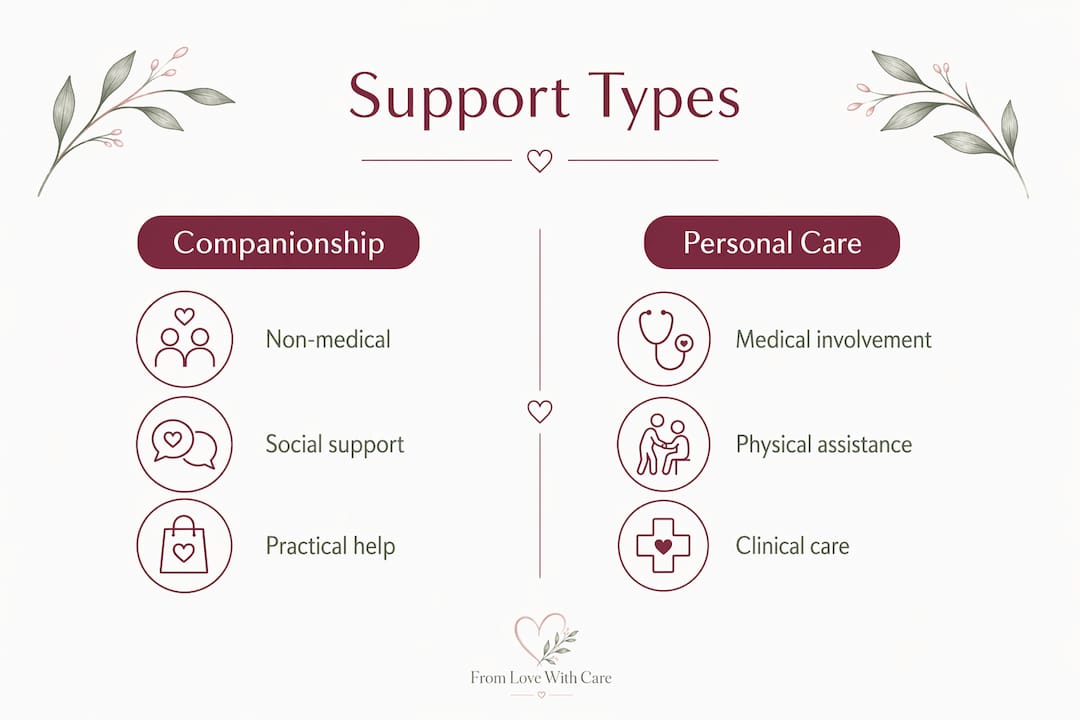
Many older adults resist "care" because the word carries connotations of dependency, illness, and loss of dignity. Companionship support sidesteps much of that resistance because it is centred on connection, not clinical need. A companion might share a pot of tea, accompany your parent to a GP appointment, help with grocery shopping, or simply sit and talk. None of these activities require medical training, and none of them signal that something is wrong.
| Feature | Companionship support | Personal care |
|---|---|---|
| Medical involvement | None | May include medication support |
| Physical assistance | Minimal (e.g., carrying bags) | Bathing, dressing, mobility |
| Primary focus | Social connection and daily activities | Physical and clinical needs |
| Typical activities | Conversation, outings, errands | Personal hygiene, wound care |
| Ease of initial acceptance | Generally higher | Often lower due to intimacy |
| Availability | Regulated agencies and voluntary schemes | Regulated care providers |
This distinction matters practically. When you explain to your parent that a companion is not a carer in the clinical sense, the conversation often shifts. You are not asking them to accept help with getting dressed. You are asking whether they would enjoy some company on a Tuesday afternoon. That reframing alone can remove the biggest psychological barrier.
Companionship support is available through regulated agencies such as Fromlovewithcare, as well as through local voluntary schemes. The range of companionship options available to older adults in the UK has grown considerably, giving families genuine flexibility in how they introduce this kind of support.
Step-by-step approaches to introducing companionship support practically
A phased introduction is the most reliable method for building acceptance. Rushing the process, or presenting it as a fixed arrangement from the start, almost always increases resistance. The goal is familiarity, and familiarity takes time.
-
Start with one short visit per week. Starting with very limited visits of one to two hours builds trust without overwhelming your parent. A single weekly visit feels manageable and non-intrusive.
-
Involve your parent in choosing the companion. Allowing parents to select their companion from a shortlist significantly lowers psychological barriers. Control over the choice increases both acceptance and trust. Failure to involve your parent in this decision frequently results in rejection or a strained relationship with the companion.
-
Set a clear trial period of 3–4 weeks. Framing the arrangement as a trial removes the pressure of permanence. Your parent is not committing to anything long-term. They are simply agreeing to try something for a month.
-
Review together after the trial. Ask your parent how they found the visits. What did they enjoy? What felt uncomfortable? This conversation reinforces their autonomy and gives you useful information for adjusting the arrangement.
-
Increase visits gradually based on comfort. Once trust is established, you can gently suggest adding a second visit or extending the duration. Let your parent lead this progression wherever possible.
-
Involve a neutral professional if needed. If gentle conversations over 4–6 weeks fail to gain acceptance, a GP or geriatric care manager can shift the dynamic. A professional voice carries different weight and can ease trust in a way that family conversations sometimes cannot.
Pro Tip: Let your parent interview the companion before any visit is confirmed. Fromlovewithcare supports this approach, and it gives your parent a genuine sense of ownership over the decision.
How do you overcome a parent's resistance to companionship support?
Fear of losing independence is the core barrier behind most parental resistance to accepting support. Recognising this changes how you respond. You are not dealing with stubbornness. You are dealing with a deeply human fear of becoming less capable, less autonomous, and less like the person your parent has always been.
Reframing support as an enhancement rather than a problem fix is the most effective counter to this fear. Presenting companionship as an enhancement to daily life, rather than a solution to a problem, improves acceptance measurably. Your parent feels supported rather than judged when the conversation centres on what they gain, not what they lack.
Modelling acceptance of help within your own life also helps. Showing support as a sign of wisdom normalises receiving it and reshapes your parent's perception. When adult children openly talk about asking for help themselves, it signals that needing support is not a weakness.
Do's and don'ts for navigating resistance:
- Do validate your parent's feelings before presenting any solution
- Do focus on their values, goals, and what matters most to them
- Do give them time and space between conversations
- Do involve a GP or care manager if family conversations stall
- Don't use fear-based arguments about safety or health decline
- Don't make decisions without your parent's input
- Don't present companionship as something the family has decided on
- Don't interpret resistance as a final answer
Pro Tip: Shift the framing from "your parent needs help" to "this will support their goals." That single change in language often transforms the entire conversation.
Key takeaways
Helping your parent accept companionship support works best when you prioritise their autonomy, introduce change gradually, and frame every conversation around what they gain rather than what they lack.
| Point | Details |
|---|---|
| Start gradually | Begin with one short weekly visit and build familiarity over 3–4 weeks before expanding. |
| Frame it as enhancement | Present companionship as a lifestyle addition, not a response to decline or risk. |
| Involve your parent in choices | Letting your parent choose their companion significantly increases acceptance and trust. |
| Validate resistance | Fear of losing independence drives most refusals. Acknowledge it before offering solutions. |
| Seek professional support if needed | A GP or care manager can shift the dynamic when family conversations alone are not working. |
What I have learned about helping parents accept support
Working with families navigating this process, I have noticed one pattern more than any other. The adult children who succeed are not the ones with the most persuasive arguments. They are the ones who slow down.
There is a strong temptation to present the case for companionship support clearly and completely, as if the right combination of facts will unlock agreement. It rarely works that way. What actually works is repeated, gentle exposure to the idea over weeks, combined with a genuine willingness to let your parent lead. The gradual introduction of a companion is not a workaround. It is the method.
The emotional shift I see in parents after they accept companionship is striking. What begins as reluctant tolerance of a weekly visitor often becomes something they genuinely look forward to. The companion becomes a consistent, trusted presence. That consistency is what loneliness lacks most.
Companionship is not a sign of weakness. It is a sign that someone in your family cares enough to make connection a priority. The parents who come to understand that tend to embrace it fully, often wishing they had started sooner.
— Ayomide
Fromlovewithcare: personalised companionship for your parent
Fromlovewithcare was built specifically to address the kind of loneliness that goes unspoken in many older adults' lives. The service focuses entirely on human connection, through shared activities like a cup of tea, a walk, or a trip to the shops, rather than clinical care.
Every companion is thoroughly vetted, giving families confidence that their parent is in safe, professional hands. Fromlovewithcare also supports the process of companion selection, so your parent can be involved in choosing who visits them. That involvement is not a small detail. It is central to how acceptance happens. If you are ready to take the next step, explore Fromlovewithcare's elderly companionship services and find the right match for your parent.
FAQ
What is companionship support for elderly parents?
Companionship support is non-medical social and practical assistance that reduces isolation and improves daily wellbeing. It includes activities such as conversation, shared outings, and help with errands, with no clinical or personal care element.
How long does it take for a parent to accept companionship support?
The process typically spans 4–8 weeks before consistent companionship is accepted. Starting with one short weekly visit and building gradually is the most reliable approach.
Why do elderly parents resist accepting help?
Fear of losing independence is the primary reason older adults resist support. Reframing companionship as an enhancement to their lifestyle, rather than a response to decline, significantly reduces this resistance.
Should I involve my parent in choosing their companion?
Involving your parent in companion selection is strongly recommended. Allowing parents to choose from a shortlist increases both acceptance and trust, and skipping this step frequently leads to rejection of the arrangement.
When should I involve a professional to help my parent accept support?
If gentle conversations over 4–6 weeks have not led to acceptance, involving a GP or geriatric care manager is advisable. A neutral professional can shift the dynamic and build trust in a way that family conversations alone sometimes cannot.