

The quickest way to reduce holiday loneliness for an isolated relative is to book a regular companionship visit or, if you're worried right now, an emergency welfare check from a DBS-checked companion. Arrange this ahead of the holidays where you can, and keep an emergency option in reserve for anything urgent. There are straightforward UK options available, with premium fees applying to same-day or urgent checks.
TL;DR:
- Booking regular companionship visits is generally more cost-effective and provides continuity that can detect subtle changes in a relative's wellbeing early.
- Emergency welfare checks are faster, structured assessments that are typically available with a premium fee and are useful for urgent concerns about a relative's safety.
- Ensuring vetting through DBS checks, references, and having clear escalation and consent plans in place is crucial for safe and reliable companionship support.
- Building a familiar routine, observing small changes, and engaging in activities tailored to your relative's interests enhances the effectiveness of visits and reduces holiday loneliness risks.
- During peak holiday periods, increasing visit frequency before and around Christmas and New Year offers better protection against isolation and unnoticed decline.
Table of Contents
- Quick checklist: who should book and what to arrange before the holiday
- What a companion visit and an emergency welfare check include
- How much companionship and welfare checks typically cost in the UK
- How to arrange reliable, regular visits and emergency welfare checks before and during holidays
- Safety, vetting and verifying a companion in the UK
- Practical tips to make companionship visits meaningful and reduce holiday loneliness
- Legal and privacy considerations for welfare checks during holidays
- Available community and voluntary support services for holiday loneliness
- Signs of holiday loneliness or distress to watch for during welfare checks
- Who should initiate holiday loneliness welfare checks
- Recommended frequency and timing of welfare checks during the holidays
- First-person perspective: what continuity quietly reveals
- How Fromlovewithcare can help this Christmas
- Sources
Quick checklist: who should book and what to arrange before the holiday
Not every relative needs the same level of support, and the holidays tend to expose gaps that go unnoticed the rest of the year. If someone lives alone, has had a recent health decline, or family are scattered across the country over Christmas, that's usually the trigger to book something rather than wait and see.
Before you make that call, work through a short list:
- Decide the format: a one-off welfare check for peace of mind, or regular companionship visits that continue through the holiday period and beyond.
- Gather the practical details: emergency contacts, GP surgery, current medication list, and how the companion will get in (key safe, neighbour, spare key).
- Agree an escalation plan: what happens if the companion is worried, who they call first, and how quickly you want to be told.
- Set expectations early: companionship covers company and light practical help, not medical or personal care, unless that's been specifically arranged.
Getting these four things sorted before the first visit saves confusion later, particularly if you're booking from a distance and can't easily pop round to check things yourself.
What a companion visit and an emergency welfare check include
A standard companionship visit centres on conversation, shared activities, and a bit of practical help: a cup of tea, a chat about the week, help writing Christmas cards, or a trip to the shops for last-minute groceries. Companions may also gently prompt meals or medication reminders where that's been agreed in advance, though companionship visits focus on company and light practical help rather than personal or medical care.
Where these visits earn their keep is continuity. A companion who visits weekly tends to notice things a relative who calls monthly simply won't: a shift in mood, a stumble mentioned in passing, a fridge that's suddenly less full than usual. Regular visits often let companions spot subtle changes before infrequent visitors do, which matters enormously when families are scattered over the festive period.
An emergency welfare check is different in kind, not just in urgency:
- Faster response, often same-day, sometimes within a set window
- A structured welfare assessment rather than a social visit
- A clear escalation route if something's genuinely wrong
Pro Tip: If you're not sure which to book, start with a one-off welfare check. It gives you a clear read on how your relative is coping, and you can convert it into a regular arrangement afterwards if needed.
How much companionship and welfare checks typically cost in the UK
Budgeting for this is straightforward once you know the range. Private companionship and visiting home services in the UK commonly charge hourly rates typical for the sector, with regional variation based on where you live and how the service is structured.
Most providers work on an hourly rate with a minimum visit length, usually one to two hours. Emergency or same-day welfare checks typically carry a premium on top of the standard hourly rate, reflecting the faster turnaround and the disruption to a companion's schedule. Some providers also charge a call-out fee separate from the hourly rate.
If cost is a factor, pre-booking a regular block of visits usually works out cheaper per hour than ad-hoc bookings, and it gives your relative something more valuable than a one-off visit: a familiar face who knows their routine. When comparing providers, weigh price against reliability and continuity of companion, not just the headline hourly rate.
How to arrange reliable, regular visits and emergency welfare checks before and during holidays
- Choose a schedule. Decide whether your relative needs a fixed weekly slot, extra ad-hoc visits over the holiday period itself, or both. Christmas week and New Year are when isolation tends to bite hardest, so build in extra cover around those dates specifically.
- Ask about continuity of companion. Matching on shared interests, language, or simply personality goes a long way toward making visits feel like a friend calling round rather than a scheduled task. Providers such as Fromlovewithcare build this matching into their process rather than treating it as a rota.
- Sort the paperwork first. Written consent from your relative, keyholder details, and a confirmed list of emergency contacts should all be in place before the first visit, not sorted out afterwards.
- Agree the escalation steps. Confirm exactly who the companion contacts first if they're concerned, whether that's you, another family member, or the GP, and what counts as urgent enough to call 999.
Getting these four steps right before the holidays start means you're not scrambling to arrange cover on Christmas Eve.
Safety, vetting and verifying a companion in the UK
Ask any provider for evidence of an enhanced DBS check before you book, not just a claim that checks happen. Companions should hold an enhanced DBS check, and a reputable provider will show you this without hesitation.
Beyond the DBS check, a few other things are worth confirming:
- References from previous families, not just internal testimonials
- How the provider handles ID verification and ongoing training
- What happens if your usual companion is unavailable, illness, holiday leave, and how quickly a replacement is arranged
One regulatory point catches families out: companionship-only services may not be registered with the Care Quality Commission in England, because CQC registration applies to personal and medical care, not social companionship. That's not a red flag in itself, but it does mean the vetting responsibility sits more with you as the family, so ask direct questions rather than assuming a regulatory badge exists.
Pro Tip: Ask the companion (or the provider) to leave a short note after each visit. Over a few weeks, these notes build a baseline you can compare against, which is exactly how small changes get caught early.
Practical tips to make companionship visits meaningful and reduce holiday loneliness
Small adjustments make a visit land better than a generic chat and a cup of tea. Match the activity to what your relative can actually enjoy: photo albums and reminiscing for someone with reduced mobility, a short walk for someone who's steady on their feet, or simply help with paperwork and post that's piled up.
A few things worth building into the visit itself:
- Use the same routine each time (tea first, chat, then a task) so visits feel familiar rather than clinical.
- Ask about connecting to a local community group, lunch club, or place of worship if your relative seems keen but hasn't had the confidence to go alone.
- Keep light prompts for hydration or medication if that's already been agreed, rather than introducing new tasks without discussion.
None of this needs to be elaborate. Consistency matters more than variety here.
Legal and privacy considerations for welfare checks during holidays
Booking a welfare check for another adult raises a genuine question of consent, and it's worth taking seriously rather than assuming family ties settle it automatically. A mentally capable adult has the right to decline visits, even from a well-meaning family member acting on their behalf, so wherever possible get your relative's agreement before booking rather than presenting it as a done deal.
Data protection also applies. Any notes a companion takes, medication reminders, mood observations, changes noticed, count as personal information under UK data protection law, so ask providers how they store visit notes and who they're shared with. You should expect a clear answer, not vague reassurance.
Where a relative lacks the mental capacity to consent (following a diagnosis of dementia, for instance), a Lasting Power of Attorney for health and welfare, or an existing arrangement with social services, may be needed before someone else can authorise ongoing care decisions on their behalf. If that's not already in place, it's worth raising with a solicitor rather than assuming a family relationship gives automatic authority.
Keyholder access is the other practical detail people overlook. If a companion is given a key or a key safe code, get this agreed and documented in writing, including what happens to that access once the arrangement ends. It sounds bureaucratic, but it protects both your relative and the companion if a dispute ever arises.
Available community and voluntary support services for holiday loneliness
Paid companionship isn't the only route, and it's worth knowing what sits alongside it. Volunteer-led welfare calls and check-in visits exist through various community organisations, and Well-Check's model of volunteer-run welfare calls is a useful example of how these community networks are structured, offering regular contact without the cost of a paid service.
Local authorities often run or fund befriending schemes, particularly around Christmas, and many church groups, community centres, and lunch clubs organise specific events for people who'd otherwise spend the day alone. GP surgeries sometimes hold lists of local groups too, so it's worth asking if your relative is registered with one.
The trade-off with voluntary services is usually consistency. Volunteers are generous with their time but can't always guarantee the same person visits week after week, and availability tends to dip exactly when demand rises, over the festive period itself. That's often where paid companionship fills a genuine gap: not replacing community support, but sitting alongside it when reliability matters most, such as during an extended holiday period when a family can't visit in person.
Signs of holiday loneliness or distress to watch for during welfare checks
Loneliness at Christmas rarely announces itself outright. It tends to show up in small, easy-to-miss details, which is exactly why continuity of visitor matters so much during welfare checks.
Watch for changes in appearance and routine: an unusually untidy home, meals not being prepared, or a fridge that's noticeably emptier than the last visit. Changes in mood matter too, a relative who's normally chatty going quiet, or someone dismissing questions with "I'm fine" a little too quickly and too often.

Physical signs are worth noting as well. Unexplained bruising, weight loss, or a stronger reluctance to move around the house than usual can all point to a decline that's gone unaddressed. Sleep disruption, mentioning being awake at odd hours, or seeming exhausted during a normally lively visit, is another marker worth flagging.
Isolation itself has a language. Comments like "nobody's been round in weeks" or a relative referring to the television as their main company deserve a follow-up conversation, not a polite nod. Companions who visit regularly are well placed to notice mobility, mood, or memory changes early, precisely because they have a baseline to compare against. A one-off visitor has nothing to measure against; a familiar companion does.
Who should initiate holiday loneliness welfare checks
In most cases, it's family who spot the warning signs first, a phone call that feels off, a Christmas card that never got sent, a relative who seems more withdrawn each time you speak. Family are usually the right people to initiate a welfare check, simply because they know the baseline behaviour best.
That's not always possible, though. Where family are absent, distant, or unaware of a decline, GPs, social workers, or local authority adult social care teams can initiate a welfare visit, particularly if a relative has recently been discharged from hospital or flagged as at-risk during a routine appointment. Neighbours and community contacts sometimes raise the first concern too, especially in close-knit areas where a missed bin collection or unopened curtains gets noticed quickly.
Whoever raises the concern, the practical booking step usually falls to family, arranging the visit, providing access details, and setting the escalation plan. If you're not local, this can all be done remotely: most providers, including Fromlovewithcare, handle bookings and instructions over the phone or online, so distance from your relative shouldn't stop you arranging cover.
Recommended frequency and timing of welfare checks during the holidays
The period between mid-December and early January is when loneliness tends to peak, so timing your bookings around it makes more difference than most families realise. Christmas Day and New Year's Eve are the two obvious pressure points, but the days either side, when everyone else has visitors and shops shut early, can feel just as isolating.
For someone already receiving regular companionship, it's worth adding one or two extra visits specifically over the Christmas and New Year fortnight, rather than assuming the usual weekly slot covers it. For someone without regular support, a single welfare check on Christmas Day itself, plus a follow-up call or visit on New Year's Day, gives reasonable coverage without overcommitting.
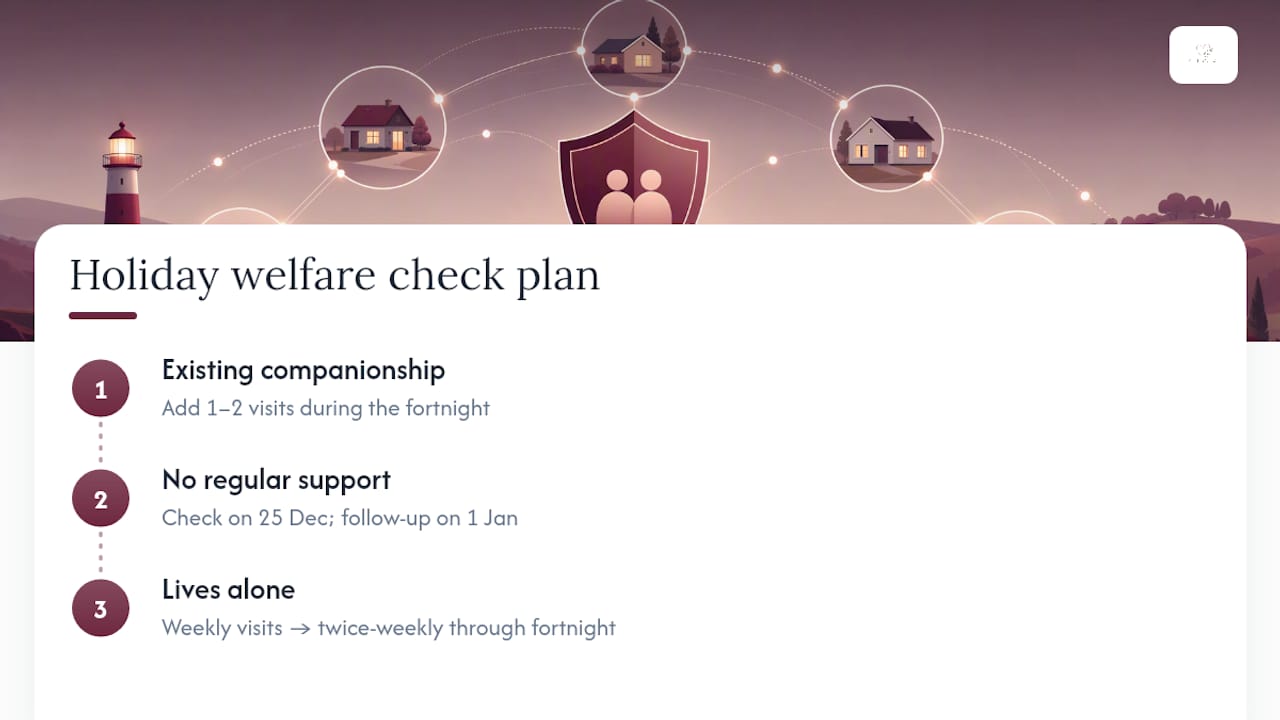
If a relative lives alone and has no visitors planned at all, weekly visits stepping up to twice-weekly through the holiday fortnight is a sensible baseline. Scheduled companionship visits give families reassurance precisely because they provide regular observation when family can't be there in person, and that reassurance matters more, not less, when everyone else is busy with their own Christmas plans.
First-person perspective: what continuity quietly reveals
The value of a regular companion rarely shows up in the visit itself. It shows up in the second or third visit, when the companion notices the fridge is emptier than last time, or that a normally talkative relative has gone quiet. That pattern, small deviations from a known baseline, is what a one-off visitor simply can't see. It's also why families who book ad hoc, only when worried, often miss the early signs that regular companionship would have caught weeks sooner.
— Ayomide
How Fromlovewithcare can help this Christmas
Fromlovewithcare gives you a fixed, paid alternative to hoping a volunteer call lands on the right day. Every companion is DBS-checked, and visits combine genuine conversation with the light practical help that catches small problems, an emptying fridge, a change in mood, before they become emergencies.
Fromlovewithcare's welfare check services cover both scheduled companionship visits and priority welfare checks for urgent situations. Families consistently report noticeable improvements in a relative's wellbeing once regular visits are in place, and continuity of companion, the same familiar face each time, is built into how bookings work rather than left to chance. If you'd like to see how matching and scheduling work in practice, how our companionship works explains the process end to end.
The next step is simple: visit the services page and book a visit or welfare check for the dates that matter most this holiday, before the calendar fills up.
Sources
For pricing norms, see NHS guidance on paying for care. For setting up visits, see matching and continuity guidance.
- Paying for your own care – NHS
- Companionship care: what it is, who it's for & how much it costs – Clarity Homecare