

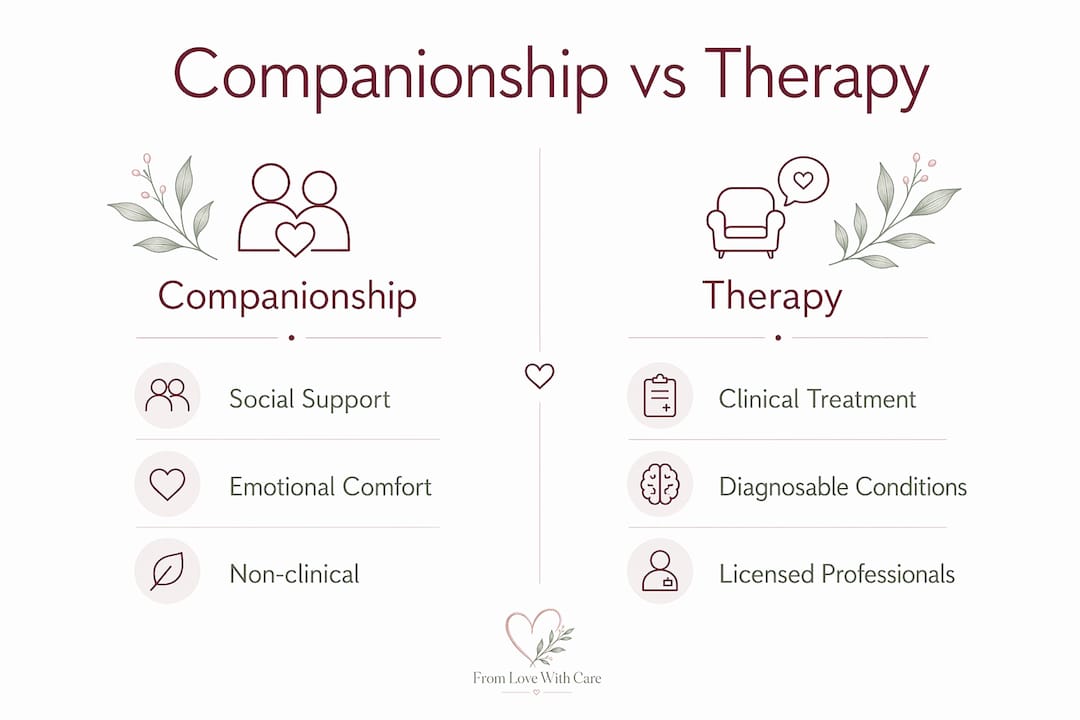
Companionship services are defined as non-medical, ongoing social and emotional support designed to reduce isolation and improve daily wellbeing. Therapy, by contrast, is a structured clinical intervention led by a licensed professional and aimed at diagnosable mental health conditions. Understanding how companionship services differ from therapy matters because choosing the wrong type of support can delay recovery or leave real emotional needs unmet. Fromlovewithcare is one example of a UK provider focused entirely on human connection, offering vetted companions for shared activities rather than clinical treatment. Knowing which service fits your situation is the first step towards genuine relief.
How do companionship services and therapy differ in purpose and scope?
Therapy is a structured clinical intervention with evidence-based practice aimed at diagnosable conditions such as major depression, PTSD, and clinical anxiety. It involves diagnostic assessment, clinical accountability, and behavioural change protocols delivered by a licensed counsellor or psychologist. The relationship is professional and non-reciprocal by design. That professional distance is what allows therapy to perform the psychological heavy lifting that companionship cannot safely replicate.

Companionship services, on the other hand, focus on social engagement and emotional comfort without any medical or therapeutic treatment. A companion might share a cup of tea, accompany someone to a GP appointment, or simply sit and talk for an hour. The relationship is mutual and based on shared humanity rather than clinical hierarchy. That relational quality is precisely what makes companionship valuable for people experiencing loneliness or mild emotional distress.
| Feature | Therapy | Companionship services |
|---|---|---|
| Delivered by | Licensed clinician | Vetted, trained companion |
| Primary goal | Treat diagnosable conditions | Reduce isolation, improve daily wellbeing |
| Session structure | Time-limited, structured protocols | Flexible, activity-led visits |
| Clinical accountability | Yes, with formal records | No clinical records or diagnosis |
| Relationship type | Professional, non-reciprocal | Mutual, relational |
| Cost and access | Higher cost, longer waitlists | More affordable, often immediate |
Pro Tip: If you are unsure which service you need, ask yourself one question: do you need a diagnosis or a conversation? The answer usually points clearly in one direction.
What activities and benefits do companionship services offer vs therapy?
Therapy sessions provide structured emotional processing. A therapist guides a person through techniques such as cognitive behavioural therapy, trauma-focused work, or dialectical behaviour therapy to build insight and change patterns of thought. The goal is clinical symptom management and lasting behavioural change. That process often involves sitting with discomfort, which is intentional and therapeutic.
Companionship services offer something different and equally real. Common activities include:
- Shared meals and tea-time conversations
- Accompanied outings to parks, shops, or community events
- Light assistance with errands such as grocery shopping
- Reading together, playing board games, or watching a film
- Regular check-in visits that provide a reliable social rhythm
The benefits of companionship services centre on belonging, comfort, and daily connection rather than clinical outcomes. People who receive regular companionship report feeling less invisible, more motivated to eat well, and more willing to leave the house. These are not small gains. Social isolation carries serious health consequences, and consistent human contact directly counters those effects.
Therapy outcomes look different. A person completing a course of cognitive behavioural therapy might develop tools to manage panic attacks, process grief, or challenge distorted thinking. These are clinical changes that companionship cannot produce. The emotional relief companionship provides is genuine but distinct from the clinical change therapy delivers through structured reflection.
When should you choose therapy over companionship, or vice versa?
The clearest guide is whether a clinical condition is present. Individuals with diagnosable conditions such as PTSD, major depression, or obsessive-compulsive disorder require therapy. Companionship is not a substitute for clinical treatment in those cases. Choosing companionship alone when therapy is needed risks allowing symptoms to worsen over time.
Use this framework to assess your situation:
- Identify the core problem. Is it a diagnosed or suspected mental health condition, or is it primarily loneliness and lack of social contact?
- Consider severity. Mild sadness and social withdrawal differ significantly from persistent low mood, suicidal thoughts, or trauma responses.
- Check access barriers. Therapy waitlists average 6–12 weeks and sessions typically cost considerably more per hour than companionship visits. Companionship can begin almost immediately.
- Assess your daily life. If you go days without speaking to anyone, companionship addresses that gap directly. If you are functioning socially but struggling internally, therapy is the more appropriate route.
- Be honest about avoidance. Many people mistake companionship for therapy and delay clinical treatment because companionship feels safer and less confronting. That avoidance can be costly.
Pro Tip: Companionship is most effective when arranged proactively, before isolation becomes entrenched. Waiting until someone is severely withdrawn makes the work of reconnection much harder for everyone involved.
Companionship suits people experiencing social isolation, mild emotional distress, bereavement adjustment, or the gradual withdrawal that can accompany ageing. It is also well suited to those already in therapy who need consistent social contact between sessions. Therapy suits people who need clinical diagnosis, structured treatment, and professional accountability.
How can companionship and therapy work together?
Therapy and companionship serve fundamentally different needs. Therapy is the deep work of recovery. Companionship is the continuous texture of daily life. Used together, they create a support system that addresses both clinical and social-emotional needs.
"Experts advocate integrated approaches where therapy handles the deep work and companionship provides the continuous social texture and sense of belonging that sustains people between clinical sessions." AI companion vs therapy (2026)
Consider a person recovering from a depressive episode. Their psychiatrist manages medication. Their therapist works through underlying patterns in weekly sessions. But between those appointments, the days can feel very long and very empty. A companion who visits twice a week for a walk and a shared lunch fills that gap in a way no clinical appointment can. The combination of therapy and companionship produces outcomes neither service achieves alone.
| Support need | Best addressed by | Why |
|---|---|---|
| Trauma processing | Therapy | Requires clinical training and safe protocols |
| Daily social connection | Companionship | Provides consistent human presence and routine |
| Behavioural change | Therapy | Structured techniques produce lasting insight |
| Reducing loneliness | Companionship | Mutual relationship meets the need directly |
| Crisis intervention | Therapy or clinical services | Companionship is not equipped for acute risk |
Fromlovewithcare works well within this integrated model. Its companions are vetted professionals who provide reliable, warm social contact. They are not therapists and do not attempt to be. That clarity of scope is a strength, not a limitation. Knowing what a service does and does not do allows families to build a genuinely complete support plan.
Key takeaways
Companionship services and therapy address different needs and work best when understood as complementary rather than competing options.
| Point | Details |
|---|---|
| Different purposes | Therapy treats diagnosable conditions; companionship reduces isolation and supports daily wellbeing. |
| Distinct relationships | Therapy is professional and non-reciprocal; companionship is mutual and relational. |
| Access and cost | Companionship is typically more affordable and available sooner than therapy. |
| Choosing correctly | Clinical conditions require therapy; social isolation and mild distress suit companionship. |
| Combined approach | Using both together addresses clinical and social-emotional needs more fully than either alone. |
What I have learned from watching people choose between these two services
People consistently underestimate how different these two services actually are. They hear "emotional support" and assume the services are interchangeable. They are not. Therapy asks you to sit with discomfort and examine it. Companionship offers warmth and presence without asking anything difficult of you. Both are valuable. Neither replaces the other.
The mistake I see most often is people using companionship to avoid therapy. It is understandable. Therapy can feel exposing and expensive. Companionship feels safe and immediate. But if someone is carrying unprocessed trauma or living with clinical depression, a friendly visit will not shift the underlying condition. It may even provide just enough relief to reduce the urgency of seeking proper clinical help.
The other mistake runs in the opposite direction. Families sometimes assume that because their loved one is seeing a therapist, the social dimension is covered. It is not. A weekly therapy session does not replace the human contact of a shared lunch or a gentle walk. Loneliness operates on a daily rhythm. Therapy operates on a weekly one. That gap matters enormously.
My honest view is this: if you are researching these options, you are already thinking more carefully than most. Use that clarity. Be specific about what the person actually needs. If it is clinical treatment, pursue it without delay. If it is daily human connection, do not underestimate how much that alone can change a life.
— Ayomide
Find the right companionship support with Fromlovewithcare
Fromlovewithcare provides professional, vetted companionship services across the UK, designed specifically for adults and elderly individuals who need consistent human connection rather than clinical treatment.

Every companion is carefully matched and thoroughly vetted, so families can trust the person coming through the door. Whether your loved one needs someone to share a meal with, accompany them on a weekly outing, or simply be present during long and quiet days, Fromlovewithcare offers a compassionate and reliable service. Explore the full range of companionship and support services or learn more about dedicated elderly companionship home visits tailored to individual needs. The right support is closer than you think.
FAQ
What is the main difference between companionship and therapy?
Therapy is a clinical intervention delivered by a licensed professional to treat diagnosable mental health conditions. Companionship is a non-medical service focused on reducing loneliness and providing social and emotional support through shared activities and regular human contact.
Can companionship services replace therapy?
Companionship services cannot replace therapy when a clinical condition is present. Substituting companionship for therapy in cases of PTSD, major depression, or clinical anxiety risks delaying treatment and allowing symptoms to worsen.
When should someone choose companionship over therapy?
Companionship suits people experiencing social isolation, mild emotional distress, or the loneliness that often accompanies ageing or bereavement. Therapy is the appropriate choice when a diagnosable mental health condition requires structured clinical treatment.
Can someone use both companionship and therapy at the same time?
Yes. Combining both services addresses clinical and social-emotional needs simultaneously. Therapy handles structured recovery work while companionship provides the consistent daily human connection that sustains wellbeing between sessions.
How do I know if a companionship service is trustworthy?
Look for providers who vet and train their companions thoroughly and operate with clear boundaries around what the service does and does not include. Fromlovewithcare, for example, screens every companion and focuses specifically on social and emotional support rather than medical or therapeutic care.