

The practical minimum for companionship visits in the UK is 30 minutes, following NICE guidance, though 60 minutes is what most providers and families find genuinely meaningful. Frequency ranges from a few hours a week to daily check‑ins or live‑in care, depending on need. Before booking, always ask a provider how they separate travel time from care time, and what their minimum booking policy actually allows.
TL;DR:
- Most UK providers and families find 60-minute visits more meaningful than the minimum 30-minute NICE guideline, especially for genuine companionship.
- Shorter visits of 15 minutes are almost always inadequate for conversation, while 30-minute slots risk being rushed and lack depth.
- Visit frequency ranges from a few hours weekly to daily, with longer, consistent visits and same companions offering stronger emotional benefits.
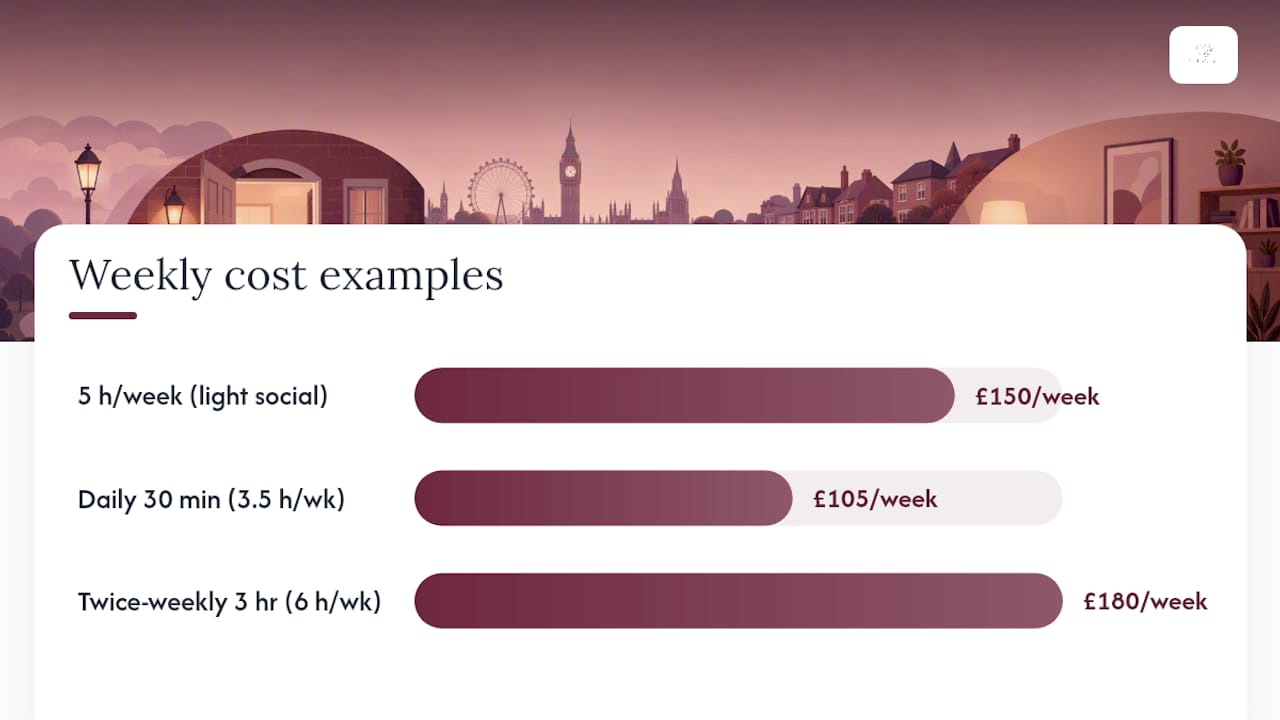
- Costs for privately funded companionship care typically fall between £26 and £38 per hour, with longer or more regular visits averaging around £105 to £180 weekly.
- Ensuring travel time is billed separately and confirming continuity with the same companion enhances the quality and effectiveness of care.
Table of Contents
- What is the minimum visit length for companionship care?
- What do NICE and statutory guidance say about visit length?
- How often should companionship visits happen?
- What does visit length and frequency cost, and where can you get help?
- How do you decide the right visit length for your relative?
- How Fromlovewithcare structures visits and what families see
- Why continuity matters more than an extra ten minutes
- Ready to arrange a visit that actually fits your relative's needs?
- Sources
- FAQ
What is the minimum visit length for companionship care?
NICE sets 30 minutes as the baseline for home care visits, and this figure has become the industry benchmark that most UK agencies quote when families ask about minimums. But a 30-minute visit and a genuinely useful companionship visit are not always the same thing. Providers and sector data both point towards 60 minutes as the length that actually delivers warmth, conversation, and connection rather than a rushed hello.
Market analysis from Care England shows a modest shift between 2022 and 2024 towards more 30‑minute visits and fewer 60‑minute ones, largely driven by non‑privately funded care where budgets are tighter. Privately funded companionship, the kind most families arrange directly, tends to favour the longer slot. Some CQC‑regulated providers, such as Neeryville Care, publish a 60‑minute minimum specifically for companionship, while others still offer 30‑minute options for lighter check‑ins.
Fifteen‑minute visits do exist in the wider care market, but they are built for narrow, practical tasks, prompting medication, a quick welfare glance, not conversation. Using a 15‑minute slot for companionship almost always backfires: there simply isn't time to settle in before it's over.
A few things shape what a provider will actually offer you:
- Whether the visit is privately funded or arranged through a local authority, which tends to run shorter slots
- Regional differences in staffing and pricing that affect how flexible providers can be
- Whether the visit is standalone or bundled into a wider care package
- The individual's needs, since someone with dementia or hearing loss may need longer simply to communicate well
What do NICE and statutory guidance say about visit length?
NICE's quality standard is explicit: older people using home care should receive visits of at least 30 minutes, except where a shorter visit for a specific task is agreed as part of a wider package. This is stated plainly in Quality statement 4 on the length of home care visits, and it exists because shorter visits were found to compromise dignity and rush essential interaction.
Visits under 30 minutes should be the exception, not the rule, according to NICE's NG21 recommendations, which call for contracts that build in enough time for genuine conversation as well as travel between visits.
The 30‑minute figure is a floor, not a target. NICE frames it as the minimum acceptable length for any visit involving personal contact, not the length providers should aim for when the goal is companionship rather than a task.
NG21 goes further than simply setting a number. It recommends that service contracts allow carers enough time to do their job properly, including travel between appointments, because a carer racing between back‑to‑back bookings cannot give anyone their full attention. This has a direct practical effect on scheduling: a well‑run provider should show travel time as a separate line in your contract, not buried inside the visit itself. If a 30‑minute slot secretly includes 10 minutes of travel either side, you are not really getting 30 minutes of companionship.
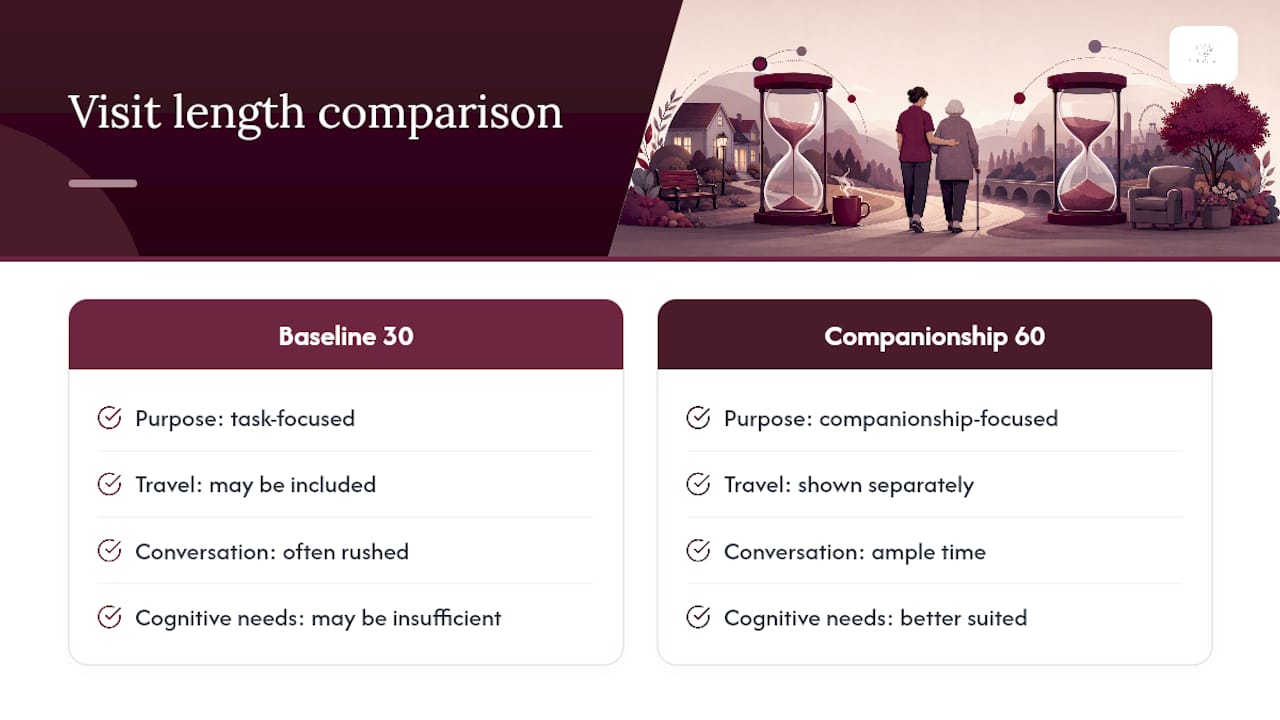
NICE guidance also flags that people with cognitive impairment, communication difficulties, or sensory loss often need longer visits simply to communicate effectively, a point worth raising directly with any provider if your relative falls into one of these groups.
How often should companionship visits happen?
Frequency depends on why the visit is happening in the first place. Loneliness, a general worry about missed social contact, or a specific concern about falls or medication all point towards different schedules.
- A few hours a week (around 5 hours split across two or three visits). This suits someone who is generally coping but would benefit from regular social contact, weekly shopping trips, or a standing chat over tea.
- Daily 30 to 60‑minute visits. Best for people who need a reassuring, predictable check‑in, whether for welfare reasons or because isolation has become a daily rather than weekly problem.
- Twice‑weekly longer sessions of 2 to 3 hours. Works well when the visit needs to cover an outing, a hospital or GP appointment, or an activity that simply can't be rushed into 60 minutes.
- Live‑in care for continuous companionship. Where isolation or vulnerability is severe, a live‑in arrangement removes the scheduling question altogether. However, it comes with a different contractual shape and cost structure than visiting care.
Most families start with one model and adjust. It's entirely normal to begin with twice‑weekly visits and move to daily contact once you see how your relative responds, or to scale back once a period of low confidence passes. For a broader look at how frequency and hours interact with budgeting, see this breakdown of weekly companionship hours.
What does visit length and frequency cost, and where can you get help?
Cost tracks visit length almost exactly, which makes budgeting more predictable than it might first appear. Privately funded visiting care in England typically runs at £26 to £38 an hour, with London and the South East sitting at the top of that range and Northern England and Wales generally cheaper.
Worked weekly examples help make sense of the models above:
- 5 hours a week at £30/hr comes to roughly £150 a week, suited to light, regular social contact.
- Daily 30‑minute visits (3.5 hours a week) land around £105, useful for welfare reassurance rather than long conversation.
- Twice‑weekly 3‑hour sessions (6 hours a week) come to around £180, appropriate where outings or appointments are involved.
- Live‑in care is priced weekly rather than hourly and sits well outside these ranges, reflecting round‑the‑clock presence.
A 30‑minute daily visit and a single 3.5‑hour weekly visit can cost roughly the same, but deliver very different experiences. Frequency, not just total hours, is often the more important variable to get right.
Funding help is worth checking before you commit to a schedule. Attendance Allowance may contribute towards costs depending on your relative's care needs, and local authorities apply their own means‑testing rules that can affect what, if anything, they'll fund. Our guide to the £23,250 threshold and council funding covers this in more depth.
Watch for contract terms that quietly inflate cost: minimum booking lengths that force you into longer (or shorter) visits than you want, travel time charged on top of the advertised rate, and cancellation or overrun policies that penalise flexibility.
How do you decide the right visit length for your relative?
Start with the outcome you actually want, not the shortest or cheapest slot on offer. A visit built purely for companionship, conversation, tea, a shared hobby, works differently to one built around a practical task like shopping or an appointment.
- Match length to need. Straightforward social contact can work in 30 to 60 minutes; anyone with dementia, hearing loss, or communication difficulties usually needs the longer end of that range simply to settle into conversation.
- Check the contract, not just the price. Ask whether travel time is separate from care time, whether you'll see the same companion regularly, and whether all companions are DBS‑checked.
- Trial before you commit. A two‑ or three‑week trial period reveals more about fit than any brochure, and lets you adjust length or frequency with evidence rather than guesswork.
- Protect mealtimes and medication slots. These need a fixed, unhurried window rather than being squeezed into whatever time is left at the end of a visit.
Pro Tip: If a provider offers only 15‑minute companionship slots, treat that as a warning sign rather than a bargain. NICE explicitly discourages visits that short for anything beyond a narrow task, and companionship built to that guidance simply doesn't fit into a quarter of an hour.
Renegotiate if visits are regularly overrunning without agreement, or if you notice the same companion rarely returns. Continuity matters more than most families expect going in.
How Fromlovewithcare structures visits and what families see
Visits are built around interactions that reduce isolation: shared tea, a supermarket trip, help getting ready for a hospital appointment, rather than a checklist of tasks. Companions should ideally be DBS‑checked and trained before matching, with continuity prioritized so the same familiar face returns rather than a rotating cast of strangers.
Visit lengths are typically aligned with NICE's guidance: 60 minutes is often recommended for meaningful companionship, with longer sessions arranged for outings or appointments that can't be rushed. Trial visits can help families see how a relative responds before committing to a recurring schedule, and travel time should be planned separately so the booked visit time is genuinely spent with the relative, not reduced by travel between clients.
Some clients report a noticeable shift in mood and confidence once visits become predictable, a change that can be observed over time through regular contact.
Why continuity matters more than an extra ten minutes
Families often ask whether to push for a longer visit or a more frequent one, as if the two were interchangeable. They aren't. A predictable, recurring slot with the same companion tends to matter more than squeezing an extra 10 minutes out of an occasional visit, because rapport builds over repeated contact, not single sessions.
Where budgets allow, I'd choose 60‑minute visits with the same companion over 90‑minute visits with a rotating one. A relative who knows who's coming on Tuesday morning settles into that visit faster than someone meeting a new face each time, however long the appointment runs.
— Ayomide
Ready to arrange a visit that actually fits your relative's needs?
Alternative companionship services aim to provide straightforward options compared to piecing together care yourself or relying on ad hoc favours from neighbours: companions are expected to be DBS‑checked, and visits should be booked with travel time kept separate from time actually spent with the recipient. That means the booked time is genuine company time, not shortened by scheduling constraints.
Bookings range from a single trial visit to recurring weekly packages, so you can start small and build up frequency once you see how your relative responds. If continuity matters to you, and for most families it does, ask about keeping the same companion for every visit rather than accepting whoever's available that week.
The next step is simple: arrange a free chat to talk through what your relative needs, ask directly about minimum visit lengths and companion continuity, and see how our companionship works before booking your first visit through our elderly companionship services page.
Sources
- Quality statement 4: Length of home care visits | NICE
- Home care cost per hour in London 2026 | Tidal Living
- Gov
FAQ
How much does companionship care cost?
Privately funded companionship visits in England typically cost £26 to £38 an hour, with London and the South East at the upper end and Northern England and Wales generally cheaper.
What are some ways to find a companion for an elderly person?
You can search local authority directories, use the NHS service finder for home care, or book directly through a specialist companionship provider such as Fromlovewithcare, which vets and DBS‑checks every companion before matching.
What does "need a companion" mean in a care context?
It usually means someone would benefit from regular, meaningful social contact, conversation, shared activities, or someone present during errands and appointments, rather than hands‑on personal or medical care.
How long should a companionship visit last?
Thirty minutes is the widely cited minimum under NICE guidance, but 60 minutes is generally recommended for a visit to feel genuinely social rather than rushed.
How do I become a companion carer?
Providers typically require a DBS check, references, and relevant training before matching candidates with clients, though specific entry routes vary by employer and region.