

Most companionship visits booked online, by phone, or over a booking form count as off‑premises or distance contracts, which gives you a 14‑day cooling‑off period by law. If you ask the companion to start visiting before that window closes, you can still cancel, but you may need to pay a fair amount for visits already carried out. Any provider worth trusting will show you their cancellation terms before you pay, not bury them in small print afterwards.
TL;DR:
- Cancellation terms must be clearly written and provided before payment, ensuring families understand their rights and potential charges upfront.
- The 14-day cooling-off period for off-premises contracts generally applies unless the service is fixed on a specific date or has already been fully performed with prior consent.
- Cancellation fees should reflect actual losses, such as travel costs or scheduled time, not punitive penalties, with notice periods graded accordingly.
- Exceptions like hospital admissions or urgent needs allow for fee waivers or flexible cancellation conditions, which providers should specify in writing.
- Check a provider’s cancellation policies by asking specific questions before booking, and keep written confirmation and timestamps to avoid disputes.
Table of Contents
- What the law says about cancelling companionship visits
- Exceptions and special cases in companionship visit cancellations
- What a fair companionship visit cancellation policy looks like
- How to check a provider's cancellation terms before you book
- How Fromlovewithcare applies these cancellation rules
- Why fair cancellation terms matter more than they seem
- Booking a companion with clear cancellation terms
- Sources
What the law says about cancelling companionship visits
The starting point for almost every family booking companionship support is the Consumer Contracts (Information, Cancellation and Additional Charges) Regulations 2013. Regulation 29 gives consumers a 14‑day cancellation period for contracts made at a distance, such as online bookings, or off‑premises, such as a phone call or a home visit from a salesperson. That clock generally starts running from the day the contract is agreed, not from the first visit.
This matters more than it sounds. A family arranging weekly companionship visits for an elderly parent, perhaps after seeing a service advertised online, is entering exactly the kind of contract these regulations were written for. You are not signing something in a shop or an office. You are agreeing to a service over the phone or through a website, and the law recognises that this kind of decision deserves a safety net.
Here is where it gets genuinely useful for anyone worried about locking themselves into something too quickly. Say you book a companion to start visiting your father tomorrow because you are heading back to work and need cover urgently. You are allowed to ask for the service to begin within the 14‑day window. But under regulation 36, if you then cancel a few days later, the provider can charge you proportionally for the visits that already happened, not the full contract value. If visits took place before you cancelled and the arrangement covered more, you owe a proportionate amount of the cost corresponding to the visits received, not the whole amount.
There is a sharper protection buried in the same regulation. If the provider failed to tell you about your right to cancel, or didn't explain how charges work during the cancellation period, you may owe nothing at all for the visits supplied, even if the companion has already been round several times. That single rule is why point‑of‑booking transparency isn't a nice‑to‑have. It's the difference between a provider being able to charge you fairly and a provider having no legal footing to charge you at all.
One distinction worth holding onto: contracts formed entirely on the provider's premises, where you walk in, discuss the service face to face, and sign up there and then, generally fall outside these cooling‑off rules. Companionship bookings almost never happen this way. Nearly every arrangement starts with a phone call, an enquiry form, or an email, which keeps the 14‑day right firmly in play. Refunds owed under cancellation must be processed promptly and providers are expected to give this cancellation information in writing, not just mention it in conversation.
Exceptions and special cases in companionship visit cancellations
The 14‑day right is broad, but it isn't absolute, and knowing where it bends helps you read a provider's terms without panic or false confidence. A handful of statutory exceptions exist across consumer contracts generally, though not all apply neatly to companionship services:
- Urgent repairs or maintenance, where a tradesperson is called out for an emergency fix, sit outside standard cancellation rules; companionship visits rarely count here, but it explains why some care‑adjacent services are excluded.
- Accommodation, transport, or leisure services tied to a specific date, such as a booked holiday cottage for a fixed week, are exempt because the business can't easily resell that slot.
- Contracts formed entirely on the trader's premises, with no distance element at all, fall outside the off‑premises rules by definition.
- Services fully performed within the cancellation period, at your express request, with your acknowledgement that you'll lose the right to cancel once complete, can close off the cooling‑off right once finished.
For companionship visits specifically, the practical exceptions tend to look less like legal loopholes and more like real life intervening. Consider a family that books a companion to help their mother get to and from a hospital appointment next Tuesday. That's a service tied to a fixed date, similar in spirit to the leisure exception, and it changes how cancellation should be handled if the appointment is cancelled by the hospital instead of the family.
Or picture the more common scenario: a companion is booked for daily visits, the visits begin immediately at the family's request, and then the parent is admitted to hospital after four days. The contract hasn't been "fully performed," so cancellation rights haven't necessarily lapsed, but the practical question becomes how the remaining, unused visits are refunded or credited. A provider who has thought this through in advance, rather than improvising once you're upset and calling them, is the one worth trusting. Families arranging a companion at short notice after a hospital discharge will recognise this pattern: urgency on the way in, uncertainty on the way out, and a policy needs to cover both directions.
What a fair companionship visit cancellation policy looks like
A cancellation policy for services is only fair if the charges genuinely reflect what the provider loses, not what they can get away with charging. Legal guidance on cancellation fees is consistent on this point: fees must map to real business loss, not act as a penalty for changing your mind. Here's what that should look like in practice for a companionship visit refund policy.
- Notice periods should be graded, not blanket. A cancellation made a week ahead should cost you nothing. One made 24 to 48 hours ahead might carry a partial charge because a companion's schedule can't always be refilled that quickly. A same‑day cancellation, particularly if the companion is already travelling, is where a fuller charge starts to make sense.
- Fees should trace back to an actual cost. If a companion has blocked out two hours of their day and travelled across town, a same‑day cancellation fee that covers their time and unrecoverable travel is defensible. A fee that's simply "one visit's full price, no matter what" starts to look like a penalty rather than a genuine loss calculation, something care sector guidance specifically warns providers against.
- Terms need to be visible before you pay, not after. This means on the booking page, in a confirmation email, or in a written document you're asked to accept, not a link buried three clicks deep in a footer.
- Human exceptions should exist and be named, not implied. Hospitalisation, sudden bereavement, or an unplanned care home admission are the kinds of events no family should have to argue about. A written commitment to waive fees in these circumstances tells you a provider has actually thought about the people using the service, not just the spreadsheet behind it.
- Refunds and credits should have a stated timescale. "We'll sort it out" is not a policy. "Refunds are processed within five working days" is.
Pro Tip: Ask any provider, before you book, exactly what would happen if your relative was admitted to hospital the day after a fortnight's worth of visits was booked and paid for. Their answer, and how quickly it comes, tells you more about their cancellation terms than the written policy ever will.
Watch for a few warning signs while you read any provider's terms. A blanket "non‑refundable" statement with no breakdown of why is a red flag, because genuine business loss should be calculable, not asserted. So is a cancellation policy that only appears after you've paid, rather than during the booking journey. And so is any provider who can't give you a straightforward answer, in writing, about how to actually cancel, whether that's a phone number, an email address, or a form.
Travel time is one area where the maths of "real cost" gets murky fast, and it's worth understanding how companions charge for travel before you assume a cancellation fee is inflated. A fee that includes a companion's genuine travel cost to your door is different from one that simply pads the bill.
How to check a provider's cancellation terms before you book
A few direct questions, asked before you hand over any payment details, will tell you almost everything you need to know about how a provider handles cancellation policy for companionship visits.
- "Where are your cancellation terms written down, and can you send them to me now?" A provider who hesitates or can only describe them verbally hasn't built a proper cancellation policy for services, whatever they might tell you on the phone.
- "At what point is the contract actually formed, the enquiry, the confirmation, or the first payment?" This matters because your 14‑day cooling‑off period starts from that moment, not from your first visit.
- "How do I notify you if I need to cancel, and what happens next?" You want a named email address or phone number, not a vague "just let us know."
- "What happens if I need to cancel because of a hospital admission or emergency?" Listen for whether they mention this unprompted or only when pushed.
Keep a simple paper trail as you go: save the booking confirmation email, screenshot the terms page if they're only shown online, and note the date you accepted them. This becomes your evidence if a dispute ever arises over what you agreed to and when. If a provider later insists you accepted different terms to the ones you remember seeing, a screenshot with a timestamp settles the argument quickly.
If a compassionate exception isn't offered but you need one, ask in writing rather than by phone; a written request creates a record and often prompts a more considered response than a rushed conversation. Should a provider refuse a reasonable request, or keep more of your money than seems fair, Citizens Advice sets out the practical steps for challenging it, and Trading Standards or small claims guidance are the next stops if a written complaint doesn't resolve things.
How Fromlovewithcare applies these cancellation rules
Fromlovewithcare builds its booking process around the principle that families should never be guessing what happens if plans change. Cancellation terms, including notice periods and how refunds or credits are handled, are set out clearly at the point of booking, so you know exactly where you stand before a single visit takes place, in line with what the companionship service works day to day.
Every companion working with Fromlovewithcare is DBS‑checked and trained specifically in providing emotional support and social connection, not medical or personal care. That distinction shapes the cancellation approach too: visits are about human presence, tea and conversation, help with the shopping, company on the way to an appointment, so the terms are written with real family circumstances in mind rather than a rigid service‑contract template borrowed from elsewhere.
Compassionate exceptions sit at the centre of that approach. Hospitalisation, a sudden change in a loved one's condition, or an unplanned admission shouldn't turn into a billing argument at the worst possible moment for a family. Confirmations are sent in writing, notice periods are stated rather than implied, and refunds or credits are processed against the agreed terms rather than left open to interpretation after the fact.
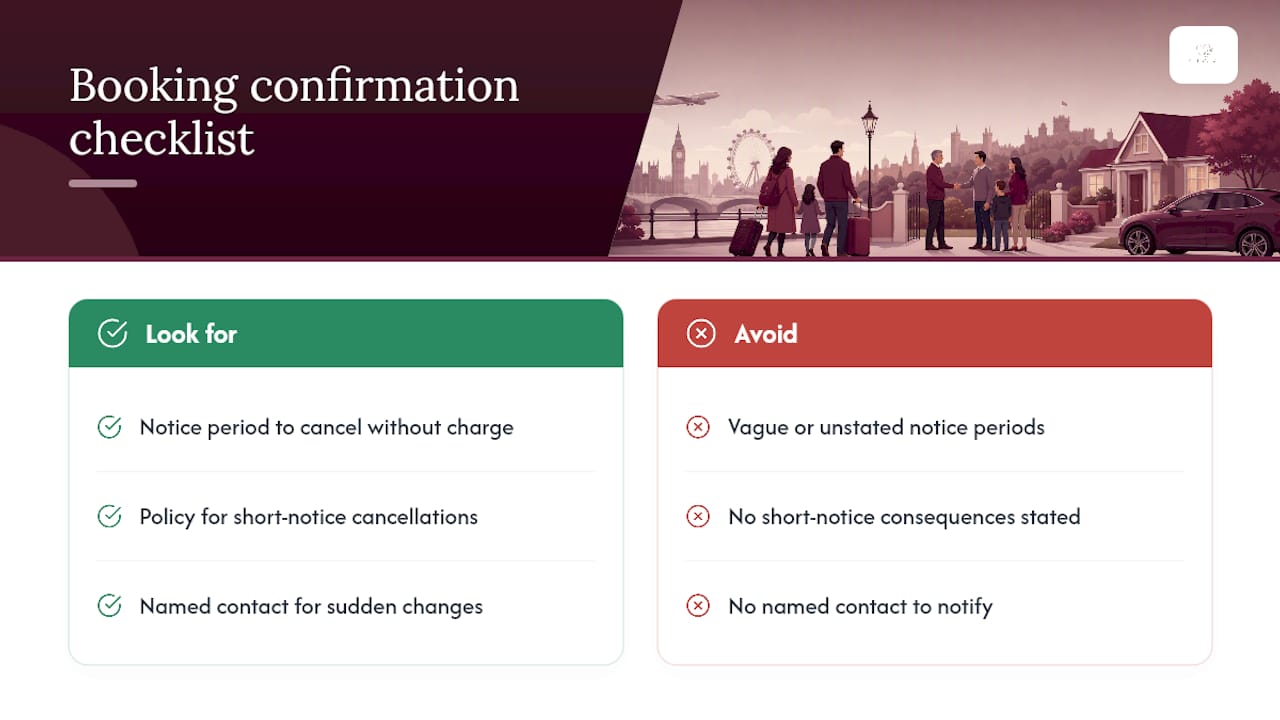
When you're checking any provider's confirmation, including Fromlovewithcare's, look for three things in writing: the notice period required to cancel without charge, what happens if you need to cancel at short notice, and a named way to get in touch if your circumstances change suddenly. Those three lines tell you more about a provider's real intentions than a page of legal‑sounding text ever will.
Why fair cancellation terms matter more than they seem
Cancellation policies sound like the dullest part of booking a companion, right up until the moment your circumstances change and you need one to actually work. That's the point at which vague terms stop being an inconvenience and start being a source of real distress for a family already under pressure.
What strikes me most, working through these regulations, is how much of the tension around cancellation policy for companionship visits could be avoided simply by writing things down properly. Families aren't usually trying to dodge fair charges. They're trying to avoid being caught out by terms they never actually saw. A provider that puts its policy in writing before you pay, and honours compassionate exceptions without a fight, is signalling something bigger than good admin. It's signalling that the relationship is built on trust rather than fine print.
My advice is simple: ask for terms in writing, ask about hospital and emergency exceptions before you need them, and treat a provider's willingness to answer clearly as the real test.
— Ayomide
Booking a companion with clear cancellation terms
A good companionship service sets out cancellation terms clearly at the point of booking, including notice periods, refund or credit calculations, and compassionate exceptions for hospitalisation or emergencies, so families know what to expect if circumstances change.
That clarity matters most for families juggling unpredictable situations, an ageing parent, a sudden hospital stay, a care plan that shifts week to week. You shouldn't have to chase a provider for answers about what happens if plans fall through. Companions are trained for providing companionship rather than medical care, focusing the service on delivering regular human connection, conversation, and practical support like help with shopping or assistance attending appointments.
If you're weighing up options for elderly companionship services or want to understand loneliness support in more depth, visit our services page to see what a visit involves and how booking works, then get in touch to talk through your family's specific situation before you commit to anything.
Sources
For the legal text itself, the Consumer Contracts Regulations 2013 sets out the full cancellation framework, including the exceptions covered above. Citizens Advice translates that into plain steps for cancelling a service and chasing a fair refund if a provider won't cooperate.
For the sector‑specific angle, Sprintlaw's guidance for care providers explains how notice periods and invoicing should be structured, while Go‑Legal AI's policy guide breaks down what makes a cancellation fee fair rather than punitive. If you're also managing a relative's wider affairs, Scruteon's guide on Medicare scam calls covers a different but related safeguarding concern worth being aware of.
- Consumer Contracts (Information, Cancellation and Additional Charges) Regulations 2013 — regulation 29
- Cancelling a service you’ve arranged — Citizens Advice
- Payment terms in contracts for UK care providers — Sprintlaw
- Cancellation fees for services UK: Legal guide & policy templates — Go‑Legal AI