

Most families arrange anywhere from a few hours a week to daily visits, with round‑the‑clock or live‑in support at the far end for those who need it. A one‑hour minimum visit is standard practice across the sector. The right number depends on how independent your relative is, how isolated they feel, and how much reassurance the wider family needs.
TL;DR:
- Most families typically book between one to three hours of companionship per week, depending on their relative’s independence and social needs.
- A minimum visit length of one hour is standard, and very short visits usually do not allow meaningful conversation or reassurance.
- During a trial period, tracking mood, engagement, and family anxiety helps determine if hours should be increased or decreased, with reviews after 4 to 6 weeks.
- Regional costs for companionship care generally range from £20 to £30 per hour, with funding options like Attendance Allowance helping offset expenses.
- Continuity of the same companion can significantly improve social and emotional outcomes, making regular, consistent visits more effective than simply increasing hours.
Table of Contents
- How many hours of companionship do families typically book?
- How do you decide how many hours you actually need?
- What does a realistic weekly companionship schedule look like?
- What are the practical rules around visit length and booking?
- What does companionship care cost, and how can you fund it?
- What actually happens during a companionship visit?
- How does a reputable provider turn an assessment into agreed hours?
- Why the "start small" advice misses the point
- Ready to agree your own hours? Here's how to start
- Sources
How many hours of companionship do families typically book?
There's no single right answer, because companionship isn't a fixed prescription. It flexes around independence, mobility, mood and how far away family members live. What does hold steady across most arrangements is the shape of the options on offer.
At the lighter end, a few hours a week suits someone who's largely independent, but going quiet, missing the daily chat that used to happen naturally at the school gate, the shop counter or over the garden fence. A single two‑hour visit, or two separate one‑hour calls, is often enough to break up an otherwise silent week.
Moderate support tends to suit someone managing reasonably well physically but who benefits from more regular contact, help with errands, and a friendly face at appointments. Families in this bracket often mix shorter visits with one longer session for an outing or a proper catch‑up over tea.
Daily short visits work well for people whose main risk is isolation rather than physical need. Brief welfare checks at breakfast and teatime keep a routine intact and catch problems early, without the cost of a full care package.
Live‑in and overnight companionship sits at the far end of the spectrum and is generally reserved for people who shouldn't be alone overnight or who need near‑constant reassurance. Hours here are less about scheduling and more about continuous presence.
Most reputable providers set a one‑hour minimum per visit. A practical guide to booking companionship care notes that very short visits rarely allow enough time to settle in, have a proper conversation, and leave calmly. That minimum shapes your weekly total more than people expect: two "quick check‑ins" a week is really two hours booked, not thirty minutes.
How do you decide how many hours you actually need?
Working out companionship time requirements starts with a handful of honest questions, not a spreadsheet. Sit down as a family and answer these:
- How much social contact is happening now? Days between conversations matter more than you'd think.
- What daily tasks cause friction? Shopping, prompts to eat, getting to appointments.
- Is medication management or memory a concern? This shifts the conversation towards more frequent, shorter check‑ins.
- Are there specific safety worries? Falls risk, wandering, or being alone for long stretches after dark.
Once you've got honest answers, agree a trial. Practitioner guidance consistently points to a 4 to 6 week review period as the sweet spot: long enough to see a genuine pattern, short enough that nobody's locked into the wrong arrangement.
During that trial, track a few simple things rather than everything: mood on visit days versus other days, whether your relative is joining in with activities rather than just tolerating them, and whether the family itself feels less anxious. Those measurable goals matter more than they sound, because "how does everyone feel" is hard to argue with weeks later when you're deciding whether to increase or reduce hours.
Pro Tip: Keep a simple weekly note, even three lines, of mood and energy on visit days. It turns a vague feeling of "things seem better" into something you can actually compare at the review point.
If the trial goes well but you sense more is needed, the usual escalation triggers are a fall, a hospital stay, or a noticeable dip in eating or hygiene. Any of those is a reasonable moment to revisit the schedule rather than wait for the next formal review.
What does a realistic weekly companionship schedule look like?
Ideal companionship time isn't one number. It's a shape that fits round the rest of someone's week. A few templates cover most situations:
- Minimal support: a couple of one‑hour visits a week, spaced to give midweek and end‑of‑week touchpoints.
- Moderate support: several visits lasting over an hour, plus a longer outing, such as a supermarket trip followed by lunch out.
- Daily check‑ins: brief morning calls most days, plus a longer weekend visit for something more social.
- Combined practical and social visits: shopping or errands built into a companionship visit, so the same time covers both a task and proper conversation.
None of these are fixed. Appointments shift, family visits change what's needed that week, and winter often calls for more frequent check‑ins simply because darker evenings and icy pavements make people more cautious about going out. The companionship options guide is worth a look if you want to see how different models compare before settling on one. Most families find their template shifts slightly after the first month, once they know what their relative actually looks forward to, and adjust accordingly.
What are the practical rules around visit length and booking?
Companionship duration tips are only useful if you also understand the small print that shapes your bill. A few things to check before you book:
- Minimum visit length is commonly one hour, regardless of how short the actual need feels.
- Notice periods for cancellations typically run 24 to 48 hours; leave it later and some providers charge anyway.
- Travel time between visits is sometimes built into the hourly rate and sometimes charged separately, so ask directly.
- Back‑to‑back visits and holiday cover need advance planning, particularly around Christmas and bank holidays when demand for emergency welfare checks spikes.
What does companionship care cost, and how can you fund it?
Hourly rates for non‑medical companionship in the UK vary by region, provider and whether any specialist skill is needed, but typical bands sit broadly in the £20 to £30 an hour range, with rural areas and specialist matching sometimes pushing higher.
Statistic to keep in mind: the Campaign to End Loneliness reports that a significant number of older people go for extended periods without meaningful social contact, which is exactly the gap a modest weekly booking is designed to close.
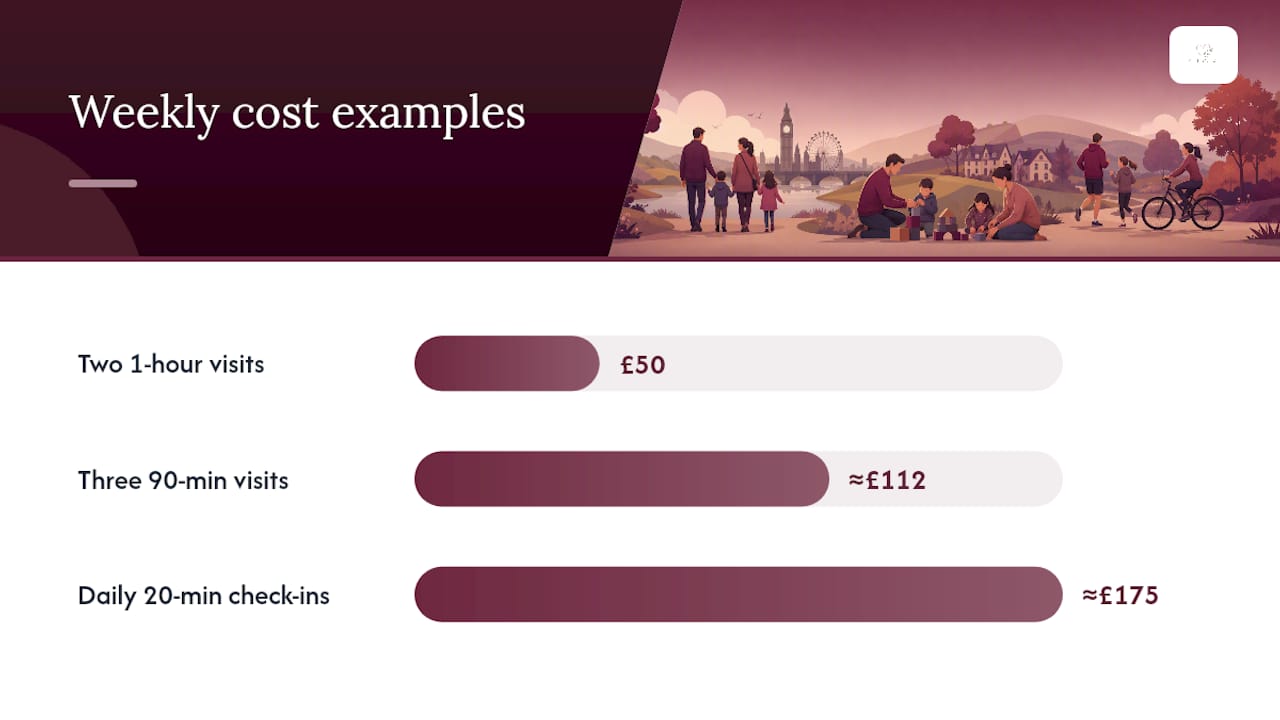
Worked simply, two one‑hour visits a week at £25 an hour comes to £50 weekly. Three 90 minute visits pushes that closer to £112 a week. Daily 20 minute check‑ins, billed at the one‑hour minimum most providers apply, land somewhere around £175 a week.
Funding doesn't have to come entirely from private pockets. Attendance Allowance is non‑means‑tested and can help cover extra costs linked to illness or disability, companionship included where it's judged appropriate. Local authorities also publish their own charging guidance, which is worth checking directly, since eligibility and local rules shift from one council to another.
What actually happens during a companionship visit?
A typical visit is built around conversation, shared hobbies, help with light shopping, or company to and from an appointment. Some visits are almost entirely social, a cup of tea and a proper chat. Others fold in a practical task, an errand run alongside a conversation that would have happened anyway.

What companions don't do is medical or personal care. Companions won't administer medication, assist with washing or dressing, or manage clinical needs. If those become a concern, that's the signal to look at personal care support alongside, or instead of, companionship.
The outcomes worth tracking are simple: reduced loneliness, a steadier daily routine, and a family that worries less. Set one small, realistic goal per visit, a walk round the block, a call to an old friend, rather than vague hopes for "more socialising."
How does a reputable provider turn an assessment into agreed hours?
Getting the number of hours right starts with proper vetting, not guesswork. Every companion should pass DBS checks before ever meeting a client, and industry bodies such as the British Franchise Association set out the kind of standards reputable providers are expected to meet.
The usual process runs in three stages: an initial assessment covering the questions above, a trial period of 4 to 6 weeks with a consistent companion wherever possible, and a formal review where hours get adjusted based on what's actually happened rather than what was guessed at the start.
Keeping the same companion across visits builds trust and routine faster than rotating staff ever can. Familiarity is what turns a booked hour into something someone genuinely looks forward to.
Outcomes from each review then feed forward, shaping how future clients with similar needs get matched and scheduled from day one.
Why the "start small" advice misses the point
Most guidance on companionship hours tells you to start conservative and add more later. That's sound in principle, but it undersells how much the quality of a visit matters more than the quantity in the early weeks.
A family that books three thin, rushed hours a week often sees less benefit than one that books two properly held hours with the same companion each time. The conventional advice fixates on hours as the variable to tune. The variable that actually moves outcomes fastest is consistency: same person, same rough time, same rhythm.
What I'd prioritise first isn't the number on the schedule. It's asking whether the provider can guarantee, or at least strongly favour, matching the same companion visit after visit. Hours are easy to adjust later. Rapport built badly in week one is much harder to fix in week five. If you're choosing between more hours with a rotating roster or fewer hours with continuity, choose continuity every time.
— Ayomide
Ready to agree your own hours? Here's how to start
Some providers skip the guesswork that comes with piecing together ad hoc cover yourself. Companions are DBS checked, matched consistently where possible, and the whole arrangement starts with a proper assessment rather than a generic package.
Booking usually begins with a conversation about what your relative actually needs, mapped against the models and templates above, followed by a 4 to 6 week trial and a review point where hours get adjusted based on real outcomes rather than assumptions. Visit details and costs should be clarified before confirmation, and pricing should be set out clearly rather than buried in small print.
If loneliness is the main driver, the loneliness support services page explains how visits are structured around meaningful connection specifically. Otherwise, the fastest way to see how this works for your family is to look at our services and request an initial assessment to agree a trial schedule.
Sources
- Attendance Allowance: what you'll get
- Facts and statistics | Campaign to End Loneliness
- How to book companionship care for a senior family member: a practical guide
- Home care services guides: care at home costs