

Paid in-home companionship in the UK falls into five main types: agency-employed visits, privately employed carers, live-in companions, platform or introduction services, and volunteer befriending. For most families, the most reliable first step is a vetted, DBS-checked companion arranged through a trusted provider, because it removes the guesswork of vetting someone yourself.
- Agency-employed visits — the agency handles payroll, cover and compliance
- Privately employed carers — you become the legal employer, with more responsibility
- Live-in companions — round-the-clock presence in the home
- Platform or introduction services — matches you with an independent companion
- Volunteer befriending — free, lighter-touch social contact, often through the NHS
The recommended path is straightforward: assess your relative's needs, shortlist a route, insist on DBS checks and references, then arrange a trial visit before committing. Fromlovewithcare offers exactly this model, and it's worth checking whether your relative also qualifies for Attendance Allowance before paying privately.
Key Takeaways
The most reliable way to arrange loneliness support is a DBS-checked, non-medical companion booked through a vetted provider, with a trial visit before committing to a contract.
| Point | Details |
|---|---|
| Five main routes exist | Agency, private hire, live-in, platform introductions, and volunteer befriending each suit different needs. |
| Vetting comes first | Insist on DBS checks, training records, and references before any visit is booked. |
| Trial visits matter most | A trial reveals personality fit in a way paperwork never can. |
| Private hire means extra duties | You become the legal employer, responsible for insurance and cover arrangements. |
| Fromlovewithcare offers a vetted option | DBS-checked companions, transparent pricing, and trial visits focused on social contact and welfare checks. |
Table of Contents
- How do you arrange emergency welfare checks?
- Agency hire versus private hire: which protects you more?
- How do you change or end a companionship arrangement?
- What should you expect from communication with a companion?
- Do you need your own insurance if you hire privately?
- What are the next steps to hiring a companion?
- Where can you check more before you hire?
- Why the "just find someone nice" approach fails families
- A vetted route to regular companionship
- Sources
How do you arrange emergency welfare checks?
Most reputable providers offer emergency welfare checks as a separate, premium service sitting alongside your regular booked visits. This isn't the same as a scheduled companionship slot. It's designed for the moment a relative doesn't answer the phone, misses a routine call, or a neighbour raises a concern.
You typically request one by phone or through the provider's booking system, and a companion is sent to confirm your relative is safe, well, and coping. Response times and costs vary by provider, so ask about both before you need the service in a crisis rather than during one.
Regular welfare visits work differently. They're planned, they follow a rhythm your relative comes to expect, and they combine a wellbeing check with genuine social contact, a cup of tea, a chat, help with a small task. Over time, that consistency is what catches small problems (a missed prescription, a fall risk, low mood) before they become emergencies.
Agency hire versus private hire: which protects you more?
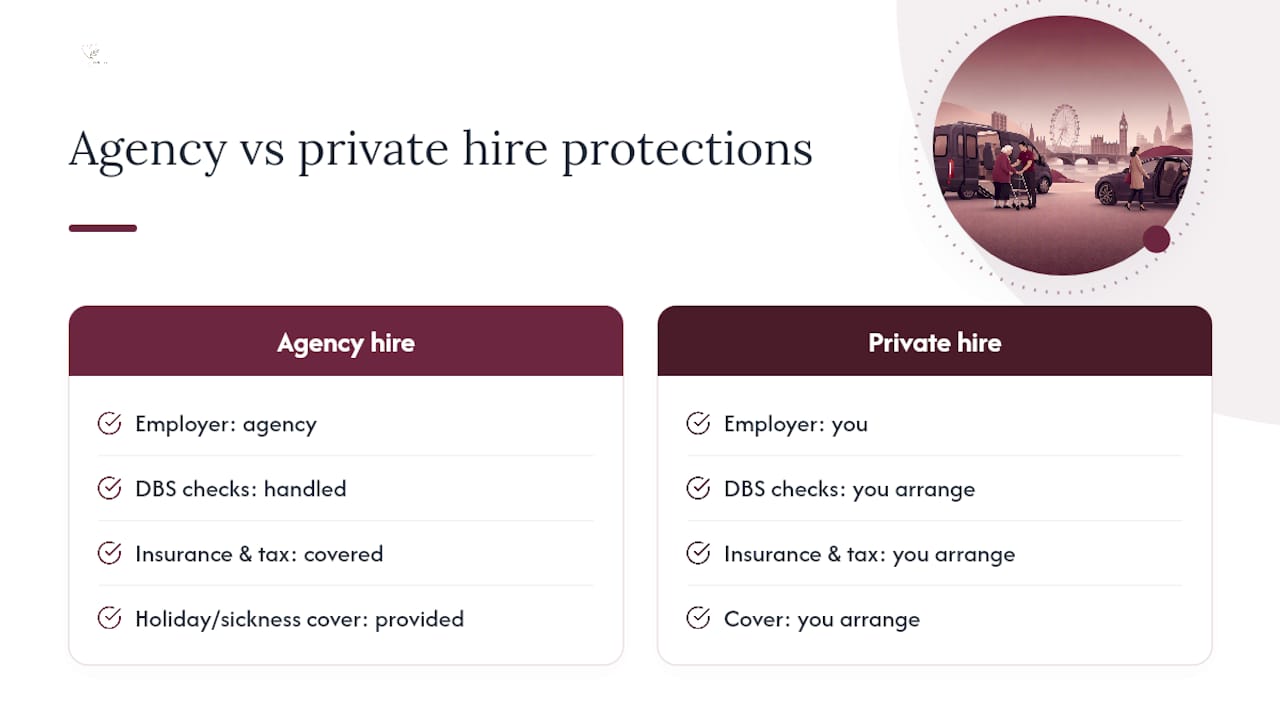
Hiring through an agency gives you contractual protection the private route doesn't. The agency is the employer, so it handles DBS checks, insurance, holiday cover, and sickness cover. If your companion is unwell, someone else steps in, and you have a formal complaints process if something goes wrong.

Hiring privately makes you the legal employer. You're responsible for vetting, tax, insurance, and finding cover if your carer is ill or takes leave. It can work out cheaper, but the compliance burden sits entirely with you, and there's no organisation standing behind the relationship if a dispute arises.
For families who don't want to become an employer overnight, an agency or a vetted provider like Fromlovewithcare removes that administrative weight entirely.
How do you change or end a companionship arrangement?
Check the notice period before you sign anything. Most agency contracts specify a short written notice, often one or two weeks, so read this clause first rather than after a problem starts.
If the match simply isn't working, whether it's personality, punctuality, or a mismatch in expectations, raise it directly with the provider before ending the arrangement entirely. A reputable service will offer to rematch you with a different companion rather than losing you as a client. Keep any concerns in writing, and don't be afraid to request a trial with someone new before committing again.
What should you expect from communication with a companion?
Set expectations early, ideally at the trial visit. Agree how visits will be confirmed, what happens if your relative is unwell or has a hospital appointment that day, and how you'd like to be updated afterwards, a text message, a short call, or a note in a shared log.
Boundaries matter both ways. A companion isn't on call for out-of-hours requests unless you've arranged an emergency welfare service specifically, and personal or medical care sits outside what a non-medical companion is there to do. Being clear about this from day one avoids awkward misunderstandings later.
Do you need your own insurance if you hire privately?
Yes. If you employ a carer directly rather than through an agency, you're generally responsible for public liability cover and, in most cases, employer's liability insurance, because you're now the employer in the eyes of the law.
This matters if your companion is injured in your relative's home, or if they're accused of causing damage or loss. Agencies and vetted providers usually carry this insurance themselves, which is one of the quieter but more significant reasons families choose that route over private hire.
What are the next steps to hiring a companion?
Fromlovewithcare works best because it combines DBS-checked companions with transparent pricing and a trial visit before you commit to anything.
- Write down what your relative actually needs: conversation, outings, shopping help, or welfare checks
- Shortlist agency, live-in, or platform routes based on how much admin you want to take on
- Ask every provider for DBS checks, training records (dementia awareness, first aid) and references
- Book a trial visit before signing a longer contract
- Check Attendance Allowance or local authority funding eligibility before paying full price privately
Three red flags should end a conversation immediately: no DBS checks offered, pricing that isn't written down clearly, and no willingness to arrange a trial or provide references. If you hire privately, confirm the contract, notice period, and your own insurance position before your companion's first visit.
Where can you check more before you hire?
- NHS homecare guide — explains typical tasks a paid carer performs and gives a realistic UK hourly cost range
- UK Care Advice's 10-step guide — a practical vetting checklist covering DBS checks, training and contract terms
- Disability Horizons' companionship booking guide — compares agency, private, live-in and voluntary routes, and flags funding to check early
- Fromlovewithcare's loneliness support page — sets out its DBS-checked, non-medical companionship model and the welfare checks it provides
- Safe in-home companionship guide — a family-facing safety checklist for first visits
Why the "just find someone nice" approach fails families
The conventional advice on companionship, find someone kind, see how it goes, tends to underestimate how much structure protects everyone involved. A pleasant personality doesn't tell you whether someone has been DBS-checked, whether they know how to respond if your relative seems confused or unwell, or what happens if they can't make a visit.
What gets overlooked most is the insurance and contractual gap in private arrangements. Families focus on personality fit and forget they've quietly become an employer with legal obligations. That's not a reason to avoid private hire outright, but it's a reason to go in with eyes open rather than discovering the gap after something's gone wrong.
If there's one thing worth prioritising above all else, it's the trial visit. Paperwork tells you a companion is vetted; a trial visit tells you whether your relative will actually look forward to seeing them. Both matter, but only one of them predicts whether the arrangement lasts.
A vetted route to regular companionship
Compared with piecing together a private arrangement yourself, Fromlovewithcare gives you a DBS-checked companion, a documented training record, and a trial visit before you commit, without you ever having to take on the role of employer.
Every companion focuses on conversation, shared activities, and welfare checks rather than medical or personal care, so you know exactly what's included from the outset. Pricing is set out clearly before you book, and notice periods are short if the match isn't right. If you're ready to arrange a trial visit for a relative who could use regular company, visit Fromlovewithcare's services page to see how the matching process works, or explore the elderly companionship service directly to check availability in your area.
Sources
- Help at home from a paid carer - Social care and support guide - NHS
- How to Choose a Home Care Provider: A 10‑Step UK Guide | UK Care Advice
- How to Book Companionship Care for a Senior Family Member: A Practical Guide | Disability Horizons