

Regular, routine visits anchor an older person's day in ways that go far beyond a friendly cup of tea. They reduce loneliness, support cognitive health, and create a reliable safety net that can catch problems before they become crises. Whether you visit daily, weekly, or fortnightly, the predictability of that contact matters as much as the visit itself.
- Companionship reduces loneliness. Chronic social isolation is linked to higher risks of functional decline and mortality among older adults in England.
- Predictable visits support sleep and cognition. A consistent schedule acts as a biological anchor, steadying mood and reducing disorientation.
- Practical checks reduce risk. Medication prompts, a glance at the fridge, and a quick mobility check can prevent avoidable hospital admissions.
For most families, a weekly visit suits a parent who is largely independent but lonely. Two or three visits a week works well when early frailty is present. Daily contact becomes appropriate after a hospital discharge or when dementia is progressing.
Table of Contents
- Why routine visits work: the mechanisms behind the benefits
- The practical benefits of routine visits
- How often should you visit? A needs-based frequency guide
- What to do during a visit: a practical checklist
- When visits reveal your parent needs more help
- How to set up dependable routine visits in the UK
- Key takeaways
- The part of caregiving nobody talks about enough
- Fromlovewithcare: companionship visits that give families peace of mind
- Useful UK resources and further reading
Why routine visits work: the mechanisms behind the benefits
The reason regular visits help ageing parents runs deeper than simple company. Three mechanisms explain most of the benefit: circadian anchoring, reduced cognitive load, and social reciprocity.

A visit at the same time each day acts as a zeitgeber, a time cue that helps reset the body's internal clock. Restoring predictable rhythms can rapidly improve mood and sleep and reduce stress markers in older adults whose days have become shapeless. When every day looks the same and nothing marks the passage of time, the body registers that as chronic stress, raising cortisol and contributing to functional decline.
Disrupted activity patterns are associated with a significantly higher risk of developing dementia compared with steady schedules. Consistent routines reduce the orientation load on the brain, freeing remaining cognitive resources for more meaningful engagement. Dementia and ageing specialists now regard structured daily routines as a high-value non-drug intervention, on a par with community occupational therapy.
Social reciprocity adds a third layer. Research into befriending services shows that visits which feel like genuine friendship, rather than clinical check-ins, produce better engagement and longer-lasting wellbeing gains. When a companion shares an activity rather than simply performing a task, the relationship itself becomes therapeutic.
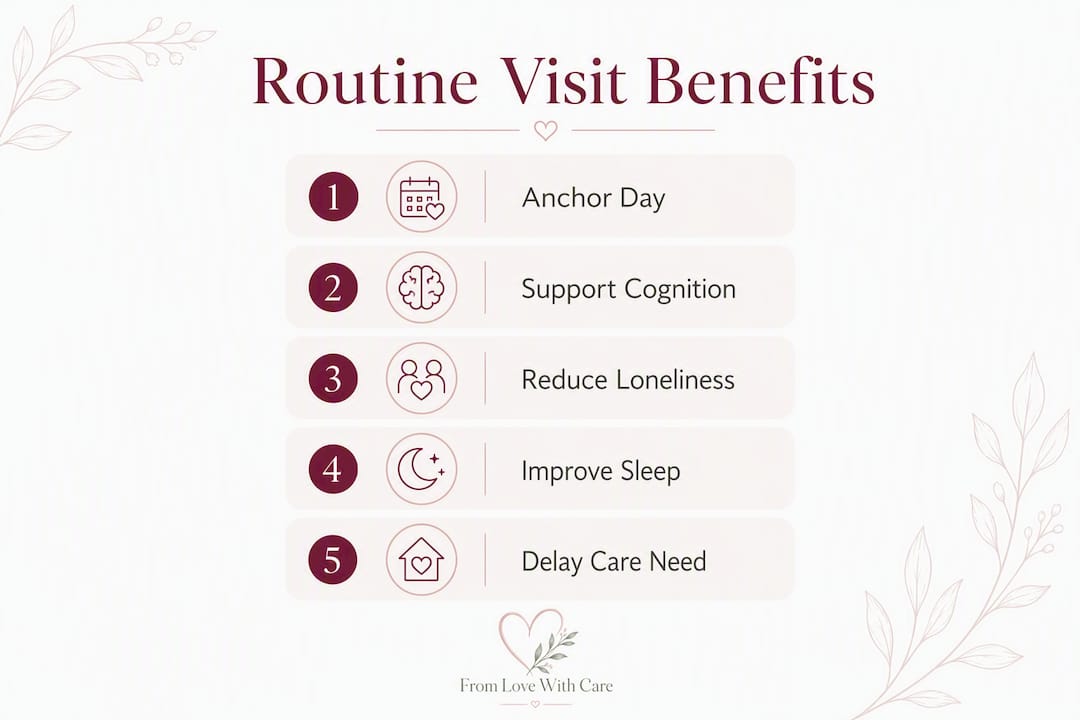
The practical outcome of all three mechanisms: better sleep, steadier mood, and a delayed need for intensive care. Scheduled companionship visits combine practical help with social interaction in a way that enables many people to remain at home longer.
The practical benefits of routine visits
The advantages of regular contact span emotional, physical, safety, and practical domains. Understanding which benefits matter most to your parent helps you plan visits that are genuinely useful.
Emotional benefits
- Reduces loneliness and the anxiety that accompanies it. During COVID-19 lockdowns, increases in loneliness were directly associated with worsened anxiety and depression in older Londoners.
- Provides a sense of being valued and remembered, which supports self-worth.
- Gives the week a shape, reducing the low-grade dread that comes from unstructured days.
- Social isolation predicts depression onset in older adults across different cultural contexts; regular visits interrupt that pathway.
Physical and health benefits
- Encourages regular meals. A companion who shares lunch makes eating a social event rather than a chore.
- Prompts light physical activity: a short walk, gentle gardening, or a trip to the shops.
- Supports medication adherence through gentle, consistent reminders.
- Regular physical activity and social engagement together support cognitive health and reduce the risk of decline.
Safety benefits
- Early identification of fall risks, trip hazards, or changes in mobility.
- A fresh pair of eyes on the home: expired food, unpaid bills, or a broken appliance.
- Welfare checks that confirm the person is safe between family visits.
Practical support
- Grocery shopping, light housework, and appointment accompaniment.
- A consistent point of contact who can relay concerns to family or a GP.
Picture a typical Wednesday visit: a companion arrives at 10 AM, shares a coffee, notices the heating is off, helps prepare lunch, and takes a short walk to the post box. That single hour touches every category above.
Pro Tip: Read more about what a companion visit involves to help you plan visits that feel natural rather than clinical.

How often should you visit? A needs-based frequency guide
Frequency should match need. The more vulnerable your parent, the more often contact is required to maintain the benefits described above.
| Need level | Typical situation | Recommended cadence |
|---|---|---|
| Independent but lonely | Lives alone, manages daily tasks, occasional low mood | Weekly visit |
| Early frailty or mild memory concerns | Needs prompts, some mobility issues, limited social contact | 2–3 visits per week |
| Post-hospital discharge | Recovering from illness, surgery, or a fall | Daily visits for 2–4 weeks, then review |
| Moderate dementia or significant frailty | Needs consistent orientation cues and practical support | Daily visits plus welfare checks |
| Advanced needs | Requires personal or medical care beyond companionship | Formal care assessment alongside visits |
When your parent lives in a care home, visits remain valuable but require coordination. Book in advance, follow the home's visiting guidelines, and speak briefly with a staff member each time to share observations. Your visits complement professional care; they do not replace it.
Adapt frequency for acute events: a bereavement, a UTI, or a difficult winter can temporarily increase need. When companionship visits alone no longer feel sufficient, that is the signal to request a formal social care assessment rather than simply visiting more often.
For a fuller overview of scheduling options, companionship options for older adults covers different visit models in detail.
What to do during a visit: a practical checklist
Prioritise welfare checks first, then companionship, then practical tasks. That order matters: a quick welfare check takes two minutes and can catch something serious; the rest of the visit is then free to feel relaxed and enjoyable.
Welfare and practical checklist
- Medication check. Are tablets being taken? Any new prescriptions or confusion about dosage?
- Nutrition and hydration. Is there food in the house? Has your parent eaten today?
- Mobility and falls. Any new aches, bruises, or reluctance to move around?
- Mood and cognition. Does your parent seem more confused, withdrawn, or agitated than usual?
- Home safety. Check heating, lighting, and any obvious hazards (loose rugs, cluttered hallways).
- Social contact. Has your parent spoken to anyone else since your last visit?
Activity ideas by energy level
Low energy: reading aloud together, looking through old photographs, gentle conversation, listening to music, watching a favourite programme.
Medium energy: baking or cooking a simple meal, light gardening, a short walk around the block, a board game or cards, writing letters or postcards.
Higher energy: a trip to a local café, a visit to a garden centre, attending a community group or faith service together.
Consistent activity cues such as a walk at the same time each visit help set circadian rhythms and improve sleep over time.
Pro Tip: Share the activity rather than doing it for your parent. Reciprocity, doing something together rather than performing a service, produces stronger wellbeing gains and preserves dignity.
When visits reveal your parent needs more help
Routine visits are valuable partly because they make change visible. A single visit tells you little; a pattern of visits tells you everything.
Act quickly if you notice any of the following:
Health indicators:
- Unexplained weight loss or a noticeably reduced appetite over two or more visits
- New or worsening breathlessness, persistent pain, or signs of infection
- Missed medications across several days
Safety indicators:
- Evidence of a fall (bruising, a broken object, reluctance to explain an injury)
- Unpaid bills, unopened post, or signs of financial confusion
- Gas left on, doors left unlocked, or other repeated safety lapses
Cognitive indicators:
- Sudden increase in confusion, disorientation about time or place
- New aggression, paranoia, or significant personality change
- Inability to recognise familiar people or complete familiar tasks
When you spot a pattern, record what you observed with dates. Then contact the GP as a first step; they can arrange a memory assessment or referral. For a formal support plan, request a social care needs assessment from the local authority. If dementia is a concern, the Alzheimer's Society provides specialist guidance and a helpline. Age UK can advise on benefits, local services, and carer support.
If your parent is in immediate danger, call 999. For a non-emergency welfare concern when you cannot visit in person, an emergency welfare check from a DBS-checked companion is a practical interim step.
How to set up dependable routine visits in the UK
A reliable plan combines an agreed schedule, clear role boundaries, safety checks, and a contingency arrangement for when the primary visitor cannot attend.
Step-by-step setup
- Agree times and days. Fix visits to the same slot each week so they become a genuine anchor.
- Define tasks clearly. Write a one-page care brief listing what the visit covers: welfare checks, activities, practical tasks, and what is out of scope.
- Nominate a backup. Identify a second family member, neighbour, or paid companion who covers absences.
- Record preferences and medical notes. Dietary needs, GP contact details, medication list, and any known triggers for anxiety or distress.
- Arrange payment and data sharing if using a paid service, and confirm how observations will be communicated back to the family.
DBS checks and vetting
Any paid companion entering your parent's home should hold a current enhanced DBS (Disclosure and Barring Service) check. Ask to see the certificate, verify the date, and request two references. A short trial visit before committing to a regular schedule gives both parties a chance to assess the fit.
Funding pointers
Attendance Allowance is a tax-free benefit for people aged 65 and over who need help with personal care or supervision. It does not cover companionship directly, but the income it provides can be used to fund visits. Age UK's benefits advisers can help your parent claim what they are entitled to.
Pro Tip: A one-page care brief, shared with every companion or family member who visits, prevents gaps and misunderstandings. Include the daily routine, emergency contacts, and one or two personal details (favourite topics of conversation, preferred tea strength) that help visits feel warm rather than procedural.
For a detailed setup guide, companionship planning for housebound seniors walks through each step.
Key takeaways
Routine visits help ageing parents by anchoring their day, supporting cognition, reducing loneliness, and creating a reliable safety net that catches problems early.
| Point | Details |
|---|---|
| Routine anchors the day | Predictable visits act as time cues that stabilise sleep, mood, and orientation. |
| Cognitive protection | Disrupted activity patterns are linked to a significantly higher risk of developing dementia; consistent visits reduce that risk. |
| Frequency matches need | Weekly visits suit independent but lonely parents; daily contact is appropriate post-discharge or with moderate dementia. |
| Warning signs need action | Record concerns with dates, then contact the GP and request a local authority social care assessment. |
| Fromlovewithcare | Provides DBS-checked companionship visits and welfare checks across the UK, with no medical or personal care scope. |
The part of caregiving nobody talks about enough
There is a tendency, understandable and well-meaning, to focus on the practical side of visiting: the medication check, the meal, the safety scan. Those things matter. But the evidence points clearly to something less tangible as the real driver of benefit: the relationship itself.
Research into reciprocity and informal support networks shows that visits which feel like genuine friendship produce better outcomes than intermittent clinical contacts. A companion who remembers that your parent once worked as a teacher, or who laughs at the same jokes, is doing something that no checklist can fully capture.
What this means practically is that the quality of a visit matters as much as its frequency. A rushed, task-focused hour can feel perfunctory to a parent who has been alone for six days. A slower, more reciprocal visit, where the companion shares something of themselves too, can shift mood for days afterwards.
Caregiving is emotionally complex, and the guilt of not visiting enough is something many adult children carry quietly. Asking for help, whether from a sibling, a neighbour, or a professional companion service, is not a failure. It is how you make the visits that do happen more sustainable and more meaningful.
Fromlovewithcare: companionship visits that give families peace of mind
For families who want reliable, safety-checked visits but cannot always be there themselves, Fromlovewithcare offers in-home companionship visits and welfare checks across the UK. Every companion is DBS-checked and trained to provide genuine social connection, not medical or personal care, so visits feel like time with a trusted friend rather than a clinical appointment.
- Typical visits include: conversation and shared activities, grocery shopping, appointment accompaniment, medication prompts, and welfare observations reported back to the family.
- Booking is straightforward: a trial visit lets your parent and the companion meet before any commitment, and emergency welfare checks are available when you need reassurance quickly.
To see the full range of services or to arrange a trial visit, visit the Fromlovewithcare services page. If you want to understand the process first, how our companionship works explains DBS checks, booking, and what to expect from the first visit.
Useful UK resources and further reading
- NHS: social care needs assessment — the starting point for arranging formal local authority support for an older person in England.
- Age UK — advice on benefits (including Attendance Allowance), local services, and carer support across the UK.
- Alzheimer's Society — specialist guidance, a helpline, and local support groups for families navigating dementia.
- Nature Mental Health: chronic loneliness and functional impairment in England — longitudinal cohort evidence linking chronic isolation to functional decline and mortality.
- PMC: social isolation and depression onset (ELSA/JAGES) — cross-national study showing how reduced contact with family predicts depression in older adults in England.
- Benefits of regular social interaction for seniors — a research-backed overview of why social contact matters for older adults, with practical examples.