

Companionship after parent bereavement is defined as the sustained, empathetic presence of others that reduces loneliness and supports healthier grieving. It is distinct from practical help, and that distinction matters enormously. Research published by the University of Haifa found that weekly contact reduces depressive symptoms after widowhood, while practical support was actually linked to increased depressive symptoms. Simply being there, consistently and without agenda, is the most protective thing another person can offer. This article explains the evidence, explores who benefits most, and shows how to provide companionship that genuinely supports healing from grief.
What does the role of companionship after parent bereavement actually look like?
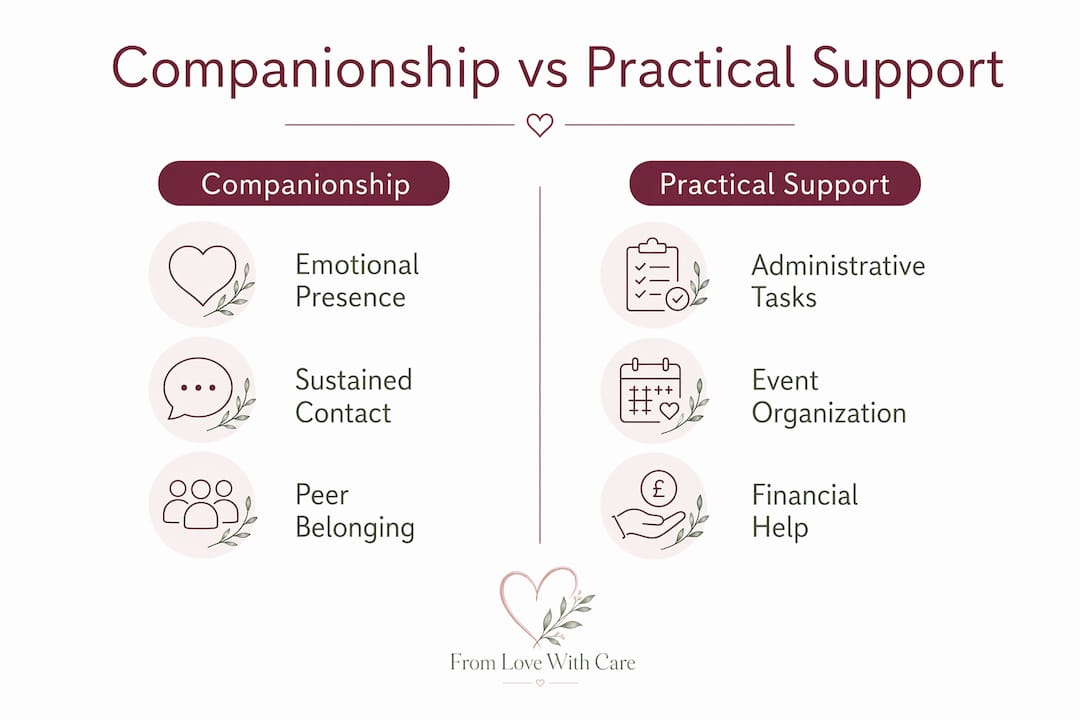
Companionship in grief is not the same as helping someone sort through paperwork or arrange a funeral. It is the act of being emotionally present: sitting quietly with someone, calling regularly, or sharing a meal without expecting anything in return. The University of Haifa study, which drew on data from 2,600 widowed women and 896 men across eight waves of analysis, confirms that emotional presence outperforms practical assistance in reducing depressive symptoms. That finding reframes what good support actually means.
The forms companionship takes are varied. Weekly phone calls, proximity, regular visits, and peer group belonging all count. What they share is consistency and low demand. The bereaved person does not need to perform gratitude or manage logistics. They simply need to feel that someone is reliably there.
Pro Tip: Do not conflate organising a bereaved person's affairs with keeping them company. Prioritise low-demand, predictable contact such as brief daily calls or short visits over task-based help, which research suggests can inadvertently increase feelings of dependency and distress.
The table below clarifies the core differences between companionship and practical support in a bereavement context.
| Feature | Companionship | Practical support |
|---|---|---|
| Primary goal | Emotional presence and connection | Task completion and problem-solving |
| Typical forms | Visits, calls, shared quiet time, peer groups | Errands, paperwork, financial help |
| Effect on depression | Associated with reduced depressive symptoms | Associated with increased depressive symptoms |
| Demand on the bereaved | Low; no performance required | Higher; may require coordination and gratitude |
| Timing | Ongoing and long-term | Often concentrated around the time of loss |
How does companionship affect mental health during bereavement?
The mental health case for companionship in grief recovery is now supported by strong, recent evidence. The University of Haifa study found that proximity within 25 km of a nearest child produced fewer depressive symptom increases than cohabitation, which suggests that close but independent contact is more protective than full-time shared living. This is a counter-intuitive finding. It implies that the quality and regularity of contact matters more than physical closeness alone.
A January 2026 randomised controlled trial involving 129 bereaved participants found that challenging negative social expectations through positive social re-experiencing produced a significant decrease in loneliness. Bereaved people often develop beliefs that others will reject or misunderstand them. When those beliefs are gently disproved through warm, consistent interaction, the cycle of social withdrawal begins to break. This is why companionship works not just as comfort, but as a form of active psychological repair.
"Sustained social support and validation over time aid adaptive coping and identity reconstruction after bereavement, while lack of continuity and recognition can cause loneliness and prolonged suffering." Research synthesised across bereavement studies, with an average loss time of 5.31 years, confirms that long-term social validation is not optional. It is central to recovery.
The meta-ethnographic research also highlights that grief does not resolve in weeks. Identity reconstruction after losing a parent can take years, and the friends and family who remain present across that span provide something no single gesture can replicate. Continuity is the ingredient most often missing from well-intentioned support. Understanding how companionship improves wellbeing over time helps families plan support that actually lasts.
Why companionship needs differ across bereaved groups
The importance of companionship is not uniform. Age, relationship to the deceased, and individual grief patterns all shape what kind of presence feels supportive.
For grieving teenagers, peer companionship carries particular weight. Psychology Today reports that teens benefit from peer groups where shared stories and lived-experience parallels reduce isolation after parental loss. Camps and safe group settings allow young people to hear that others understand their specific pain, which adult companionship alone cannot replicate. The sense of not being uniquely broken is itself therapeutic.

For adult children supporting a surviving parent, the dynamic is different. They are often grieving themselves while simultaneously becoming the primary source of companionship for someone else. This dual role is exhausting and frequently underacknowledged.
Research on continuing bonds theory adds further nuance. Key distinctions in companionship needs include:
- Bereaved individuals who maintain warm, comforting bonds with the memory of the deceased show better grief adjustment than those whose bonds involve guilt or avoidance.
- Between 40% and 80% of bereaved spouses report sensing the presence of the deceased, suggesting that internal companionship with memory is also part of the healing process.
- Maladaptive continuing bonds, characterised by avoidance or unresolved guilt, signal a need for professional support beyond what companionship alone can provide.
- Older adults often need companionship that respects their autonomy, rather than well-meaning but infantilising care.
Knowing which type of support fits which person requires attentiveness. The goal is not to apply a single model of companionship but to stay responsive to what the bereaved person actually needs at each stage.
How to provide effective companionship after parent bereavement
Effective companionship is not spontaneous. It requires intention, especially as weeks turn into months and the initial wave of support from others naturally fades.
Psychology Today recommends that supporters prioritise consistent follow-ups over one-off gestures. A single visit in the first week is kind. A phone call every week for six months is transformative. The bereaved person needs to feel that they have not been forgotten once the funeral is over.
Pro Tip: Use what grief counsellors call "temporal engineering." Mark key dates in your calendar: the one-month anniversary, the first birthday without the parent, the first Christmas. Reach out on those days specifically. Grief intensifies around milestones, and a message on an ordinary Tuesday is far less powerful than a call on the day that matters.
A practical sequence for sustained companionship looks like this:
- Make contact within the first 48 hours. A short message acknowledging the loss is enough. You do not need to say the right thing. Presence matters more than eloquence.
- Schedule regular contact for the next three months. Weekly calls or visits, kept brief and low-pressure, build the consistency that protects against depression.
- Prepare a meal or help with a specific errand. Practical help is not useless. It becomes harmful only when it replaces emotional presence rather than supplementing it.
- Challenge social withdrawal gently. If the bereaved person begins to pull away, the RCT evidence shows that positive social re-experiencing can break the cycle of loneliness. Invite them to low-stakes activities without pressure to engage.
- Plan for the long term. Mark anniversaries, holidays, and significant dates in your calendar for at least one year. Grief does not end at three months, and neither should your support.
How does companionship compare with other bereavement support?
Companionship is one part of a broader support ecosystem, not a replacement for professional care. Understanding where it fits helps bereaved individuals and their families make better decisions.
| Support type | Primary goal | Who provides it | Limitations |
|---|---|---|---|
| Companionship | Emotional presence and connection | Friends, family, vetted companions | Cannot address clinical depression or trauma |
| Counselling or therapy | Processing grief and rebuilding coping skills | Qualified therapists, grief counsellors | Requires professional training; time-limited sessions |
| Instrumental support | Task completion | Family, neighbours, care agencies | Can increase dependency if not balanced with emotional care |
| Legal recognition | Documenting loss of relationship value | Solicitors, courts | Retrospective; does not support active healing |
The legal concept of "lost companionship" is worth noting here. In wrongful death claims, proving companionship loss relies on documenting regular daily contact and routine involvement. That legal standard reflects something true about human experience: companionship is built through ordinary, repeated presence, not grand gestures. The law recognises what psychology confirms.
Professional companionship services, such as those offered by Fromlovewithcare, sit between informal friendship and clinical care. They provide the consistency and warmth of a trusted presence without the emotional burden that can fall on family members who are grieving themselves. For those who want to understand how companionship differs from care agencies, the distinction is significant and worth exploring before making decisions about support.
Key takeaways
Companionship after parent bereavement reduces depressive symptoms and loneliness more effectively than practical support alone, and its benefits grow with consistency and duration.
| Point | Details |
|---|---|
| Emotional presence over practical help | Weekly contact reduces depressive symptoms; task-based help alone can increase them. |
| Consistency is the active ingredient | Long-term, regular contact across months and years drives identity recovery and adaptive coping. |
| Needs vary by age and grief pattern | Teens benefit from peer groups; adults need autonomy-respecting presence; maladaptive grief needs professional care. |
| Temporal engineering works | Scheduling contact around anniversaries and milestones prevents the fading of support at critical moments. |
| Companionship complements, not replaces, therapy | Professional counselling addresses clinical needs; companionship addresses the daily human need for connection. |
What grief taught me about simply showing up
by Ayomide
The hardest part of supporting someone through bereavement is not knowing what to say. It is staying when you have nothing to say. Most people disappear after the first few weeks, not out of cruelty, but because they feel useless once the practical tasks are done. That is precisely when the bereaved person needs them most.
What I have observed, both through the work we do at Fromlovewithcare and through personal experience, is that the people who help most are rarely the ones who arrive with solutions. They are the ones who call on a random Wednesday, who remember the parent's name, who ask how someone is doing six months later when everyone else has moved on.
The research backs this up, but the research is also just describing something most of us know instinctively. Grief is not a problem to be solved. It is a weight to be shared. The role of a companion is not to lift that weight away but to sit beside the person carrying it, for as long as it takes.
If you are supporting someone through loss, resist the urge to do more and simply be more present. That is the thing they will remember.
— Ayomide
How Fromlovewithcare supports those facing bereavement
Losing a parent changes everything. The silence that follows can be profound, and not everyone has a network of friends or family who know how to stay present through it.

Fromlovewithcare provides compassionate companionship services specifically designed to address the loneliness that so often follows bereavement. Every companion is thoroughly vetted and trained to offer consistent, empathetic presence, whether that means a weekly home visit, a shared cup of tea, or simply a reliable voice on the end of the phone. For families concerned about an elderly parent grieving alone, trusted home visits offer peace of mind alongside genuine human connection. If you or someone you love is facing bereavement without enough support, Fromlovewithcare is here to help.
FAQ
What is the role of companionship after parent bereavement?
Companionship after parent bereavement provides sustained emotional presence that reduces loneliness and depressive symptoms. Research shows it is more protective than practical support alone, particularly when maintained consistently over months and years.
How does companionship differ from practical bereavement support?
Companionship focuses on emotional connection through regular contact and presence, while practical support involves tasks such as errands or paperwork. University of Haifa research found that practical support is linked to increased depressive symptoms, whereas companionship reduces them.
Can companionship replace grief counselling or therapy?
Companionship complements professional therapy but does not replace it. For bereaved individuals experiencing clinical depression, prolonged grief disorder, or maladaptive coping patterns, a qualified grief counsellor or therapist is the appropriate primary support.
How long should companionship support continue after bereavement?
Meta-ethnographic research with an average loss time of 5.31 years suggests that social support continuity matters long after the initial loss. Meaningful companionship should extend across at least the first year, with particular attention to anniversaries and significant dates.
How can teens cope with the loss of a parent through companionship?
Peer companionship in group settings, such as camps or support groups for parentless teens, is particularly effective. Sharing stories with others who have experienced parental loss reduces isolation and promotes healthier grief processing, according to Psychology Today.