

If an older person in the UK has no family to help, the first and most effective step is to request a council care needs assessment and contact national helplines while you sort out short-term welfare checks. The assessment is free, available regardless of income, and can be requested by a neighbour, GP, or friend acting in the person's best interests. Age UK's advice line and The Silver Line can offer guidance and companionship the same day.
TL;DR:
- A needs assessment is free, accessible without income restrictions, and can be requested by friends, neighbors, or GPs with the person's consent.
- The assessment covers support options like home care, equipment, and social activities, while a separate financial assessment determines who pays.
- Immediate safety concerns should prompt calling 999 or 111, and keeping detailed records of contacts simplifies navigating multiple agencies.
- Local councils, the NHS, and charities each have distinct roles; knowing who to contact saves time and ensures appropriate services are provided.
- Paid companionship services can fill gaps in social support and are especially useful if volunteer options are limited or ongoing presence is needed.
Table of Contents
- How do you get a needs assessment when there is no family?
- Who actually helps: councils, the NHS, and charities
- What kind of care and support can actually be arranged?
- Who pays, and what does it cost when there's no family to fall back on?
- How do you build a support network from scratch?
- A practical companion option when there's no family nearby
- Where to go next: official pages and helplines worth saving
- Fromlovewithcare: a paid, reliable answer to companionship
- The uncomfortable truth about "ageing without children" nobody says out loud
- Sources
How do you get a needs assessment when there is no family?
Ring your local council and ask, specifically, for a "care needs assessment." Every council in England and Wales has a duty to arrange one, and you don't need to be related to the person to start the process, though you should have their agreement wherever possible.
Before you call, gather a few basics: the person's name, address, GP surgery, and a short account of what's changed recently, such as missed meals, falls, or confusion about medication. Councils move faster when the picture is clear.
- Call the adult social services team at the local council and ask for an assessment.
- Confirm who can attend the assessment, since a friend or neighbour can often sit in with permission.
- If the person cannot express a clear view or lacks the mental capacity to decide, ask the council directly whether an independent advocate should be arranged through scheduled welfare checks.
- While you wait for the visit, ring the Age UK Advice Line or The Silver Line for immediate guidance and a friendly voice.
- If you're worried about safety today, not next week, call 999 or 111, or ask a trusted neighbour to check in person.
Pro Tip: Keep a written note of every call you make, including the date, the name of the person you spoke to, and what was agreed. Councils and charities move through several staff members on a single case, and a clear record saves you repeating the whole story from scratch each time.
Who actually helps: councils, the NHS, and charities
Each organisation has a distinct job, and knowing which one to call saves time when you're already stretched.
- Local council social services carry out the needs assessment and decide what support the person is entitled to, from home care to equipment.
- The NHS steps in when health needs dominate. NHS continuing healthcare can fund care fully when a person's primary need is medical rather than social, though this is a separate, stricter assessment.
- Age UK and The Silver Line offer advice, telephone friendship, and signposting to local services, often within a single call.
- Care Rights UK runs a free, confidential helpline specifically to help people navigate the care system when they're unsure what they're owed.
- Ageing Without Children (AWOC) provides information and local peer groups for people who have no children or close relatives to lean on, and pushes services to stop assuming everyone has a family member in the wings.
- Independent Mental Capacity Advocates (IMCAs) step in under the Mental Capacity Act when someone lacks capacity for a decision and has no one appropriate to consult on their behalf.
What kind of care and support can actually be arranged?
The range is wider than most people expect, and a needs assessment is what unlocks it.
- Home care visits for washing, dressing, and medication, arranged either through the council or privately.
- Reablement support after a hospital stay, usually free for a short period, aimed at rebuilding independence.
- Meals services, home adaptations, and equipment such as grab rails or raised toilet seats.
- Telecare and personal alarms that connect to a monitoring centre at the press of a button.
- Housing with support, sheltered housing, or residential care homes for those needing round-the-clock help.
- Telephone friendship, volunteer visiting, and local peer groups that tackle isolation directly, separate from personal care needs.
Who pays, and what does it cost when there's no family to fall back on?
The needs assessment is entirely free, regardless of income, and it's a separate process from the financial assessment that decides who pays. Many people assume the two are bundled together and delay calling out of worry about cost, which only pushes back the point at which help arrives.
Once needs are identified, the council carries out a means test. Depending on savings and income, the person may pay nothing, contribute partially, or fund their own care in full.
- Ask the council directly whether the financial assessment happens before or after care starts locally.
- Request quotes from at least two private providers if you're arranging interim support while waiting for a decision.
- Check whether a provider charges a minimum visit length, since this affects the real hourly cost.
Pro Tip: Don't wait for the financial assessment to finish before arranging short-term paid welfare checks. You can pay privately in the interim and adjust once the council confirms what it will fund.
How do you build a support network from scratch?
Without family, the goal is to create a small, dependable circle rather than relying on one or two contacts who might not always be free.
- List everyone currently in contact with the person: GP, pharmacist, neighbours, a local place of worship, or a community group.
- Add AWOC's local peer groups and Age UK's telephone friendship scheme, both designed for exactly this gap.
- Schedule a mix of contact types, weekly volunteer calls, occasional neighbour drop-ins, and paid welfare checks for consistency.
- Write down the essentials in one place: current medicines, GP details, next of kin (if any exist at all), and an emergency plan for who to call first.
- Ask a solicitor about setting up a Lasting Power of Attorney early, before a crisis forces a rushed decision about who manages finances or health choices.
Practitioner guidance for people living alone with dementia recommends this kind of network-mapping approach precisely because gaps in contact are what lead to missed needs and avoidable hospital admissions. A regular welfare-check routine closes those gaps before they become emergencies.
A practical companion option when there's no family nearby
Statutory care and charity helplines cover a great deal, but neither is designed to sit with someone over a cup of tea on a quiet Tuesday afternoon. That's the gap Fromlovewithcare fills. Its companions are DBS-checked and trained to provide social visits, welfare check-ins, and support during appointments or grocery trips, without stepping into medical or personal care territory.

Paid companionship makes most sense when volunteer schemes have limited slots or when someone wants scheduled, reliable contact rather than ad hoc visits. It sits comfortably alongside a council care plan, or as a bridge while an assessment is still being arranged, giving the person consistent company in the meantime.
Where to go next: official pages and helplines worth saving
Save these numbers now, before you need them urgently. GOV.UK explains how to request a needs assessment, the NHS offers a broader introduction to care and support, and Age UK covers both the assessment process and telephone companionship. Care Rights UK's helpline and AWOC's peer groups round out the list. Also keep your local council's social services number written down somewhere visible, not just saved in a phone that might run out of battery at the wrong moment.
Fromlovewithcare: a paid, reliable answer to companionship
A paid companionship service is an alternative to hoping a neighbour happens to pop round, for anyone in the UK whose elderly relative has no family close enough to check in regularly. Rather than a one-off welfare call, you get a consistent, named companion who visits on a schedule you set, whether that's a weekly chat over tea, help with the weekly shop, or company during a hospital appointment.
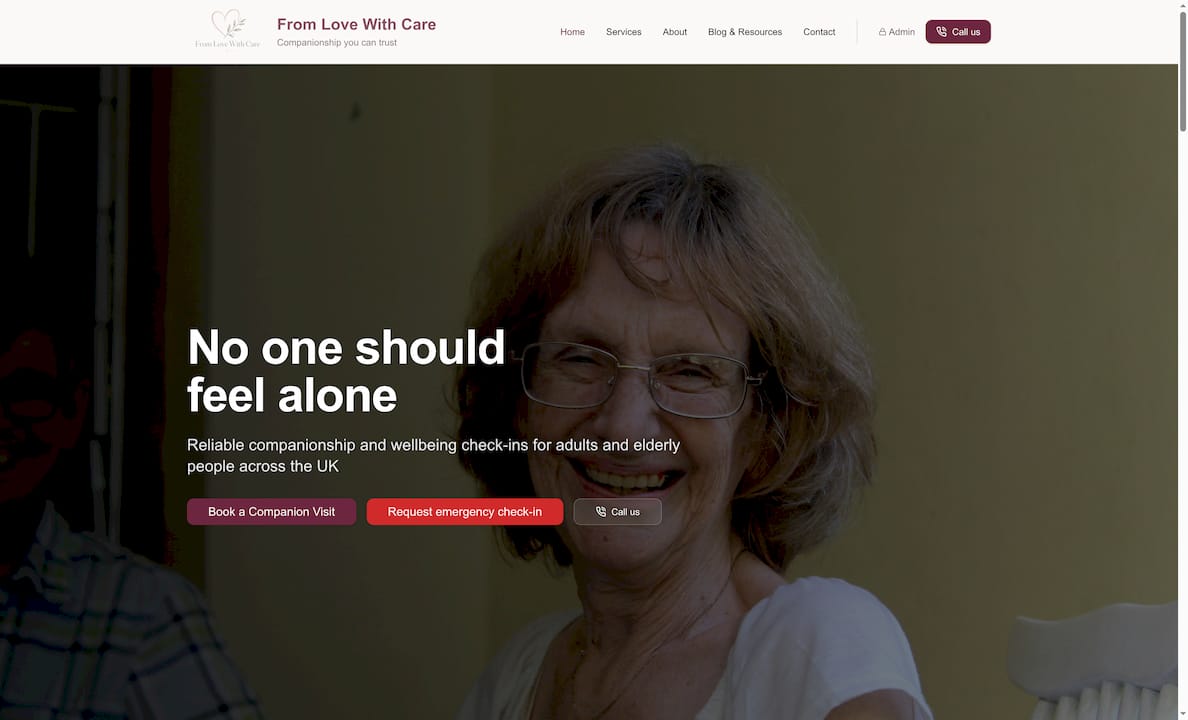
Companions are checked and trained to provide reliable visits, so you're not gambling on an unvetted volunteer for someone who can't easily assess a stranger's intentions themselves. This works well alongside a council care package, filling the companionship gap that personal care visits don't cover, or as a steady presence while a needs assessment is still working its way through the system.
If you want to see what a typical visit looks like, the senior home visits page sets out how scheduled companionship works in practice, and the welfare checks service covers urgent check-ins when you need reassurance fast. For those weighing up options after an assessment, or before one, the full range is listed on the services page, where you can check availability and arrange a first visit.
The uncomfortable truth about "ageing without children" nobody says out loud
Most guidance on elderly care assumes a background cast of adult children fielding calls, chasing paperwork, and turning up unannounced. Strip that cast away and the system doesn't collapse, but it does slow down, because so much of it relies on informal chasing that nobody officially accounts for.
AWOC's research on people ageing without children makes a point that's easy to miss: the problem isn't usually a lack of services, it's that services assume someone else is already coordinating them. A needs assessment gets booked, then nobody follows up when the letter with the date gets lost. A care plan gets written, then nobody notices when the visits quietly stop happening. Family, for all its flaws, tends to do this chasing almost by instinct.
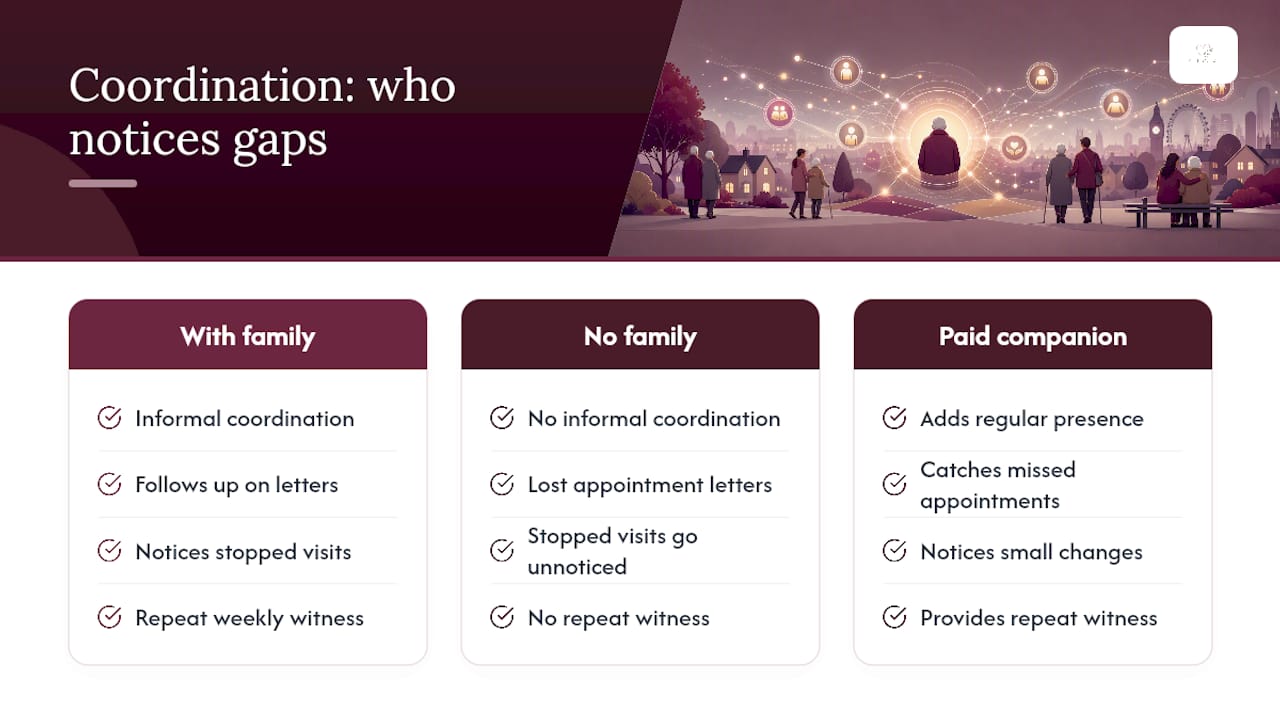
That's why I'd push back on the idea that charities and statutory services alone are "enough" for someone with no family. They're necessary, but they're not designed to notice when something small goes wrong on an ordinary Wednesday. A scheduled, paid companion visit does something a one-off assessment can't: it creates a repeat witness to how someone is actually doing, week to week, who will notice if the fridge is suspiciously empty or the same cardigan has been worn for four days running.
The real fix isn't choosing between statutory care and paid companionship. It's stacking them, using the free assessment to secure entitlements, the charities for advice and advocacy, and a consistent paid or volunteer presence to catch the small things that fall through every other net.
— Ayomide
Sources
- Gov
- Introduction to care and support - NHS
- The care needs assessment explained | Age UK
- Care Rights UK helpline