

Expect companionship visits to cost roughly £20 to £35 an hour across most of the UK, with live-in companionship from around £900 to £1,800 a week depending on need and location. Whether you or your family pay the full amount depends on a council means test and whether benefits such as Attendance Allowance apply. The sections below explain how those figures break down and how to fund them.
TL;DR:
- Companionship visits typically cost between £20 and £35 an hour, with live-in care costing around £900 to £1,800 weekly depending on needs and location.
- The cost can vary based on whether you are self-funding, using council support, or receiving benefits like Attendance Allowance, which is non-means-tested.
- Companionship care includes social interaction, errands, and companionship activities, but excludes medical or personal care tasks.
- Choosing a provider requires checking DBS checks, training, references, backup plans, and clear pricing, with continuity being key for wellbeing.
- Families should confirm their funding options and eligibility before comparing providers, as this influences whether they negotiate with councils or self-pay.
Table of Contents
- How much does companionship care cost in the UK?
- What does companionship care include and exclude?
- Who pays: council means test, Attendance Allowance and direct payments
- How do you choose a companionship provider?
- What are your responsibilities if you use direct payments?
- Does companionship care cost more in London?
- How From Love With Care's companionship service works
- Why funding-first thinking beats price-first thinking
- Ready to arrange companionship support?
- Sources
How much does companionship care cost in the UK?
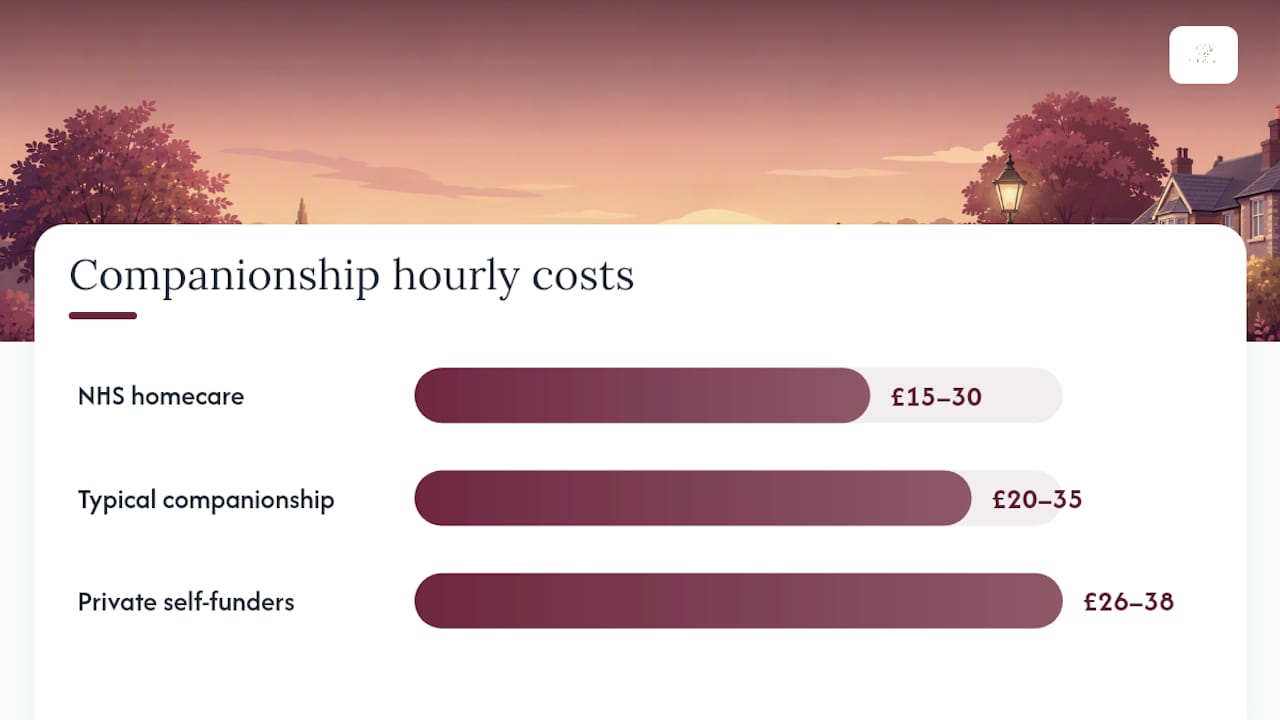
Hourly visiting rates for companionship typically sit between £20 and £35, though the NHS puts general homecare costs at £15 to £30 an hour, and private self-funders often pay more. Birdie's analysis of the private market found self-funders commonly paying between £26 and £38 an hour, with London and specialist support pushing towards the top of that range.
Live-in companionship works differently. Instead of paying per visit, you pay a weekly rate that covers someone living in the home, typically comparable to general live-in care cost ranges observed in the UK. Costs climb when the person needs more supervision or has complex routines, even without formal personal care involved.
Worked examples of weekly costs can be estimated by multiplying typical hourly rates by visit frequency and duration, reflecting varied companionship needs.
Pro Tip: Ask any provider for a written breakdown of what the hourly rate includes before you agree to anything.
That last point matters more than it sounds. Birdie's research notes that agencies typically fold travel time and admin into the headline hourly rate, so two quotes that look identical on paper can cover very different amounts of actual face-to-face time.
What does companionship care include and exclude?
Companionship care is non-medical social support, not clinical or personal care. It's built around presence and connection rather than tasks a nurse or carer would perform.
Typically, companionship care covers:
- Conversation and shared time, such as tea and a chat.
- Accompanying someone to appointments or social events.
- Help with light shopping and errands.
- Shared hobbies, games or gentle activities.
- Regular welfare checks to confirm someone is safe and well.
It excludes personal care tasks such as washing, dressing, medication administration, or moving and handling. If your relative needs both, most families arrange a blended package: a personal care agency for the physical tasks, and a dedicated companionship service such as Fromlovewithcare's non-medical home care for the human connection side. Blending two providers costs more in total than either alone, but it usually costs less than asking one generalist provider to cover everything, since companionship specialists tend to price their time more simply than agencies juggling clinical risk.
Who pays: council means test, Attendance Allowance and direct payments
Most families discover fairly quickly that funding companionship care isn't one single system. It's several overlapping routes, and which one applies to you depends largely on savings and existing benefit entitlement.
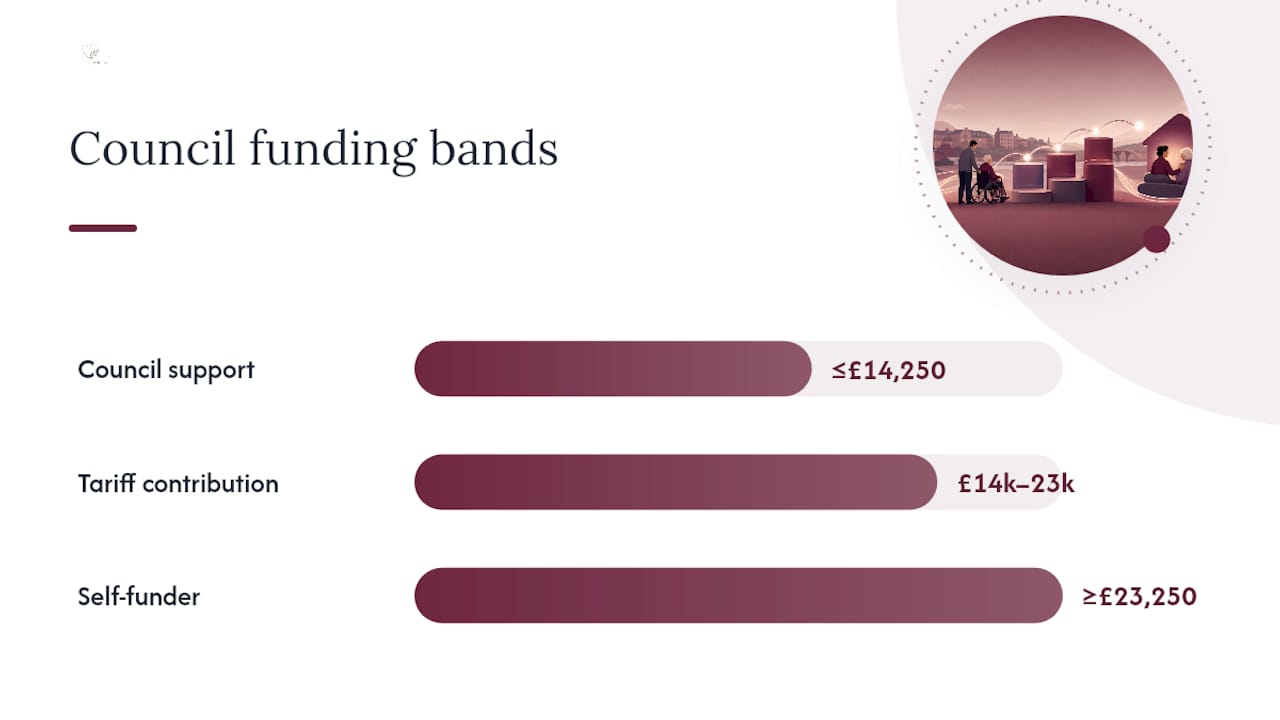
Your starting point is a council needs assessment, which any local authority in England must offer regardless of your finances. If that assessment confirms a need for support, a financial assessment follows, and this is where the capital thresholds decide what happens next. Age UK explains the bands clearly: above £23,250 in capital, you're usually a self-funder; between £14,250 and £23,250, you pay a tariff contribution towards costs; below £14,250, you may receive council support. These figures come directly from the government's local authority charging circular, which sets the upper and lower capital limits nationally.
Attendance Allowance sits outside this means test entirely. It's non-means-tested, so savings don't affect it, and it can be put directly towards companionship visits. Carer's Allowance, by contrast, supports the family carer rather than paying for services, though it can free up household budget that indirectly funds visits. Reading more on funding companionship through Attendance Allowance is worth doing before you assume you're a full self-funder.
Practical next steps, in order:
- Contact your local council and request a needs assessment.
- Check Attendance Allowance eligibility even if you assume savings rule out council help.
- Gather bank statements and savings evidence ahead of any financial assessment.
- Ask whether a direct payment (cash instead of council-arranged care) suits your situation better.
How do you choose a companionship provider?
Price matters, but it shouldn't be the only filter. Continuity and personality fit tend to matter more for companionship specifically, because the entire point of the service is genuine connection, not task completion.
Before committing to any provider, check:
- DBS checks are current and were carried out for this specific role, not a generic historical check.
- Companions receive proper training and there's a clear process for matching personality, not just availability.
- References are available and the provider has liability insurance in place.
- There's a defined backup plan if your regular companion is ill or on holiday.
- The cancellation policy and travel charges are stated in writing, not verbally implied.
Ask providers directly: what happens if my usual companion can't make a visit? How is matching decided, and can we request a change if it isn't working? Are rates inclusive of travel, or added separately?
Pro Tip: A slightly higher hourly rate from a provider offering consistent companion matching often beats the cheapest quote, because repeatedly introducing a lonely or vulnerable person to new faces can undo the wellbeing benefit you're paying for in the first place.
Red flags include vague answers about DBS timing, no named backup companion, and reluctance to put pricing in writing. If you're deciding between an agency and hiring privately, comparing companionship services against care agencies side by side is worth doing before you sign anything.
What are your responsibilities if you use direct payments?
Taking a direct payment sounds simpler than council-arranged care, but it comes with real obligations. Once you use that money to employ a companion privately rather than through an agency, you become their employer in the eyes of the law.
That status brings specific duties:
- Running PAYE payroll and deducting the correct tax and National Insurance.
- Paying employer National Insurance contributions on top of wages.
- Auto-enrolling into a workplace pension where required.
- Holding employer liability insurance in case of injury or dispute.
Many families find this administrative load heavier than expected, which is precisely why agencies and specialist companionship services remain popular even though they cost more per hour than a private hire. If you do go down the direct payment route, Citizens Advice and most local authorities offer payroll support, and third-party payroll services exist specifically to handle this for families who'd rather not manage it themselves.
Does companionship care cost more in London?
Location changes the numbers meaningfully. London and the South East consistently sit at the top of the national range, with self-funders often paying towards £35 to £38 an hour, while other regions frequently see rates closer to £20 to £28.
The delivery model matters just as much as geography:
- Hourly visiting suits families wanting flexibility, occasional cover, or specific check-in times.
- Live-in weekly pricing suits situations needing near-constant presence, and works out more cost-effective than multiple daily visits once needs are frequent enough.
- Alternative models such as Shared Lives, homeshare arrangements, and volunteer befriending schemes offer lower-cost or unpaid options, though availability varies by area and matching can take longer. Recent government funding for adult social care has supported some of these community models, though they remain patchier than paid provision in most regions.
How From Love With Care's companionship service works
Fromlovewithcare provides vetted companionship visits built entirely around social connection, not clinical tasks. Every companion completes DBS checks and training before matching begins, and visits typically follow a regular pattern, such as weekly tea and conversation, shopping trips, or accompanied appointments. Families commonly fund visits through self-payment, direct payments, or Attendance Allowance income, and the service tends to suit households where isolation, rather than physical care need, is the main concern. You can see how matching and booking work on the how our companionship works page.
Why funding-first thinking beats price-first thinking
Most guidance on companionship care cost UK searches leads with hourly rates and stops there, which sets families up to make the wrong first decision. The number that actually matters isn't the hourly rate. It's whether you've established your capital position against the £23,250 and £14,250 thresholds before you start comparing providers, because that determines whether you're shopping in the self-funder market or negotiating with a council.
Conventional advice also underrates continuity. Families chase the lowest quote, then wonder why a lonely relative doesn't seem happier after several visits from rotating strangers. The wellbeing case for companionship rests entirely on trust building over time, so a provider that can't guarantee a consistent, well-matched companion is arguably not offering the same product as one that can, regardless of how their hourly rates compare.
If you take one thing from this guide, make it this: get the needs assessment and check Attendance Allowance eligibility before you commit to a provider, not after. Money spent working out entitlement upfront saves far more than money saved chasing a marginally cheaper hourly rate.
— Ayomide
Ready to arrange companionship support?
Fromlovewithcare gives you a way to fund genuine companionship without navigating an agency's full personal care bureaucracy. Every visit is delivered by a DBS-checked companion focused purely on connection, whether that's a weekly chat over tea, help with the shopping, or accompanying a relative to an appointment.
If you've worked out your funding route, whether that's self-paying, a direct payment, or Attendance Allowance income, the next step is straightforward. Browse the companionship services on offer, or go directly to the elderly companionship services page to check coverage in your area and request an assessment. For those specifically worried about a relative's isolation rather than physical care needs, the loneliness support services page outlines how visits are structured around rebuilding regular human contact.
This article is general information, not a substitute for advice from a qualified financial advisor. Consult a qualified financial professional about your own circumstances before acting on anything here.
Sources
- Social care charging for care and support: 2026 to 2027 (local authority circular)
- Help at home from a paid carer - NHS
- Paying for care at home | Age UK
- Average private homecare rates in the UK: how to price your services in 2026 | Birdie Blog