
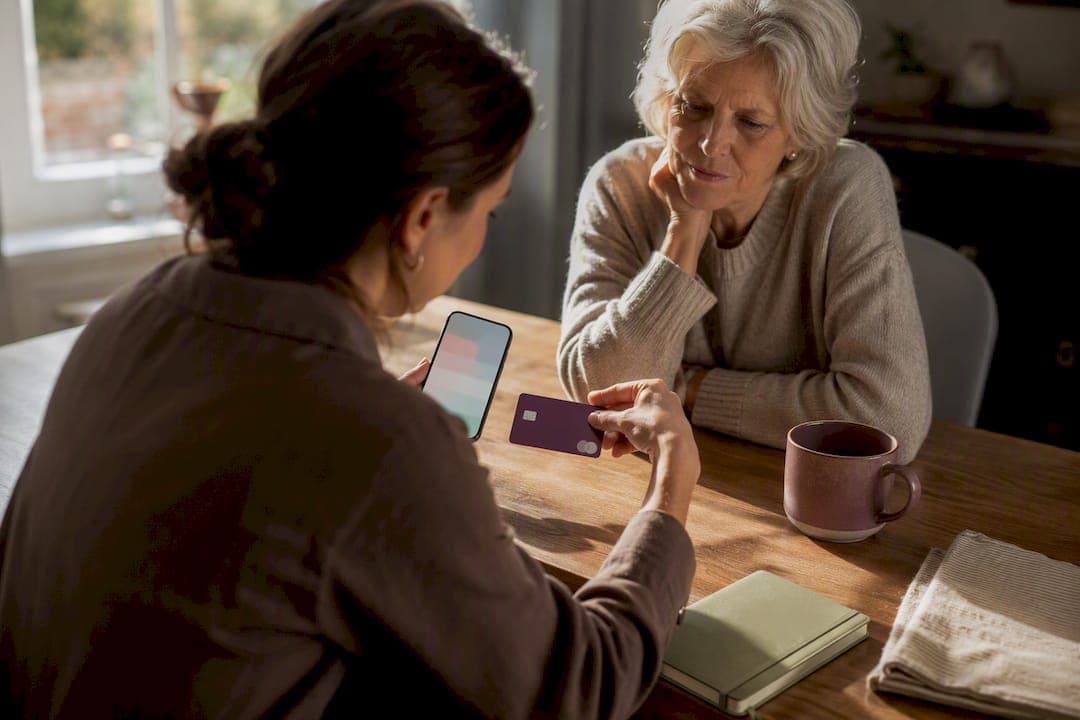
Most families end up paying for companionship through a mix of routes rather than one clean source: self-funding, a council personal budget or direct payment, NHS Continuing Healthcare where health needs qualify, and benefits such as Attendance Allowance. The first practical step is always the same, whatever the mix turns out to be. Request a needs assessment from your local council and check Attendance Allowance eligibility. If your relative's needs are primarily health-related, ask their GP about starting a CHC checklist, and whichever payment method you settle on, insist on written invoices from day one.
TL;DR:
- Combining multiple funding sources, such as Attendance Allowance, council budgets, and benefits, is common and can significantly reduce out-of-pocket costs for companionship.
- NHS Continuing Healthcare is a non-means-tested option that, if approved, can cover full care costs, but families often overlook or delay applying for it.
- Insisting on written invoices, visit logs, DBS checks, and insurance from providers ensures legal and financial protections when arranging care funding.
- Paying a family member for companionship is legal if documented properly, evidence-based, and in the person's best interests, but tax obligations may apply if employed formally.
- Starting with a needs assessment and benefits check in parallel offers the quickest access to funding, especially during urgent situations, while exploring CHC eligibility can eliminate costs entirely.
Table of Contents
- What are the payment methods for companionship?
- How do council funding and NHS Continuing Healthcare work?
- Which benefits and grants help pay for companionship?
- What day-to-day payment methods work for companionship visits?
- Can you pay a family member for companionship legally?
- A checklist for setting up companionship payments safely
- Why funding shouldn't be the barrier to companionship
- How Fromlovewithcare can help you arrange and pay for visits
- Sources
- FAQ
What are the payment methods for companionship?
Families rarely rely on a single pot of money. They stitch together whatever is available, and the combination usually depends on how urgent the need is and how much the family already has in savings or pension income.
The main routes look like this:
- Self-funding: paying privately from savings, pension income or family contributions, with no means test involved.
- Council personal budgets and direct payments: money allocated after a needs and financial assessment, either arranged by the council or paid to you to manage yourself.
- NHS Continuing Healthcare (CHC): full funding for care at home when a primary health need is identified, assessed separately from social care.
- Benefits and grants: Attendance Allowance, Disabled Facilities Grants and local charitable support that top up whatever else is in place.
The common pattern is combining two to four of these sources: Attendance Allowance plus pension income plus a council contribution, for example, rather than expecting one scheme to cover everything. If the need is urgent, start with a needs assessment and an Attendance Allowance check in parallel; for an international perspective, see how some insurance models, like Pflegezusatzversicherung for U.S. residents, approach long‑term care coverage. If you have more time, it's worth exploring CHC eligibility first, since it can remove the cost question entirely for families who qualify.
How do council funding and NHS Continuing Healthcare work?
Council-funded support and NHS Continuing Healthcare follow different assessment routes, and confusing the two wastes time families often don't have. Here's the practical sequence.
- Request a care needs assessment. Anyone can ask their local authority for one, and it's free regardless of income. It establishes what support your relative actually needs, which then determines whether council funding is even on the table.
- Undergo a financial assessment. If the needs assessment suggests eligibility, the council carries out a means test to work out how much, if anything, it will contribute towards a personal budget.
- Choose between a personal budget and direct payments. A personal budget can be arranged directly by the council, or paid to your family as a direct payment so you commission and pay companions yourselves. Direct payments give more control but shift administrative responsibility onto you.
- Ask a clinician about a CHC checklist. If your relative has a significant, primary health need, a GP or community nurse can start the Continuing Healthcare assessment. CHC is non-means-tested, and many families never think to ask, so it gets overlooked even when someone would qualify.
Timescales vary by area, but a full CHC decision typically takes several weeks once the checklist is submitted, so it's worth starting the conversation early rather than waiting for a crisis.
Which benefits and grants help pay for companionship?
Attendance Allowance is the benefit most families lean on, and it deserves attention because it isn't means-tested. Anyone over State Pension age with care needs can apply, regardless of savings or income, and the money can be spent however the family chooses, including on companionship visits. At the higher rate, it can effectively subsidise around three hours of private companionship a week, which for many households turns an occasional visit into a regular one.
A few other things worth checking:
- Carer's Allowance interacts with Attendance Allowance in specific ways, so check eligibility carefully if a family member also claims it.
- Disabled Facilities Grants can fund home adaptations that reduce the need for support hours elsewhere, freeing up budget for companionship.
- Local charitable grants, often signposted by Age UK or Citizens Advice, can bridge short-term gaps while a benefits claim is processed.
Apply early. Attendance Allowance claims can take weeks to process, and keeping a written record of the outcome (award letter, rate, review date) makes future council or CHC assessments considerably smoother, since assessors often ask what other support is already in place.
What day-to-day payment methods work for companionship visits?
Once funding is sorted, the practical question is how money actually moves from your account to the companion or agency providing the visits. Most families use one of a handful of methods, and each carries its own paperwork expectations.
- Bank transfer (standing order or one-off BACS/CHAPS payment): the most common method for regular weekly or monthly visits, and it leaves a clear audit trail.
- Direct debit: convenient for agencies with fixed monthly invoicing, though less flexible if visit hours change week to week.
- Card payment or online payment link: increasingly common for agencies with app-based booking, useful for one-off or occasional visits.
- Cash: still used for informal arrangements, but far riskier without a receipt, since it leaves nothing to show an assessor, a bank, or the Office of the Public Guardian if questions ever arise.
If you're using a council direct payment to employ a companion directly rather than through an agency, you take on employer responsibilities. That means running payroll, deducting PAYE and National Insurance where thresholds are met, and keeping proper employment records. Many families use a payroll service designed for direct payment recipients specifically to avoid the administrative risk of getting this wrong.
Whatever method you choose, insist on itemised invoices, visit logs, evidence of DBS checks, and proof of insurance from any provider before the first visit. A longer scheduled visit of one to two hours also tends to represent better value than several short 15-minute drop-ins, since travel and admin time get absorbed into the session rather than charged separately each time.
Pro Tip: Set up a dedicated bank account or standing order just for care payments. It makes reconciling invoices at year-end far easier, and it gives you a clean paper trail if a council assessor or the Office of the Public Guardian ever asks how funds were used.
Can you pay a family member for companionship legally?
Paying a relative to provide companionship is legal, but it needs to be handled carefully, particularly if you're acting as a deputy or attorney under a Lasting Power of Attorney. The Office of the Public Guardian expects these payments to be evidenced, affordable, and demonstrably in the person's best interests, not simply a convenient way to move money within the family.
A few principles to follow:
- Benchmark the payment reasonably. The OPG's own guidance suggests using commercial care rates (from ASHE tables) minus roughly 20% as a fair starting point, rather than an arbitrary figure.
- Apply to the Court of Protection for approval if the payment is substantial, ongoing, or if there's any risk of dispute among other family members.
- Keep detailed records of hours worked, tasks performed, and how the arrangement compares to what a professional companion would have cost.
- Understand the tax position. HMRC often treats informal family care payments as voluntary and exempt, but formally employing a relative triggers PAYE and National Insurance obligations just as it would for anyone else.
Getting this wrong doesn't just risk a tax problem. It can also undermine trust between siblings or other family members who weren't consulted, which is often the more painful outcome.
A checklist for setting up companionship payments safely
Getting the paperwork right at the start saves weeks of frustration later, particularly if a council or CHC assessment happens down the line and asks what evidence you have.
- Book a needs assessment with your local authority, even if you expect to self-fund, since it establishes a paper trail for any future funding application.
- Check Attendance Allowance eligibility in parallel, and apply promptly given typical processing times.
- Get two to three quotes from companionship providers so you have a realistic sense of local rates, which commonly sit at the lower end of the £25 to £38 hourly range typical for UK home care.
- Decide between council-arranged care and self-funding based on the financial assessment outcome and your relative's preferences.
- Confirm a visit schedule in writing before the first session, including duration, frequency and cost per visit.
Documents to have on file: a care plan, a written contract or service agreement, evidence of DBS checks, itemised invoices, and digital visit records where the provider offers them. Be wary of any provider who won't put arrangements in writing, insists on cash with no receipt, or issues vague, undated invoices. If something feels off, your local authority's adult social care team, Age UK, and Citizens Advice can all offer free, practical guidance on what a legitimate arrangement should look like.
Why funding shouldn't be the barrier to companionship
Loneliness in older age is often compared to smoking fifteen cigarettes a day, and that comparison exists for good reason: the health consequences are that serious, and yet funding paperwork is frequently what stops families from acting. Fromlovewithcare exists because too many people go days without a real conversation, not because families don't care but because the system for paying for support can feel harder to navigate than it needs to be.
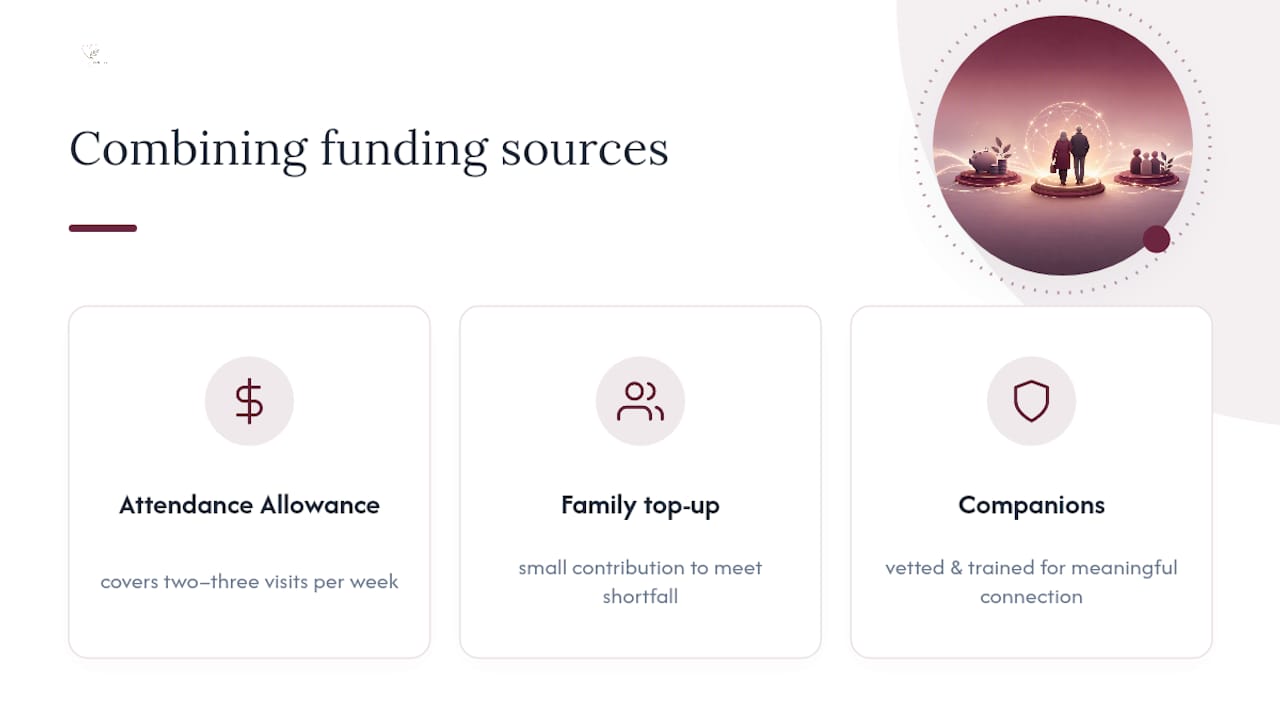
What we see in practice is families making it work through modest combinations: an Attendance Allowance award covering two or three visits a week, topped up by a small family contribution, rather than waiting for one scheme to cover everything. Companions are generally vetted and trained specifically for meaningful connection rather than clinical care, which helps keep the offering focused and the cost realistic for families combining various funding sources.
— Ayomide
How Fromlovewithcare can help you arrange and pay for visits
Companionship services offer regular visits and welfare check-ins, focusing on conversation, shared activities, grocery trips, and support during appointments, delivered by companions trained for this kind of human connection.
If you've worked through the funding routes above and want a straightforward next step, our services overview sets out what a typical visit includes and how pricing works per hour. Families arranging visits for an elderly parent often start with our page on companion visits for elderly parents, which explains scheduling and how invoicing works in practice. If your relative lives alone and safety is the immediate worry, our welfare checks service covers emergency check-ins alongside regular visits. Whichever funding mix you've settled on, you can request a written quote today and get a schedule confirmed before your first Attendance Allowance payment even lands.
Sources
- Paying for your own social care (self-funding) - NHS
- OPG's approach to family care payments
- How to Pay for Home Care in the UK — 2026 Funding Guide & FAQs – Oath Healthcare
- Private Home Care UK: Costs and Options | RightCareHome
This article is general information, not a substitute for advice from a qualified financial advisor. Consult a qualified financial professional about your own circumstances before acting on anything here.
FAQ
What is the cheapest way to pay for companionship visits?
Self-funding with a direct bank transfer avoids agency and payroll fees, but combining it with Attendance Allowance, which is non-means-tested, usually reduces the family's out-of-pocket cost more than switching payment methods alone.
Can I use a council personal budget to pay for companionship rather than personal care?
Yes, if a needs assessment identifies companionship or welfare support as part of your relative's care plan, a personal budget or direct payment can be used to fund it, either through an agency like Fromlovewithcare or by employing a companion directly.
Do I have to pay tax if I pay a family member for companionship?
Informal, voluntary family care payments are often treated by HMRC as exempt, but if you formally employ a relative through a direct payment, PAYE and National Insurance obligations apply just as they would with any employee.
How much of my Attendance Allowance can go towards companionship?
Attendance Allowance is paid directly to the claimant with no restrictions on how it's spent, and at the higher rate it can subsidise roughly three hours of private companionship a week, depending on local rates.
What paperwork should I insist on from a companionship provider?
Always ask for a written contract, itemised invoices, evidence of DBS checks and proof of insurance before the first visit; a provider unwilling to provide these is a clear red flag.