

The most useful thing you can do before a companion visit is prepare a short, person-centred conversation plan: one page listing three themed prompts (life story, hobbies, sensory), two memory aids such as photos or a familiar song, and a timed outline for a 10, 30 or 60-minute visit. DBS-checked companions build rapport faster when they arrive with a clear, dignified plan rather than relying on improvisation. NHS guidance on communicating with people living with dementia supports short, single-idea prompts and validation over correction. If a crisis arises during or after a visit, The Silver Line (0800 4 70 80 90) offers free, confidential support for older people across the UK.
Before the visit, gather:
- The person's preferred name and any name they dislike
- Two or three labelled photographs
- A short life-story note (three bullet points: childhood place, former job, a favourite memory)
- A playlist or one familiar song
- Current routine details: tea or coffee preference, medication times to avoid
- Emergency contact number and any known triggers or sensitivities
Table of Contents
- Three-minute checklist before each companion visit
- Practical prompts grouped by theme
- How to adapt prompts for people with dementia or memory loss
- Photos, music and simple activities that spark conversation
- Sample 10, 30 and 60-minute visit outlines
- Topics and behaviours to avoid, and red flags to escalate
- Safeguarding, consent and handover guidance
- Adapting prompts for phone or video calls
- Key takeaways
- Why the conversation itself is the care
- Fromlovewithcare: arranging a visit that feels like it matters
- Useful UK resources and helplines
Three-minute checklist before each companion visit
A quick pre-visit check prevents the small oversights that derail an otherwise warm visit. Work through this before the companion arrives or send it to them the evening before.
Identity and consent
- Confirm the person's preferred name and how they like to be addressed
- Note any GDPR considerations: get verbal or written consent before sharing photos or personal details with a new companion
- Record any topics that are currently distressing or off-limits
Practical kit
- Two to three labelled photos (people, places, pets)
- A short life-story note (three bullet points maximum)
- A playlist of five familiar songs or one song to play on arrival
- Current routine: preferred drink, meal times, medication schedule (times only, not details)
- Emergency contact and GP surgery number
Environment
- Choose a quiet room with comfortable seating at the same eye level as the person
- Turn off the television and radio before the companion arrives
- Ensure good lighting and remove trip hazards from the route to the seating area
NHS guidance on loneliness in older people recommends speaking clearly, pausing between sentences and allowing extra time for responses. Build those pauses into the plan itself.
Pro Tip: Write one clear sentence at the top of the companion card: "Please call [name] by [preferred name] and avoid the topic of [X] today." That single line can prevent distress before the visit has even begun.
Practical prompts grouped by theme
Ready-to-use questions give companions confidence and keep visits dignified. A good mix of open and closed prompts means the conversation can flex around the person's energy on any given day. For a longer curated list, the elderly companionship conversation topics guide offers additional sensitive-topic guidance.
Life story: "Tell me about where you grew up." / "What was your first job like?" / "What did you love most about [town/city]?"
Hobbies and skills: "Did you ever grow your own vegetables?" / "What did you used to bake?" / "Were you a knitter or a sewer?"
Daily routine and practical choices: "Shall we have tea or coffee?" / "Would you like the window open?" Simple choices restore a sense of control.
Sensory prompts: Hold out a familiar object, describe a smell, or play 30 seconds of a song before asking: "Does that remind you of anything?"

Favourites: "What was your favourite holiday?" / "Was there a TV programme you never missed?"
Gentle current happenings: Local weather, a community event, or a seasonal change ("The daffodils are out in the park this week") keep the conversation grounded in the present without demanding recall.
| Theme | Example prompt | Suggested follow-up action |
|---|---|---|
| Life story | "Tell me about your first home." | Show a photo of a similar street or era |
| Hobbies | "Did you have a garden you were proud of?" | Hand over seed packets or a gardening magazine |
| Sensory | "Does this smell remind you of anything?" | Play a 30-second song from the same era |
| Favourites | "What was your favourite meal growing up?" | Offer a familiar biscuit or cup of tea |
| Current events | "The weather has been lovely this week." | Point to a window view or a seasonal flower |
Companion care focused on conversation improves emotional wellbeing and provides mental stimulation for isolated older adults. One idea at a time, a pause after each question, and acceptance of non-verbal replies (a smile, a nod) are all valid responses.
Pro Tip: If the person goes quiet, resist filling the silence immediately. A pause of five to ten seconds often produces a richer response than a follow-up question.
How to adapt prompts for people with dementia or memory loss
Use sensory-led and validation approaches rather than testing memory. The NHS recommends short, single-idea sentences, sitting at the same eye level and validating feelings rather than correcting facts. If someone says it is 1975, agree with the feeling behind the statement rather than the date.
- Sit at eye level; standing over someone creates an unintentional power imbalance
- Use the "rule of one": one idea, one question, one instruction at a time
- Pause after speaking and wait; rushing triggers anxiety
- Offer simple binary choices: "Tea or coffee?" not "What would you like to drink?"
- Validate rather than correct: "That sounds like it was a wonderful time" rather than "No, that was your sister, not your mother"
Sensory triggers and memory boxes often produce the most meaningful connection for people with memory loss, precisely because they bypass the need for verbal recall. A familiar scent, a piece of fabric, or a hymn can open a conversation that direct questions cannot.
Pro Tip: If distress arises, acknowledge the feeling calmly ("I can see that's upsetting"), shift to a quiet sensory task such as holding a warm cup of tea, and note the trigger in the handover so the next companion can plan around it.
Photos, music and simple activities that spark conversation
Props do most of the conversational work when words are hard to find. Keep the selection small and meaningful rather than overwhelming.
Effective props to bring:
- Three to five labelled photographs (family, former home, a pet, a holiday)
- A single familiar fragrance: fresh flowers, a baking smell, or a favourite soap
- A playlist of five songs from the person's 20s and 30s
- A small memory box with tactile items: a button, a fabric swatch, a postcard
- A simple tactile object linked to a former hobby: knitting needles, seed packets, a recipe card
Activities to pair with props:
- Look at one photograph together and ask a single question about it
- Fold a small item of laundry together while chatting (purposeful, calming, familiar)
- Sort recipe cards by season or ingredient
- Listen to one song and share a memory it prompts
- Water a small plant or arrange a few flowers in a vase
Memory boxes, playlists and repeatable short projects create continuity across visits, giving the person something to look forward to and the companion a natural starting point. Person-centred engagement that draws on lifelong roles restores purpose; offering someone a role (choosing, sorting, arranging) is more dignifying than asking them to watch passively. For more activity ideas, the shared hobbies guide covers practical approaches to shared projects.
Sample 10, 30 and 60-minute visit outlines
These templates are designed to be printed and handed to a companion before a visit. Adapt the script snippets to the person's name and preferences.
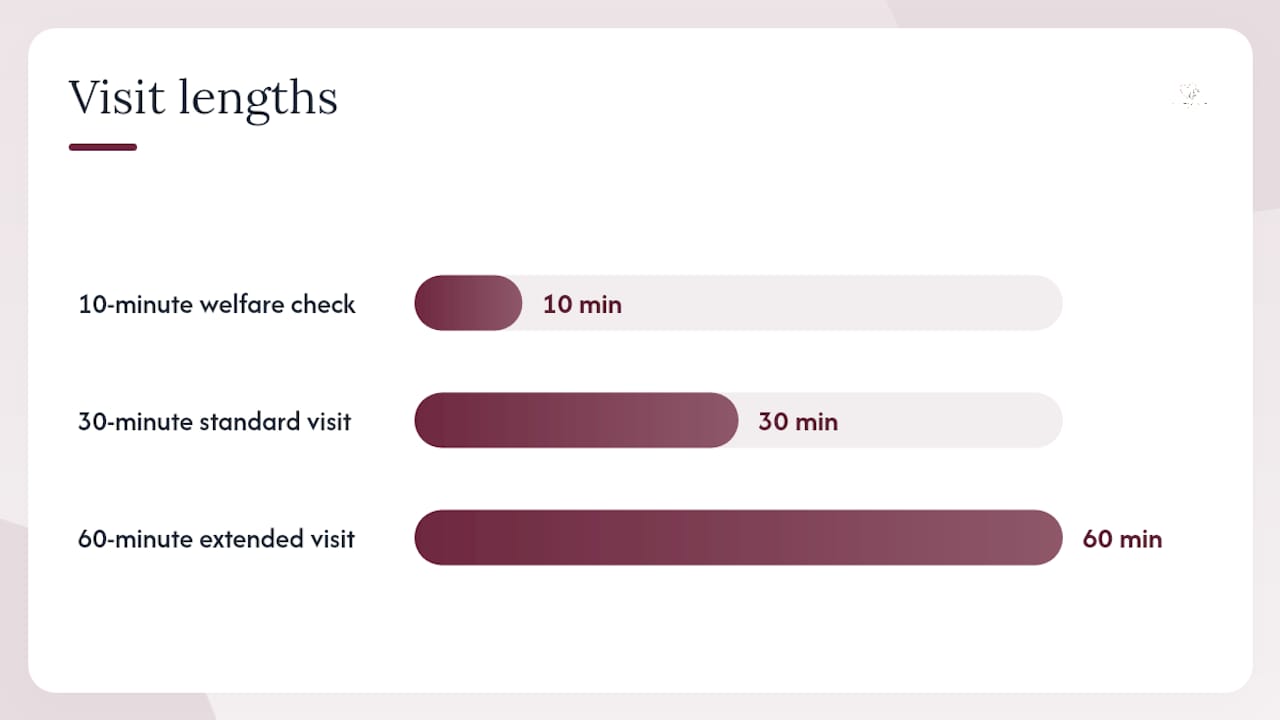
10-minute welfare check
- Arrive, greet by preferred name: "It's lovely to see you, [name]. I just wanted to pop in and say hello."
- One sensory prompt: offer a familiar drink or play 30 seconds of a song
- One short, open question: "How has your morning been?"
- Brief tidy or practical help if needed
- Warm close: "I'll see you [day]. Take care of yourself."
- Record mood and any concerns in the handover note
30-minute standard visit
- Greeting and preferred drink
- First themed prompt (life story or hobbies) with one photo or object
- Second prompt (sensory or favourites) with a short activity
- Refreshments and gentle conversation
- Warm close and handover note (mood, what worked, what to try next time)
60-minute extended visit
- Greeting, preferred drink, settle into comfortable seating
- Life-story prompt with photographs (10 minutes)
- Shared activity: sorting, folding, gardening task or recipe cards (15 minutes)
- Music or rhythmic reading: a poem, a hymn, a familiar song (10 minutes)
- Refreshments and open conversation (15 minutes)
- Gentle recap and close: "We had a lovely chat about [topic] today."
- Full handover note: mood, triggers, successes, any welfare concerns
Maximising short support visits depends on a clear structure that the companion can follow without improvising, particularly when the person's energy or recall varies from one visit to the next.
Topics and behaviours to avoid, and red flags to escalate
Avoid correction, arguing, complicated choices and any topic the person has flagged as distressing. Companions should never offer medical advice or comment on medication.
Topics and behaviours to avoid:
- Correcting factual errors about people, dates or events
- Asking "Do you remember?" (it tests memory and can cause shame)
- Raising contentious family disputes or financial worries unless the person raises them
- Offering more than two choices at once
- Speaking about the person as though they are not present
Red flags to record and escalate:
- Sudden withdrawal or refusal to engage over multiple visits
- New unexplained bruising or physical marks
- Repeated distress about the same person or event
- Confusion about medication timing or signs of missed doses
- Evidence of self-neglect: unwashed clothing, no food in the house, poor hygiene
Sample handover wording: "I noticed repeated distress about [X]. When we discussed it, [name] became more anxious and asked about [Y]. I have noted this for the family and suggest a follow-up call."
Safeguarding, consent and handover guidance
Confirm consent and scope before every visit. Companions from Fromlovewithcare are DBS-checked and trained in person-centred communication, but they are not medical carers. Families should confirm clear limits and provide emergency contacts in writing before the first visit.
Safeguarding checklist:
- Confirmed DBS certificate for the companion
- Named emergency contact (family member or GP surgery)
- Known allergies and medical alerts (no medication details, just alerts)
- Documented triggers and topics to avoid
- Mobility aids or accessibility needs noted
Handover essentials after each visit:
- Brief mood note: calm, anxious, tired, engaged
- What worked well (topic, prop, activity)
- What to avoid or adapt next time
- Any welfare concern requiring family or GP follow-up
Pro Tip: Create a one-page "companion card" the family fills in once and updates after each visit. Keep it in a consistent place in the home so any companion can find it immediately on arrival.
Adapting prompts for phone or video calls
Keep remote calls shorter and more structured than in-person visits. Start with the person's name and a clear reason for calling, offer one sensory substitute and one practical question.
Remote call checklist:
- Confirm hearing device is in and working before starting
- Reduce background noise at both ends
- Ask one closed question first: "Are you warm enough today?"
- Follow with one open prompt: "Tell me about something you enjoyed this week."
- Schedule the next call before ending
Short remote call script:
- "Hello [name], it's [companion name] calling for your usual chat."
- "I'm going to play you a short piece of music. Tell me if it sounds familiar." (Play 20 seconds)
- "That always makes me think of summer. Does it remind you of anything?"
- One practical question: "Is there anything you need before I call again on [day]?"
- "Lovely to talk with you. I'll ring again [day] at [time]."
For video calls, show a photograph on screen, use subtitles or the chat function where helpful, and keep the call to 15 minutes unless the person is clearly energised and engaged. Regular, reliable contact reduces loneliness even when visits are not possible; the consistency of the call matters as much as its content.
Key takeaways
A short, themed conversation plan with sensory aids and a timed visit outline gives DBS-checked companions everything they need to deliver a dignified, engaging visit from the first moment.
| Point | Details |
|---|---|
| Prepare a one-page plan | List three themed prompts, two memory aids and a timed outline before every visit. |
| Use sensory aids | Photos, familiar music and tactile objects often open conversations that direct questions cannot. |
| Adapt for memory loss | Use the "rule of one," validate rather than correct, and sit at eye level for every interaction. |
| Record and iterate | Note mood, triggers and successes after each visit and update the companion card accordingly. |
| Fromlovewithcare | Provides DBS-checked, vetted companions trained in person-centred communication for in-home visits across the UK. |
Why the conversation itself is the care
The conventional view of companion visits is that conversation fills time between more "important" care tasks. That framing gets it backwards. For many isolated older adults, a well-prepared, unhurried conversation is the most therapeutic thing that happens in their week. Not because it is complex or cognitively demanding, but because it says: your story matters, your preferences matter, you are worth listening to.
What the evidence consistently shows is that the biggest barrier to good conversation is not the person's memory or hearing. It is the companion arriving unprepared, filling silences with questions that test recall, and inadvertently turning a social visit into something that feels like an assessment. A short, thoughtful plan removes that pressure from both sides.
Fromlovewithcare's approach, and the experience reflected across the visits its companions make, is that the smallest details carry the most weight: using the right name, bringing one photograph, playing one familiar song. Those acts of preparation are not administrative. They are the care.
Fromlovewithcare: arranging a visit that feels like it matters
Preparing a conversation plan is only half the picture. The other half is finding a companion who will use it with warmth, patience and genuine skill.
Fromlovewithcare provides DBS-checked, vetted companions trained in person-centred communication for in-home visits across the UK. Every companion arrives ready to follow the plan you prepare, whether that means a 10-minute welfare check, a 60-minute extended visit with shared activities, or a regular weekly visit that builds trust over time. The service covers conversation and emotional support, shared hobbies, grocery shopping assistance and emergency welfare checks. There are no medical tasks and no ambiguity about scope.
To arrange a visit or find out how the service works, visit the services page or read about how it works before booking.
Useful UK resources and helplines
- 2.2 Demonstrate communication techniques adapted for elderly patients – Care Learning
- Communicating with someone with dementia - NHS
- Loneliness in older people — how to help
- Making engagement truly person-centered - Dementia Life
- Companion Care: Conversation and Engagement - Caregiver Information
- Staying connected
- If someone you know is lonely
This article provides general information and practical guidance, not professional medical or legal advice. For concerns about a person's health, safety or welfare, contact their GP, a qualified care professional, or emergency services.