

A professional companion during respite is defined as a vetted, trained individual who provides emotional support, practical daily assistance, and care continuity for an elderly person while their family caregiver takes a planned or emergency break. The role sits within the broader category of respite care assistance, which the ACL Lifespan Respite Care Programme describes as temporary, community-coordinated relief that maintains care quality throughout. Unlike a clinical nurse or live-in carer, a professional companion focuses on human connection, routine maintenance, and rapport. The Frontiers journal and HRCloud job description frameworks both confirm that relational trust is the defining quality of effective respite companionship. Understanding this role clearly helps families make confident, informed decisions for their loved ones.
What is the role of professional companion during respite?
The role of professional companion during respite covers three core areas: emotional support, continuity of daily routines, and practical assistance with everyday living. These are not passive tasks. A companion actively implements the existing care plan, maintains the elder's familiar schedule, and communicates clearly with the family before and after each visit.
Emotional and social support is the foundation of the companion role in caregiving. Companions engage the care recipient in conversation, shared activities, and gentle encouragement tailored to their cognitive level. For someone living with early-stage dementia, this might mean reminiscing over photographs. For a physically frail but mentally sharp elder, it might mean a lively discussion over a cup of tea.

Practical daily living assistance includes help with meals, light mobility support, personal hygiene prompts, and medication reminders where permitted. Professional caregiver responsibilities defined in standard job frameworks include preparing light meals, accompanying clients on short walks, and supporting safe transfers between rooms.
Care plan implementation and handover is where many companions distinguish themselves. A skilled companion does not simply arrive and fill time. They follow the family's established routines precisely, note any changes in mood or physical condition, and provide a written handover to the returning family caregiver. This detail matters enormously for continuity.
- Engage the care recipient in activities matched to their cognitive and physical ability
- Prepare and serve meals according to dietary preferences and restrictions
- Provide gentle mobility support and accompany on short outings
- Observe and record any changes in behaviour, mood, or physical condition
- Complete a thorough handover to the family caregiver on return
Pro Tip: Before a companion's first visit, prepare a one-page summary of your loved one's daily routine, preferences, and any triggers to avoid. A good companion will use this immediately. A great one will add to it.
How does respite companionship benefit families and care recipients?
Professional companionship during respite produces measurable benefits for both the family caregiver and the person receiving care. These benefits are not anecdotal. A 2026 group respite study published in ScienceDirect found a 94% reduction in stress scores among caregivers following a structured respite intervention. That figure reflects how profoundly even short-term, well-managed respite can shift a caregiver's physical and emotional state.
"The relational process between respite personnel and caregivers, marked by listening, respect, and time to build trust, is a key factor in reducing caregiver burden and improving satisfaction." — Frontiers, Value of Respite Model, 2026
For the care recipient, the benefits are equally real. Companions who take time to learn personal preferences, replicate familiar routines, and offer genuine warmth reduce the anxiety that often accompanies a change in carer. The Value of Respite Model from Frontiers identifies listening, respecting established habits, and allowing an acclimation period as the foundations of positive outcomes for elders during respite.
Research also highlights that measurable respite benefits often require observation over several weeks rather than a single visit. Families who commit to regular, recurring respite sessions see greater reductions in caregiver stress than those who use it only in crisis moments. This is a critical point. Respite works best as a planned, consistent part of the care routine, not a last resort.
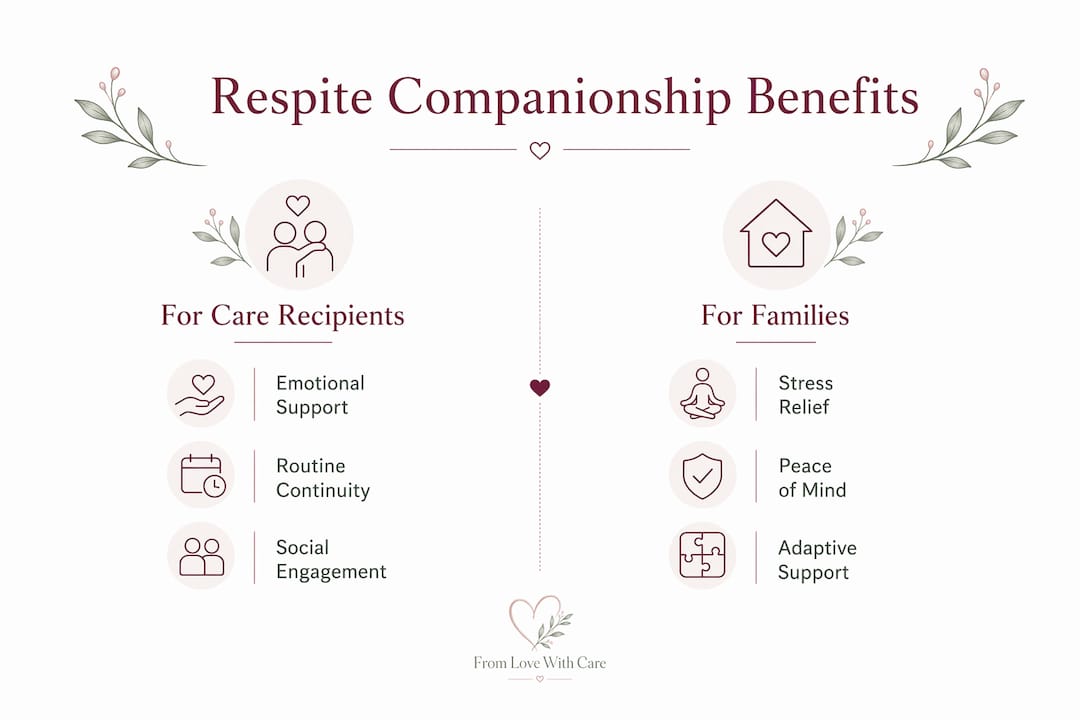
Support for family caregivers also extends beyond the respite period itself. A 2026 JMIR Aging study found that adaptive stress-reduction interventions designed for dementia caregivers produced significant stress reduction and high acceptance rates. This reinforces that the emotional support a companion provides during respite is part of a wider ecosystem of caregiver wellbeing. The importance of respite services is now well-evidenced: outcomes research consistently prioritises caregiver wellbeing over simple hours-of-coverage metrics.
How does a companion differ from other respite care providers?
Professional companionship differs from other respite care options by placing social connection and emotional support at the centre, rather than clinical or medical tasks. This distinction matters when families are choosing the right type of support.
A companionship service versus a care agency represents a genuine difference in purpose, not just in price. Care agencies typically provide trained carers who handle personal care, medication administration, and post-hospital recovery support. Companion services focus on presence, conversation, shared activities, and practical non-clinical help.
| Feature | Professional Companion | Care Agency |
|---|---|---|
| Primary focus | Emotional support and social connection | Personal care and clinical tasks |
| Medical tasks | Not included | Often included |
| Typical engagement | Conversation, activities, outings, meals | Washing, dressing, medication management |
| Relationship style | Friendly, peer-like | Professional, task-oriented |
| Best suited for | Socially isolated or mildly dependent elders | Elders with high physical or medical needs |
One common misconception is that companions are passive sitters who simply keep an eye on someone. This is inaccurate. A professional companion actively engages, observes, and responds. They notice when an elder seems withdrawn, when appetite has changed, or when a familiar routine has been disrupted. That attentiveness is precisely what fills care gaps between clinical visits and family care.
Pro Tip: If your loved one is physically well but increasingly isolated or anxious when left alone, a companion service is likely the better fit over a full care agency. Reserve agency-level support for when personal care or medical oversight is genuinely required.
What should families consider when choosing a companion?
Selecting the right professional companion for respite care requires more than checking a box for availability. The companion's compatibility with your loved one's personality, cognitive level, and daily habits is the single most important factor in whether the arrangement succeeds.
-
Assess cognitive and emotional compatibility. A companion working with someone living with dementia needs patience, experience with memory loss, and the ability to redirect gently. A companion for a physically frail but cognitively sharp elder needs strong conversational skills and genuine curiosity. Ask specifically about the companion's experience with your loved one's condition.
-
Review their approach to care routines. The best companions treat an elder's micro-routines as non-negotiable. Whether that is a specific mug for morning tea or a particular chair for afternoon television, these details matter deeply to the person receiving care. Ask how the companion would learn and replicate these habits.
-
Evaluate communication style and trust-building. The Lifespan Respite Care Programme specifically highlights the handoff back to family caregivers as a quality indicator. Ask prospective companions how they document observations and what their handover process looks like.
-
Arrange an introduction visit before the first solo session. Families benefit significantly from a structured introduction period where the companion meets the elder with the family present. This reduces anxiety for the elder and gives the family a chance to observe the companion's manner directly.
-
Ask about vetting and professional standards. Every companion should have a current DBS check, verifiable references, and clear guidance on what falls outside their remit. Knowing these boundaries protects your loved one and sets clear expectations from the start.
Key takeaways
The role of professional companion during respite is to maintain emotional continuity, replicate daily routines, and provide family caregivers with evidence-based, measurable relief.
| Point | Details |
|---|---|
| Companion role is active, not passive | Companions implement care plans, observe changes, and complete written handovers after every visit. |
| Stress reduction is measurable | A 2026 study found 94% of caregivers showed reduced stress scores following structured respite involvement. |
| Companions differ from care agencies | Companion services focus on social connection; care agencies handle clinical and personal care tasks. |
| Acclimation periods improve outcomes | Introducing a companion gradually reduces elder anxiety and builds the trust needed for effective respite. |
| Routine and handover quality define success | Companions evaluated on micro-routine maintenance and detailed handover notes produce the best continuity of care. |
Why companionship quality matters more than coverage hours
I have seen families approach respite care as a coverage problem. They count hours, check availability, and tick the box. What they often miss is that the quality of the relational connection between companion and elder determines whether respite actually works.
In my experience, the families who report the greatest peace of mind are not those who arranged the most hours. They are the ones who found a companion who genuinely listened to their loved one, remembered small preferences, and handed back care with a clear, honest account of how the day went. That handover moment is undervalued. It is where trust between family and companion is built or lost.
The research supports this. The Frontiers Value of Respite Model places relational soft skills above task completion as the primary driver of positive outcomes. Yet many families still evaluate companions primarily on practical tasks. I would encourage you to weight the relationship equally.
One thing I would caution against is rushing the introduction. Elders, particularly those with any degree of cognitive change, need time to feel safe with a new person. A companion who arrives and immediately takes charge can increase anxiety rather than reduce it. The best companions I have observed move slowly, follow the elder's lead, and earn trust before asserting any routine. That patience is not a luxury. It is the mechanism through which family peace of mind is actually achieved.
— Ayomide
Trusted respite companionship from Fromlovewithcare
Fromlovewithcare provides professional companionship services designed specifically for families who need reliable, compassionate support during respite periods. Every companion is thoroughly vetted, DBS-checked, and matched to your loved one's personality and daily routine.

Whether you need short-term cover for a few hours or regular weekly respite sessions, Fromlovewithcare offers tailored elderly companionship services that prioritise genuine human connection over task completion. Families across the UK trust Fromlovewithcare because companions are trained to maintain routines, observe carefully, and hand back care with full, honest notes. To arrange a visit or discuss your loved one's needs, explore the full range of respite and companion services available today.
FAQ
What does a professional companion do during respite?
A professional companion provides emotional support, maintains the care recipient's daily routines, assists with practical tasks such as meals and light mobility, and completes a written handover to the family caregiver. The role is active and relational, not simply supervisory.
How is a companion different from a respite carer?
A companion focuses on social connection, conversation, and non-clinical practical support, while a respite carer from a care agency typically handles personal care and medical tasks. The right choice depends on your loved one's level of physical and medical need.
How quickly does respite care reduce caregiver stress?
A 2026 ScienceDirect study found that 94% of caregivers showed measurable stress reduction following a structured respite intervention. Consistent, planned respite produces greater benefits than one-off or crisis-driven arrangements.
How long does it take for an elder to adjust to a new companion?
The Frontiers Value of Respite Model recommends a structured acclimation period where the companion gradually builds familiarity before taking on solo sessions. Most elders adjust more comfortably when introduced with the family present first.
What questions should i ask before hiring a companion?
Ask about their experience with your loved one's specific condition, how they learn and replicate daily routines, what their handover process involves, and whether they hold a current DBS check and verifiable references.