

Companionship is defined as regular, non-medical social and practical support that directly sustains an ageing parent's ability to live independently. The role of companionship in parent independence goes well beyond pleasant conversation. Professional companionship reduces isolation and lowers the risk of depression and cognitive decline, making it a form of preventive care rather than a comfort add-on. Families who understand this distinction make better decisions about the kind of support their parents actually need. Fromlovewithcare exists precisely because that distinction matters, and because too many older adults in the UK go days without speaking to anyone.
How does companionship support parent independence and emotional wellbeing?
Companionship sustains independence by addressing the single greatest threat to it: loneliness. Loneliness is a serious health risk comparable in importance to physical illness, not a minor inconvenience. When older parents become socially isolated, their motivation to manage daily tasks, maintain routines, and stay physically active declines sharply. The result is a gradual loss of the very independence families are trying to protect.

The emotional benefits of regular social contact are well documented. Social interaction improves optimism and cognitive function in older adults, with families reporting measurable positive changes within weeks of regular companion visits beginning. That speed of improvement reflects how starved of connection many older parents already are by the time support is introduced.
Companion activities that promote emotional engagement include:
- Shared meals and tea time, which create a predictable, warm social anchor in the day
- Walking together, which combines gentle physical activity with conversation
- Reading aloud or discussing current events, which stimulates memory and opinion-forming
- Accompanying parents to appointments or community events, which maintains their connection to the wider world
- Playing cards or board games, which provide mental challenge and genuine fun
Regular social contact provided by a companion is directly linked to improved emotional and cognitive health in ageing adults. Companionship is not a supplement to care. It is care.
The parenting and emotional support literature consistently shows that older adults who feel heard and valued maintain better physical health. A companion who listens, remembers preferences, and shows genuine interest provides something no medication can replicate.
In what ways does companionship support practical independence without undermining autonomy?
The most important distinction in companion care is between helping and doing. Maintaining autonomy requires assisting selectively, only with tasks the parent finds genuinely difficult, while encouraging them to manage everything else themselves. Doing too much erodes confidence just as surely as doing too little creates risk.
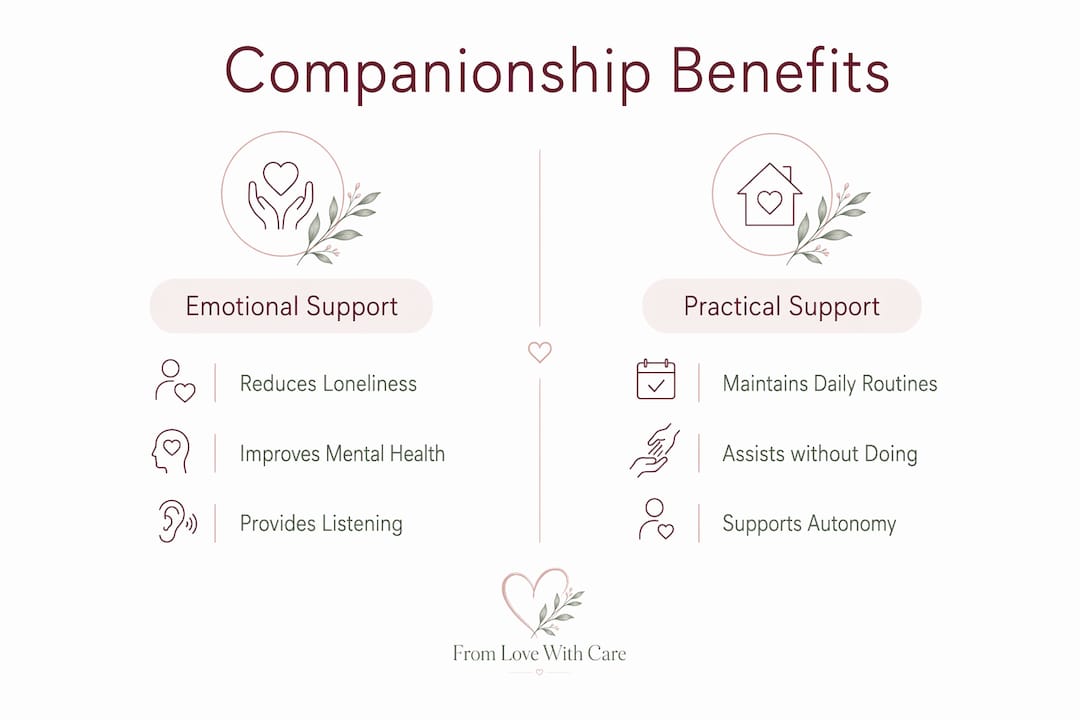
Companion care assists with errands, light housekeeping, and social interaction without replacing the parent's own agency. A companion might drive a parent to the supermarket rather than doing the shopping for them. They might tidy the kitchen together rather than cleaning while the parent sits in another room. These are not small distinctions. They determine whether a parent feels supported or sidelined.
Practical ways companions preserve independence while providing genuine help:
- Accompany, don't replace. Walk alongside the parent during errands so they make the decisions and handle the interactions.
- Prompt, don't remind. Gently mention an upcoming appointment rather than managing the parent's calendar on their behalf.
- Assist with difficulty, not with habit. If a parent has always made their own tea, the companion makes it with them, not for them.
- Encourage social planning. Ask the parent who they would like to visit or what they would like to do, then help make it happen.
- Respect refusals. If a parent declines help with a task, accept it. Autonomy includes the right to struggle productively.
Pro Tip: Involve your parent in choosing the companion's visit times and activities from the very first conversation. Parents who choose the timing and nature of visits report feeling more in control and are far more accepting of the support.
The importance of social support for parents is not just emotional. When a parent feels in charge of their own routine, they are more likely to maintain it. That consistency is what keeps them safe and independent at home.
Why is consistent companionship more effective than occasional visits?
Consistent companionship creates something occasional visits cannot: a reliable rhythm that the parent can anticipate and prepare for. Anticipation of a companion's visit triggers mental preparation, such as choosing conversation topics, grooming, and tidying, all of which are cognitively and emotionally engaging activities. This preparation effect alone reverses social withdrawal tendencies that build up between visits.
The second advantage of frequency is early detection. Regular companions notice subtle changes in behaviour, appetite, mood, and mobility far earlier than family members who visit at weekends. A companion who visits four times a week builds a detailed, accurate picture of a parent's baseline. Deviations from that baseline become visible quickly.
| Aspect | Occasional visits | Consistent companion care |
|---|---|---|
| Routine and rhythm | Disrupted between visits | Maintained through predictable scheduling |
| Early health detection | Limited; changes may go unnoticed | High; companions spot subtle shifts early |
| Cognitive stimulation | Irregular; depends on visit frequency | Regular; anticipation itself provides engagement |
| Emotional continuity | Low; relationship does not deepen | High; trust and rapport build over time |
| Family reassurance | Partial; gaps in knowledge remain | Strong; families receive consistent updates |
Frequent visits provide a more accurate picture of a parent's wellbeing than intermittent family contact. This is not a criticism of families. It is a structural reality. A companion who visits regularly simply accumulates more data points, and that knowledge protects the parent.
Strengthening parent independence through companionship therefore depends less on the quality of any single visit and more on the regularity of all of them. Consistency is the mechanism, not the goal.
How can families introduce companionship while respecting a parent's independence?
The most common reason companion care fails is that it is introduced without the parent's genuine involvement. Families arrange visits, select companions, and set schedules, then present the arrangement as a done deal. Parents, understandably, resist. The solution is collaborative planning from the start.
Practical steps for introducing companionship effectively:
- Start the conversation early, before a crisis makes the decision feel urgent or imposed.
- Frame it as social, not medical. Describe the companion as someone to share time with, not a carer sent to monitor them.
- Let the parent interview the companion. This restores agency and builds immediate trust.
- Begin with one activity the parent already enjoys, such as a weekly walk or a trip to a favourite café.
- Review and adjust together. Ask the parent after the first few visits what they would like to change.
Addressing common concerns is also part of the process. Many parents worry that accepting a companion signals a loss of capability. Reassure them that the most independent people in any community are those with the richest social connections. Friendship and parental independence are not in tension. They reinforce each other.
Pro Tip: Read introducing a new companion to elderly loved ones before the first visit. Knowing what to expect reduces anxiety for both the parent and the family.
Social connections and family autonomy grow together when the introduction is handled with patience and respect. Fromlovewithcare matches companions carefully to each client's personality and preferences, which makes the early stages of trust-building significantly smoother. The companion visit experience is designed to feel natural, not clinical.
Key takeaways
Companionship is the most direct and practical way to sustain an ageing parent's independence, because it addresses loneliness, preserves daily routines, and provides early warning of health changes.
| Point | Details |
|---|---|
| Companionship prevents decline | Regular social contact reduces depression risk and slows cognitive decline in older adults. |
| Autonomy requires selective help | Companions assist only with genuinely difficult tasks, preserving the parent's confidence and skills. |
| Consistency outperforms frequency | Regular visits build trust, detect changes early, and create the routine that sustains independence. |
| Collaborative planning works | Parents who choose their companion's visit times and activities accept the support far more readily. |
| Anticipation is itself beneficial | Preparing for a companion's visit stimulates cognitive engagement and reverses social withdrawal. |
Why I believe companionship is the most underestimated form of care
I have seen families spend considerable energy arranging medical reviews, medication management, and home adaptations for an ageing parent, while the parent sits alone for six hours a day with no one to talk to. The medical arrangements are necessary. But the loneliness is what actually accelerates decline.
What strikes me most is how quickly things shift once consistent companionship begins. A parent who seemed confused and withdrawn often becomes sharper and more engaged within a matter of weeks. The change is not medical. It is social. The brain responds to being needed, heard, and expected somewhere.
The families I see struggle most are those who treat companionship as a last resort, something to consider after everything else has been tried. The families who do best introduce it early, frame it as a social arrangement rather than a care package, and involve the parent in every decision. That approach respects the parent's dignity and produces better outcomes.
My honest view is this: if your parent is spending more time alone than with people, that is the most pressing care gap to address. Not because it feels nice to fix, but because the evidence is clear that loneliness carries serious health consequences. Companionship is not a luxury. It is the foundation everything else rests on.
— Ayomide
Fromlovewithcare: companionship that supports independence
Fromlovewithcare provides vetted, compassionate companionship services across the UK, designed specifically to help ageing adults maintain their independence and emotional wellbeing. Every companion is matched to the individual client, with visits structured around the parent's own preferences and routines.

The service focuses entirely on human connection, whether that means sharing a cup of tea, accompanying a parent to the shops, or simply being present for a conversation. There are no medical tasks and no clinical atmosphere. Fromlovewithcare's companionship services are built on the understanding that social connection is preventive care. Families who want to understand the full range of support available can explore how the service works and find an approach that fits their parent's life.
FAQ
What is the role of companionship in parent independence?
Companionship sustains independence by reducing loneliness, maintaining daily routines, and providing selective practical support that preserves a parent's confidence and skills. It is non-medical care that addresses the social and emotional conditions independence depends on.
How often should a companion visit an ageing parent?
Consistent, frequent visits throughout the week are more effective than occasional contact. Regular visits build trust, create routine, and allow companions to detect subtle changes in health or behaviour early.
Can companionship replace family visits?
Companionship complements family visits rather than replacing them. A companion provides consistent daily presence that families cannot always offer, while family visits remain an important source of emotional connection and reassurance.
How does companionship affect a parent's mental health?
Regular social interaction improves optimism and cognitive function in older adults. Even the anticipation of a companion's visit provides cognitive stimulation by prompting preparation and engagement.
What if my parent refuses a companion?
Involve your parent in selecting the companion and planning the visits from the start. Parents who feel in control of the arrangement, rather than subject to it, are significantly more likely to accept and benefit from the support.