

Secondary caregiver support is defined as the assistance provided by individuals who supplement the primary carer in managing a care recipient's daily needs, offering backup, emotional stability, and practical help. The term "secondary carer" is functional rather than formal. The Care Act 2014 does not legally define secondary carer status, which means many people in this role go unrecognised and unsupported. 5.4 million people in the UK provide unpaid informal care, and a significant proportion of those do so in a secondary capacity. Understanding what secondary caregiver support includes, and where to find it, is the first step towards making care arrangements more sustainable for your whole family.
What is secondary caregiver support and what does the role involve?
Secondary caregiver support covers the tasks, responsibilities, and resources that help a non-primary carer contribute meaningfully to a loved one's care. The secondary carer is not the person doing the daily hands-on work. That responsibility belongs to the primary carer. The secondary carer steps in to provide relief, coordination, and supplementary assistance when needed.
Secondary carers balance caregiving with full-time jobs and other commitments, often managing financial matters, remote coordination, and emergency backup. This makes the role genuinely demanding, even when it appears less visible than primary caregiving. The emotional weight of being "on call" without a fixed schedule is one of the most underappreciated aspects of secondary caregiving.
Typical secondary caregiver roles include:
- Emergency backup: Stepping in when the primary carer is ill, unavailable, or needs a break
- Financial and administrative support: Managing bills, benefits applications, and care-related paperwork
- Emotional support: Providing companionship and reassurance to both the care recipient and the primary carer
- Care coordination: Liaising with healthcare professionals, social workers, and service providers
- Practical tasks: Grocery shopping, transport to appointments, and household tasks on an occasional basis
- Remote monitoring: Checking in by phone or video call when distance prevents regular visits
Pro Tip: Keep a shared digital log of care tasks, appointments, and observations. This makes it far easier for secondary carers to step in confidently and keeps everyone informed without relying on memory.
What legal rights and statutory support are available to secondary caregivers in the UK?
The legal position for secondary carers in the UK is nuanced. The Care Act 2014 gives carers the right to a carer's assessment, but carers' assessments focus primarily on principal carers and do not formally recognise secondary carer status. Secondary carers must often self-advocate by demonstrating the essential support they provide to sustain the primary care arrangement.
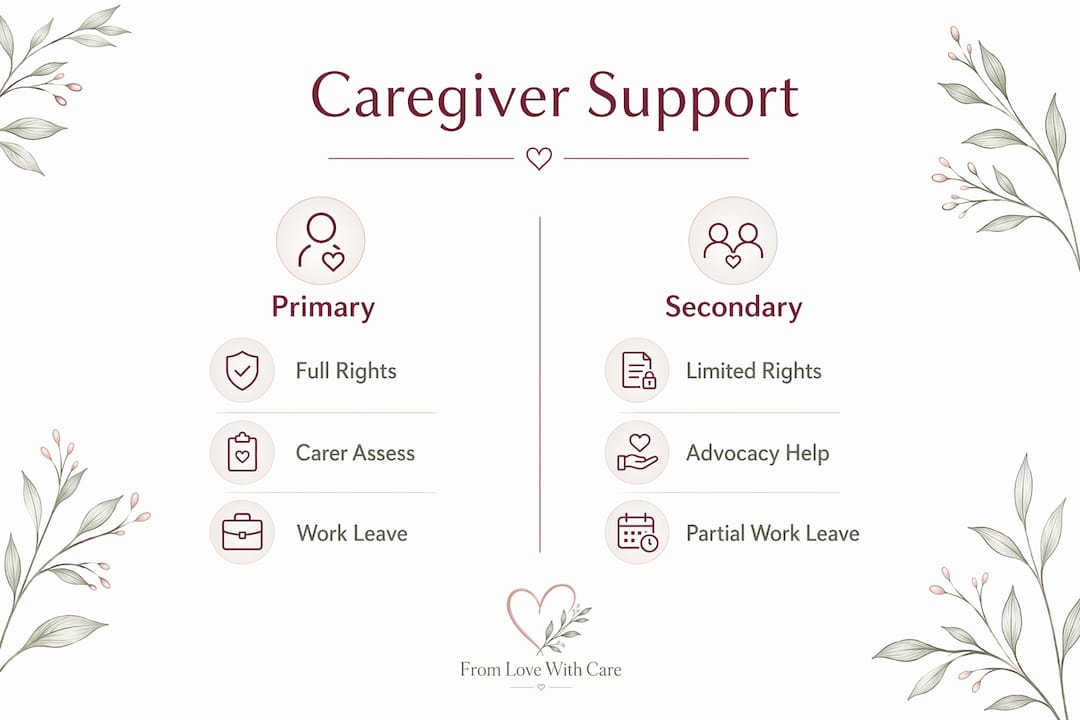
The Scottish National Care Service Charter, which takes effect in 2026, strengthens this position. Under the National Care Service Charter, all unpaid carers have the right to a personalised support plan and involvement in care decisions, regardless of whether they are primary or secondary carers. This is a meaningful shift. It means secondary carers in Scotland can formally request support plans and expect to be included in care planning conversations.
Independent advocacy is vital for secondary carers who face barriers to recognition or service access. An independent advocate can help you secure involvement in healthcare planning and ensure your contributions are formally acknowledged.
The table below summarises the key differences in statutory support between primary and secondary carers under current UK frameworks.
| Area | Primary carer | Secondary carer |
|---|---|---|
| Carer's assessment | Full entitlement under Care Act 2014 | Accessible but not automatically offered |
| Personalised support plan | Standard entitlement | Available under Scottish NCS Charter 2026 |
| Employer leave | Statutory carer's leave (one week unpaid) | Varies by employer; no separate statutory right |
| Independent advocacy | Available | Available but significantly under-used |
| Formal legal recognition | Recognised in law | Functional role only; no formal legal category |
Workplace support is improving, though unevenly. Markel UK now offers up to 26 weeks of paid leave for secondary carers, setting a benchmark that other employers are beginning to follow. Most workplaces still treat secondary carer needs as ad hoc, which creates real difficulties for people managing unpredictable care demands alongside employment.
Pro Tip: When requesting a carer's assessment, bring written evidence of the care you provide and explain clearly how the primary care arrangement would fail without your involvement. Demonstrating this fragility is the most effective approach to securing official recognition and resources.
How can secondary caregivers balance caregiving with work and personal life?
Secondary carers face a specific kind of pressure. Unlike primary carers, whose role is consistent and visible, secondary carers face unpredictable demands that make workplace accommodation difficult to plan for. Employers often view these needs as occasional rather than ongoing, which means secondary carers receive less formal support despite carrying real responsibility.

Burnout is a genuine risk. The combination of unpredictability, emotional labour, and the feeling of being permanently "on standby" takes a cumulative toll. Recognising this risk early is the most effective way to prevent it.
These steps help secondary carers maintain balance without compromising the quality of care they provide:
- Create a contingency plan. Agree in advance with the primary carer on what triggers your involvement and what your specific responsibilities are. Written plans reduce confusion during stressful moments.
- Communicate with your employer. Share the broad outline of your caregiving role with your line manager. Many employers have carer policies that are never activated simply because employees do not ask.
- Set boundaries around availability. Being reachable does not mean being available at all times. Agree on specific check-in windows with the primary carer to protect your own time.
- Use peer support. Carer support groups, both local and online, connect you with people who understand the secondary carer experience. Shared knowledge reduces isolation and provides practical solutions.
- Prioritise your own health. Secondary carers who neglect their own wellbeing become less effective over time. Regular rest, social connection, and professional support are not luxuries. They are part of sustainable caregiving.
Pro Tip: If your employer does not have a formal carer policy, ask HR to point you to the Carer's Leave Act 2023, which gives all employees the right to one week of unpaid carer's leave per year. This is a starting point for a broader conversation about flexible working.
What community and professional resources can secondary caregivers access in the UK?
Secondary carers do not have to navigate this role alone. A range of community and professional resources exists specifically to support people in supplementary caregiving roles, though many go unused simply because families are not aware of them.
Carer support workers are one of the most valuable and under-used resources available. They use a person-centred approach to help carers access assessments, understand their rights, and connect with respite and peer support groups. A carer support worker can help you build a personalised support plan even if you do not hold formal secondary carer status.
Respite care is another practical resource. Respite companionship services give primary carers a genuine break while ensuring the care recipient remains supported. This directly reduces the pressure on secondary carers to fill every gap themselves.
The table below outlines the main types of support available to secondary carers and where to find them.
| Type of support | What it provides | Typical provider |
|---|---|---|
| Carer's assessment | Identifies needs and access to support plans | Local authority social services |
| Carer support worker | Personalised guidance, rights advice, peer group access | Local carers' centres, NHS |
| Respite care | Temporary relief for primary carer | Charities, private care providers |
| Independent advocacy | Representation in care planning and rights enforcement | Advocacy organisations, NHS |
| Companionship services | Social connection and emotional support for care recipient | Fromlovewithcare and similar services |
| Peer support groups | Shared experience, practical advice, reduced isolation | Local carers' groups, online communities |
Key resources worth knowing:
- Local carers' centres: Most areas in the UK have a dedicated carers' centre offering free advice, assessments, and group support
- Carers UK: A national charity providing information, helplines, and policy advocacy for all unpaid carers
- Age UK: Offers practical support for older people and their families, including loneliness support services and signposting to local care networks
- Fromlovewithcare: Provides vetted companionship visits for elderly people in the UK, giving secondary carers confidence that their loved one has regular, meaningful social contact between care visits
Independent advocacy remains significantly under-used nationally. If you feel your contributions as a secondary carer are being overlooked in care planning meetings, an independent advocate can represent your interests and ensure your voice is heard.
Key takeaways
Secondary caregiver support is most effective when carers understand their rights, access available resources, and plan proactively rather than reacting to crises.
| Point | Details |
|---|---|
| No formal legal status | The Care Act 2014 does not define secondary carer status; self-advocacy is essential to secure recognition. |
| Charter rights apply | The Scottish NCS Charter 2026 gives all unpaid carers, including secondary carers, the right to a personalised support plan. |
| Workplace support varies | Leading employers like Markel now offer 26 weeks' paid leave; most still treat secondary carer needs as ad hoc. |
| Burnout is a real risk | Unpredictable demands and lack of employer accommodation make secondary carers particularly vulnerable to exhaustion. |
| Professional resources exist | Carer support workers, independent advocates, and respite services are available but widely under-used. |
The secondary carer's contribution deserves more recognition
I have spoken with many families where the secondary carer is the person holding everything together quietly, and no one has ever called them that. They are the sibling who handles the GP appointments by phone, the adult child who drives three hours every other weekend, the neighbour who checks in when the primary carer is unwell. They do not appear in any formal care plan. They receive no assessment, no support worker, and no acknowledgement from the system.
What strikes me most is how often secondary carers underestimate their own value. They compare themselves to the primary carer and conclude they are doing less. But the primary care arrangement frequently depends on them entirely. Without demonstrating this fragility, secondary carers remain invisible to local authorities and healthcare teams.
The most practical shift I would encourage is this: stop waiting to be recognised and start documenting what you do. A simple log of tasks, calls, and decisions made over four weeks is often enough to change how a social worker or care coordinator views your role. It is not about proving yourself. It is about making visible what was always there.
Families also need to talk more openly about how secondary caregiving responsibilities are shared. Many of the tensions I see between siblings or partners stem from unspoken assumptions about who does what. A direct conversation, even an uncomfortable one, prevents far greater strain later.
Secondary carers deserve support, not just gratitude. The system is slowly catching up, but you do not have to wait for it.
— Ayomide
How Fromlovewithcare supports families sharing care responsibilities
Caring for an elderly relative is rarely one person's responsibility alone. Fromlovewithcare offers companionship visits for elderly parents that give secondary carers genuine peace of mind between their own visits. Every companion is thoroughly vetted, and each visit is built around meaningful connection rather than task completion.
Whether you are coordinating care from a distance or simply need to know your loved one has regular social contact, Fromlovewithcare's elderly companionship services are designed to fit around your family's existing arrangements. Flexible scheduling means support is available when you need it, not only when it is convenient for a provider. Visit the services page to see how Fromlovewithcare can complement your caregiving role.
FAQ
What is the difference between a primary and secondary carer?
A primary carer provides the main, day-to-day care for a person. A secondary carer offers supplementary support such as backup care, financial help, and emotional assistance, typically on a less regular basis.
Does a secondary carer have legal rights in the UK?
The Care Act 2014 does not formally recognise secondary carer status, but secondary carers can still request a carer's assessment. Under the Scottish National Care Service Charter 2026, all unpaid carers have the right to a personalised support plan.
What does secondary caregiver support typically include?
Secondary caregiver support includes emergency backup care, financial and administrative help, emotional support for the care recipient and primary carer, care coordination, and occasional practical tasks such as transport or shopping.
How can secondary carers avoid burnout?
Secondary carers reduce burnout risk by creating written contingency plans, setting clear availability boundaries, using peer support groups, and communicating their caregiving role to their employer to access flexible working arrangements.
Where can secondary carers find support in the UK?
Secondary carers can access support through local carers' centres, Carers UK, carer support workers via the NHS or local authority, independent advocacy organisations, and companionship services such as Fromlovewithcare.