
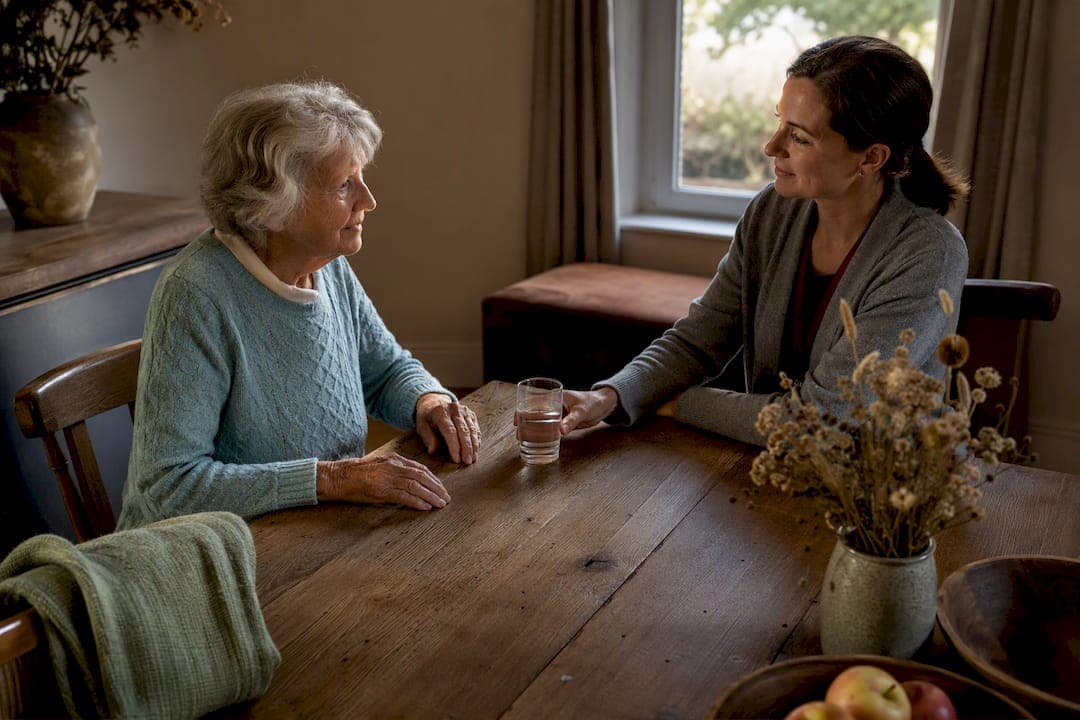
Yes, you can usually arrange a short notice companion after discharge, with many UK providers starting visits the same day or within 24 to 72 hours. The next action is simple: call the ward discharge nurse or a companionship provider such as Fromlovewithcare with the postcode, discharge time and immediate needs to hand, and confirm the companion is DBS‑checked before payment.
TL;DR:
- Short‑notice companionship visits are often available within 24 hours in urban areas, but rural locations may require up to 72 hours depending on case complexity.
- The service covers welfare checks, companionship, medication prompts, light household tasks, and appointment accompaniment, but not medical or nursing care.
- Verify DBS checks, experience, and establish clear communication with the provider before the visit, using at least one trusted person as the main contact.
- Costs include an hourly rate plus an urgent premium, with same‑day visits more likely in cities and during daytime hours, and a cancellation policy should be clarified upfront.
- Short‑notice visits are intended as a temporary stabilizer, providing time to observe needs and avoid rushed permanent care decisions.
Table of Contents
- What short‑notice companionship after discharge covers
- How to arrange a short‑notice companion visit, step by step
- Typical costs and timelines for same‑day or urgent visits
- Safety and vetting: what to check before someone enters the home
- On‑the‑day checklist: handover and what the companion will do
- Legal and privacy considerations for short-notice companion services
- How to handle cancellations or last-minute changes
- Communication tips for coordinating short-notice visits
- Typical limitations and exclusions of short-notice companion services
- Use companionship as a stabiliser, not a permanent fix
- Book a short-notice companion with Fromlovewithcare
- Quick links to act on now
What short‑notice companionship after discharge covers
A companion visit after hospital discharge is built around welfare and reassurance, not clinical treatment. Understanding that distinction early helps families avoid booking the wrong kind of help at the worst possible moment.
Typical duties include:
- A welfare check to confirm someone has got home safely and is comfortable
- Company and conversation, often over a cup of tea, for someone who feels shaken or isolated after a hospital stay
- Prompts to eat, drink and take medication at the right time (not administering it)
- Light household tasks such as tidying, laying out meals, or a short pharmacy run
- Accompaniment to a GP or outpatient appointment
Families usually reach for this kind of support after a same‑day or unplanned discharge, when the usual family carer is unavailable, following a fall or sudden change in mobility, or when early signs of confusion or memory trouble make being alone unsettling.
It helps to be clear on what a companion will not do. They will not carry out wound care, administer medication, or perform any prescribed nursing task. If clinical needs are present, involve the district nursing team or GP alongside the companion visit, not instead of it.
How to arrange a short‑notice companion visit, step by step
Speed matters here, but so does accuracy. A rushed call that misses a key detail can slow down matching rather than speed it up.
- Get the discharge details from the ward. Ask for the discharge time, current medication list, any mobility risk noted by staff, and follow‑up appointments already booked.
- Call the provider with specifics ready. Give the postcode, discharge time, any mobility or cognition flags, and the arrival window you need. Fromlovewithcare and similar companionship services can often match faster when this information arrives in one go, rather than piecemeal.
- Verify and agree terms on arrival. Check DBS proof and photo ID, agree the exact duties for the visit, confirm the minimum booking length, and settle the payment method before the companion leaves.
If in‑person cover is delayed, use a fallback while you wait: ask a trusted neighbour to check in, request a GP practice tele‑check, or book a short telephone companionship call so the person is not left with zero contact.
Pro Tip: Ask the companion or provider to leave a short written visit note, even a few lines, covering mood, appetite and anything unusual. It means family members who were not there still know exactly what happened, and it becomes a useful record if things change quickly.
Typical costs and timelines for same‑day or urgent visits
Response speed depends on three things: where you live, how complex the case is, and what time of day you call. A request made at 9am for a straightforward welfare check in a well‑covered postcode will move faster than an evening call involving dementia care in a rural area.
Realistic windows to expect:
- Same day: possible in many urban and suburban areas for straightforward companionship needs
- Within 24 hours: the most common outcome once a provider has your details and confirms a match
- 24 to 72 hours: more likely in rural postcodes or where the case needs a specifically experienced companion
Costs for short‑notice bookings typically follow a standard hourly rate plus an urgent premium for same‑day or emergency requests. Some UK urgent‑care providers publish example urgent‑rate ranges precisely because the premium varies so much by region and notice period. Ask upfront about the minimum booking length, whether there's a cancellation fee, and how payment is taken, card, invoice, or on‑the‑day, so there are no surprises once the visit is confirmed.
Many UK home‑care providers report placing carers or companions within 24 hours of a request, with same‑day placement achievable in many cases depending on location. Treat this as a general benchmark rather than a guarantee for your postcode.
Safety and vetting: what to check before someone enters the home
Letting a stranger into a vulnerable relative's home, even briefly, warrants a few firm questions. A reputable provider will expect them and answer without hesitation.
- Ask how DBS checking is verified, not just claimed. A trustworthy provider should be able to confirm certificate status rather than simply asserting it. Fromlovewithcare sets out its vetting and matching process so families know what checks companions go through before a first visit.
- Request photo ID on arrival and ask whether the companion has relevant experience with dementia or mobility support if that applies.
- Ask for a named, consistent companion where possible. Continuity across the first few visits helps a companion notice changes in mood or condition sooner, and it reduces distress for someone already unsettled by a hospital stay.
- Ask how the provider handles an incident or a sudden change in needs. There should be a clear escalation contact, not a vague "someone will call you back".
Pro Tip: Treat any refusal to show DBS proof, a vague answer about whom to contact in an emergency, or a different companion turning up each visit without explanation as a red flag. Walk away and call another provider.
On‑the‑day checklist: handover and what the companion will do
Getting the handover right in the first few minutes sets the tone for the whole visit.
- Have discharge papers, the current medication list, mobility aids, house keys or access instructions, and emergency contacts ready before the companion arrives.
- Put valuables somewhere sensible, not out of suspicion, simply good practice with any visitor.
- On arrival, confirm the companion's name, ask to see DBS proof, and agree exactly what they'll do and how long they're staying.
- Ask who to contact if something changes or concerns arise during the visit.
- Expect a straightforward first visit: a welfare check, a cup of tea and conversation, a gentle medication prompt, perhaps a light meal or a short walk to the pharmacy.
- Ask for a brief note afterwards and pencil in a review within 48 to 72 hours.
Legal and privacy considerations for short-notice companion services
Booking care in a hurry doesn't mean skipping the paperwork questions. A few points matter legally and practically, even for a single visit.
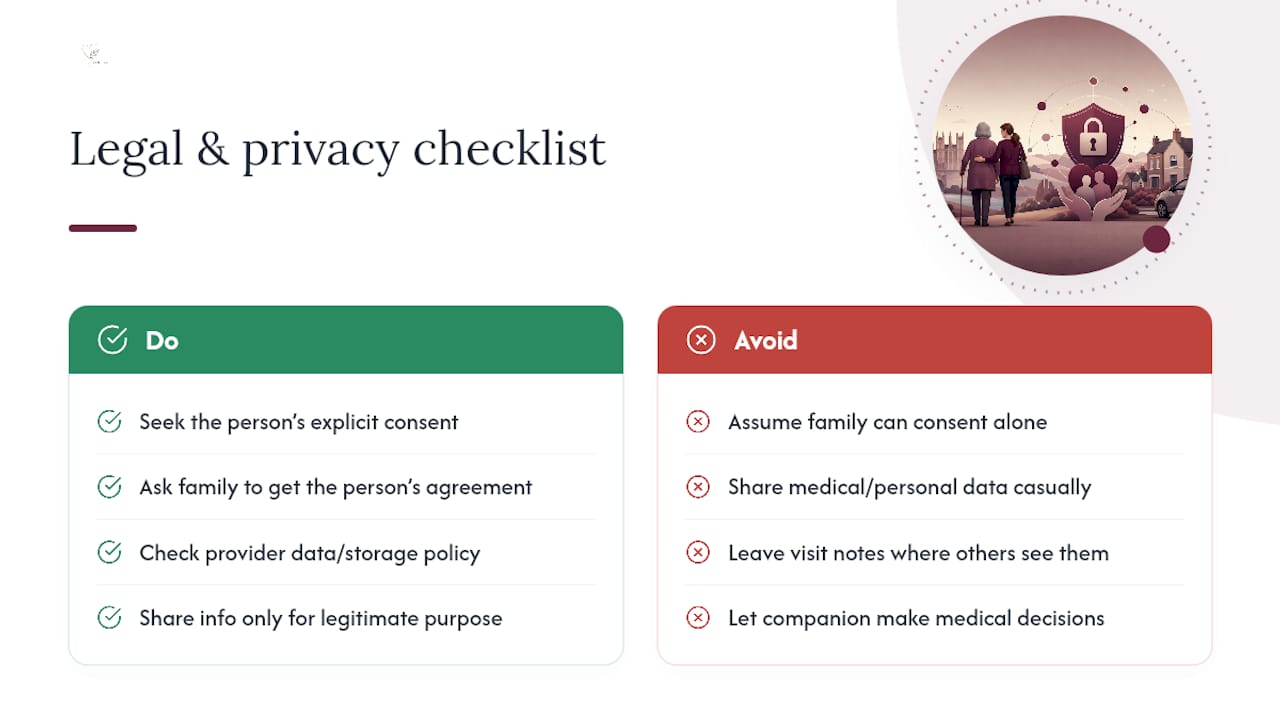
Consent sits at the centre of this. If the person being visited has capacity, they should agree to the visit and to what the companion is told about their situation. Where a family member is arranging the visit on someone else's behalf, without power of attorney or formal authority, the provider should still seek the person's own agreement wherever they're able to give it.
Data handling matters too. Any details shared with a provider, medical history, medication lists, mobility notes, should only be passed on with a legitimate purpose in mind, and a reputable company will have a clear policy on how that information is stored and who can see it. Ask directly if this isn't stated on their website.
Written visit notes deserve the same care. A note left for the family describing mood, appetite or behaviour is useful, but it's also personal information about a vulnerable adult. Keep it somewhere private rather than shared casually.
Finally, be clear on what the companion is and isn't authorised to do inside the home. A companion providing non‑medical support has no authority to make medical decisions, access financial accounts, or act on a power of attorney, even informally. Keeping that boundary explicit from the first visit avoids confusion later.
How to handle cancellations or last-minute changes
Plans change fast after a hospital discharge, sometimes hour by hour, so ask about a provider's cancellation policy before you book, not after you need to use it.
Find out the notice period required to cancel or reschedule without a fee. Many providers apply more flexible terms to urgent, short‑notice bookings than to standard appointments, recognising that discharge timing itself is often unpredictable. If the hospital delays discharge by several hours, tell the provider as soon as you know rather than waiting until the original arrival time passes.
If a companion cancels on their end, ask what happens next: is a replacement offered immediately, or does the booking simply lapse? This is worth asking at the point of booking, when you have leverage to choose a provider, rather than discovering the answer mid‑crisis.
Keep a note of who you spoke to and when, particularly for anything arranged by phone. If a dispute arises over a missed visit or a fee, a simple record of the call time and what was agreed resolves most of it quickly.
Build in a small buffer where you can. If discharge is expected at 2pm, book the companion for a window rather than an exact minute, and confirm with the provider on the morning of the visit that the plan still holds.
Communication tips for coordinating short-notice visits
Clear, early communication between the family, the hospital and the provider is what actually determines whether a short‑notice visit runs smoothly.
Nominate one family member as the main point of contact. When two or three relatives are all calling the provider separately with slightly different information, mismatches creep in fast, wrong arrival time, wrong address, wrong understanding of what the companion should do.
Share the same core facts every time you call: postcode, discharge time, any mobility or cognition flags, and what the visit needs to achieve. Written detail travels better than a rushed phone call, so a short text or email summary after the initial booking call gives the provider something to check against.
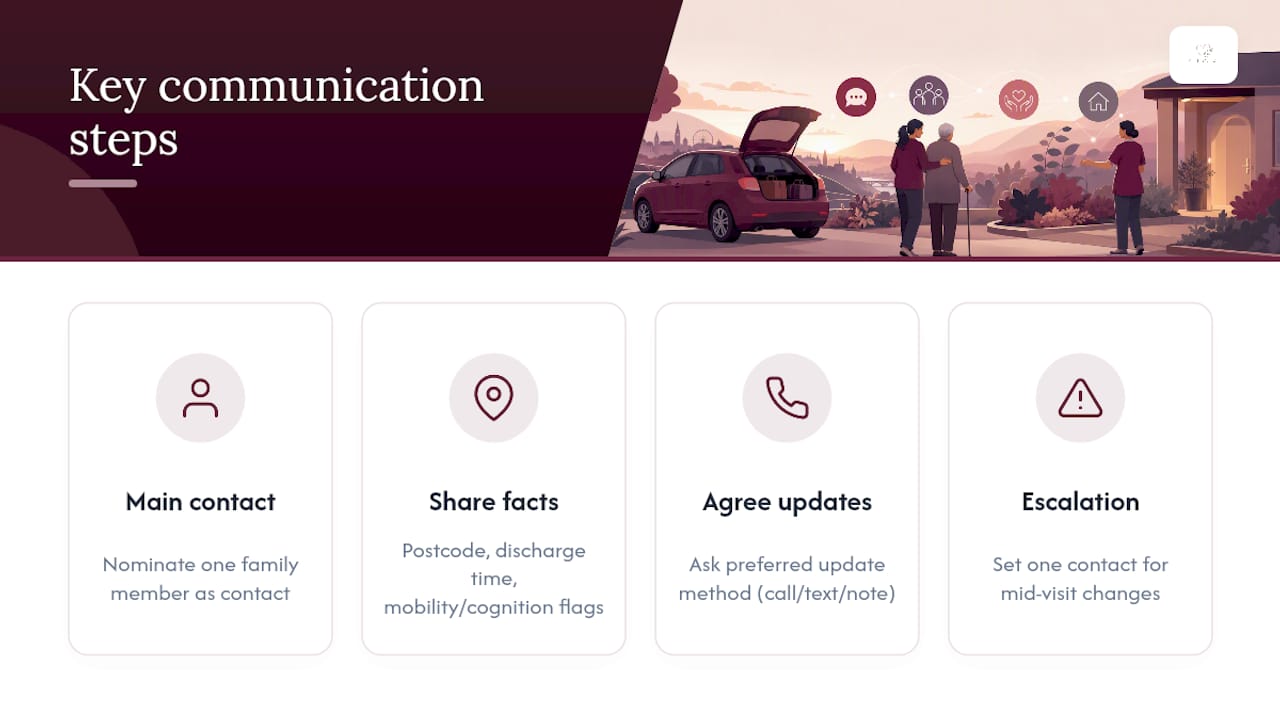
Ask the companion or provider how they prefer to update the family after a visit, a phone call, a text, a written note left at the house, and agree that method upfront rather than assuming. If more than one relative wants updates, ask whether the provider can copy a second contact, rather than relying on one person to relay everything.
If the situation changes mid‑visit, say the person seems more confused than expected, make sure everyone knows who the companion should call first. One clear escalation contact beats three people all expecting to be told.
Typical limitations and exclusions of short-notice companion services
Knowing what a companion visit won't do is just as important as knowing what it will, especially when a family is under pressure and might assume more coverage than is actually on offer.
Companions do not provide medical care. That means no wound dressing, no injections, no managing complex medication regimes beyond a simple reminder, and no clinical assessment of symptoms. If something looks medically concerning during a visit, the companion's role is to alert the family or call emergency services, not to treat it.
Overnight cover, live‑in care and personal care tasks such as bathing or toileting sit outside most companionship services too. If the discharge plan involves any of these, that's a conversation for a registered home care agency or the district nursing team, not a companionship booking.
Short‑notice availability also has real limits. Same‑day cover is common in many areas but not guaranteed everywhere, particularly rural postcodes or highly specialised needs such as advanced dementia care can push the wait closer to 72 hours. And a single visit, however good, is not a substitute for an ongoing care plan if the person's needs turn out to be more than temporary.
Finally, most providers won't take on tasks involving legal or financial decisions, managing bank accounts, signing documents, or acting under a power of attorney, even informally. That boundary protects everyone involved.
Use companionship as a stabiliser, not a permanent fix
Families often feel pressure to decide everything about long‑term care within days of a discharge, and that pressure leads to rushed, expensive decisions that don't always fit. A short‑notice companion buys something valuable: time to actually observe how someone is coping at home before committing to anything permanent.
Set a review point at 48 to 72 hours. Log what the companion or family notices, appetite, mood, mobility, confusion, and involve the GP or a community nurse if anything looks concerning. This measured pace matches what care managers generally recommend when families are tempted to lock in permanent arrangements before the picture is clear. It's consistent, too, with what families report after the first few visits: a noticeable lift in someone's mood once regular contact replaces days of silence.
— Ayomide
Book a short-notice companion with Fromlovewithcare
This service exists for situations where a relative is discharged with little warning and a family needs DBS‑checked support quickly, without a lengthy assessment process.
Every companion is vetted and matched with continuity in mind, so the person who visits on day one is, wherever possible, the same person who returns for follow‑up visits. Fromlovewithcare's elderly companionship services cover social visits, welfare checks and accompaniment to non‑medical appointments, and the welfare check service specifically supports families who need someone checking in soon after a hospital stay. To check availability, call or use the online enquiry form with your postcode, discharge time and any mobility or cognition notes to hand, the same details that speed up matching with any provider. Payment options and full visit details are set out on the services page, and the how it works page explains vetting and matching in full. If you need help today, that's the page to start with.
Quick links to act on now
Start with Fromlovewithcare's services page to book urgent support, or check welfare check options for ongoing visits. For sudden care costs, financial guidance for families covers wider planning, though UK‑specific advice is worth seeking separately.