
Older adults' social needs differ from younger adults' because their priorities, capacities, and network composition change with age in ways that are purposeful, not simply a sign of decline. The primary theoretical explanation is Socioemotional Selectivity Theory (SST), developed by psychologist Laura Carstensen, which holds that as people perceive their future time horizon as shorter, they shift their social goals away from information-gathering and novelty towards emotional meaning and closeness. Longitudinal UK evidence, including data from the English Longitudinal Study of Ageing (ELSA), consistently supports this pattern. The main drivers are a changed sense of time and priorities, physical health and mobility limits, bereavement and role changes such as retirement, and reduced digital access.
What this means in practice:
- Older adults typically maintain a smaller total social network, but the number of emotionally close relationships stays relatively stable.
- Social goals shift from acquiring new contacts and knowledge to deepening existing, trusted bonds.
- Support needs change: instrumental help (transport, shopping, appointments) becomes a gateway to social participation, not just a practical convenience.
- Loneliness risk is more closely tied to the loss of close ties and the inability to reciprocate than to network size alone.
Table of Contents
- What does the research show about older adults' social networks?
- Why do social motivations change with age?
- What practical factors change older adults' social opportunities?
- How do network changes affect wellbeing and loneliness risk?
- How do social networks shift in structure and daily function?
- What evidence-based responses and UK resources actually help?
- How companionship visits meet older adults' emotional needs in practice
- Key takeaways
- What families and carers often miss about older adults' social lives
- Companionship support from Fromlovewithcare
- Useful sources and further reading
What does the research show about older adults' social networks?
Total social network size peaks in early adulthood and then declines with age, while the number of emotionally close partners remains relatively stable. This finding holds across longitudinal and cross-sectional studies, and it is one of the most replicated patterns in the psychology of ageing.
Research drawing on ELSA data shows that older adults with diverse social networks are better placed to meet different types of social care needs, and that people with poor health or those living alone are most likely to experience persistent unmet social needs over time. The key measures researchers use are total network size, frequency of contact, number of daily social partners, and rated emotional closeness. When these are separated out, a clear picture emerges: peripheral contacts fall away, but inner-circle relationships endure.
Statistic callout: A 10-year English panel study found that loneliness trajectories in later life are shaped not by network size alone, but by the quality of family and friendship ties and the ability to maintain them over time.
Studies also show that older adults report fewer peripheral contacts and more predictable, positive emotional experiences with close partners. Across cultures, narrower social lives in older age are consistently associated with greater emotional satisfaction, not less. The popular assumption that a smaller network signals unhappiness is not supported by the evidence.
Longitudinal growth-curve analyses confirm that selective narrowing of networks across adulthood is associated with improved emotional experience in daily life, with reductions observed mainly among peripheral partners. The inner circle holds.
Why do social motivations change with age?
Socioemotional Selectivity Theory explained
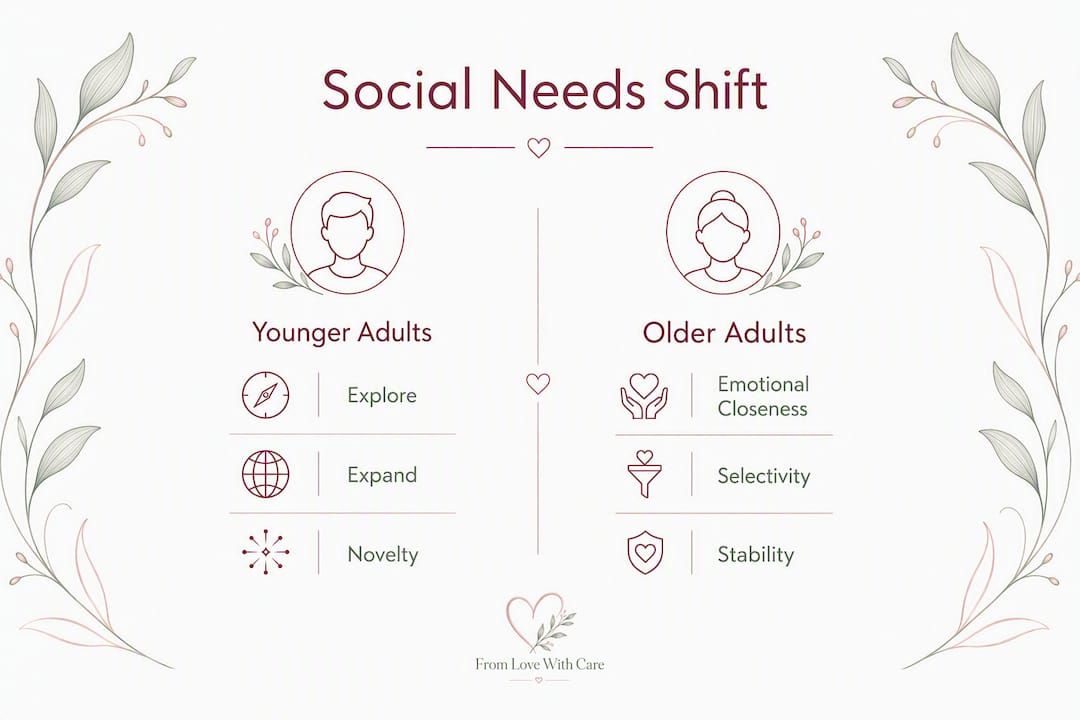
Socioemotional Selectivity Theory proposes that social behaviour is driven by two broad classes of goals: knowledge-acquisition goals (learning new things, meeting new people, expanding horizons) and emotion-regulation goals (feeling good, finding meaning, maintaining close bonds). In younger adulthood, when the future feels open-ended, knowledge goals dominate. As people age and perceive their remaining time as more limited, emotion goals take precedence.
This is not passive resignation. SST frames the shift as an active, adaptive reordering of priorities. Older adults are not withdrawing from social life; they are concentrating it. They invest more deeply in fewer, higher-quality relationships and let peripheral ties fade without distress. Crucially, social goal shifts are fluid: people of any age who perceive limited future time adopt the same preference for familiar, emotionally rewarding contacts. A young person facing a serious illness often shows the same pattern.
How SST compares with earlier theories
Two older frameworks are worth knowing, because they still circulate in care settings and popular writing.
Activity theory holds that older adults who stay active and maintain many social roles will age most successfully. It captures something real about the value of engagement, but it misses the point that quality matters more than quantity. Maintaining a large network for its own sake does not predict wellbeing.
Disengagement theory argued that withdrawal from social roles is a natural, mutual process between older adults and society. This framing has largely been discredited, as it pathologised normal network pruning and implied passivity where SST shows agency.
| Dimension | Younger adults | Older adults |
|---|---|---|
| Primary social goal | Knowledge, novelty, expanding contacts | Emotional meaning, deepening close ties |
| Preferred partners | New acquaintances, colleagues, broad peer groups | Family, long-standing friends, trusted companions |
| Network breadth | Wide, diverse | Narrower, more selective |
| Conflict management | More likely to engage and confront | More likely to avoid or de-escalate |
| Emotional priorities | Future-oriented, achievement-linked | Present-focused, relationship-quality-linked |
What practical factors change older adults' social opportunities?
Theory explains the motivation shift. Everyday life adds a set of concrete barriers and triggers that shape how those motivations play out.
Health, mobility, and activities of daily living
Physical health changes reduce social opportunity in ways that are easy to underestimate. When changing ADLs and reduced physical functioning make social activities effortful, participation drops without practical support. Getting to a community centre, managing stairs at a friend's house, or sustaining a long conversation when fatigue is a factor all become genuine obstacles. The estimated number of older people in England unable to perform at least one basic ADL is projected to rise from 3.5 million in 2018 to 5.2 million in 2038, which gives a sense of the scale of need.
Instrumental support, such as help with transport, shopping, or attending appointments, is therefore not separate from social life. It is the gateway to it.
Bereavement, retirement, and role change
Retirement removes a large category of peripheral contacts overnight. Colleagues, professional acquaintances, and the daily rhythm of workplace interaction simply disappear. For many older adults, this is the first significant pruning of the peripheral network, and it can feel disorienting even when retirement itself is welcome.
Bereavement compounds this. Losing a spouse or long-standing friend removes not just one person but often an entire social world: shared friends, shared routines, and a source of reciprocal support. Caregiving roles can have a similar effect, pulling an older adult inward and reducing time for maintaining wider ties.
Digital access and literacy
Peripheral social ties are increasingly maintained online, through messaging apps, video calls, and social media. Older adults who lack digital access or confidence are cut off from this layer of connection in a way that younger adults rarely experience. This is not a minor inconvenience: it affects contact frequency with grandchildren, access to community information, and the ability to use services that have moved online.
Digital inclusion programmes, such as those run by Age UK and local councils, can meaningfully restore this access. The gap is not about capacity; it is about opportunity and confidence.
Pro Tip: When assessing an older relative's social situation, check two practical things first: whether they can get to the places they want to go (transport), and whether they can stay in contact with people they care about (digital access or phone use). These two factors predict social participation more reliably than network size.
Reciprocity
The ability to give as well as receive matters deeply to older adults' sense of dignity and belonging. When health or mobility limits the ability to reciprocate, whether by visiting in return, helping with tasks, or simply being reliably present, the emotional quality of relationships can suffer. This is one reason why diverse social networks are most effective at meeting different types of social care needs: they spread the load and preserve the older person's sense of contribution.
How do network changes affect wellbeing and loneliness risk?
Smaller does not mean lonelier. This is perhaps the most important distinction for families and carers to hold onto. Older adults are often more satisfied with smaller, high-quality networks; loneliness is more strongly linked to the loss of close ties and the inability to reciprocate than to network size alone.
The benefits of regular social interaction for seniors are well documented: lower rates of depression and anxiety, better cognitive function, and reduced risk of physical health deterioration. But these benefits flow from the quality and consistency of contact, not from the number of people involved.
Statistic callout: A 10-year English panel study found varied loneliness trajectories in later life, with persistent loneliness most strongly associated with poor health, living alone, and the loss of close relationships rather than with having a small network overall.
When does a smaller network become a risk? The warning signs are specific: loss of the last remaining close confidant, inability to reciprocate in any meaningful way, and a combination of poor health and social isolation. These factors together, rather than network size in isolation, predict the most harmful outcomes. Network size alone is a poor proxy for wellbeing; practitioners and families should focus on the frequency and quality of interaction within an individual's inner circle when assessing risk.
Socioeconomic factors add another layer. Older adults on lower incomes face compounding barriers: less access to transport, fewer resources for activities, and greater likelihood of living alone. Cultural background also shapes what social support looks and feels like, which means that a one-size-fits-all approach to reducing isolation will miss many people.
How do social networks shift in structure and daily function?
The "social convoy" model, developed by researchers Kahn and Antonucci, describes social networks as a set of concentric circles travelling through life with the individual. The innermost circle contains the closest, most stable relationships. Outer rings hold more peripheral ties. As people age, family relationships tend to remain stable across the lifespan while acquaintances and peripheral network members decline, making family and close friends relatively more central.
In the UK context, this means that adult children and siblings often become the primary source of both emotional support and practical help. Neighbours and local community members fill a secondary role, particularly for older adults whose family members live at a distance. Volunteers, befrienders, and paid companions provide a third layer, one that becomes especially important when family capacity is limited or when the older person lives alone.
Cognitive and sensory changes also reshape daily social life in ways that are often overlooked. Slower processing speed can make fast-moving group conversations harder to follow. Hearing loss, one of the most common sensory changes in later life, makes noisy environments exhausting rather than stimulating. Memory changes can affect the ability to recall shared history, which matters in long-standing relationships. These are not reasons to withdraw from social life; they are reasons to adapt it. Quieter settings, one-to-one conversations, and familiar routines all support continued engagement.
For families navigating these changes, a dementia care roadmap can help structure thinking about how cognitive changes affect social needs and what adjustments to plan for.
What evidence-based responses and UK resources actually help?
The evidence points to a clear set of interventions that reduce isolation and meet older adults' emotional needs. Not all of them work equally well for everyone, and the best approach is usually a combination tailored to the individual.
Interventions with evidence behind them
- Befriending and volunteer programmes — Regular one-to-one contact from a trained volunteer, delivered in person or by phone, consistently shows positive effects on loneliness and mood. Age UK runs one of the UK's largest befriending networks.
- Social prescribing — NHS social prescribing link workers connect older adults to community activities, groups, and services based on their personal interests and needs. It is available through most GP surgeries in England.
- Community hubs and day centres — Group settings that offer structured activities reduce isolation and provide a sense of belonging. The key is that activities match the person's interests and mobility.
- Transport solutions — Community transport schemes, dial-a-ride services, and volunteer driver networks remove the physical barrier to participation. Many local councils fund these; availability varies by area.
- Digital inclusion programmes — Organisations including Age UK, the Good Things Foundation, and local libraries offer free digital skills support, helping older adults stay connected via video calls and messaging.
What to look for in a befriending or companionship service
- Is the companion or volunteer DBS-checked and trained?
- Does the service prioritise continuity, meaning the same person visits regularly?
- Can activities be matched to the older person's interests and mobility?
- Is there a clear process for raising concerns or changing arrangements?
Pro Tip: Ask any befriending or companionship provider how they handle continuity if a regular companion is unavailable. Services that have a clear cover process show they have thought seriously about the relationship, not just the visit.
UK signposts
- Age UK — befriending, telephone friendship, and local services
- NHS social prescribing — available via GP referral across England
- Local council adult social care teams — assessment and referral to community services
- The Good Things Foundation — digital inclusion support
For a practical overview of companionship options for older adults, including how different service types support social interaction, Fromlovewithcare's resource hub covers the main choices available in the UK.
How companionship visits meet older adults' emotional needs in practice
Consider a scenario that Fromlovewithcare companions encounter regularly. An older woman in her late seventies, living alone after the death of her husband, has a daughter who lives two hours away. She is physically well but has gradually stopped attending her local community group, partly because the bus route changed and partly because the group feels noisier and harder to follow than it used to. Her daughter notices she sounds flat on the phone and is not mentioning anyone she has spoken to during the week.
This is not a crisis, but it is a recognisable pattern: peripheral contacts have gone, the practical barrier of transport has not been addressed, and the inner circle has shrunk to one regular phone call. The emotional need is real, and it is not being met.
What works in a companionship visit in this situation is not complicated, but it is specific. Relationship continuity matters enormously: the same companion visiting regularly, building familiarity and trust, allows the older person to invest in the relationship rather than repeatedly starting from scratch. Activity matching, whether that is a shared cup of tea, a walk at a manageable pace, or help getting to a local event, preserves the older person's sense of agency. And the visit itself addresses the reciprocity gap: a good companion listens as much as they talk, and the older person contributes to the relationship rather than simply receiving from it.
Companionship visits that prioritise continuity, activity-matching and reciprocity tend to produce the largest improvements in emotional wellbeing among clients. This is not incidental to the service model; it is the model.
Fromlovewithcare companions are DBS-checked and trained specifically for this kind of emotional support work. The service does not provide medical or personal care, which means companions can focus entirely on the relationship. For families who want to understand how this translates into improved wellbeing for an elderly relative, the evidence and the practice point in the same direction.
Key takeaways
Older adults' social needs differ from younger adults' because SST-driven priority shifts, health changes, and network restructuring combine to make emotional quality, not quantity, the defining measure of social wellbeing.
| Point | Details |
|---|---|
| Smaller but closer networks | Total network size declines with age, but emotionally close ties remain stable and deeply satisfying. |
| SST explains the shift | Perceived time horizon drives older adults to prioritise emotional meaning over novelty, an active and adaptive choice. |
| Loneliness risk is specific | Persistent loneliness is linked to loss of close ties, inability to reciprocate, and poor health, not to small networks alone. |
| Practical barriers matter | Transport, digital access, and ADL support are gateways to social participation and must be addressed alongside emotional needs. |
| Fromlovewithcare's approach | Regular, continuity-based companionship visits from DBS-checked companions directly address the emotional and social needs described in this article. |
What families and carers often miss about older adults' social lives
The most persistent misreading of older adults' social lives is the assumption that a smaller network is a problem to be fixed. Families sometimes worry when an elderly parent stops attending a large social group or no longer seems interested in meeting new people. The research is clear that this is usually not a warning sign. It is SST in action: a purposeful concentration on what matters most.
The real concern is different. It is not the size of the network but the health of the inner circle. When the last close confidant is lost to bereavement, when health makes reciprocity impossible, or when practical barriers quietly erode the remaining connections, that is when isolation becomes genuinely harmful. The question to ask is not "does my parent have enough friends?" but "are the relationships they have still nourishing them?"
There is also something worth saying about intergenerational relationships. Older adults often find deep meaning in connections with younger family members or volunteers, not because they want to recapture youth, but because these relationships carry a sense of continuity and contribution. A grandparent who feels they have something to offer a grandchild, knowledge, stories, presence, is experiencing exactly the kind of reciprocity that protects against loneliness. Services and families that create space for this are doing something genuinely valuable.
The practical lesson is this: meet the person where they are, not where you think they should be. Understand what their social world looks like now, what they value in it, and what barriers are quietly shrinking it. Then address those barriers, one at a time, with patience.
Companionship support from Fromlovewithcare
For families who recognise the patterns described in this article, Fromlovewithcare offers something specific: not a care service, not a medical intervention, but genuine human connection delivered consistently and with care.
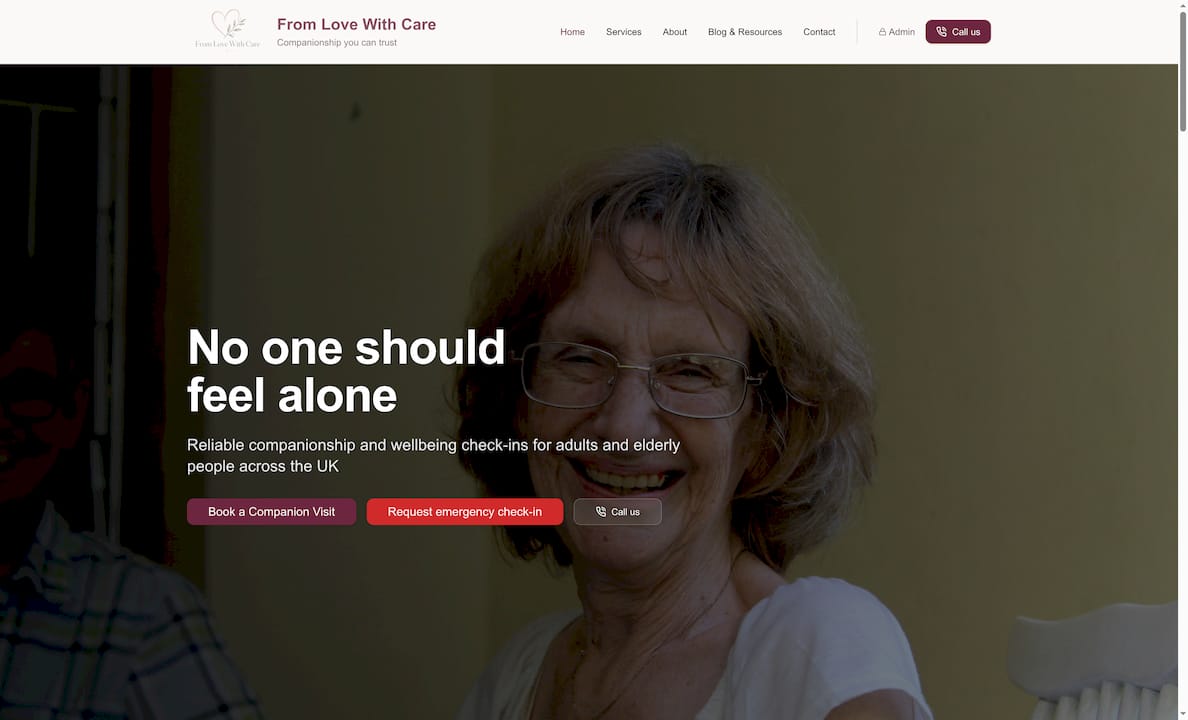
Every Fromlovewithcare companion is DBS-checked and trained to provide emotional support, not clinical care. Visits are built around the older person's interests, pace, and preferences, whether that means a shared cup of tea, help getting to a local appointment, or simply being a reliable, familiar presence each week. The service is typically arranged and paid for by adult children or family members, though older adults themselves are equally welcome to enquire.
The typical service scope includes:
- Regular social visits and conversation
- Welfare check-ins for peace of mind
- Shared activities matched to the individual
- Grocery shopping and errand support
- Accompaniment to appointments
- Emergency welfare checks when needed
If you are concerned about an older relative's social wellbeing, the clearest next step is to explore what regular, consistent companionship could look like for them. Visit Fromlovewithcare's elderly companionship services page to see how the service works and arrange a visit.
Useful sources and further reading
The following sources underpin the evidence in this article and are worth consulting directly for anyone who wants to go deeper.
- Socioemotional Selectivity Theory: The Role of Perceived Endings in Human Motivation (PMC) — the primary theoretical account of why social goals shift with age
- Social and emotional aging (PMC) — a broad review of empirical evidence on ageing, networks, and emotion regulation
- Age differences in reported social networks and well-being (PMC) — cross-cultural evidence on network size and life satisfaction
- Selective narrowing of social networks across adulthood (SAGE Journals) — longitudinal growth-curve analysis linking network change to daily emotional experience
- Trajectories of loneliness in later life: 10-year English panel study (UCL Discovery) — UK-specific evidence on loneliness risk factors and trajectories
- Unmet care needs and social networks: ELSA analysis (ePrints Soton) — ELSA-based findings on diverse networks and persistent unmet needs
- Dynamics of unmet need for social care in England (Cambridge Core) — analysis of how social care needs change over time in England
- Contexts in late adulthood: family, friendships and communities (OpenStax) — accessible overview of social convoy theory and intergenerational relationships
- Changes in network composition among older people in inner London and Essex (UEA Digital Repository) — UK longitudinal study of network change in urban and semi-rural older adults
- Age UK — befriending services, telephone friendship, and local support across the UK
- Fromlovewithcare loneliness support services — in-home companionship and befriending for isolated adults and older people in the UK