

Companionship is defined as the experience of shared human connection that directly shapes how much value a person places on themselves. Research published in 2026 confirms that loneliness predicts drops in self-esteem more strongly than the reverse, meaning isolation actively erodes your sense of worth over time. This relationship between social connection and self-perception is not incidental. It is one of the most consistent findings in social psychology, and understanding it is the first step towards doing something about it.
What scientific evidence links companionship to self-worth?
The connection between companionship and self-worth is measurable, not merely anecdotal. A 2026 longitudinal study using the LISS panel of 19,841 participants found that loneliness produces a "scar effect" on self-esteem, with the damage peaking over roughly two years. That finding matters because it means the longer someone goes without meaningful connection, the harder it becomes to recover a positive sense of self.
Social prescribing offers one of the clearest economic proofs of this link. A nationwide UK analysis of 14,657 to 19,627 patients found that structured social interventions return £9 in measurable wellbeing benefits for every £1 spent. Participants showed improvements in life satisfaction and feelings of worthwhileness within just 2.5 months. That is a remarkably short window for psychological change.
The vulnerability of certain groups makes this evidence even more urgent. 32.2% of UK adults in their last year of life report lacking companionship or feeling isolated at least some of the time. This population faces compounded harm: physical decline alongside a shrinking sense of personal value, often with no structured support to address either.
Social support also acts as a direct stress buffer. The Time to Change initiative highlights that companionship protects against depression and anxiety by providing psychological resources that individuals cannot generate alone. Put simply, having someone present who cares about you changes your internal chemistry and your self-perception.

Key research findings at a glance
| Finding | What it means |
|---|---|
| Loneliness scars self-esteem over two years | Early intervention in isolation prevents long-term damage to self-worth |
| £9 return per £1 in social prescribing | Structured companionship is cost-effective and psychologically measurable |
| 32.2% of end-of-life adults feel isolated | Companionship deficits are most acute when people are most vulnerable |
| Wellbeing improves within 2.5 months | The benefits of social connection appear faster than most people expect |
How does the quality of companionship affect self-worth?
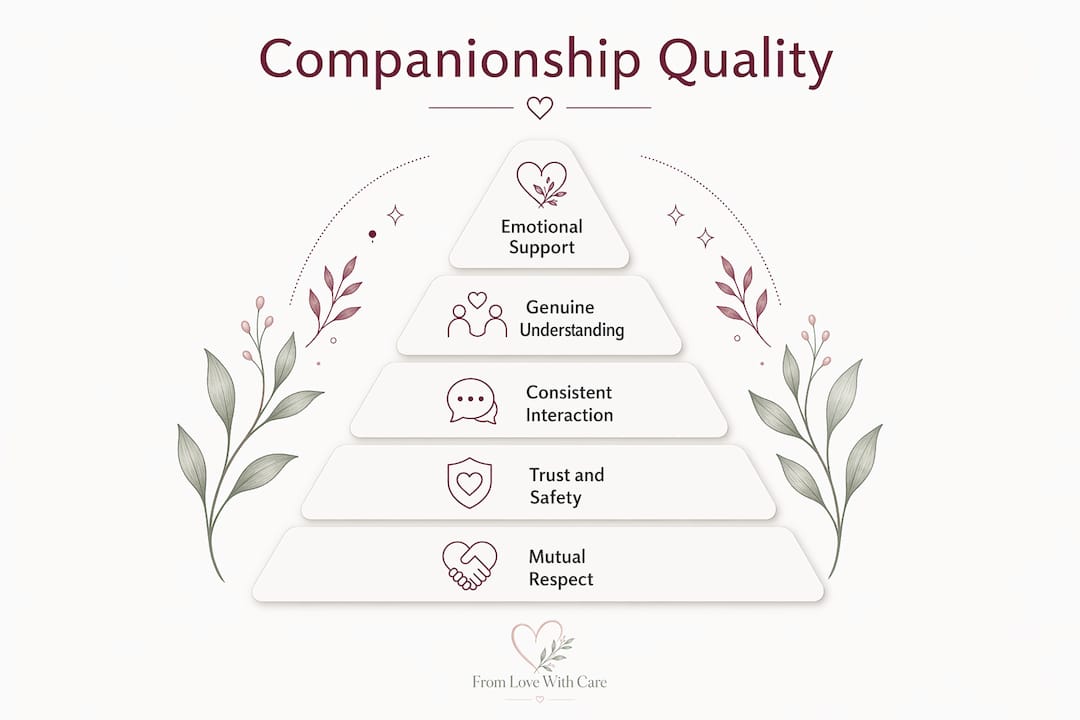
Quality of connection matters far more than the number of people in your life. Rethink Mental Illness confirms that quality relationships build self-worth by creating feelings of being understood and in control. A person with one genuinely supportive companion will typically report higher self-esteem than someone surrounded by superficial acquaintances who offer no real understanding.
That said, casual interactions carry more weight than most people realise. Research cited by the British Psychological Society shows that weak tie interactions, such as brief chats with a neighbour or a friendly exchange with a shopkeeper, boost daily happiness and feelings of connection consistently. These small moments accumulate. They signal to the brain that you belong, that you are seen, and that you matter.
The medium of contact also shapes the outcome. A 2026 study found that face-to-face contact maintains cognitive stability and delivers stronger emotional benefits than digital contact, particularly for older adults. Video calls and messaging have real value, but they do not fully replicate the physiological and emotional response triggered by physical presence.
- Close relationships provide the deepest sense of being valued and understood, directly strengthening self-worth.
- Casual interactions (weak ties) create a steady baseline of belonging that supports daily mood and confidence.
- Face-to-face contact produces stronger cognitive and emotional benefits than screen-based alternatives.
- Frequency matters less than authenticity. One honest conversation outperforms ten polite but hollow exchanges.
Pro Tip: If you cannot arrange frequent in-person visits, prioritise one meaningful face-to-face interaction per week over daily digital check-ins. The depth of a single real conversation does more for your sense of value than a string of text messages.
What practical strategies build self-worth through companionship?
Small social actions, practised consistently, produce measurable gains in self-worth. The British Psychological Society identifies minimal social interactions such as greetings, small talk, and brief exchanges with strangers as reliable ways to strengthen social connectedness and daily happiness. These are not trivial gestures. They are the social equivalent of daily exercise: low effort, high return when done regularly.
Reconnecting with acquaintances is often more effective than seeking entirely new relationships. Reaching out to someone you have lost touch with removes the anxiety of meeting strangers while still expanding your social world. A simple message or a shared cup of tea can reactivate a connection that restores your sense of belonging and personal value.
Structured social interventions offer a more formal route for those who need additional support. Social prescribing programmes, available through many NHS-linked services, connect people with community activities matched to their interests and circumstances. The UK Social Connection Framework 2026 notes that social interventions work best when paired with psychological support and offered in a non-intimidating, meaningful way, particularly for men who may otherwise disengage.
- Greet someone new each day. A brief, genuine exchange with a neighbour or colleague builds your sense of social belonging over time.
- Reconnect with one acquaintance per week. Reactivating existing relationships is lower risk and often more rewarding than building new ones from scratch.
- Join a community activity. Classes, walking groups, and volunteering create regular contact with others who share your interests.
- Ask for a social prescription. Speak to your GP about referral to a social prescribing link worker who can connect you with local support.
- Accept help without shame. Seeking companionship support is a sign of self-awareness, not weakness.
Pro Tip: Kindness towards others also strengthens your own sense of worth. Performing one small act of generosity each day, whether holding a door or offering a compliment, activates the same neural pathways as receiving social support.
How does companionship affect vulnerable groups?
Older adults and those facing serious health challenges experience the sharpest deficits in companionship, and the consequences for self-worth are severe. As noted earlier, nearly a third of UK adults in their final year of life report feeling isolated. For this group, the loss of social connection compounds physical decline and strips away the sense that their presence still matters to others.
Meeting Centres, designed primarily for people affected by dementia, offer a well-evidenced group-based model. A multi-site UK study found that Meeting Centres reduce loneliness significantly among members who actively participate in group activities, with female members showing particularly strong benefits. The key word is "actively." Mere attendance does not produce the same results as genuine engagement.
Carers attending these programmes alongside patients benefit less when they do not engage in the activities themselves. This finding reveals something important: passive presence is not the same as companionship. Real connection requires participation, attention, and reciprocity. For older adults especially, companionship in later life must be structured to encourage active involvement, not just proximity.
| Approach | Best suited for | Key condition for effectiveness |
|---|---|---|
| Meeting Centres | Adults with dementia and their carers | Active participation in group activities |
| Social prescribing | Adults with mild to moderate isolation | Paired with psychological support |
| One-to-one companionship visits | Housebound or end-of-life adults | Regular, consistent, face-to-face contact |
| Community groups and classes | Mobile older adults | Shared interest and low-barrier entry |
Key takeaways
Companionship directly protects self-worth by reducing loneliness, providing social support, and creating consistent feelings of belonging and personal value.
| Point | Details |
|---|---|
| Loneliness scars self-esteem | The damage from isolation peaks over two years, making early action critical. |
| Quality beats quantity | One genuine relationship does more for self-worth than many superficial ones. |
| Small interactions count | Brief daily exchanges with weak ties reliably improve mood and connectedness. |
| Face-to-face contact is superior | In-person interaction produces stronger emotional and cognitive benefits than digital contact. |
| Active participation is essential | Joining activities, not just attending, determines how much companionship improves self-worth. |
What I have learned about self-worth and connection
People often assume that improving self-worth requires deep, transformative relationships. In my experience, that belief stops many people from taking any action at all. They wait for the "right" friendship or the "perfect" community, and in the meantime, their sense of value quietly erodes.
What the research actually shows is more encouraging and more accessible. The brief chat with a neighbour, the weekly community group, the professional companionship visit: these are not consolation prizes for people who cannot manage "real" relationships. They are legitimate, evidence-backed routes to feeling more valued and more connected.
I have also noticed that people feel genuine shame about seeking companionship support, as though needing human connection is a personal failing. It is not. It is biology. The same social wiring that makes isolation harmful is what makes connection healing. Accepting that is not weakness. It is clarity.
The most practical shift anyone can make is to stop waiting for a large social change and start with the smallest possible action today. Greet someone. Message an old friend. Ask your GP about social prescribing. The benefits of companionship services are not reserved for a particular type of person. They are available to anyone willing to take the first small step.
— Ayomide
How Fromlovewithcare supports self-worth through companionship
Fromlovewithcare was built around a simple truth: human connection is not a luxury. It is a health need. The service provides thoroughly vetted companions who visit clients for meaningful shared time, whether that is a cup of tea, a walk, or help with everyday errands.
Every companion is matched carefully to the individual, prioritising genuine rapport over routine. For adults who go days without speaking to anyone, that regular presence can shift their sense of value in ways that are both immediate and lasting. Fromlovewithcare's companionship and loneliness support services are designed specifically for adults and older people across the UK who need consistent, caring human contact. If you or someone you love is experiencing isolation, explore the full range of services and find the right level of support.
FAQ
How does companionship affect self-worth?
Companionship directly strengthens self-worth by reducing loneliness, providing emotional support, and creating consistent feelings of being valued and understood. Research shows that loneliness actively erodes self-esteem over time, making regular social connection a protective factor.
Does the quality of friendship matter more than the number of friends?
Yes. Quality relationships, where a person feels genuinely understood and supported, have a stronger positive effect on self-worth than a large number of superficial connections. Even one close, reliable companion produces measurable improvements in self-esteem.
Can brief, casual interactions really improve self-worth?
Research from the British Psychological Society confirms that weak tie interactions, such as small talk with neighbours or strangers, consistently boost daily happiness and feelings of social belonging. These small exchanges accumulate into a meaningful sense of connection over time.
Is face-to-face companionship better than digital contact?
Face-to-face contact produces stronger cognitive and emotional benefits than digital alternatives, particularly for older adults. A 2026 study found that in-person interaction maintains cognitive stability in ways that screen-based contact does not replicate.
What can I do if I feel too isolated to seek companionship?
Start with the smallest possible action: greet a neighbour, message an acquaintance, or speak to your GP about social prescribing. Professional companionship services such as those offered by Fromlovewithcare provide structured, low-pressure support for people who find it difficult to build connection independently.