

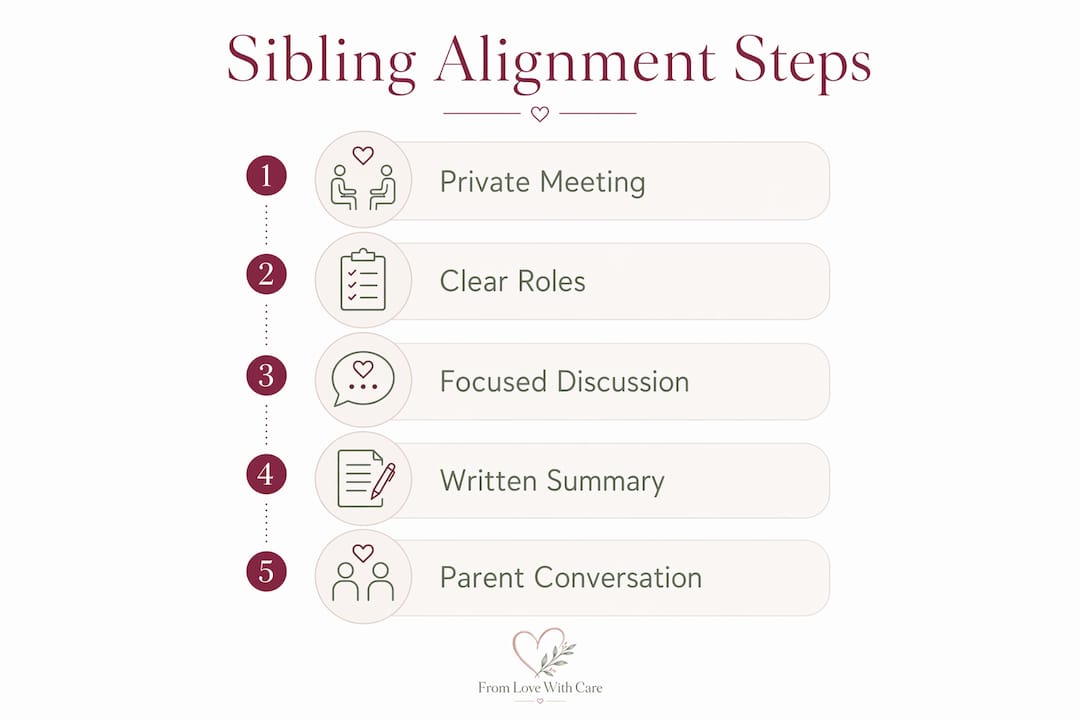
Start with a short private sibling meeting before anyone speaks to your parent. Agree shared goals, a rough budget, and at least one concrete task each. That single step, done well, prevents most of the conflict that derails family companionship decisions later.
Two tools make the meeting work. First, prepare a one-page care snapshot covering your parent's current needs, recent incidents, medication schedule, and how often they have meaningful social contact. Second, create a shared folder or calendar so every sibling sees the same factual care log, not a version filtered through whoever made the last phone call. Platforms such as Google Drive or a simple shared notes app are enough.
- Agree shared goals: parent wellbeing, independence, and dignity
- Set a budget range and any firm red lines before the meeting ends
- Assign one concrete task to each sibling immediately (pharmacy runs, appointment scheduling, provider research)
Pro Tip: Send the one-page care snapshot to all siblings at least 48 hours before the meeting. People who arrive informed argue less and decide faster.
Table of Contents
- How should siblings align before involving the parent in companionship decisions?
- How do you divide responsibilities between local and remote siblings?
- How do you talk to your parent about companionship without undermining their dignity?
- What should you check when vetting a UK companionship service?
- How do you handle sibling disagreements without reopening old wounds?
- How do you run a trial visit, review it, and set up ongoing monitoring?
- Key takeaways
- Why the process matters as much as the decision
- Fromlovewithcare: a vetted companion option for families coordinating care
How should siblings align before involving the parent in companionship decisions?
Scheduling a dedicated meeting rather than discussing care at Christmas dinner or in a rushed phone call dramatically improves outcomes. Ad-hoc conversations trigger conflict; a structured agenda keeps the focus on facts.
Prepare the one-page factsheet before you meet. Include current needs, any recent falls or health incidents, medication schedule, how often your parent speaks to someone outside the family, and finances to whatever level siblings agree to share. Bring the document, not your feelings about who has done more.
Run the meeting with a clear agenda:
- State the parent's current situation using facts only
- Share the full picture of existing tasks and who currently covers them
- Propose shared goals: wellbeing, independence, dignity
- Discuss budget range and any non-negotiables
- Assign a named owner to each immediate task
- Agree a check-in cadence (fortnightly works well to start)
- Set a date to reconvene after the first trial visit
Keep the meeting brief and focused. Use 'I' statements, avoid re-litigating old grievances, and agree confidentiality for sensitive financial details. Concrete care logs make needs undeniable and harder to dismiss, so document recurring tasks and incidents before the meeting, not after.
Pro Tip: Nominate one sibling to circulate a written summary within 24 hours of the meeting. Memory bias is real, and a shared written record prevents arguments about what was actually agreed.
How do you divide responsibilities between local and remote siblings?
Role ownership beats vague requests every time. Assign each sibling a domain they are responsible for meeting, not a favour they might offer. Vague agreements evaporate within weeks.

Match tasks to location, time, and skills rather than to guilt or birth order.
| Domain | Typical tasks | Ideal owner |
|---|---|---|
| In-person visits and welfare checks | Companion visits, appointment escort, emergency response | Local sibling or paid service |
| Transport | GP appointments, hospital trips, pharmacy collection | Local sibling |
| Admin and finances | Insurance, direct debits, provider contracts, benefit claims | Remote sibling |
| Scheduling and research | Booking companions, researching providers, managing calendars | Remote sibling |
| Emotional connection | Weekly video calls, regular phone check-ins | Any sibling, any location |
| Financial contribution | Contributing to companion costs when time is limited | Sibling with capacity |
Remote siblings reduce local burnout by owning admin and scheduling while maintaining emotional connection through regular calls. That is a genuine contribution, not a consolation prize.
When one sibling cannot engage at all, build a care plan that works without them. That may mean hiring paid companionship and splitting costs, rather than leaving the plan dependent on someone who will not show up.
How do you talk to your parent about companionship without undermining their dignity?
Parents often withdraw when they see their adult children in disagreement. Align privately first, then approach your parent as a united family with a clear, calm message centred on their wishes.
Open with one honest sentence that puts them first: "We want someone to visit so you have more company and we can worry less." Frame companionship as something that increases independence, not something that signals decline.
Script variants for common situations:
- Parent resistant to outside help: "This isn't about replacing us. It's about making sure you have someone around on the days we can't be there."
- Parent worried about strangers: "We've looked carefully at who they are. Every companion is DBS-checked and we'd meet them with you first."
- Parent proud of managing alone: "You're doing brilliantly. This is just a bit of extra company, not care."
- Parent with mild memory changes: "Having someone visit regularly means you don't have to remember everything yourself. It takes the pressure off."
Choose a relaxed moment, not a rushed visit or a family gathering. Offer a short trial visit as a low-commitment first step. Linking to practical phrases for resistant parents can help you prepare further.
Pro Tip: Invite your parent to name one thing they'd enjoy doing with a companion, whether that's a walk, a card game, or simply a cup of tea. Their answer shapes the matching process and gives them ownership of the decision.
What should you check when vetting a UK companionship service?
Safe in-home companionship rests on a short list of non-negotiable checks. Work through these before booking a trial visit.
Immediate trust checks:
- Valid DBS (Disclosure and Barring Service) certificate for every companion
- Identity verification completed by the provider
- Employer liability insurance in place
- Written references or published client testimonials
Scope and clarity:
- Written confirmation that the service covers companionship, social visits, light tasks, and welfare checks only
- Clear statement that clinical or personal care is not included unless explicitly offered
- Defined escalation route if a welfare concern arises during a visit
Questions to ask on your first call:
- How are companions recruited, trained, and matched to clients?
- What happens if the assigned companion cannot attend?
- What are the cancellation and notice periods?
- What are the hourly rates, and are there premium fees for emergency welfare checks?
- Does the service have a named local coordinator for family communication?
Safeguarding signals beyond DBS:
- Safeguarding training completed by all companions
- Clear protocol for recognising and reporting signs of elder abuse or neglect
- Welfare-check procedures with written records shared with the family
Loneliness carries serious health consequences for older adults, which is why the quality of the companionship service matters as much as its convenience. Researching your options carefully before committing protects your parent and gives every sibling confidence in the choice. A thorough guide to researching providers can help you compare services systematically.
How do you handle sibling disagreements without reopening old wounds?
Most sibling conflict in care decisions is rooted in historical family dynamics, not in genuine disagreement about what the parent needs. Elder care mediators consistently find that addressing present needs rather than re-running past grievances is the only constructive path forward.
Three common root causes: unequal geography (one sibling carries the physical burden), implicit scorekeeping (who has sacrificed more), and old family fault lines that care decisions reactivate. Naming these openly in the private meeting reduces their power.
A brief mediation framework that works:
- Align privately before any conversation with the parent
- Use factual care logs as the basis for every discussion
- Assign role ownership so there is no ambiguity about who is responsible for what
- Agree an escalation path in advance: a trusted family friend, a professional mediator, or a neutral care manager if siblings reach a genuine impasse
When a conversation drifts into blame, pause it. Return to the parent-centred goal. If voices rise, agree a short cooling-off period before continuing. UK law is clear that older adults with mental capacity cannot be forced into care arrangements against their wishes, so the parent's expressed preferences are always the anchor point. Families who cannot resolve serious disagreements may need to consider a Lasting Power of Attorney to clarify decision-making authority before a crisis forces the issue.
Grief and loss often sit beneath sibling tension, particularly when a parent's decline is gradual. Recognising that grief affects family members differently can soften the edges of a difficult conversation.
Pro Tip: Circulate a one-page written summary immediately after every meeting. Documented agreements cannot be rewritten by memory, and that single habit removes the most common trigger for reopening old arguments.
How do you run a trial visit, review it, and set up ongoing monitoring?
Short trials with an early review protect everyone. Practitioners recommend testing a companion match before making any long-term commitment.
A simple four-week timeline:
- Week 0: Agree trial scope, confirm vetting checks, book the first visit
- Week 1: First trial visit takes place
- Week 2: Siblings hold a quick review (30 minutes by video is enough)
- Week 4: Fuller review and decision on next steps
Trial visit checklist:
- Companion arrived on time and introduced themselves clearly
- Agreed activities took place (conversation, shared task, walk)
- Welfare check completed and notes recorded
- Parent's mood and engagement observed and noted
- Any missed expectations flagged immediately to the coordinator
Simple post-visit review form:
After the trial, set a fortnightly or monthly check-in cadence. Keep a shared care log updated after each visit. Agree a rapid escalation route for any safeguarding concern so every sibling knows exactly what to do if something feels wrong. Documentation and regular follow-ups keep agreements alive; vague one-off decisions fade without written roles and scheduled reviews.
Key takeaways
Involving siblings in companionship decisions works best when you align privately first, divide roles by capacity, and keep the parent's dignity and preferences at the centre of every step.
| Point | Details |
|---|---|
| Private alignment first | Hold a 30 minute sibling meeting before speaking to your parent to agree goals, budget, and roles. |
| Divide roles by capacity | Match tasks to location and skills: local siblings handle in-person visits; remote siblings own admin and scheduling. |
| Centre the parent's voice | Frame every conversation around your parent's expressed wishes and offer a trial visit as a low-commitment first step. |
| Vet thoroughly | Check DBS certificates, scope of service, safeguarding training, and cancellation terms before booking. |
| Fromlovewithcare as a vetted option | Fromlovewithcare provides DBS-checked companions, a matching process, trial visits, and welfare checks for families across the UK. |
Why the process matters as much as the decision
The families who navigate companionship decisions most successfully are not the ones who agree on everything. They are the ones who agree on a process. When siblings use factual care logs, assign clear roles, and run a short trial before committing, they reduce the emotional load on everyone, including their parent. Companionship, when it is the right match, genuinely improves emotional wellbeing for older adults. The evidence for that is consistent. But the match only works when the family has done the groundwork: a parent who feels consulted and respected is far more likely to welcome a companion than one who feels the decision was made for them. Centring dignity at every step is not just kind. It is what makes the arrangement last.
Fromlovewithcare: a vetted companion option for families coordinating care
When siblings have done the private alignment work and are ready to book a trial visit, Fromlovewithcare offers a straightforward next step. Every companion is DBS-checked and identity-verified before their first visit. The matching process pairs companions to your parent's personality, interests, and preferred activities, so the first meeting feels natural rather than clinical.
Services cover social visits, conversation and emotional support, shared activities, grocery shopping assistance, support during appointments, and emergency welfare checks. There is no clinical or personal care, and the scope is confirmed in writing so every sibling knows exactly what is included. A named coordinator handles family communication, which means one point of contact rather than a different answer every time someone calls.
To see the full range of services or to book a trial visit, visit the Fromlovewithcare services page. You can also read about how the matching process works before making any commitment.