

A caregiver needs additional support when persistent physical, emotional, or behavioural signs begin to affect their health, safety, or ability to care reliably. If you are noticing even one or two of these signs in yourself or a family member, act now: book a GP appointment and tell them explicitly "I am a carer," request a carer's assessment from your local council, and contact Carers UK or Age UK for immediate guidance. Arranging even a single short respite or companionship visit this week can make a meaningful difference before strain deepens.
- Book a GP appointment for the carer (say "I am a carer" at reception so the appointment is flagged)
- Request a carer's assessment from your local council adult social care team
- Call Carers UK (0808 808 7777) or Age UK (0800 678 1602) for free advice
- Arrange one short respite or companionship visit as a low-pressure first step
Pro Tip: Frame the GP appointment as protecting the quality of care your loved one receives. GPs respond well to this framing and can write supporting letters that accelerate council respite responses.
Table of Contents
- What are the early warning signs a caregiver is struggling?
- How severe is it, and what should you do first?
- What UK support options are available to carers?
- How do you ask for help, and what should you check when hiring?
- Which symptoms need urgent attention right now?
- Why does seeking support actually help?
- Key takeaways
- The moment it becomes real
- How Fromlovewithcare companions support carers right now
- Useful UK sources and further reading
What are the early warning signs a caregiver is struggling?
Caregiver burnout is a process, not a single event. South London & Maudsley NHS Foundation Trust notes that early symptoms such as headaches, forgetfulness, and impatience are quiet warnings that the caregiving routine is becoming unsustainable, yet they are routinely misread as ordinary tiredness or a difficult week.
Physical signs
- Persistent headaches, stomach pains, or muscle tension
- Chronic fatigue even after a full night's sleep
- Falling ill more frequently than usual
- Skipping your own GP appointments or health checks
- Unexplained weight loss or gain
Emotional signs
- Increased irritability or snapping at the person you care for
- Persistent guilt when you take any time for yourself
- Feeling numb, detached, or emotionally disconnected from the person you care for
- Hopelessness or crying without an obvious cause
- Anxiety that does not lift, even during quiet moments
Behavioural signs
- Withdrawing from friends, family, or activities you once enjoyed
- Skipping meals or relying on alcohol or sleeping tablets to cope
- Making care errors such as missed medication doses
- Feeling unable to switch off from caregiving responsibilities
Statistic callout: Ascot Medical Centre NHS reports that 46% of caregivers experience depression, one of the most commonly overlooked signs of burnout.
Recognising 1–4 of these signs is a prompt to act early. Carers UK–aligned guidance suggests that reaching 5–9 persistent symptoms indicates likely burnout already underway.
Pro Tip: Keep a brief daily note for one week. Patterns become visible quickly, and a written record helps enormously when speaking to a GP or social worker.

How severe is it, and what should you do first?
A simple severity scale helps you decide how urgently to act.
- Mild (1–4 signs present): Strain is building. Act now to prevent escalation.
- Moderate (5–9 signs present): Burnout is likely underway. Seek professional support within days.
- Severe (10+ signs, or any safety risk): Immediate action is required, including contacting adult social care for emergency respite.
Action timeline
- Today or this week: Book a GP appointment; arrange one companion or respite visit; call Carers UK or Age UK.
- Within 1–2 weeks: Request a formal carer's assessment from your local council; ask the GP for a supporting letter if needed.
- Within 2–6 weeks: Arrange regular companion visits or home-care hours; review any employment needs (flexible working, carer's leave).
Pro Tip: One GP visit and one companion visit, taken together in the same week, significantly increase the likelihood of sustained caregiving without an emergency intervention later.
What UK support options are available to carers?
The range of support is wider than most carers realise. Under the Care Act 2014, every carer aged 18 or over has a legal right to a carer's assessment from their local authority, regardless of income, benefits status, or the number of hours they care. The assessment can unlock direct payments, respite care, and equipment.
You do not need a formal caring arrangement or to be receiving benefits to qualify. Simply caring for someone is sufficient.
| Support option | Main benefit | Who arranges it | Typical speed |
|---|---|---|---|
| Carer's assessment | Unlocks respite, direct payments, equipment | Local council adult social care | 1–4 weeks |
| Companionship visits | Reliable respite, social connection for cared-for person | Private provider or charity | Days |
| GP health check | Clinical support, supporting letters for council | GP surgery | Days to 1 week |
| Carers UK helpline | Free advice, signposting, emotional support | Carers UK (0808 808 7777) | Immediate |
| Age UK local services | Befriending, day centres, practical help | Age UK local branches | 1–2 weeks |
| NHS 111 | Medical advice, urgent referrals | NHS | Immediate |
| Samaritans | Emotional crisis support | Samaritans (116 123) | Immediate |
Carers UK and Age UK run helplines, local support groups, and Memory Cafés that reduce isolation for both the carer and the person they support. Memory Cafés, in particular, create predictable respite windows because the cared-for person is engaged and supported while the carer has a genuine break.
Pro Tip: Search carersuk.org/localsupport to find carer organisations in your specific area. Local groups often know about funding and services that national helplines cannot always signpost.
How do you ask for help, and what should you check when hiring?
Asking for help is harder than it sounds. Many carers feel guilt, or worry their loved one will only accept support from them. A direct, honest opener removes much of that friction.
Conversation starters
- To your GP: "I am a carer and I am struggling. I need support for myself, not just for the person I look after."
- To a family member: "I cannot keep doing this alone. Can you take one regular slot each week?"
- To the person you care for: "Having someone visit means I can be more present and patient when I am with you."
When hiring a paid companion, use this checklist before confirming any arrangement.
- DBS check: Confirm the companion holds a current Disclosure and Barring Service certificate
- References: Request and follow up on at least two references
- Written scope: Agree in writing that visits are companionship only, non-medical
- Hours and cost: Confirm session length, frequency, and total cost before the first visit
- Emergency procedure: Establish who to call and what to do if something changes during a visit
- Trial visit: Arrange one trial visit with feedback from both the carer and the cared-for person
Companions provide conversation, shared activities, grocery shopping assistance, welfare check-ins, and emotional support. They do not provide personal care or medical treatment. Understanding that distinction protects everyone involved. A professional companion during respite gives the carer a predictable, reliable break without the anxiety of leaving a loved one unsupported.
Pro Tip: Schedule a single weekly companion visit first. One predictable slot each week is enough to restore a sense of breathing room without committing to a large arrangement immediately.
Which symptoms need urgent attention right now?
Some signs go beyond strain and require immediate action.
- Risk of harm to self or others: Call 999 immediately.
- Suicidal thoughts: Contact Samaritans (116 123, free, 24 hours) or call 999 if there is immediate danger.
- Severe neglect of the cared-for person (missed medication, dehydration, unsafe living conditions): Contact your local council adult social care team for emergency respite.
- Rapid health deterioration in the carer: Call NHS 111 or request a same-day GP appointment.
- Sudden incapacity of the carer (illness, injury, collapse): Call 999 and contact adult social care for emergency cover.
If you are unsure whether a situation is urgent, treat it as if it is. Acting too early is never the wrong call.
Why does seeking support actually help?
Practitioners frame help-seeking as a strategic, strength-based decision that reduces long-term risk of crisis and preserves caregiving capacity. Respite, in particular, lets carers recharge and return with more patience and consistency, which directly improves the quality of care the vulnerable person receives.
Emotional detachment and resentment are not moral failings. They are clinical indicators of compassion fatigue, and recognising them early is what restores empathic capacity. Carers who act at the mild stage consistently avoid the emergency interventions that follow full burnout.
The legal framework supports this. A carer's assessment under the Care Act 2014 is a right, not a favour. GPs can perform dedicated health checks for carers and write letters that accelerate council responses. These are not bureaucratic hurdles; they are tools designed to keep carers well.
Pro Tip: When speaking to your GP, mention the emotional support for carers dimension explicitly. GPs often focus on physical symptoms; naming the emotional strain helps them understand the full picture.
Key takeaways
Carers who recognise strain early and take one concrete step, whether a GP appointment or a single companion visit, are far more likely to sustain quality care without reaching crisis point.
| Point | Details |
|---|---|
| Act at 1–4 signs | Early action prevents burnout from advancing; do not wait for a crisis to seek help. |
| Tell your GP you are a carer | This precise framing unlocks health checks and supporting letters that speed up council responses. |
| Request a carer's assessment | Under the Care Act 2014, every carer has a legal right to this assessment regardless of income or benefits. |
| Use UK helplines immediately | Carers UK (0808 808 7777) and Age UK (0800 678 1602) offer free, immediate guidance and local signposting. |
| Fromlovewithcare companion visits | A single weekly DBS-checked companion visit creates reliable respite and social connection for the cared-for person. |
The moment it becomes real
There is a particular kind of exhaustion that does not show up on any checklist. It is the moment you realise you have not thought about yourself, your own needs, or your own life, in weeks. For many carers, that moment passes without action because asking for help feels like admitting defeat.
What changed everything, in the accounts of carers who did reach out, was one small step. Not a complete overhaul of the care arrangement, but a single afternoon where someone else was present. A companion sitting with their loved one over a cup of tea, while they walked around the block alone for the first time in months. That one afternoon did not solve everything. But it proved that help was possible, and that accepting it did not diminish the love behind the caring.
If you have recognised yourself in any of the signs above, that recognition is not failure. It is the beginning of doing something about it. For families navigating grief or loss alongside caring responsibilities, bereavement resources can offer additional emotional grounding during an already difficult time.
How Fromlovewithcare companions support carers right now
Fromlovewithcare offers something specific: a DBS-checked, trained companion who visits your loved one at home for conversation, shared activities, grocery shopping, and welfare check-ins. No medical care, no clinical appointments. Just genuine human connection that gives the carer a reliable, predictable break.
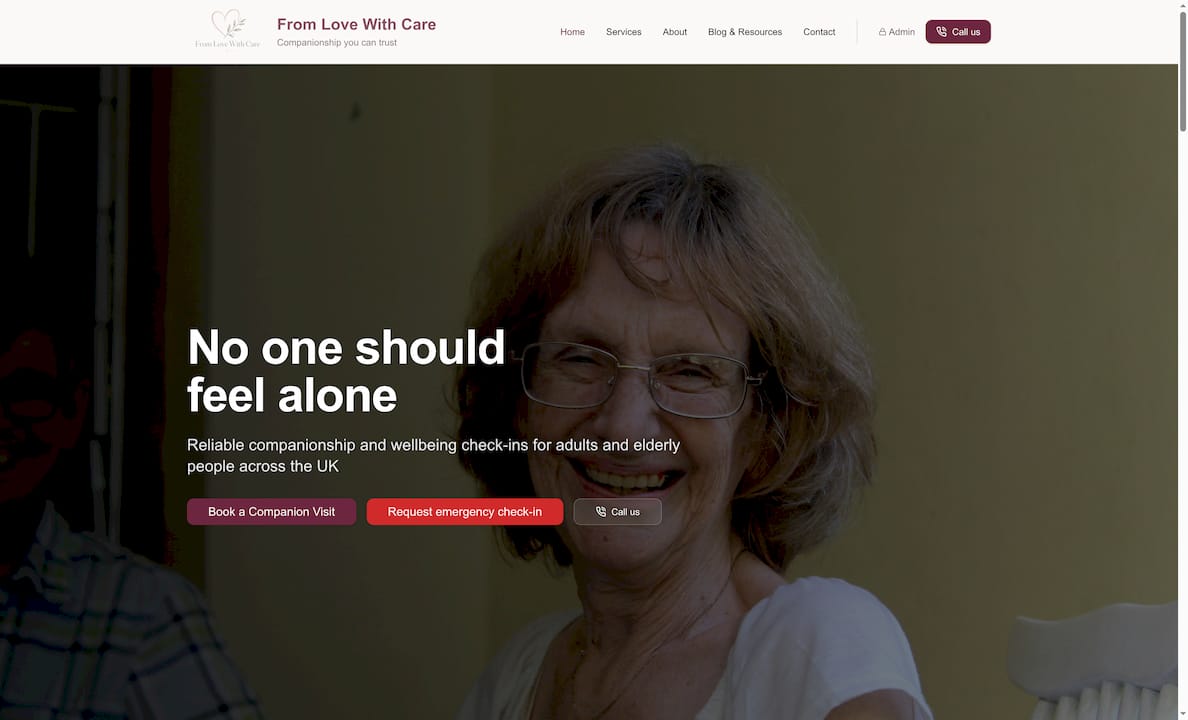
The most practical first step is a single trial visit. You confirm the companion's DBS certificate, agree the scope and hours in writing, and arrange one session. Families who take this step consistently report that their loved one's mood improves and their own sense of relief is immediate. That is not a small thing when you are running on empty.
To see how the service works and what a visit involves, visit how our companionship works. For families specifically concerned about isolation and loneliness, the loneliness support services page explains the full range of options available.
Useful UK sources and further reading
- Carers UK: Helpline (0808 808 7777), carer's assessment guidance, local support directory, and online forum (Carers Connect).
- Age UK: Helpline (0800 678 1602), befriending services, day centres, and local branch support.
- NHS 111: Urgent medical advice and referrals, available 24 hours online or by phone.
- Samaritans: Free emotional crisis support (116 123), available every hour of every day.
- South London & Maudsley NHS Foundation Trust: Expert guidance on caregiver burnout as a process and early intervention strategies.
- Fromlovewithcare companionship services: DBS-checked companion visits, welfare checks, and loneliness support across the UK.
- Fromlovewithcare elderly companionship: Dedicated service page for families arranging ongoing visits for elderly relatives.
This article provides general information for UK carers and families. It is not a substitute for professional medical, legal, or social care advice. For your specific situation, speak with your GP, contact your local council adult social care team, or call Carers UK.