

Yes. Most in‑home companionship providers charge for travel time in one of three ways: it is folded into the hourly rate you pay, shown as a separate travel time line, or claimed back as mileage. Which method a provider uses affects both what you pay and whether that provider is meeting its legal pay obligations under National Minimum Wage rules enforced by HMRC.
On a typical invoice, you might see any of the following:
- A single hourly rate with no travel mentioned (it may be included)
- A "contact time" charge plus a separate "travel time" charge
- An hourly rate plus a travel fee or mileage figure per visit
None of these is automatically wrong. What matters is whether the provider can explain which model they use and show that staff travel pay meets the legal minimum.
Key Takeaways
Travel charges from in‑home companionship providers are legitimate and legally required, but transparency about which billing model applies determines whether you're getting fair value.
| Point | Details |
|---|---|
| Travel is usually charged | Providers fold travel into the hourly rate, list it separately, or charge mileage, so always ask which applies. |
| Travel counts as working time | Under National Minimum Wage rules, average pay across contact and travel time must meet £12.71 an hour from April 2026. |
| Short visits cost more per hour | Travel stays roughly constant while contact time falls, so a 30‑minute visit can cost nearly £19.48 an hour effectively. |
| Consolidate visits to save | Booking longer or consecutive visits in the same area cuts the travel proportion and lowers the effective cost. |
| Fromlovewithcare prices transparently | Minimum visit lengths and clear pricing before booking mean no hidden travel surcharges on your invoice. |
Table of Contents
- How companions typically charge for travel time
- Does the law require companions to be paid for travel time?
- What drives the cost of travel charges up or down?
- How does travel time change the real cost of a visit?
- What should you ask a provider about travel charges?
- How does Fromlovewithcare handle travel time and pricing?
- How can you keep travel costs down without cutting corners?
- Want transparent pricing without the guesswork of comparing quotes?
- Where can you check the law and sector guidance yourself?
- Sources
How companions typically charge for travel time
Four billing models cover almost every quote you'll receive from a UK companionship or home care provider.
- Travel included in the hourly rate. You pay one figure per hour of companionship, and the provider absorbs travel costs into that price. This is the most common approach, partly because very few council contracts require travel to be billed separately, so providers build it into their standard rate instead.
- Paid travel time between visits. Some agencies itemise travel as its own charge, particularly for rural rounds where distances are longer.
- Flat travel fee per visit. A fixed amount added regardless of distance, common with smaller or self‑employed companions.
- Mileage reimbursement. A per‑mile charge on top of the hourly rate, usually reflecting fuel and running costs rather than paid time.
Self‑employed companions often quote a simpler blended rate, since they're managing their own diary and don't need to reconcile payroll across a team. Agency‑employed companions work to a scheduled round, and the agency has a legal duty to ensure travel between clients is paid at least the National Living Wage once averaged across the shift. That distinction shapes how transparent the pricing tends to be.
Pro Tip: Ask directly whether the quoted hourly rate is "all‑inclusive" of travel or "contact time only." The phrasing alone tells you which model you're being offered.
Does the law require companions to be paid for travel time?
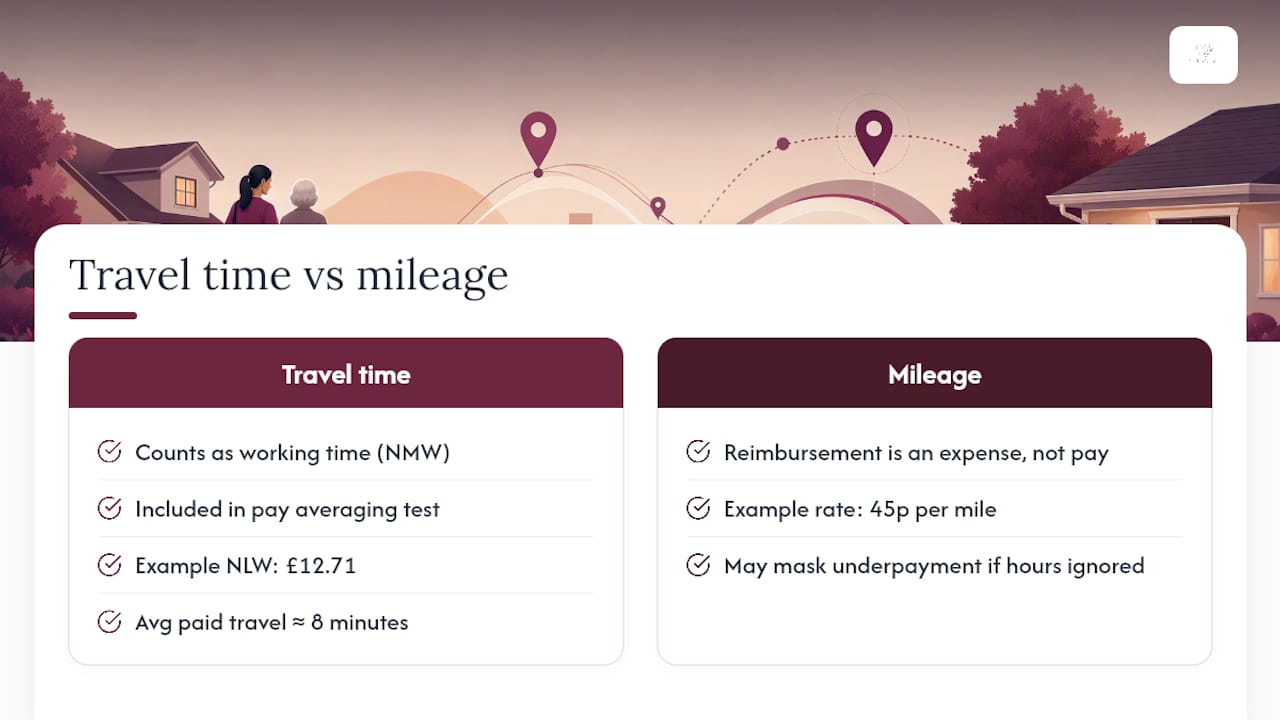
Time spent travelling between client visits generally counts as working time for National Minimum Wage purposes. Employers must ensure a companion's average pay across all working hours, contact time plus travel, meets at least the current National Living Wage for workers aged 21 and over. This is an averaging test, not a per‑minute one: a provider can pay a flat visit rate as long as the total earned across a shift, divided by total hours worked (including travel), clears £12.71.
Mileage reimbursement is a separate matter entirely. HMRC guidance treats journeys between client visits as business travel that counts toward working time for minimum wage calculations, but mileage payments themselves are an expense, not pay. A provider that reimburses 45p a mile but doesn't separately account for the paid hours that travel represents may still be underpaying staff on paper.
Paid travel time per visit averages around eight minutes, a figure used in Homecare Association pricing models, which shows how significant travel becomes when visits themselves run only 30 to 60 minutes.
Pro Tip: Ask a provider to walk you through a "three‑carer averaging test", picking three companions on a typical day and confirming their total pay divided by total hours (contact plus travel) clears the current National Living Wage. A provider who understands this instantly is one who takes compliance seriously.
What drives the cost of travel charges up or down?
Several factors decide whether a travel charge feels fair or feels padded.
- Visit length. A 30‑minute visit carries roughly the same travel time as a 90‑minute one, so short visits have a much higher travel‑to‑contact ratio.
- Schedule density and routing. Tightly clustered visits in the same postcode cost far less to travel between than scattered, one‑off bookings.
- Rural versus urban geography. Rural rounds and sparse localities raise paid travel time per visit purely through distance, regardless of how efficient the provider is.
- Staff pay rates. A provider paying above the National Living Wage will naturally charge more per hour, travel included.
- Local charges. ULEZ and congestion charges in London and similar zones elsewhere add a real, if modest, cost that some providers pass through.
An urban round with four visits inside two miles might average 15 minutes of travel across the whole afternoon. A rural round covering the same four visits across 20 miles could easily double or triple that travel time, and the price reflects it.
How does travel time change the real cost of a visit?
Numbers make this easier to see than descriptions do. Take a single 30‑minute visit with 8 minutes of travel each way, roughly the sector average reported by the Homecare Association.
- Contact time: 30 minutes. Travel time: 16 minutes (8 each way). Total paid time: 46 minutes.
- At £12.71 an hour, that visit costs £9.74 in wages alone, before employer costs like National Insurance and holiday pay.
- The effective hourly rate, once you divide that £9.74 by the 0.5 hours of actual companionship delivered, works out closer to £19.48 an hour.
Consolidating visits in the same area, rather than booking two isolated slots, cuts the travel proportion nearly in half. That's the single clearest lever families have over cost, and it applies whether you're comparing companion visits for one relative or coordinating cover across a wider family.
What should you ask a provider about travel charges?
Before booking, ask these five questions and expect clear, immediate answers:
- How exactly do you charge for travel, included in the rate, separate line, or mileage?
- Do your staff get paid for travel time, or only for contact time with the client?
- How is mileage calculated and reimbursed?
- Can you show a compliance policy or confirm staff pay meets the National Living Wage once travel is averaged in?
- What does a sample invoice actually look like?
Some warning signs are worth taking seriously. A provider that can't explain its own travel policy, or gets vague when asked how staff are paid, is a genuine compliance red flag. Sector experts have flagged that very low headline rates paired with unexplained separate travel fees often signal a provider that hasn't budgeted travel pay properly, which puts them at risk of HMRC enforcement, and puts your loved one's care continuity at risk if that provider suddenly can't retain staff.
Always ask for written terms and a sample invoice before you commit. If a provider hesitates to give you either, that's your answer.

How does Fromlovewithcare handle travel time and pricing?
Fromlovewithcare structures its companionship visits around clear, upfront pricing rather than surprise line items. Families arranging companion visits for elderly parents can expect:
- A pricing model explained before booking, so there's no ambiguity about what a quote covers
- Minimum visit lengths designed to keep the travel‑to‑contact ratio sensible, rather than squeezing in very short, expensive slots
- Every companion DBS‑checked and vetted, with the same standard applied regardless of round or location
We'd rather a family ask too many questions before booking than discover a gap afterwards. If you want to see exactly how a visit is priced, you can request a sample invoice and we'll talk you through it line by line.
Pro Tip: If you're comparing Fromlovewithcare against another provider, ask both the same travel question word for word. The difference in how confidently they answer tells you more than the price itself.
How can you keep travel costs down without cutting corners?
Cost control here isn't about squeezing companions on pay, it's about scheduling smarter.
- Book longer visits where you can. A single hour‑long visit carries a far smaller travel proportion than two 30‑minute visits.
- Cluster visits geographically if you're coordinating care across siblings or several relatives nearby, as families often do when splitting responsibilities.
- Ask about a blended hourly rate that explicitly states it covers both travel and contact time, so there's no separate surprise.
- Request consecutive visit slots rather than scattered single bookings across the week.
Pro Tip: Ask your provider whether they can schedule your relative's visit next to another client on the same street. Shared rounds bring travel time down for everyone on that route, and providers are often happy to arrange it if you simply ask.
Pro Tip: Confirm the minimum visit length upfront. A 45 to 60 minute minimum, rather than 15 or 20, keeps the travel percentage low and the value of each visit high.
Why travel charges exist, in the provider's own words
Travel charges aren't padding. They fund the reality that a companion driving between clients has to be paid properly for that time, not just for the minutes spent at your relative's kitchen table. Cutting that pay to offer a cheaper headline rate is exactly the shortfall that leads to high staff turnover and unreliable rounds. If you want a personalised costing for your situation, get in touch and we'll talk it through properly.
Want transparent pricing without the guesswork of comparing quotes?
Fromlovewithcare prices companionship visits around genuine transparency rather than the layered fees you'll find elsewhere. There's no separate travel surcharge sprung on you after booking, and no unexplained mileage line buried in an invoice. What you're quoted reflects what your companion is actually paid, travel included.
Here's what that means in practice:
- Every companion is DBS‑checked, vetted, and trained before a single visit
- Pricing is explained clearly before you book, not discovered after your first invoice
- Rounds are scheduled sensibly, so your relative gets proper contact time rather than a rushed, travel‑heavy slot
If you'd like to see how this works for your own family, browse our companionship services or ask us for a sample invoice tailored to your relative's location and visit frequency. We'll talk you through the pricing before you commit to anything.
Where can you check the law and sector guidance yourself?
- Gov, the official rate and averaging rules
- Homecare Association Minimum Price toolkit, sector cost modelling including travel time
- Homecare Association: travel time resource, on council contract practices
- The Access Group: travel time pay obligations, compliance risk explained
- LITRG: minimum wage help for care workers, on record‑keeping and proof
If you suspect a companion or agency is underpaying travel time, ask directly for payslip evidence or a written pay policy before booking further visits.
This article is general information, not a substitute for advice from a qualified lawyer. Consult a qualified legal professional about your own circumstances before acting on anything here.
Sources
- The national minimum wage in 2026
- Homecare Association — Minimum Price for Homecare (England) 2025–2026
- HSC home care and travel time pay: what are your obligations?
- Domiciliary care mileage and travel time: HMRC rules
- LITRG — Minimum wage, tax and benefits help for care workers