

Outside relationships, including paid, vetted in-home companionship, produce clear and well-documented benefits for many older people in the UK. Age UK data shows that an estimated 270,000 people aged 65 and over in England go an entire week without speaking to a single friend or family member. NICE quality standards endorse one-to-one social interaction as an effective, non-clinical intervention for mental wellbeing. If your parent is among those going days without meaningful contact, arranging a vetted trial visit is a practical and evidence-aligned next step.
Immediate benefits to look for:
- Improved mood and reduced low-level depression
- Cognitive stimulation through conversation and shared activities
- Regular welfare checks that give your family peace of mind
- A trusted, consistent presence that links your parent to the outside world
Table of Contents
- What UK evidence says about social contact and companionship
- How outside relationships benefit ageing parents in practical terms
- What does high-quality in-home companionship actually look like?
- How to choose and vet a paid companionship service in the UK
- What to expect during the first visits and how quickly benefits appear
- How Fromlovewithcare approaches companionship
- Key takeaways
- Why this matters more than most guides acknowledge
- Fromlovewithcare: safe, meaningful companionship visits for your parent
- Useful sources and further reading
What UK evidence says about social contact and companionship
The scale of isolation among older people in England is striking. An estimated 270,000 people aged 65 and over go a full week without speaking to anyone they know, and those who do are almost three times more likely to report feeling lonely than people with regular contact.
NICE quality statement 3 on social participation is explicit: targeted one-to-one interaction is an effective intervention for older people at risk of isolation. That is not a general recommendation to "get out more." It is a clinical endorsement of the kind of structured, personal contact that a trained companion provides.
The peer-reviewed evidence reinforces this. A 2021 PLOS ONE realist evaluation identified four mechanisms through which befriending services reduce loneliness: reciprocity, empathy, autonomy, and privacy. A 2026 PMC dyadic study found five pathways to broader health benefit, including emotional support, mood improvement, and cognitive stimulation. Study designs vary, and not every trial shows a dramatic reduction in loneliness scores. What recurs consistently across higher-quality research is improvement in mood, daily functioning, and sense of identity.
How outside relationships benefit ageing parents in practical terms
The benefits of regular social interaction for seniors operate through several distinct pathways, not just "feeling less alone."
Cognitive stimulation. Conversation introduces novelty, requires recall, and exercises language. For a housebound parent whose days follow a narrow routine, a companion who asks about their past, shares news, or plays a card game provides genuine mental exercise.
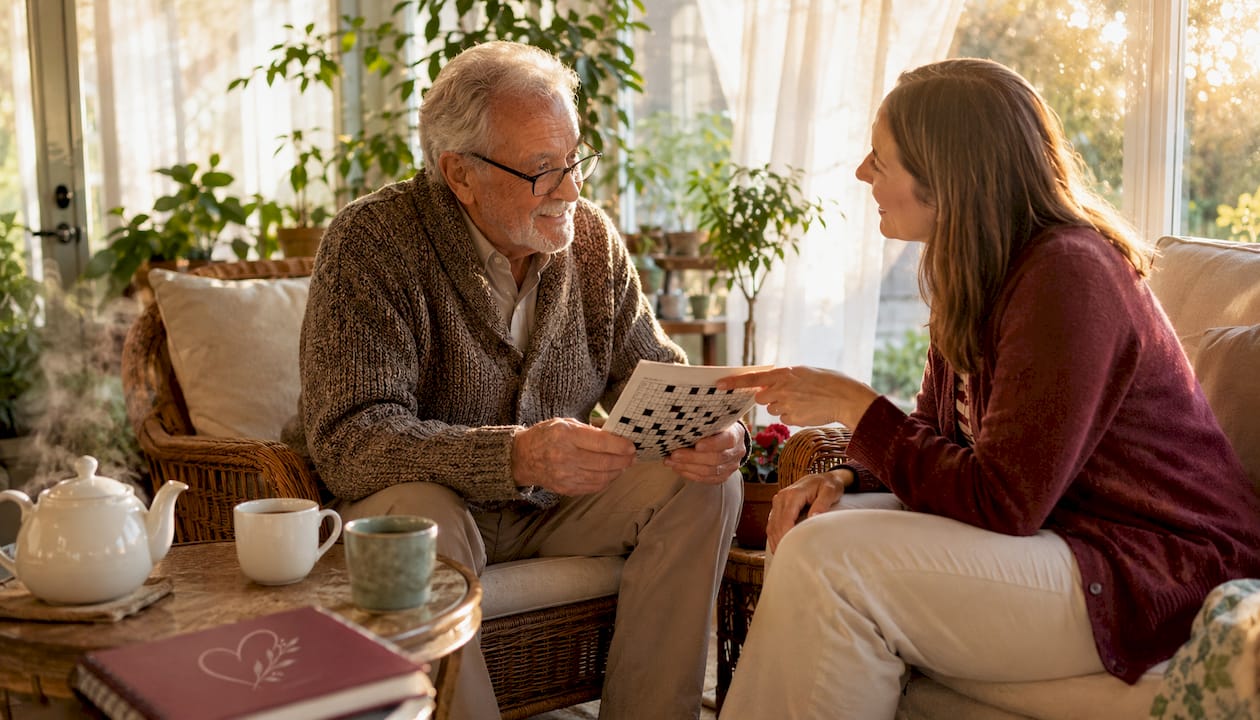
Mood and emotional wellbeing. The PMC study identifies emotional support and mood improvement as two of the five core mechanisms. For a parent who has been bereaved or who rarely leaves the house, even a single weekly visit can shift the emotional baseline measurably within weeks.
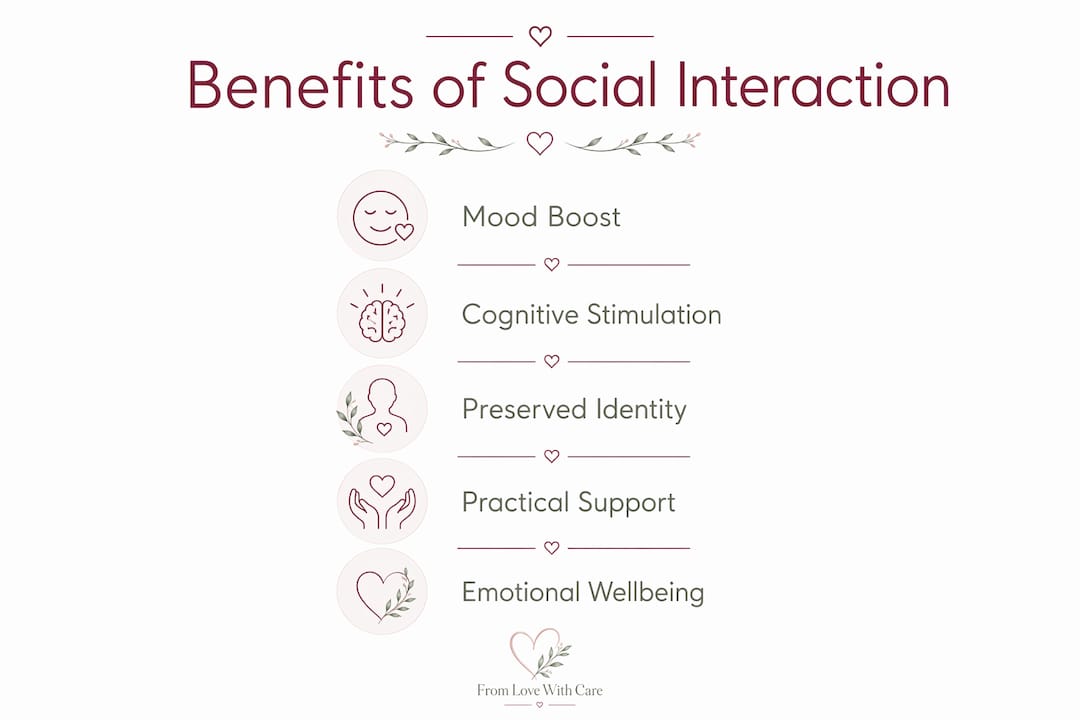
Preserved identity and reciprocity. Older people value relationships where they are treated as equals, not recipients of charity. Research consistently shows that reciprocal companionship — where the older person contributes to the conversation and feels genuinely heard — is more transformative than a welfare check alone.
Practical welfare benefits. A companion who visits regularly notices changes in appearance, mobility, or mood that a weekly phone call would miss. They can support attendance at appointments, encourage healthier habits, and act as an early-warning system for families at a distance. The role of companionship in fall prevention is one practical example of this.
| Benefit | Mechanism | Likely timeframe |
|---|---|---|
| Mood improvement | Emotional support, reduced isolation | Weeks |
| Cognitive stimulation | Conversation, shared activities, novelty | Weeks to months |
| Preserved identity | Reciprocity, shared interests, autonomy | Months |
| Welfare monitoring | Consistent presence, observation | Immediate |
| Family peace of mind | Regular reporting, welfare checks | Immediate |
What does high-quality in-home companionship actually look like?
Not all companionship services are equal. The difference between a meaningful visit and a superficial check-in often comes down to three things: matching, consistency, and training.
Cambridge Ageing & Society research found that long-term, consistent relationships yield stronger benefits than short-term or revolving arrangements, particularly for people with cognitive or mobility impairments. The same companion, visiting regularly over months, builds the trust that makes reciprocal conversation possible.
Hallmarks of quality to look for:
- The same companion assigned to your parent for every visit, not a rotating pool
- Matching based on shared interests, background, or life experience
- Clear role boundaries: social visits and welfare checks, not medical or personal care
- Companions trained in dementia awareness and safeguarding
- DBS checks completed before any visit takes place
- A supervision structure so the service can respond if something changes
Pro Tip: During a trial visit, watch whether the companion asks your parent questions and genuinely listens to the answers, or whether they do most of the talking. Reciprocal conversation is the single clearest signal that a companion has been trained to treat your parent as an equal, not a patient.
How to choose and vet a paid companionship service in the UK
A structured approach protects your parent and helps you avoid services that look professional but lack substance.
- Confirm DBS checks. Every companion should hold a current enhanced DBS certificate. Ask to see evidence, not just a verbal assurance.
- Ask about training. Dementia awareness, safeguarding, and first-aid awareness are the minimum. Ask specifically what training companions receive before their first visit.
- Clarify role limits. A companion is not a carer. They should not administer medication, assist with personal hygiene, or provide medical advice. Clear role definition protects both your parent and the companion.
- Ask about matching. How does the service pair companions with clients? Is it based on shared interests, personality, or simply availability?
- Check continuity policy. What happens if your regular companion is unavailable? Will a substitute be sent, or will the visit be rescheduled?
- Understand the trial visit. A reputable service will offer a structured first visit with no long-term commitment required. Ask what the trial includes and how feedback is gathered.
- Get transparent pricing. Costs should be stated clearly per hour, with any additional fees (such as emergency welfare checks) listed separately. If a service is vague about pricing, that is a warning sign.
For families concerned about cost, starting with one visit per fortnight rather than weekly is a practical way to test the service before committing. The guide to finding companionship in later life covers this in more detail.
What to expect during the first visits and how quickly benefits appear
Resistance from your parent is common and normal. Many older people feel uncomfortable with the idea of a "stranger" visiting, or worry it signals a loss of independence. Framing the first visit as a social introduction rather than a care arrangement often helps.
The goal of the first visit is not transformation — it is simply a warm, unhurried conversation. Benefits build through repetition and trust, not a single encounter.
A realistic four-visit arc looks like this:
- Visit one: Introduction, shared tea, light conversation. The companion listens more than they speak. Your parent may be guarded.
- Visit two: Familiarity begins. Shared interests emerge. The companion may bring a relevant activity or topic.
- Visits three and four: Routine establishes itself. Your parent starts to anticipate the visit. Mood effects become observable.
Timeline for benefits:
- Welfare monitoring and family reassurance: immediate, from the first visit
- Mood improvement and reduced anxiety: typically within a few weeks of regular visits
- Cognitive and identity benefits: months of consistent, matched companionship
Common early challenges include mismatched interests or a companion whose communication style does not suit your parent. A good service will act on feedback quickly and, if necessary, rematch. Do not abandon a promising arrangement after one difficult visit, but do raise concerns with the provider promptly.
How Fromlovewithcare approaches companionship
Fromlovewithcare was built specifically around the evidence that meaningful, one-to-one social contact improves wellbeing for isolated older people in the UK. Every companion is DBS-checked and trained before their first visit. The service covers regular social visits, shared activities, grocery shopping support, attendance at appointments, and emergency welfare checks — but explicitly excludes medical and personal care, keeping the role boundaries clear.
The service model maps directly to the research mechanisms:
- Consistent matching: the same companion visits each time, building the trust that reciprocity requires
- Interest-based pairing: companions are matched on shared hobbies and background, not just availability
- Long-term visits: the service is designed for ongoing relationships, not one-off check-ins
- Trained companions: dementia awareness and safeguarding training are standard
- Welfare check option: an emergency welfare check service is available for families who need rapid reassurance
Families who use Fromlovewithcare report meaningful improvements in their relatives' mood and daily engagement, alongside the practical reassurance of knowing a trusted, vetted person is visiting regularly.
Key takeaways
Outside relationships, including paid, vetted in-home companionship, deliver measurable benefits for ageing parents through reciprocity, emotional support, cognitive stimulation, and consistent welfare monitoring.
| Point | Details |
|---|---|
| Scale of isolation | An estimated 270,000 people aged 65 and over in England go a full week without speaking to a single friend or family member. |
| Evidence base | NICE, PLOS ONE 2021, and PMC 2026 all identify one-to-one contact as beneficial for mood, cognition, and wellbeing. |
| Consistency matters | The same companion over time builds trust and produces stronger benefits than rotating or short-term arrangements. |
| Role limits | Companions provide social visits and welfare checks; they are not a substitute for medical or personal care. |
| Fromlovewithcare | Offers DBS-checked, interest-matched in-home companionship with a trial visit option and transparent hourly pricing. |
Why this matters more than most guides acknowledge
There is a tendency to treat companionship as a soft option — something nice to arrange if the budget allows, but secondary to medical care or practical support. The evidence does not support that framing. Social disconnection is associated with poorer health outcomes across multiple dimensions, and the mechanisms are specific: it is not simply about having people around, but about the quality and reciprocity of those relationships.
What families often underestimate is how quickly a well-matched companion can shift the emotional texture of a parent's week. Not because one visit solves loneliness, but because a consistent, trusted presence changes what your parent has to look forward to. That anticipation matters. It is a form of engagement with the future, and for many isolated older people, it is something they have quietly lost.
The practical implication is straightforward: do not wait until a crisis. A single trial visit costs little and risks nothing. The cost of continued isolation is considerably higher.
Fromlovewithcare: safe, meaningful companionship visits for your parent
For families who have read the evidence and want a service that actually reflects it, Fromlovewithcare offers something specific: DBS-checked, trained companions matched to your parent's interests, visiting regularly in their own home. There are no long-term contracts to sign before you have seen the service work. A trial visit is the starting point.
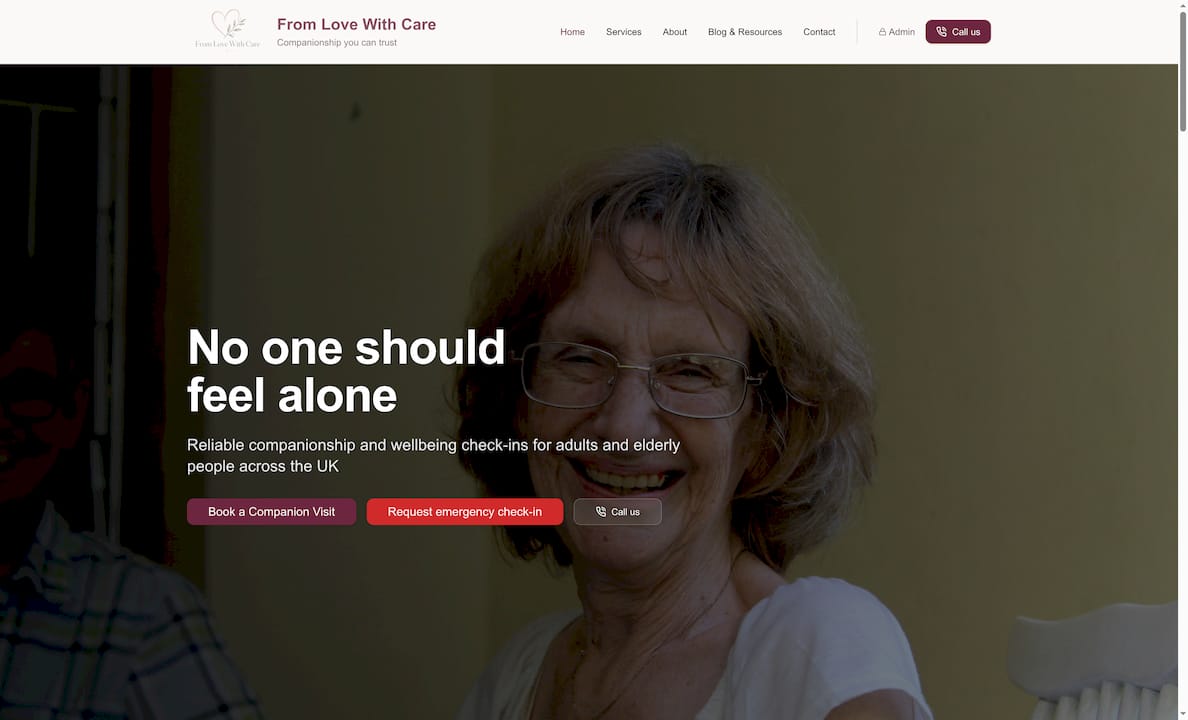
The elderly companionship services page sets out exactly what is included, how companions are vetted, and what a first visit involves. If your parent is going days without meaningful contact, a single visit is a low-risk, evidence-backed way to begin changing that. You can also explore the full range of companionship and welfare check services to find the option that fits your family's situation.
Useful sources and further reading
The evidence cited throughout this article draws on the following primary sources. Readers are encouraged to review them directly.
Key sources used in this article: Age UK parliamentary briefing on loneliness in later life (2024); NICE quality standard QS137 on social participation; PLOS ONE realist evaluation of befriending interventions (2021); PMC dyadic qualitative study on befriending mechanisms (2026); Cambridge Ageing & Society exploration of befriending value and mechanisms; Ageing & Society systematic review on social engagement and wellbeing in late life; PMC cohort study on patterns of social connection among older adults in England.
Before booking any paid companionship service, families should verify DBS certificate status via the DBS Update Service and review the government's safeguarding guidance for vulnerable adults. For non-clinical signposting on loneliness support, the NHS and GOV.UK both carry up-to-date resources.
The 270,000 figure on older people going a week without speaking to anyone comes from Age UK's own analysis of people aged 65 and over in England. It is the most widely cited UK-specific measure of severe social isolation in later life and remains the benchmark for understanding the scale of the problem.
This article provides general information about companionship and social wellbeing. It is not a substitute for medical, social care, or professional advice. For concerns about your relative's health or care needs, consult their GP or a qualified social care professional.