

Before the first visit, tell your companion three things: who they are visiting and why, which daily routines matter most, and what the role does not cover. Every companion arranged through a reputable UK provider such as Fromlovewithcare should be DBS-checked, trained in person-centred support, and briefed in writing before they arrive. NICE guidance is clear that visits should normally last longer than half an hour and that the same worker should visit where possible, so continuity is something to confirm at booking, not after.
Use this short checklist when completing a booking form or sending an introductory email:
- Purpose of visits: social contact, conversation, a shared activity, or a welfare check-in
- Top three routines to maintain: for example, a morning cup of tea, a daily newspaper, or an afternoon walk
- One clear boundary: companions do not provide personal care, nursing tasks, or medical treatments
- Emergency contact: name, relationship, and preferred method of contact
- Family communication preference: how often you want updates and by which channel (text, phone, email)
That is the brief. Everything below helps you build on it.
Table of Contents
- What does a companion actually do during a visit?
- How person-centred care shapes what you should expect
- What to agree before the first visit
- Preparing your home and family for the first visit
- Visit lengths, pricing and scheduling: what to confirm before booking
- How to build trust across the first 4–6 weeks
- DBS checks, safeguarding and emergency protocols
- What to do if expectations are not being met
- Conversation starters and activities that work well during visits
- Key takeaways
- Why the briefing matters more than most families realise
- Fromlovewithcare: DBS-checked companionship you can book with confidence
- Useful UK sources and further reading
What does a companion actually do during a visit?
Companionship care is a non-medical service focused entirely on social and emotional support. A companion might share a pot of tea and conversation, help with light grocery shopping, accompany your relative to a GP appointment, assist with a hobby, or simply sit and read together. These visits can also include assisted walks, help attending community groups, and regular welfare check-ins.
What companions do not do is equally important to state clearly. They do not administer medication, assist with bathing or dressing, provide nursing care, or act as a substitute for a GP or district nurse.
"Boundaries and expectations are the framework that allows care to remain ethical, supportive, and reliable. Without them, even the most well-meaning companion risks overstepping or underdelivering." — A Few Thoughts
A simple way to think about it: if a task requires a clinical qualification or involves the body, it sits outside a companion's role. If it involves time, conversation, or company, it almost certainly sits within it.
How person-centred care shapes what you should expect
Person-centred practice is not a buzzword. When your relative keeps genuine control over their routines and choices, they are far less likely to resist visits and far more likely to benefit from them. NICE guidance on home care states that individuals should decide what support they receive, with privacy and dignity respected throughout.
"Home care should reflect what is important to the person. Workers should have the right training, visits should normally be longer than 30 minutes, and the same workers should visit where possible." — NICE, NG21
In practice, this means recording your relative's preferences in a short care brief before the first visit: preferred name, favourite topics of conversation, activities they enjoy, and anything they find distressing. Your relative has the right to change their mind about activities, to have privacy during visits, and to request a different companion if the relationship is not working.
What to agree before the first visit
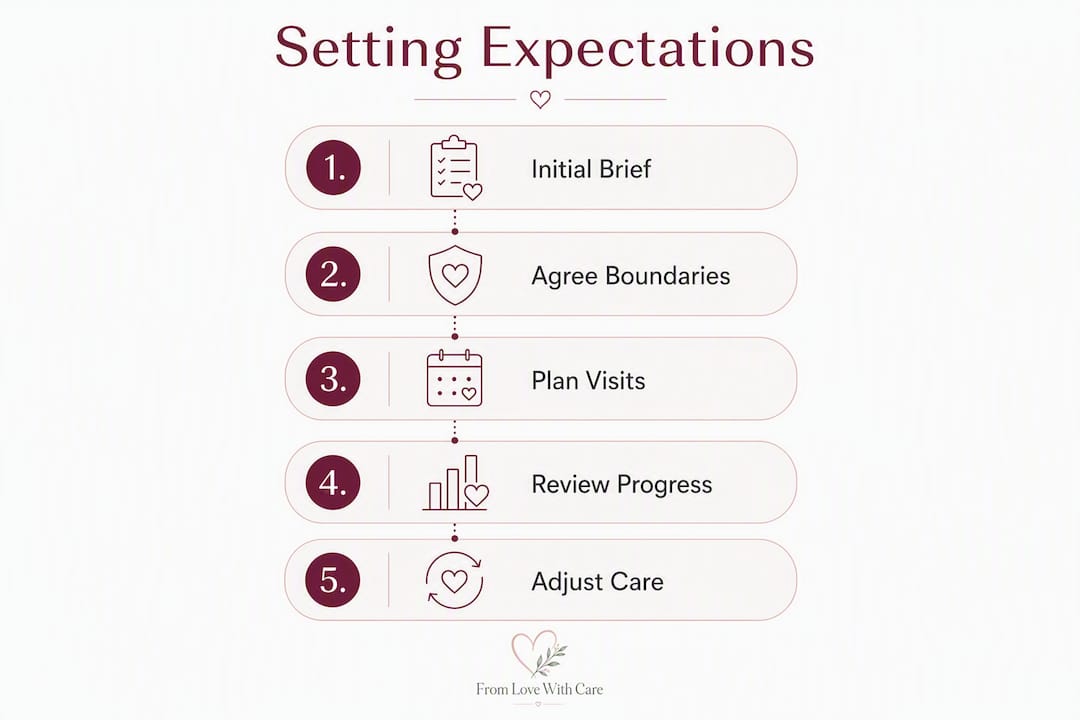
Agree a trial visit and set a formal review point at about a month to a month and a half. That window gives both sides enough time to settle without locking anyone into an arrangement that is not working.
When booking, work through this sequence:
- State the purpose of visits clearly (social contact, welfare check, activity support).
- Share the top three daily routines the companion should respect or support.
- Note any mobility issues, hearing or sight difficulties, or medical alerts the companion should be aware of for safety.
- Confirm arrival preferences (time of day, whether to ring or knock, whether a key safe is in place).
- Ask the provider: Is the companion DBS-checked? Can you guarantee continuity of the same visitor? What is the cancellation policy? Who is the safeguarding lead?
Sample briefing message you can copy: "My [mother/father/relative] enjoys [activity]. Please arrive at [time]. Key priorities: [routine 1], [routine 2], [routine 3]. Please do not assist with personal care. In an emergency, call [name] on [number]."
Preparing your home and family for the first visit
Clear walkways and good lighting matter more than most families realise. Before the companion arrives, check that the route from the front door to the main sitting area is free of trip hazards, that an up-to-date medication list is visible (even if the companion will not administer anything), and that an emergency contact is posted somewhere obvious.
Decide who in the family will be the single point of contact for the companion. Multiple family members sending separate messages creates confusion. Agree how often you want updates and in what format: a brief text after each visit works well for most families.
Pro Tip: If your relative is anxious about a stranger visiting, frame the visits as "someone coming to spend time with you" rather than "a carer". Framing visits around maintaining independence, rather than replacing family care, significantly reduces resistance from older people who worry about losing autonomy. Having a familiar object, a favourite biscuit, or a shared activity ready for the first visit helps too.
Visit lengths, pricing and scheduling: what to confirm before booking
Visit length should match the purpose. A brief welfare check-in suits 30 minutes; a social visit with conversation and a shared activity works better at 60 minutes; accompanying someone to an appointment or helping with a longer outing typically needs two hours or more.
| Visit length | Typical purpose |
|---|---|
| 30 minutes | Welfare check-in, brief social call |
| 60 minutes | Conversation, shared activity, light errands |
| 2+ hours | Appointment accompaniment, shopping trip, extended social visit |
Before booking, confirm these pricing elements with your provider:
- Hourly rate and whether it changes at weekends or on bank holidays
- Any travel or fuel charge for your area
- Premium for short-notice bookings or emergency welfare checks
- Cancellation terms (how much notice is required and whether a fee applies)
- Accepted payment methods
How to build trust across the first 4–6 weeks
The first four to six weeks are the most fragile part of any new companionship arrangement. Relatives often feel anxious about a stranger visiting, and that anxiety can lead to cancelled sessions if the early visits are not handled carefully. Keeping visits at the same time and day, with the same companion, reduces that risk considerably.
After each early visit, ask for a brief welfare update. It does not need to be detailed: a short message confirming the visit went well and noting any observations is enough. Use those updates to build a picture of what is working.
At the end of the trial period, run a short formal review. Ask three questions: Is the relative looking forward to visits? Is the companion maintaining the agreed routines? Are there any concerns on either side?
For more on the trust-building process, this guide on building trust with your elderly companion covers the practical steps in detail.
DBS checks, safeguarding and emergency protocols
A Disclosure and Barring Service (DBS) check reveals whether a person has criminal convictions or is barred from working with vulnerable adults. Any reputable UK companionship provider will carry out an enhanced DBS check on every companion before they work with clients. Ask to see confirmation of this at booking.
Beyond DBS, ask your provider:
- What training do companions receive before their first visit?
- Who is the named safeguarding lead, and how do I contact them?
- What is the protocol if a companion has a welfare concern during a visit?
- When should the companion call emergency services directly, and when should they call the family first?
The general rule: if there is immediate risk to life, the companion calls 999 first and the family second. For non-urgent concerns, the companion contacts the family point of contact and logs the concern with the provider.
Useful safeguarding contacts: your local authority Adult Social Services team, and the Care Quality Commission (CQC) if you have concerns about a regulated provider.
What to do if expectations are not being met
Collect specific examples before raising a concern. "The companion arrived 20 minutes late on three occasions" is actionable; "visits don't feel right" is not.
Follow this path:
- Speak privately with the companion first, if appropriate, and note the date and outcome.
- Contact the provider's client liaison or feedback route with your specific examples.
- If unresolved within a reasonable timeframe, request a formal review and ask for a different companion.
- If you suspect harm or neglect, contact your local Adult Social Services safeguarding team without delay. Do not wait for the provider to act.
Conversation starters and activities that work well during visits
Tailor activities to your relative's current abilities and interests. Low-risk, familiar activities build rapport faster than anything ambitious or unfamiliar.
Conversation starters by interest:
- Memories: "What was your favourite holiday?" / "Tell me about where you grew up."
- Hobbies: "Have you always enjoyed [gardening/knitting/crosswords]?"
- Local news: A local newspaper or community newsletter works as a natural prompt.
- Music: A favourite song or radio station from their younger years often opens conversation immediately.
Simple activities companions can introduce gently:
- Tea and a chat, with no agenda
- Reading a newspaper or magazine together
- A short walk if mobility allows
- A jigsaw puzzle or card game
- Looking through a photograph album
Companions should note which activities the relative responds to positively and share that with the family after the first few visits. Those notes become the foundation of a meaningful companionship plan over time.
Key takeaways
Setting expectations with an elderly companion works best when the purpose of visits, the key routines, and the boundaries of the role are agreed in writing before the first visit, with a formal review scheduled at weeks 4–6.
| Point | Details |
|---|---|
| Brief in writing before visit one | Share purpose, top routines, one boundary, and emergency contact at booking. |
| Companions are non-medical | Social visits, conversation, light errands and welfare checks only; no personal or nursing care. |
| Confirm DBS and continuity | Ask for enhanced DBS confirmation and request the same companion for every visit. |
| Schedule a 4–6 week review | Use the trial period to assess fit; request a change of companion if the match is not right. |
| Fromlovewithcare for DBS-checked visits | Fromlovewithcare provides vetted, DBS-checked companions with continuity and emergency welfare checks across the UK. |
Why the briefing matters more than most families realise
The families who get the most from companionship visits are rarely the ones who chose the most expensive provider. They are the ones who took twenty minutes before the first visit to write down what their relative actually enjoys, what makes them anxious, and what they want from the time. That brief changes everything: it gives the companion something real to work with, and it gives the relative a sense that someone has listened before walking through the door.
There is a tendency to treat the briefing as a formality, something to tick off on a booking form. It is not. A companion who knows that your father prefers Radio 4 to small talk, or that your mother finds it easier to talk while doing something with her hands, will build trust in two visits rather than ten. The wellbeing improvements families report most often trace back to that early specificity, not to the number of visits.
Fromlovewithcare: DBS-checked companionship you can book with confidence
Families who have worked through this checklist often find that the hardest part is not knowing what to ask for. Fromlovewithcare takes that uncertainty away. Every companion is DBS-checked and trained before their first visit, matched carefully to your relative's interests and routines, and committed to continuity so your relative sees the same familiar face each time.
The service covers regular social visits, welfare check-ins, shared activities, grocery shopping assistance, appointment accompaniment, and emergency welfare checks across the UK. Pricing is transparent, with no hidden travel charges sprung on you after booking. Trial visits are available so you can assess the match before committing to a regular schedule.
To arrange a visit or ask about availability, visit the companionship services page or find out more about how the matching and vetting process works.
Useful UK sources and further reading
- NICE NG21: Home care for older people — Policy guidance on person-centred home care, visit lengths, and dignity standards. Use this to understand what any provider should be meeting as a baseline.
- Disability Horizons: How to book companionship care — Practical checklist covering needs assessment, provider research, trial periods, and review timelines. A useful companion to this article.
- Fromlovewithcare blog: Introducing a new companion — Step-by-step guidance on framing visits and easing a relative's anxiety during the first few weeks.
- Fromlovewithcare: Our services — Full details of DBS-checked companionship visits, welfare checks, and booking options.