
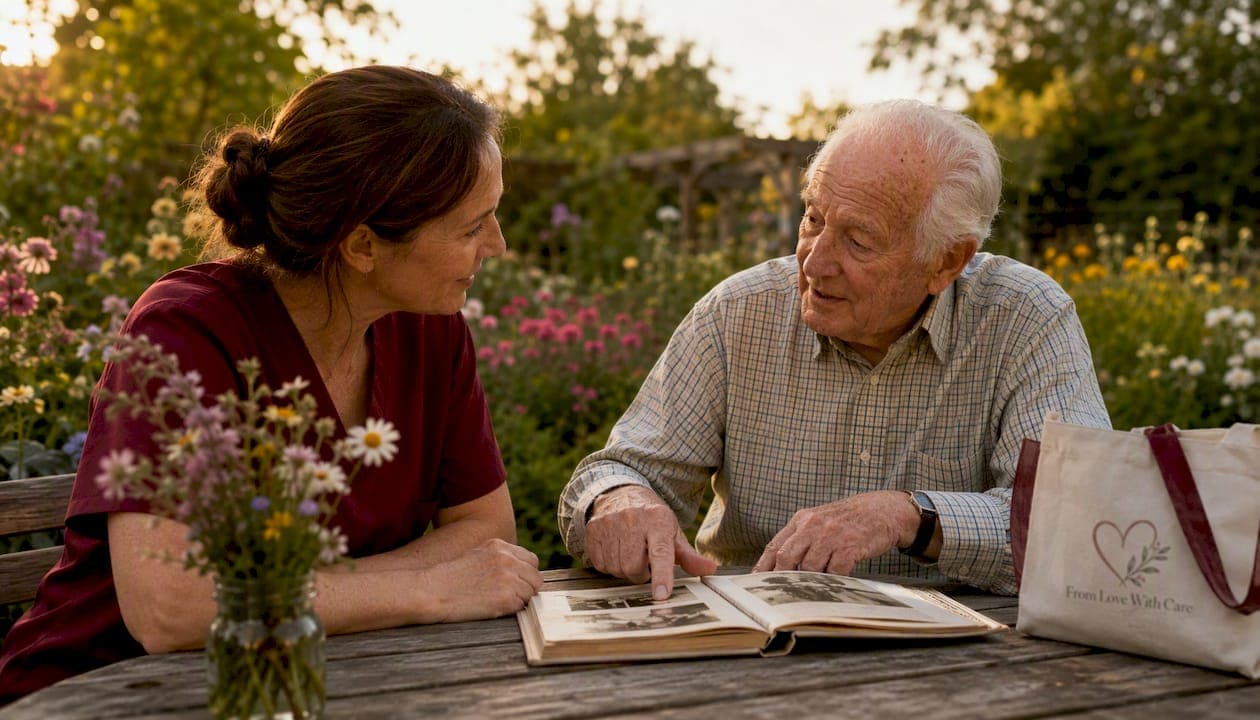
Meaningful interaction for an older person is any exchange — a conversation, a shared task, a moment of genuine connection — that the person themselves finds emotionally significant, personally relevant, and worth having again. It is not about how many visits happen in a week. It is about whether those visits leave the person feeling seen, valued, and less alone. NICE defines meaningful activity for older people as physical, social or leisure engagement tailored to the individual's interests, preferences and abilities. The Royal College of Occupational Therapists adds that involving older people in defining what is meaningful transforms passive receipt into active engagement. Fromlovewithcare builds its companion service on exactly this principle.
Three things matter most:
- Quality over quantity. A cohort study of older adults in England found that poor-quality social connections associate with worse health outcomes even when structural ties exist.
- Subjective experience is the measure. Age UK's loneliness research confirms that being physically surrounded by people does not guarantee meaningful social contact.
- Agency is non-negotiable. When an older person chooses the activity and the companion, the wellbeing benefit is measurably stronger.
Table of Contents
- What researchers mean by meaningful interaction for older people
- What does the evidence show about benefits for older people?
- What forms of meaningful interaction work well for older adults?
- How can families and companions create meaningful interactions?
- How UK guidance and services support meaningful activity
- Key takeaways
- The detail that most people miss about meaningful interaction
- Useful sources and further reading
What researchers mean by meaningful interaction for older people
Researchers draw on symbolic interactionism and person-centred care theory to define meaningful interaction as an exchange that carries emotional, informational, or tangible significance for the person receiving it. A cross-cultural survey found that people across cultures consistently define meaningful social interactions by whether they perceive the exchange as enhancing their life, not by its duration or frequency.
Five characteristics distinguish a meaningful interaction from a routine one:
Emotional significance. The exchange produces a feeling the person values: warmth, laughter, comfort, or a sense of being understood. A companion who listens attentively to a story about a person's working life creates this. A carer who talks at someone while completing a task does not.
Reciprocity. Both parties contribute. Even where cognitive or physical decline limits what an older person can offer, a skilled companion finds ways to receive: asking for an opinion, accepting help with a small task, or simply showing genuine curiosity.
Personal relevance. The topic, activity, or setting connects to the person's history, values, or current interests. Discussing a lifelong passion for gardening carries more weight than a generic group quiz.
Agency and choice. The Royal College of Occupational Therapists is explicit: when older people define what is meaningful to them, participation increases and sense of self improves. Being asked "What would you like to do today?" is itself a meaningful act.
Continuity and cultural fit. Interactions that connect to a person's cultural background, language, faith, or life narrative feel more authentic. A single visit from a stranger rarely achieves this; a regular companion who learns someone's story over time does.
What does the evidence show about benefits for older people?
The research base is strong and consistent. A systematic review published in Ageing & Society concludes that the benefits of social engagement are cumulative: regular, quality interaction buffers wellbeing decline over time by reinforcing identity, belonging, and purpose. Crucially, the review also notes that high-demand activities can cause fatigue if not adapted to the person's capacity, which is why tailoring matters as much as frequency.
A cohort study of older adults in England found that the quality of social connections, not their mere presence, predicts health outcomes. Older people with structurally intact social networks but poor-quality relationships fared worse than those with fewer but more meaningful ties.
Social engagement supports mental health, cognitive resilience, and functional independence in later life. The mechanism is not simply distraction from loneliness; it is the restoration of identity, purpose, and the sense that one's presence matters to another person.
Practical benefits documented across the evidence include:
- Reduced symptoms of depression and anxiety
- Slower cognitive decline in people with mild impairment
- Better maintenance of daily living skills through supported participation
- Lower subjective loneliness, which research consistently links to serious physical health risks
The distinction between social quantity and social quality is the single most important finding for families and carers to absorb. Arranging more visits is not enough if those visits are one-sided, rushed, or disconnected from what the person actually cares about.
What forms of meaningful interaction work well for older adults?
The right format depends entirely on the person. NICE quality statement 3 recommends offering a range of options, both one-to-one and group, for older people at risk of declining independence. Offering a menu increases the chance that each person finds a sustainable fit.
| Format | Examples | Best suited to |
|---|---|---|
| One-to-one conversation | Reminiscence, life review, shared reading | People who find groups tiring or overstimulating |
| Shared daily tasks | Laying the table, folding laundry, simple cooking | Those who value purpose and contribution over leisure |
| Group activities | Local clubs, faith groups, community choirs | People who draw energy from peers and shared identity |
| Intergenerational contact | School visits, mentoring, family storytelling | Those who find purpose in passing on knowledge |
| Leisure and hobbies | Gardening, crafts, music, gentle walks | People with specific long-standing interests |
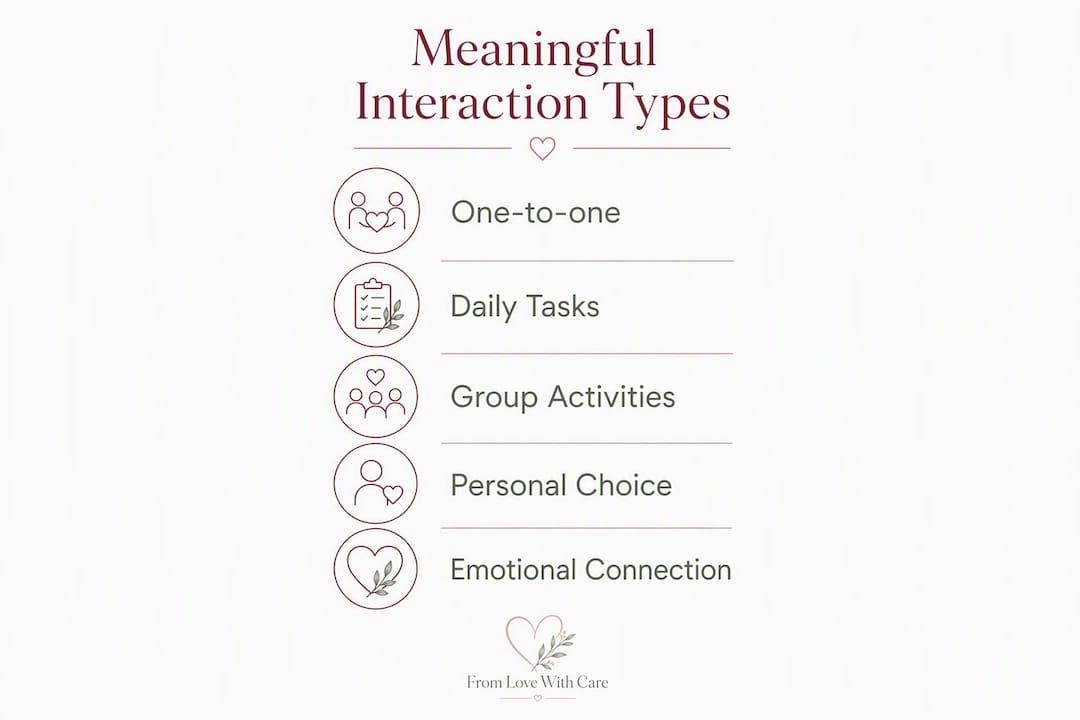
One-to-one interactions tend to be the most reliably meaningful because they allow the depth of attention that group settings rarely permit. A companion sitting with someone for an hour of reminiscence conversation, asking about their childhood home or their first job, creates the kind of reciprocal exchange that group activities often cannot.
Daily tasks reframed as participation rather than assistance carry particular power. RCN guidance is clear that doing things with an older person, rather than for them, supports independence and produces more lasting wellbeing benefits. Asking someone to help choose what to have for lunch, or to hold the shopping list, is not a token gesture. It is a genuine act of inclusion.
Pro Tip: Match activity intensity to the person's energy levels on the day, not to a fixed plan. A companion who arrives with a rigid agenda and ignores visible fatigue turns a potentially meaningful visit into a stressful one. Start with a low-demand activity and let the person lead the pace.
Group activities work best when attendance is voluntary and the group shares a genuine common interest. Faith communities, gardening clubs, and local history groups consistently show stronger engagement than generic "activities sessions" because the shared identity is real. For shared hobbies with an elderly companion, the companion's genuine curiosity about the activity matters as much as the activity itself.
How can families and companions create meaningful interactions?
Start by asking, not assuming. The single highest-yield step a family member or companion can take is to ask the older person directly: "What matters most to you?" and "What would make today feel worthwhile?" This person-centred approach is endorsed by both NICE and the Royal College of Occupational Therapists, and it takes less than two minutes.

From there, a few practical principles make a consistent difference:
Active listening over talking. Meaningful communication in ageing is not about filling silence. It is about attending fully: making eye contact, reflecting back what you hear, and resisting the urge to redirect the conversation. A companion who asks a follow-up question about something said ten minutes earlier signals that they were genuinely listening.
Scaffold, do not substitute. NICE PH16 guidance recommends involving older people as partners in sessions and paying close attention to communication and accessibility. In practice, this means offering support at the edges of a task rather than taking it over. If someone is struggling to pour tea, steady the pot rather than pouring it for them.
Adapt for sensory and cognitive change. Hearing loss, reduced vision, and cognitive impairment all affect how interaction lands. Speak clearly and at a moderate pace, face the person directly, reduce background noise, and use familiar objects or photographs to anchor conversation. For people living with dementia, short exchanges built around sensory cues, a familiar song, a photograph, a piece of fabric, often reach further than words alone.
Watch for red flags. One-sided interaction where the older person is passive, repeated visible distress during visits, or a consistent absence of emotional engagement are signals that the current approach is not working. Change the format, the topic, or the companion before concluding that the person is simply "not interested."
For families managing this from a distance, conversation topic guides offer practical prompts that companions and relatives can use to open genuine exchanges rather than defaulting to health updates.
How UK guidance and services support meaningful activity
NICE quality statement 1 (QS50) defines meaningful activity as engagement tailored to individual interests, preferences and abilities that promotes health and mental wellbeing. Quality statement 3 (QS137) specifically recommends offering both one-to-one and group social participation options for older people at risk. Together, these statements set a clear expectation: services should not offer a single activity format and call it sufficient.
The Royal College of Occupational Therapists frames this as a matter of professional responsibility. Occupational therapists working with older people are trained to identify what is personally meaningful to each individual and to design interventions accordingly. Their guidance on living well in care homes explicitly states that involving older people in defining what is meaningful transforms passive receipt into active engagement.
Companion services translate this guidance into everyday practice. Fromlovewithcare's senior home visits are built around exactly these principles: each companion is DBS-checked and trained to prioritise the older person's preferences, to listen rather than direct, and to adapt the visit to what the person needs on that particular day. Companions support social and practical needs, including conversation, shared activities, grocery shopping, and welfare check-ins. They do not provide personal or medical care.
This distinction matters. Meaningful social interaction is not a clinical intervention. It does not require a nurse or a therapist. It requires a trustworthy, attentive person who shows up consistently and genuinely cares about the individual they are visiting. That is what a well-matched companion provides, and it is why companionship services sit alongside, rather than in competition with, formal health and social care.
Key takeaways
Meaningful interaction for older people is defined by emotional significance, reciprocity, personal relevance, and agency, and the quality of those interactions predicts wellbeing outcomes more reliably than their frequency.
| Point | Details |
|---|---|
| Quality over frequency | Poor-quality connections associate with worse health outcomes even when social ties exist. |
| Person-centred definition | Ask the older person what matters to them; this single step increases long-term participation. |
| Range of formats | Offer one-to-one and group options; NICE QS137 recommends a menu, not a single activity. |
| Scaffold, do not substitute | Doing things with an older person, not for them, supports independence and lasting wellbeing. |
| Consistent presence matters | Cumulative, regular interaction buffers wellbeing decline; one-off visits rarely achieve this. |
One action you can take today: ask an older relative or person you support to name one thing they used to enjoy that they have not done recently. Then find a way to bring a version of it into the next visit.
The detail that most people miss about meaningful interaction
Most conversations about meaningful interaction focus on what to do: which activities, which topics, which formats. That is understandable, but it misses the deeper point.
What makes an interaction meaningful is not the activity. It is the quality of attention brought to it. Fromlovewithcare companions sometimes visit people who have not had a genuine conversation in days. The activity on those visits, whether it is a cup of tea, a short walk, or looking through old photographs, is almost incidental. What the person remembers is that someone sat with them, asked real questions, and listened to the answers.
A practical tip that works consistently: bring a photograph or a familiar object to the visit. Not as a therapy tool, but as a natural conversation starter. A photograph of a place the person once lived, or a small object connected to a past hobby, opens doors that direct questions sometimes cannot. The person leads, the companion follows, and the exchange becomes genuinely reciprocal without either party having to try very hard.
The research on elective social relationships from Lancaster University supports this: chosen relationships, where the older person feels genuine warmth and trust rather than obligation, produce stronger wellbeing benefits than obligatory contacts. A companion who earns that trust over repeated visits is not a substitute for family. But for someone whose natural network has shrunk, they can be the difference between a week that feels connected and one that does not.
Useful sources and further reading
The following UK-focused sources underpin the guidance in this article and are worth consulting directly:
| Source | What it covers |
|---|---|
| NICE QS50: Meaningful activity | NICE quality statement defining meaningful activity for older people and setting service expectations |
| NICE QS137: Social participation | Recommends offering one-to-one and group options for older people at risk of declining independence |
| NICE PH16: Occupational therapy and physical activity | Guidance on session design, communication, and involving older people as partners |
| Royal College of Occupational Therapists: Living well in care homes | Person-centred activity and the importance of involving older people in defining what is meaningful |
| Age UK: Loneliness research and resources | Explains why subjective experience of loneliness must guide interventions, not contact counts |
| RCN Learn: Meaningful activities for older people | Practical nursing guidance on doing things with, not for, older people |
| Ageing & Society: Social engagement systematic review | Peer-reviewed evidence on cumulative benefits and the importance of tailoring activity |
| PMC cohort study: Social connection and health outcomes | English cohort data showing quality of social ties predicts health outcomes |
| Fromlovewithcare: Companionship services | Overview of in-home companionship visits, welfare checks, and DBS-checked companion matching |
| Fromlovewithcare: Blog and resources | Practical guides on social engagement, conversation topics, and companion activities for older people |
| Timeless: Community and longevity research | Research overview on how community and social factors influence healthy ageing and longevity |
This article provides general information about meaningful social interaction for older people. It is not a substitute for professional health, care, or clinical advice. For guidance specific to an individual's circumstances, consult a qualified occupational therapist, GP, or social care professional.