

Early companionship support is a preventative measure that significantly lowers the likelihood of physical and mental health crises in elderly individuals by addressing loneliness and social isolation before they escalate. Research shows that 47% of families fear falls for elderly relatives, yet 41% worry equally about loneliness. Despite this awareness, only 16% act proactively before a crisis occurs, compared to 45% who respond only after visible decline. Understanding why early companionship support prevents crisis is the first step towards protecting the people you love, before worry becomes an emergency.
Why early companionship support prevents crisis in elderly adults
Loneliness is not simply an emotional discomfort. Persistent loneliness links directly to poor mental wellbeing, increased mortality, and higher rates of illness. That connection means an elderly person who goes days without meaningful conversation is not just sad. They are at measurably greater risk of physical and mental collapse.
The mechanisms are well established. Social isolation reduces physical activity, disrupts sleep, and weakens the immune response. It also removes the informal safety net that human contact provides. A companion who visits regularly will notice a change in mood, a missed meal, or an unsteady gait long before a family member who lives an hour away. That early observation is often what prevents a fall from becoming a hospitalisation.
Social prescribing interventions that address loneliness proactively reduce unplanned hospital admissions and A&E attendances, particularly in deprived communities. This is the importance of companionship support made visible in NHS data. When social connection is treated as a health intervention rather than a luxury, outcomes improve measurably.
Consider what 32.2% of UK adults in their last year of life report: feelings of lacking companionship or isolation some or more of the time. That figure represents a population who reached crisis without adequate support. Early intervention changes that trajectory entirely.
"Loneliness is not a personal failing. It is a health risk that responds to the same early intervention logic as high blood pressure or poor diet. Addressing it before symptoms worsen is not kindness alone. It is clinical sense."
The benefits of early support extend beyond the individual. Families report reduced anxiety. GPs report fewer non-clinical calls. Carers report that their loved ones are more engaged and more willing to accept help when they need it.
Key risks that early companionship directly mitigates include:
- Cognitive decline accelerated by social withdrawal and lack of mental stimulation
- Depression and anxiety linked to prolonged isolation and loss of routine
- Falls and physical accidents that go unnoticed without regular human contact
- Delayed help-seeking where individuals in distress have no one to alert family or services
What does proactive companionship actually look like?
Effective early intervention in companionship is not simply sending someone round for a cup of tea, though that matters too. The most effective approaches are structured, personalised, and facilitated by trained individuals who understand both the social and emotional needs of older adults.
The PALS trial, a facilitated social network intervention study, found that trained companions map personal interests to local community activities to improve engagement and health outcomes. That process, matching a person's existing passions to accessible local opportunities, is far more effective than generic social contact. An elderly man who once played chess benefits more from a companion who finds a local chess club than from one who simply sits with him in silence.
Proactive companionship works best when it follows a clear structure:
- Assess individual interests and social history. Understand what the person valued before isolation set in. Hobbies, friendships, routines, and community ties all provide a map for re-engagement.
- Identify local community resources. Libraries, faith groups, gardening clubs, and day centres each offer connection points that feel natural rather than clinical.
- Address practical barriers directly. Transport difficulties and cost are the two most common reasons older adults cannot access social activities. Subsidies or tailored assistance remove these obstacles.
- Build trust before expanding support. A companion who visits weekly for a month before suggesting a group outing is far more likely to succeed than one who pushes too fast.
- Maintain ongoing coaching and psychological support. Facilitated interventions work best when companions receive high-quality training and regular supervision, not just an initial briefing.
Active engagement, including conversation about daily interests, shared hobbies, and meaningful check-ins, creates a genuine safety net. Passive presence, where someone simply occupies the same room, does not produce the same outcomes.
Pro Tip: Ask your elderly relative to name three things they used to enjoy but no longer do. Use that list as the starting point for any companionship plan. Reconnecting with past interests is often easier than introducing new ones.

What stops families from acting early, and how can they overcome it?
The gap between concern and action is rarely about indifference. Families care deeply. The barriers are practical, emotional, and sometimes rooted in the elderly person's own resistance.
53% of older adults fear losing independence, and 51% fear becoming a burden to their families. These fears make many elderly people actively resist help, even when they are lonely and struggling. A companion who arrives framed as "someone to help" may be rejected. The same person, introduced as "someone who enjoys a good conversation," is far more likely to be welcomed.
Families can overcome these barriers with patience and the right framing. Practical steps include:
- Introduce companionship gradually. A single shared activity, such as a walk or a meal, is less threatening than a formal care arrangement.
- Respect the language of independence. Frame companionship as a choice, not a solution to a problem. Dignity matters enormously to older adults.
- Use technology as a gentle bridge. AI companions and family-shared apps can provide friendly reminders and daily prompts without the feeling of surveillance or intrusion.
- Involve the elderly person in decisions. Asking "Would you like someone to go to the market with you?" gives agency. Announcing "We've arranged for someone to visit" removes it.
Guidance on introducing a new companion to an elderly relative emphasises that trust is built through consistency, not speed. The first few visits set the tone for everything that follows.
Pro Tip: If your relative resists the idea of a companion, try framing the first visit around something they want to do, not something you think they need. Shared purpose removes the feeling of being managed.
What are the long-term benefits of early companionship support?
The positive outcomes of companionship are not limited to emotional wellbeing. Early intervention produces measurable changes in physical health, healthcare use, and sustained independence over time.
| Outcome area | Effect of early companionship support |
|---|---|
| Hospital admissions | Reduced unplanned admissions through early identification of health changes |
| Mental wellbeing scores | Improved scores linked to decreased loneliness and increased social engagement |
| Physical activity | Higher levels of daily movement when companions encourage gentle activity |
| Independence | Longer periods of independent living when support is introduced early |
| Family anxiety | Reduced caregiver stress when a trusted companion provides regular contact |
Multi-level social prescribing models that embed community connectors within clinical settings show the strongest results for elderly people in deprived areas. The key word is "embed." When companionship is woven into the existing care structure rather than added as an afterthought, it reaches the people who need it most.
Early support also sustains independence in a way that reactive care cannot. An elderly person who receives companionship before they reach crisis retains confidence, routine, and a sense of self. One who receives help only after a fall or a hospital admission often loses ground that is very difficult to recover.
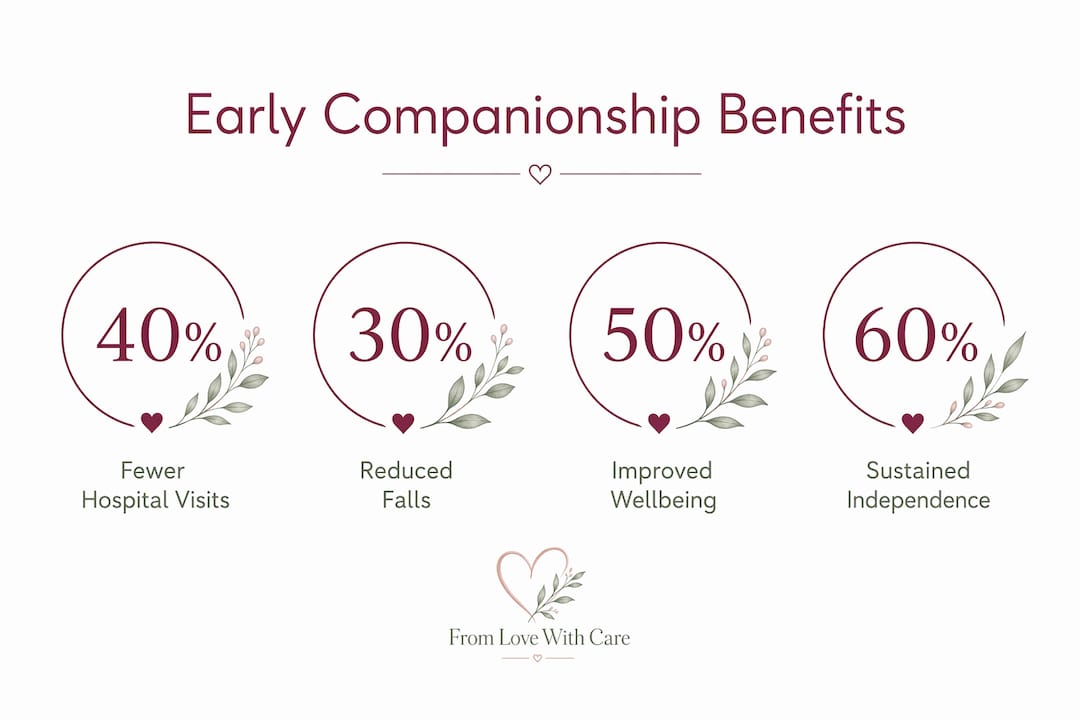
Monitoring matters too. Support plans should be reviewed regularly, with adjustments made as the person's needs and interests change. A companion who notices that a previously sociable person has become withdrawn is providing exactly the kind of early warning that prevents the next crisis.
Key takeaways
Early companionship support prevents crisis by addressing loneliness and social isolation before they produce physical and mental health emergencies, reducing hospital admissions and sustaining independence in older adults.
| Point | Details |
|---|---|
| Act before crisis, not after | Only 16% of families act proactively; early support changes outcomes before decline sets in. |
| Loneliness is a health risk | Persistent loneliness links directly to higher mortality, poor mental wellbeing, and physical decline. |
| Facilitated approaches work best | Trained companions who match interests to local activities produce stronger outcomes than passive presence. |
| Overcome resistance with dignity | Frame companionship as a choice, introduce it gradually, and respect the elderly person's need for independence. |
| Monitor and adjust over time | Regular review of support plans ensures companionship remains relevant and effective as needs change. |
What I have learned about acting early, not waiting
By Ayomide
Families often tell me they knew something was wrong months before they did anything about it. They noticed the unanswered calls, the fridge with little in it, the reluctance to leave the house. But they waited, hoping things would improve on their own. They rarely do.
What I have found, time and again, is that the families who act early are not the ones who worry more. They are the ones who have accepted that waiting for a crisis is not the same as respecting independence. There is a real difference between imposing help and offering connection. The first feels like a loss of control. The second feels like care.
The most effective companionship I have seen combines emotional warmth with practical consistency. A companion who remembers that someone takes their tea with two sugars, who asks about the grandchildren by name, and who notices when the curtains are still drawn at noon is doing something that no clinical intervention can replicate. That kind of attentive presence is what improves elderly wellbeing in ways that are felt long before they show up in any data.
My honest advice to any family reading this: do not wait for a fall, a hospital visit, or a tearful phone call to act. The earlier you introduce companionship, the more natural it feels, and the more effective it becomes. Patience and consistency are the two things that matter most. Everything else follows from those.
— Ayomide
How Fromlovewithcare supports families before crisis strikes
Fromlovewithcare was built around one clear belief: that human connection is not a luxury for older adults. It is a necessity.

Every companion at Fromlovewithcare is thoroughly vetted and matched to the individual, not just their postcode. The focus is on early, proactive support: shared activities, regular visits, and the kind of consistent presence that keeps small problems from becoming large ones. Families gain peace of mind. Elderly relatives gain a trusted face and a reason to look forward to the week ahead. If you are thinking about support for someone you love, the right time to act is now, before worry becomes an emergency. Visit the Fromlovewithcare services page to find the right option for your family.
FAQ
What is early companionship support?
Early companionship support is regular, structured social and emotional contact provided to elderly individuals before loneliness or isolation leads to a health crisis. It includes visits, shared activities, and consistent check-ins from a trained, vetted companion.
How does companionship reduce the risk of falls and hospitalisation?
A companion who visits regularly notices early warning signs, such as changes in mood, mobility, or appetite, that family members at a distance may miss. Social prescribing evidence shows this kind of proactive contact reduces unplanned hospital admissions.
Why do so few families act before a crisis occurs?
Research shows only 16% of families take proactive steps before visible decline, often because elderly relatives resist help or families underestimate the health impact of loneliness.
Can companionship support help with mental health as well as physical health?
Yes. Persistent loneliness links directly to poor mental wellbeing and increased mortality. Regular companionship reduces isolation, improves mood, and supports psychological resilience in older adults.
How do I introduce a companion to an elderly relative who resists help?
Frame the first visit around something the person enjoys rather than something they need. Introduce the companion gradually, respect their language of independence, and allow trust to build through consistent, low-pressure contact before expanding the level of support.